Lower Back Rehab Challenge · 20
Lower back pain red flags: when to seek urgent medical care
Red flags are features from the history or examination that raise the probability of a serious underlying cause of back pain — such as cauda equina…
Key points
- Emergency. Bladder or bowel change, saddle numbness, both-leg symptoms, rapidly worsening weakness: emergency department now.
- Urgent. Trauma, cancer history, weight loss, fever, long-term steroids: prompt medical review.
- Routine. No red flags: reassurance, stay active, review if not improving after about 4 weeks.
What it is
Red flags are features from the history or examination that raise the probability of a serious underlying cause of back pain — such as cauda equina syndrome (compression of the lumbosacral nerve roots below the spinal cord), vertebral fracture, malignancy or infection. A single red flag rarely confirms a serious problem; some (e.g. new bladder/bowel dysfunction with saddle numbness) need same-day emergency assessment because delay can cause permanent loss of function.
How we analysed the movement
Three movements relevant to this topic were analysed from illustrated reference figures. Joint centres were located with two-dimensional pose estimation; joint angles, the whole-body centre of mass and, where relevant, the low-back lever (the horizontal distance from the upper-body centre of mass to the L5/S1 joint) were then calculated from standard segment parameters. The figures are educational estimates that show how position changes mechanical demand; they are not measurements of a patient. Every research value quoted below comes from the published source cited beside it.
Movement A: Calling for help
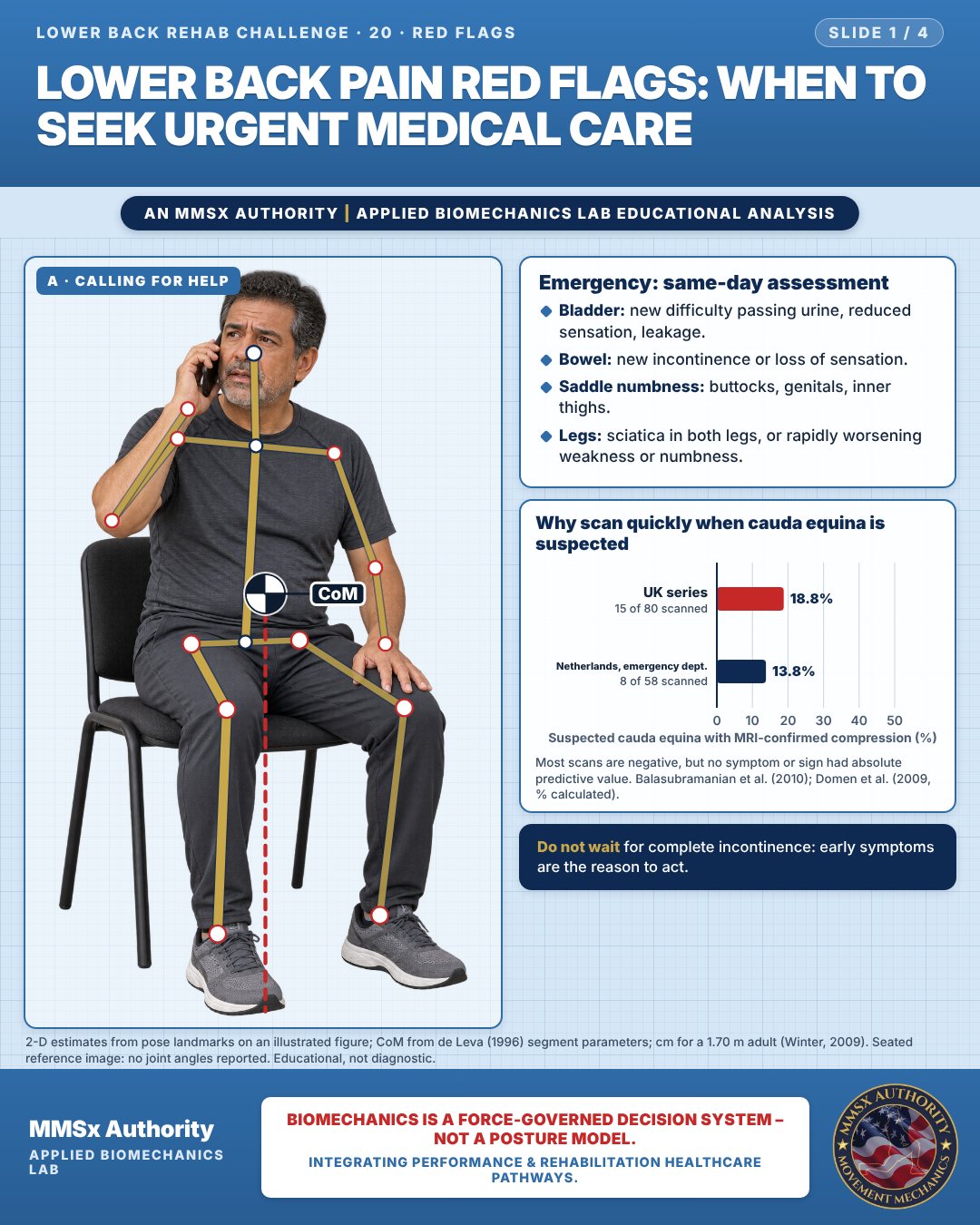
Emergency: same-day assessment
Bladder: new difficulty passing urine, reduced sensation, leakage.
Bowel: new incontinence or loss of sensation.
Saddle numbness: buttocks, genitals, inner thighs.
Legs: sciatica in both legs, or rapidly worsening weakness or numbness.
Why scan quickly when cauda equina is suspected
Movement B: Reporting leg changes
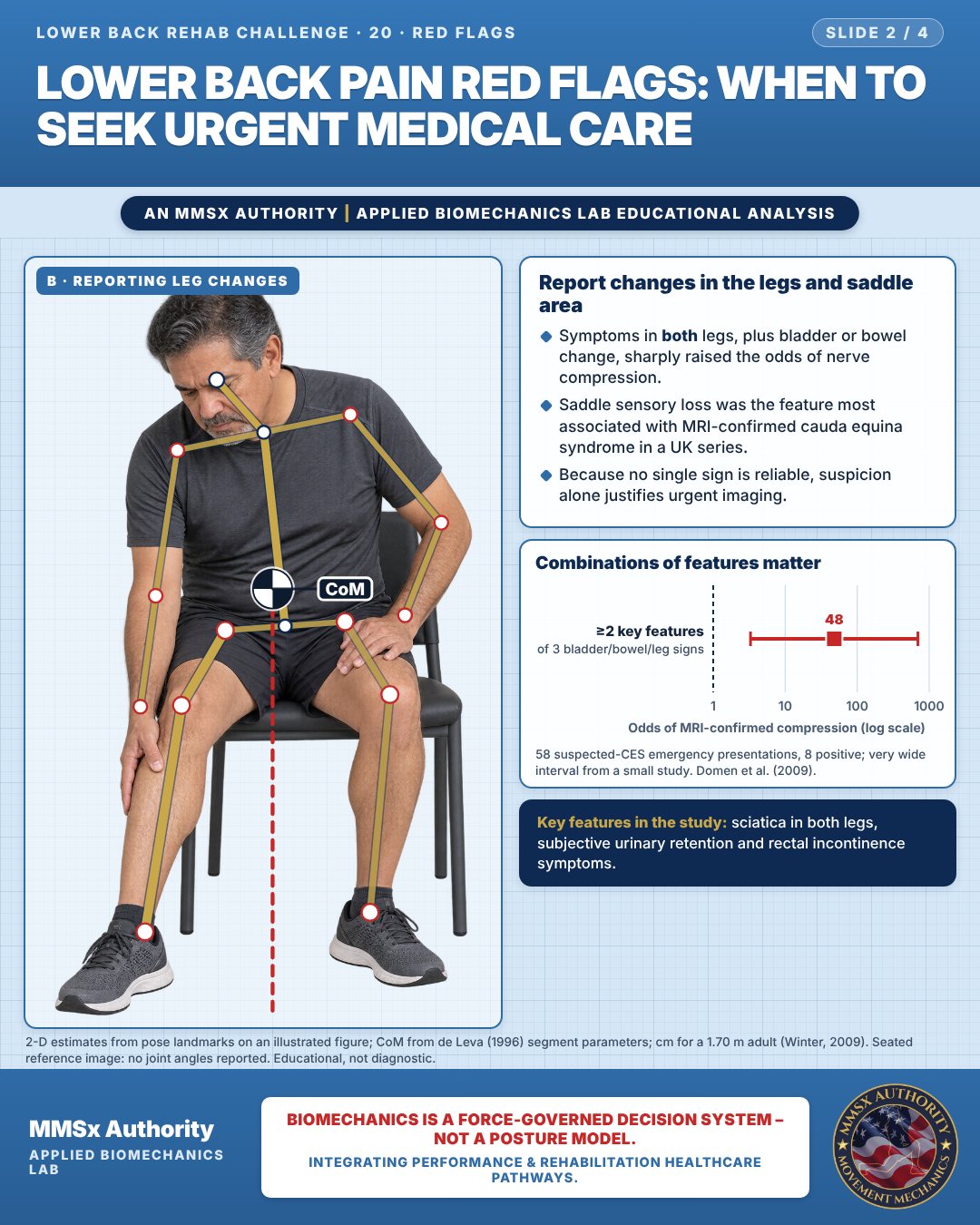
Report changes in the legs and saddle area
Symptoms in both legs, plus bladder or bowel change, sharply raised the odds of nerve compression.
Saddle sensory loss was the feature most associated with MRI-confirmed cauda equina syndrome in a UK series.
Because no single sign is reliable, suspicion alone justifies urgent imaging.
Combinations of features matter
Movement C: Medical assessment
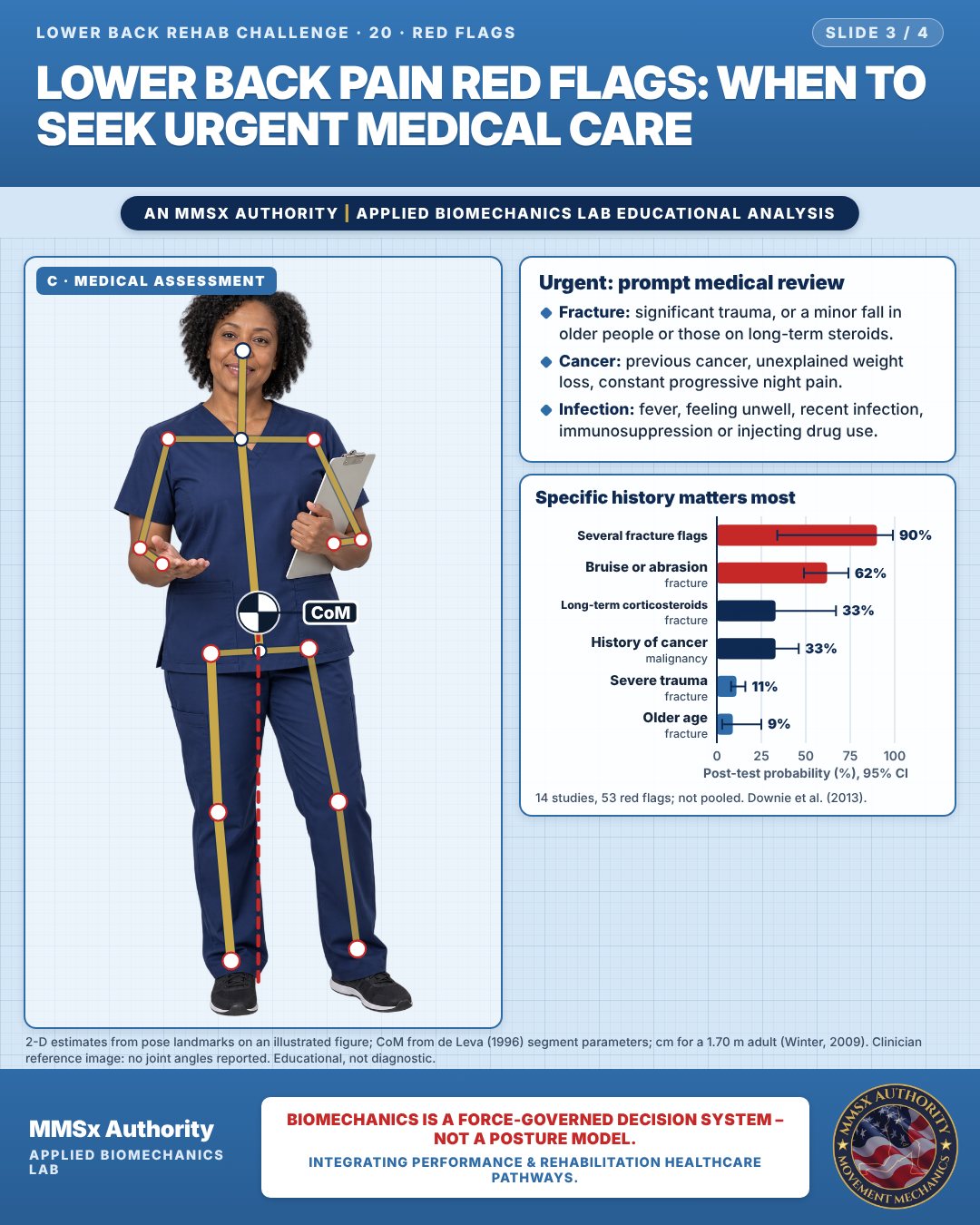
Urgent: prompt medical review
Fracture: significant trauma, or a minor fall in older people or those on long-term steroids.
Cancer: previous cancer, unexplained weight loss, constant progressive night pain.
Infection: fever, feeling unwell, recent infection, immunosuppression or injecting drug use.
Specific history matters most
Decision pathway
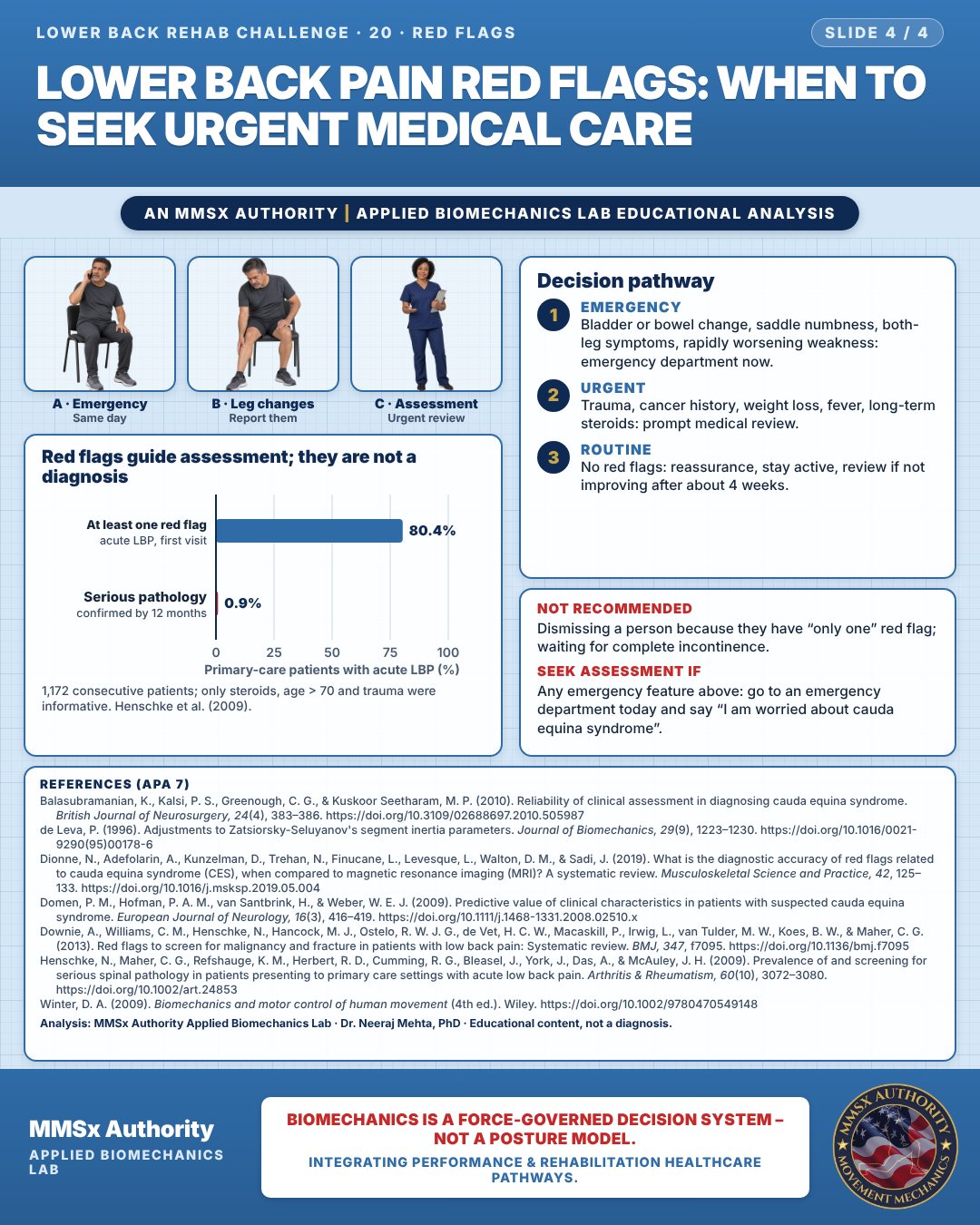
Red flags guide assessment; they are not a diagnosis
Emergency
Bladder or bowel change, saddle numbness, both-leg symptoms, rapidly worsening weakness: emergency department now.
Urgent
Trauma, cancer history, weight loss, fever, long-term steroids: prompt medical review.
Routine
No red flags: reassurance, stay active, review if not improving after about 4 weeks.
What the evidence supports
- EMERGENCY (same day, emergency department): new difficulty passing urine or loss of bladder sensation, new urinary or faecal incontinence, numbness in the saddle/genital/back-passage area, sexual dysfunction of new onset, sciatica in both legs, or rapidly worsening leg weakness or numbness — suspect CES; urgent MRI (Balasubramanian et al., 2010; Domen et al., 2009; red-flag framework: Dionne et al., 2019).
- URGENT medical assessment: back pain after significant trauma, or after a minor fall in older people or those on long-term steroids (fracture); history of cancer, unexplained weight loss, or constant progressive night pain (malignancy); fever, feeling unwell, recent infection, immunosuppression or injecting drug use (infection) (Downie et al., 2013; Henschke et al., 2009).
- Routine: for most people with back pain and no red flags, reassurance, staying active and review if not improving — serious pathology in primary care is about 1 in 100 (Henschke et al., 2009).
Myth and evidence
Myth“Having any red flag means something serious is wrong.”
Evidence80.4% of acute LBP patients had ≥1 red flag, while serious pathology was 0.9% (Henschke et al., 2009).
Myth“A normal examination rules out cauda equina syndrome.”
EvidenceNo symptom or sign had absolute predictive value; suspected CES needs urgent MRI (Balasubramanian et al., 2010).
Cautions
Not recommended
Dismissing a person because they have “only one” red flag; waiting for complete incontinence.
Seek assessment if
Any emergency feature above: go to an emergency department today and say “I am worried about cauda equina syndrome”.
Methods note
2-D estimates from pose landmarks on an illustrated figure; CoM from de Leva (1996) segment parameters; cm for a 1.70 m adult (Winter, 2009). Seated reference image: no joint angles reported. Clinician reference image: no joint angles reported. These are educational estimates, not a diagnosis.
References
- Balasubramanian, K., Kalsi, P. S., Greenough, C. G., & Kuskoor Seetharam, M. P. (2010). Reliability of clinical assessment in diagnosing cauda equina syndrome. British Journal of Neurosurgery, 24(4), 383–386. https://doi.org/10.3109/02688697.2010.505987
- de Leva, P. (1996). Adjustments to Zatsiorsky-Seluyanov's segment inertia parameters. Journal of Biomechanics, 29(9), 1223–1230. https://doi.org/10.1016/0021-9290(95)00178-6
- Dionne, N., Adefolarin, A., Kunzelman, D., Trehan, N., Finucane, L., Levesque, L., Walton, D. M., & Sadi, J. (2019). What is the diagnostic accuracy of red flags related to cauda equina syndrome (CES), when compared to magnetic resonance imaging (MRI)? A systematic review. Musculoskeletal Science and Practice, 42, 125–133. https://doi.org/10.1016/j.msksp.2019.05.004
- Domen, P. M., Hofman, P. A. M., van Santbrink, H., & Weber, W. E. J. (2009). Predictive value of clinical characteristics in patients with suspected cauda equina syndrome. European Journal of Neurology, 16(3), 416–419. https://doi.org/10.1111/j.1468-1331.2008.02510.x
- Downie, A., Williams, C. M., Henschke, N., Hancock, M. J., Ostelo, R. W. J. G., de Vet, H. C. W., Macaskill, P., Irwig, L., van Tulder, M. W., Koes, B. W., & Maher, C. G. (2013). Red flags to screen for malignancy and fracture in patients with low back pain: Systematic review. BMJ, 347, f7095. https://doi.org/10.1136/bmj.f7095
- Henschke, N., Maher, C. G., Refshauge, K. M., Herbert, R. D., Cumming, R. G., Bleasel, J., York, J., Das, A., & McAuley, J. H. (2009). Prevalence of and screening for serious spinal pathology in patients presenting to primary care settings with acute low back pain. Arthritis & Rheumatism, 60(10), 3072–3080. https://doi.org/10.1002/art.24853
- Winter, D. A. (2009). Biomechanics and motor control of human movement (4th ed.). Wiley. https://doi.org/10.1002/9780470549148
Cite this article
Mehta, N. (2026, October 23). Lower back pain red flags: when to seek urgent medical care. MMSx Authority Applied Biomechanics Lab. https://mmsxauthority.org/edu/analysis/lower-back/20-lower-back-pain-red-flags-when-to-seek-urgent-medical-care/
Part of the collection
Mehta, N. (2026). Lower Back Rehabilitation: 50 Evidence-Based Biomechanics Analyses [Collection]. MMSx Authority Applied Biomechanics Lab. Zenodo. https://doi.org/10.5281/zenodo.23735778
All Lower Back Rehab Challenge articles · Rehabilitation Library