Lower Back Rehab Challenge · 19
Osteoporosis and lower back pain: when exercise needs fracture precautions
Osteoporosis is a skeletal condition of low bone mass and deteriorated bone micro-architecture that increases fracture risk (commonly identified by a…
Key points
- Stay strong. Progressive resistance and balance training are recommended, supervised where possible.
- Protect the spine. Hip hinge, loads close, avoid repeated loaded sit-ups and toe-touches.
- Know the signs. Sudden pain after a minor bend, lift or fall needs a fracture check.
What it is
Osteoporosis is a skeletal condition of low bone mass and deteriorated bone micro-architecture that increases fracture risk (commonly identified by a DXA T-score ≤ −2.5; osteopenia between −1.0 and −2.5). Osteoporotic vertebral fractures (compression/wedge fractures) can follow little or modest force and may present as sudden mid- or lower-back pain, height loss or increasing kyphosis — or be painless. Exercise is recommended, but loaded or end-range spinal flexion needs precaution.
How we analysed the movement
Three movements relevant to this topic were analysed from illustrated reference figures. Joint centres were located with two-dimensional pose estimation; joint angles, the whole-body centre of mass and, where relevant, the low-back lever (the horizontal distance from the upper-body centre of mass to the L5/S1 joint) were then calculated from standard segment parameters. The figures are educational estimates that show how position changes mechanical demand; they are not measurements of a patient. Every research value quoted below comes from the published source cited beside it.
Movement A: Supported balance (front view)
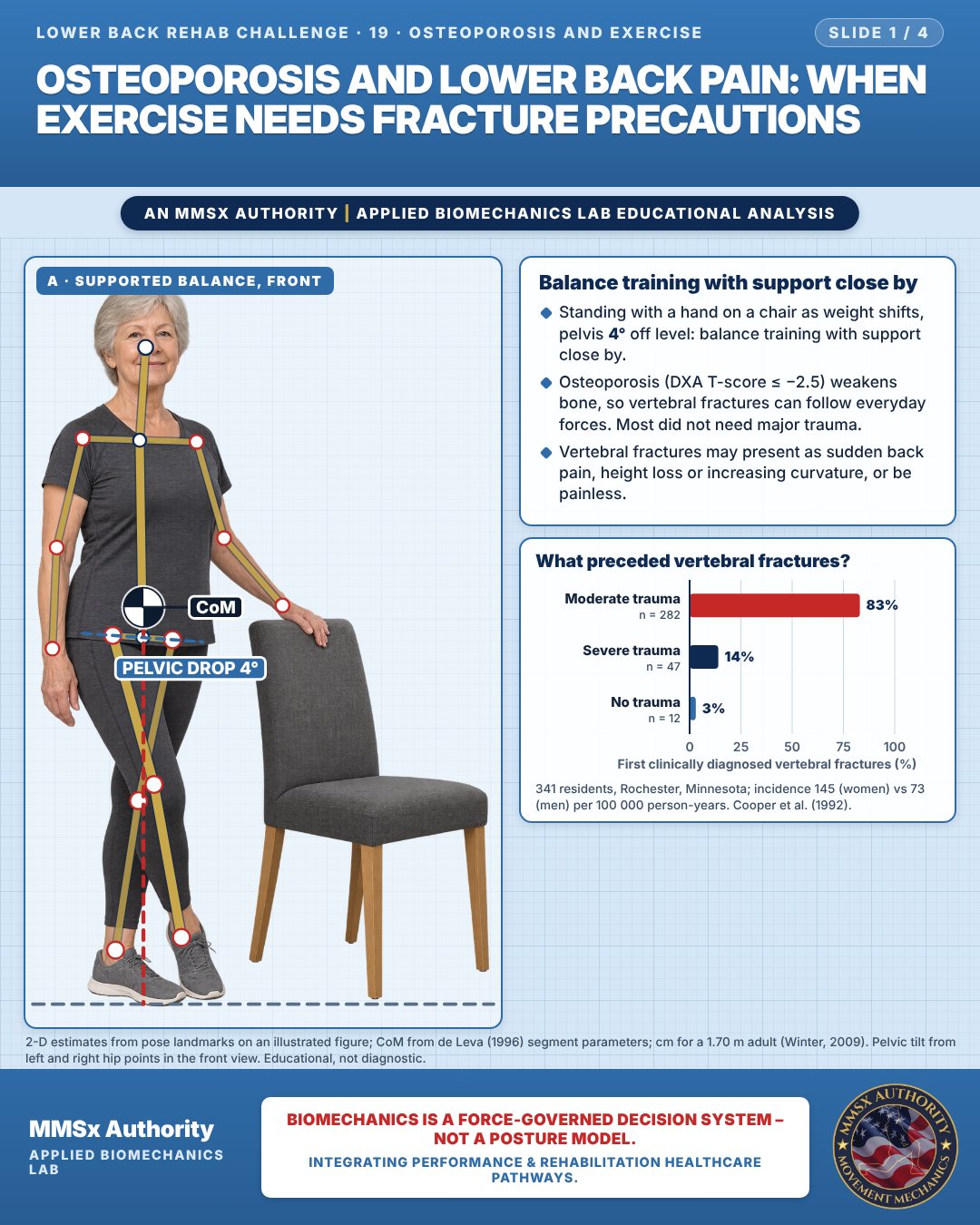
Balance training with support close by
Standing with a hand on a chair as weight shifts, pelvis 4° off level: balance training with support close by.
Osteoporosis (DXA T-score ≤ −2.5) weakens bone, so vertebral fractures can follow everyday forces. Most did not need major trauma.
Vertebral fractures may present as sudden back pain, height loss or increasing curvature, or be painless.
What preceded vertebral fractures?
Movement B: Light resistance (side view)
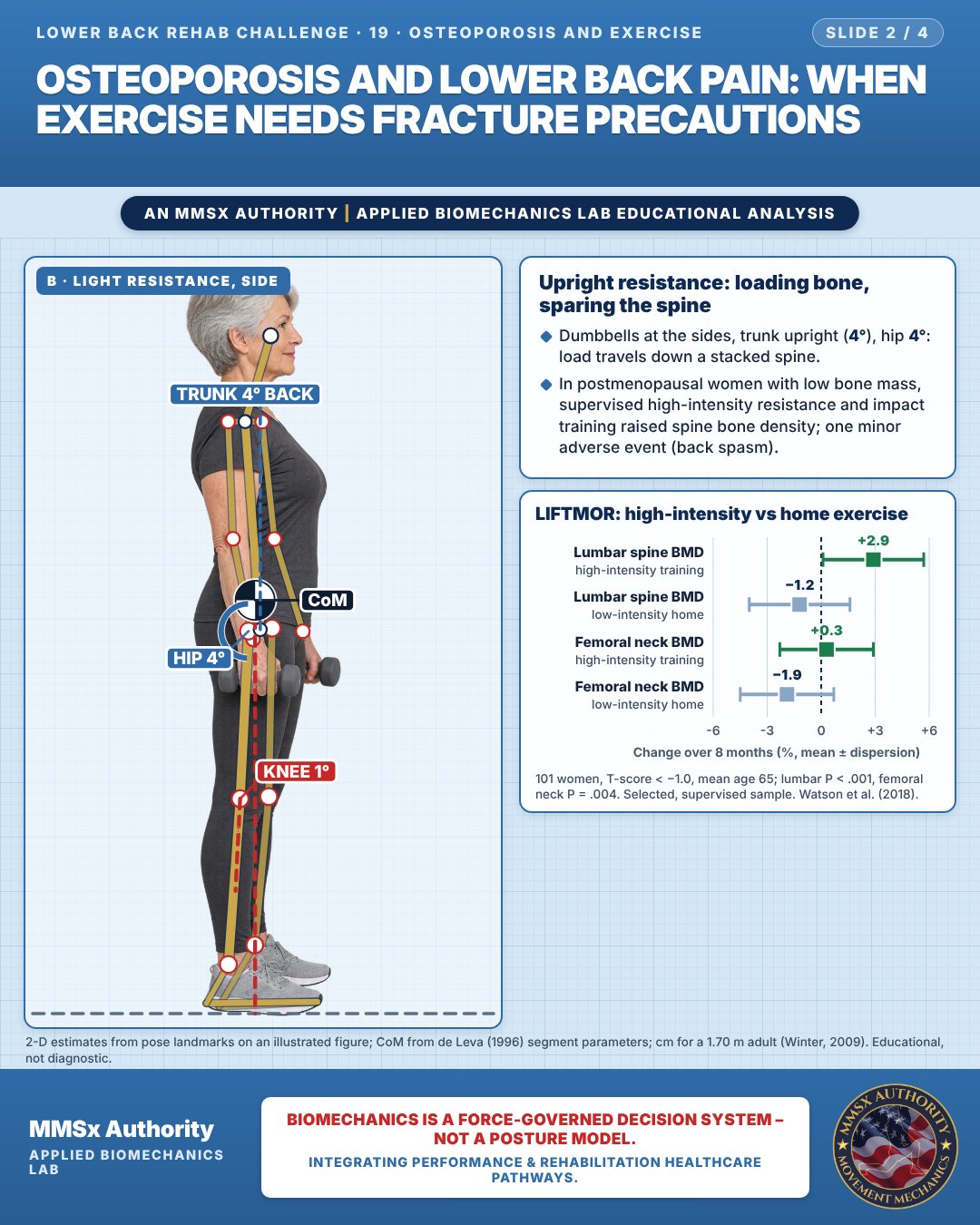
Upright resistance: loading bone, sparing the spine
Dumbbells at the sides, trunk upright (4°), hip 4°: load travels down a stacked spine.
In postmenopausal women with low bone mass, supervised high-intensity resistance and impact training raised spine bone density; one minor adverse event (back spasm).
LIFTMOR: high-intensity vs home exercise
Movement C: Chair rise (side view)
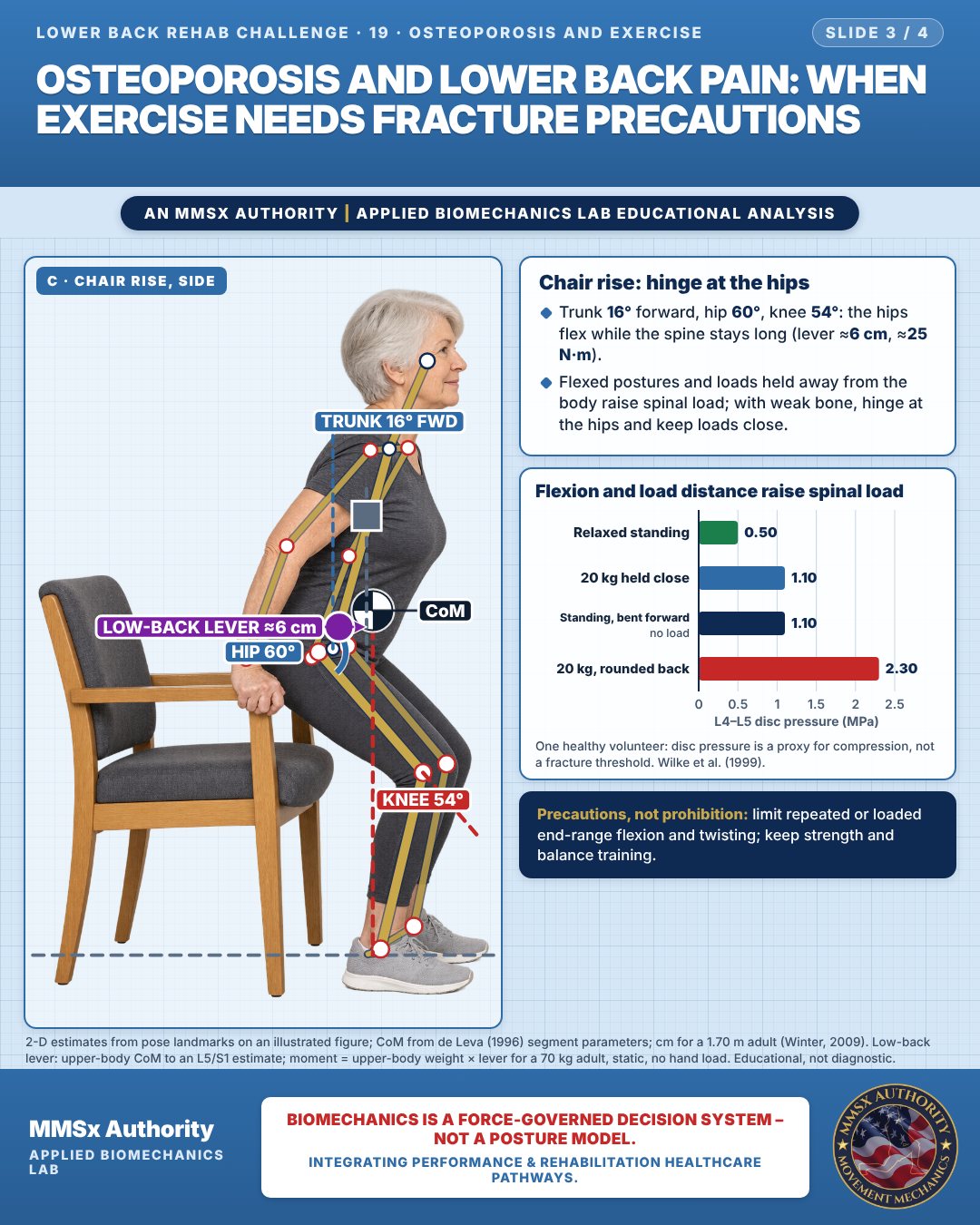
Chair rise: hinge at the hips
Trunk 16° forward, hip 60°, knee 54°: the hips flex while the spine stays long (lever ≈6 cm, ≈25 N·m).
Flexed postures and loads held away from the body raise spinal load; with weak bone, hinge at the hips and keep loads close.
Flexion and load distance raise spinal load
Decision pathway
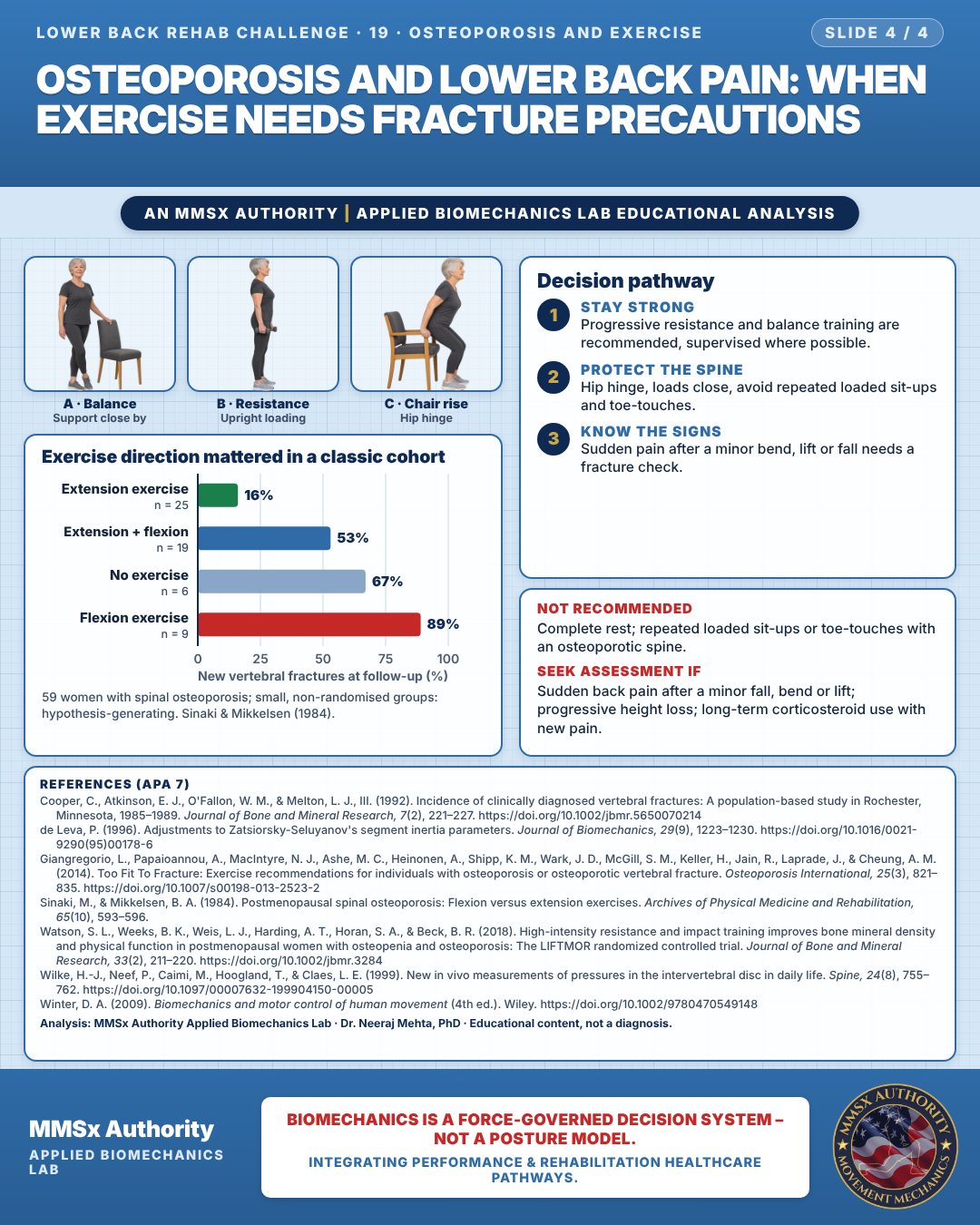
Exercise direction mattered in a classic cohort
Stay strong
Progressive resistance and balance training are recommended, supervised where possible.
Protect the spine
Hip hinge, loads close, avoid repeated loaded sit-ups and toe-touches.
Know the signs
Sudden pain after a minor bend, lift or fall needs a fracture check.
What the evidence supports
- Exercise is recommended for people with osteoporosis or vertebral fracture, emphasising progressive resistance and balance training, with posture-aware movement; the international consensus "Too Fit To Fracture" provides the framework (Giangregorio et al., 2014).
- Load bone progressively under supervision where appropriate; high-intensity, technique-focused resistance and impact training improved spine BMD and function in selected women with low bone mass (Watson et al., 2018).
Myth and evidence
Myth“With osteoporosis you should avoid strength training.”
EvidenceSupervised high-intensity training raised lumbar spine BMD (+2.9% vs −1.2%) with one minor adverse event (Watson et al., 2018).
Myth“Any exercise is fine — including lots of sit-ups.”
EvidenceNew vertebral fractures in 89% of a small flexion-exercise group vs 16% with extension exercise (Sinaki & Mikkelsen, 1984) — direction and load matter.
Cautions
Not recommended
Complete rest; repeated loaded sit-ups or toe-touches with an osteoporotic spine.
Seek assessment if
Sudden back pain after a minor fall, bend or lift; progressive height loss; long-term corticosteroid use with new pain.
Methods note
2-D estimates from pose landmarks on an illustrated figure; CoM from de Leva (1996) segment parameters; cm for a 1.70 m adult (Winter, 2009). Pelvic tilt from left and right hip points in the front view. Low-back lever: upper-body CoM to an L5/S1 estimate; moment = upper-body weight × lever for a 70 kg adult, static, no hand load. These are educational estimates, not a diagnosis.
References
- Cooper, C., Atkinson, E. J., O'Fallon, W. M., & Melton, L. J., III. (1992). Incidence of clinically diagnosed vertebral fractures: A population-based study in Rochester, Minnesota, 1985–1989. Journal of Bone and Mineral Research, 7(2), 221–227. https://doi.org/10.1002/jbmr.5650070214
- de Leva, P. (1996). Adjustments to Zatsiorsky-Seluyanov's segment inertia parameters. Journal of Biomechanics, 29(9), 1223–1230. https://doi.org/10.1016/0021-9290(95)00178-6
- Giangregorio, L., Papaioannou, A., MacIntyre, N. J., Ashe, M. C., Heinonen, A., Shipp, K. M., Wark, J. D., McGill, S. M., Keller, H., Jain, R., Laprade, J., & Cheung, A. M. (2014). Too Fit To Fracture: Exercise recommendations for individuals with osteoporosis or osteoporotic vertebral fracture. Osteoporosis International, 25(3), 821–835. https://doi.org/10.1007/s00198-013-2523-2
- Sinaki, M., & Mikkelsen, B. A. (1984). Postmenopausal spinal osteoporosis: Flexion versus extension exercises. Archives of Physical Medicine and Rehabilitation, 65(10), 593–596.
- Watson, S. L., Weeks, B. K., Weis, L. J., Harding, A. T., Horan, S. A., & Beck, B. R. (2018). High-intensity resistance and impact training improves bone mineral density and physical function in postmenopausal women with osteopenia and osteoporosis: The LIFTMOR randomized controlled trial. Journal of Bone and Mineral Research, 33(2), 211–220. https://doi.org/10.1002/jbmr.3284
- Wilke, H.-J., Neef, P., Caimi, M., Hoogland, T., & Claes, L. E. (1999). New in vivo measurements of pressures in the intervertebral disc in daily life. Spine, 24(8), 755–762. https://doi.org/10.1097/00007632-199904150-00005
- Winter, D. A. (2009). Biomechanics and motor control of human movement (4th ed.). Wiley. https://doi.org/10.1002/9780470549148
Cite this article
Mehta, N. (2026, October 23). Osteoporosis and lower back pain: when exercise needs fracture precautions. MMSx Authority Applied Biomechanics Lab. https://mmsxauthority.org/edu/analysis/lower-back/19-osteoporosis-and-lower-back-pain-when-exercise-needs-fracture/
Part of the collection
Mehta, N. (2026). Lower Back Rehabilitation: 50 Evidence-Based Biomechanics Analyses [Collection]. MMSx Authority Applied Biomechanics Lab. Zenodo. https://doi.org/10.5281/zenodo.23735778
All Lower Back Rehab Challenge articles · Rehabilitation Library