Lower Back Rehab Challenge · 18
Inflammatory back pain: when stiffness needs a different assessment
Inflammatory back pain (IBP) is a clinical pattern of chronic back pain (≥3 months) typical of axial spondyloarthritis (axSpA, including ankylosing…
Key points
- Recognise. Under ~45 at onset, pain ≥3 months, morning stiffness, better with exercise not rest, night waking.
- Count the features. 2 of 4 raises the probability; 3 of 4 raises it a lot. No single feature decides.
- Refer, keep moving. Rheumatology for markers, HLA-B27 and MRI; continue regular exercise meanwhile.
What it is
Inflammatory back pain (IBP) is a clinical pattern of chronic back pain (≥3 months) typical of axial spondyloarthritis (axSpA, including ankylosing spondylitis): onset usually before middle age, insidious start, prolonged morning stiffness, waking in the second half of the night, improvement with exercise but not with rest, and sometimes alternating buttock pain. IBP is a screening pattern that raises the probability of axSpA — it is not a diagnosis on its own (diagnosis needs rheumatology assessment, imaging and/or HLA-B27 and other features).
How we analysed the movement
Three movements relevant to this topic were analysed from illustrated reference figures. Joint centres were located with two-dimensional pose estimation; joint angles, the whole-body centre of mass and, where relevant, the low-back lever (the horizontal distance from the upper-body centre of mass to the L5/S1 joint) were then calculated from standard segment parameters. The figures are educational estimates that show how position changes mechanical demand; they are not measurements of a patient. Every research value quoted below comes from the published source cited beside it.
Movement A: Morning stiffness, seated
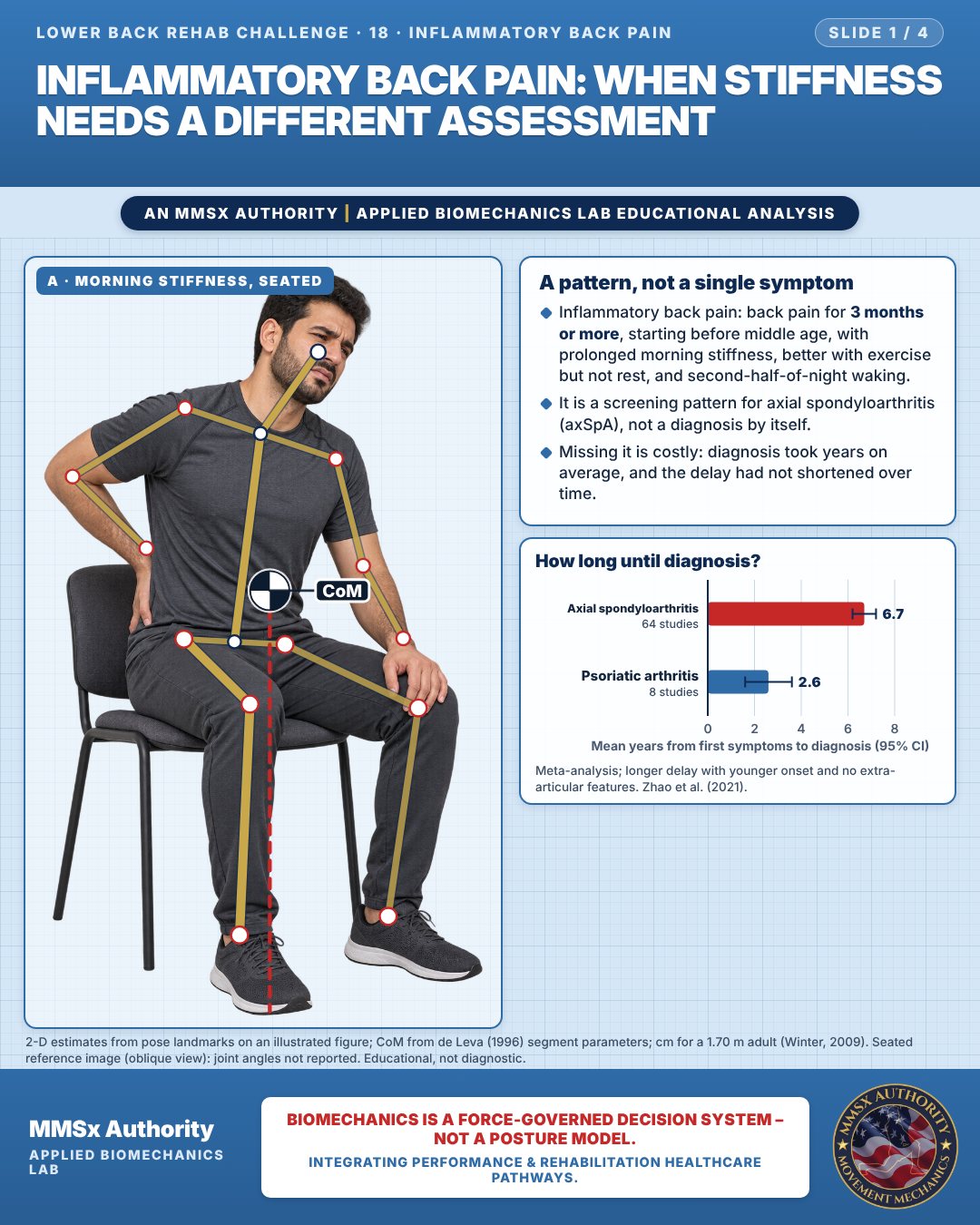
A pattern, not a single symptom
Inflammatory back pain: back pain for 3 months or more, starting before middle age, with prolonged morning stiffness, better with exercise but not rest, and second-half-of-night waking.
It is a screening pattern for axial spondyloarthritis (axSpA), not a diagnosis by itself.
Missing it is costly: diagnosis took years on average, and the delay had not shortened over time.
How long until diagnosis?
Movement B: Thoracic rotation (front view)
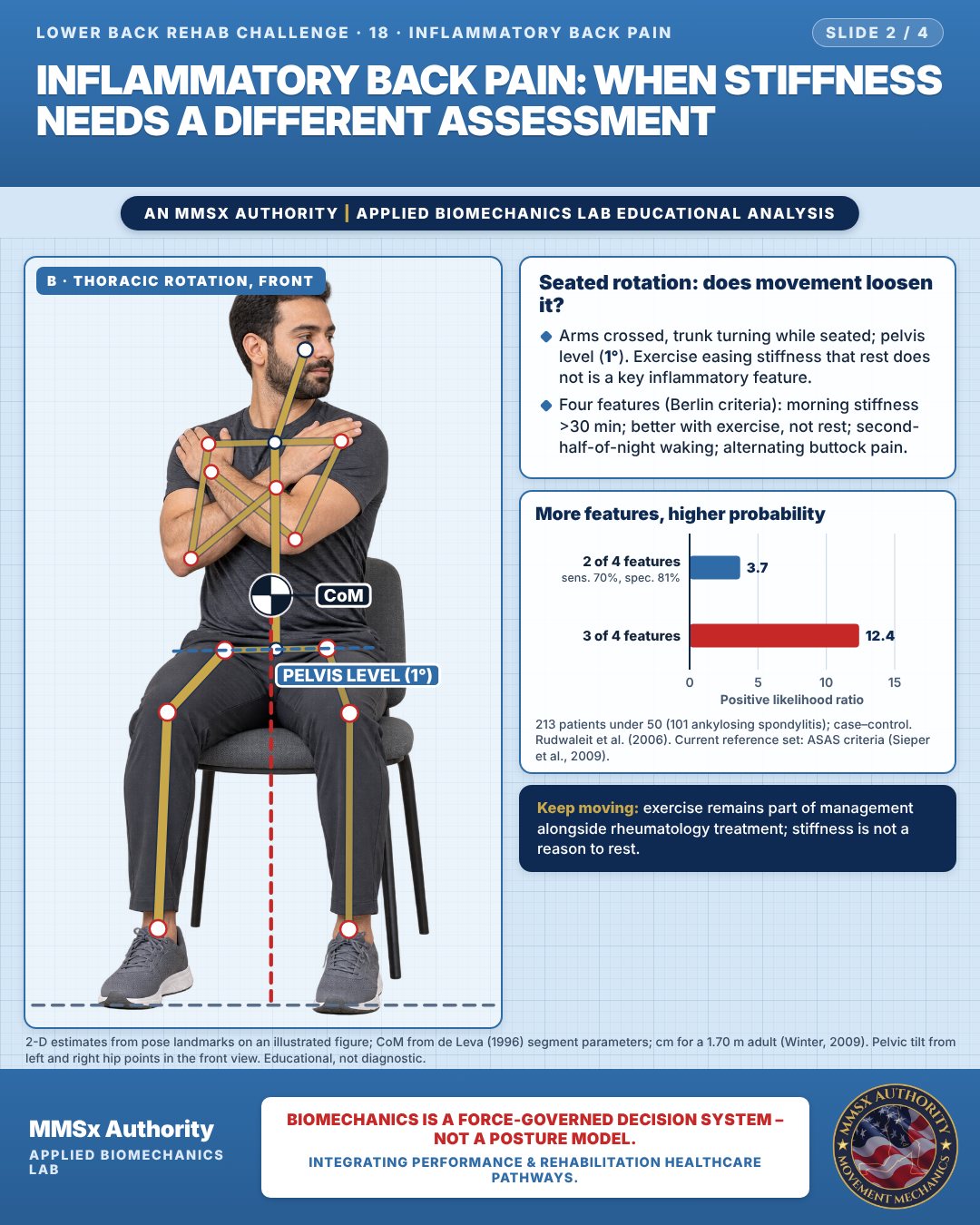
Seated rotation: does movement loosen it?
Arms crossed, trunk turning while seated; pelvis level (1°). Exercise easing stiffness that rest does not is a key inflammatory feature.
Four features (Berlin criteria): morning stiffness >30 min; better with exercise, not rest; second-half-of-night waking; alternating buttock pain.
More features, higher probability
Movement C: Arranging assessment (front view)
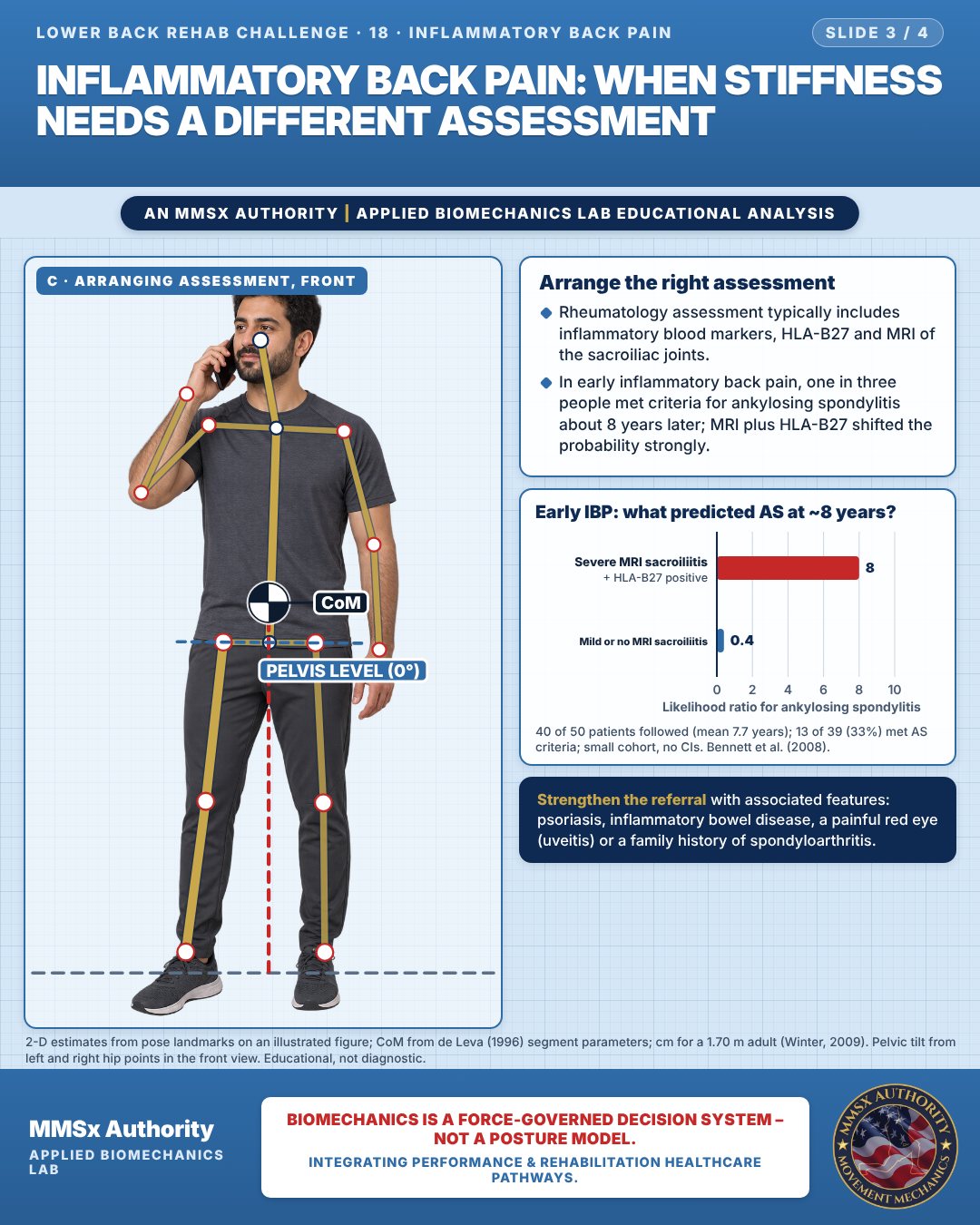
Arrange the right assessment
Rheumatology assessment typically includes inflammatory blood markers, HLA-B27 and MRI of the sacroiliac joints.
In early inflammatory back pain, one in three people met criteria for ankylosing spondylitis about 8 years later; MRI plus HLA-B27 shifted the probability strongly.
Early IBP: what predicted AS at ~8 years?
Decision pathway
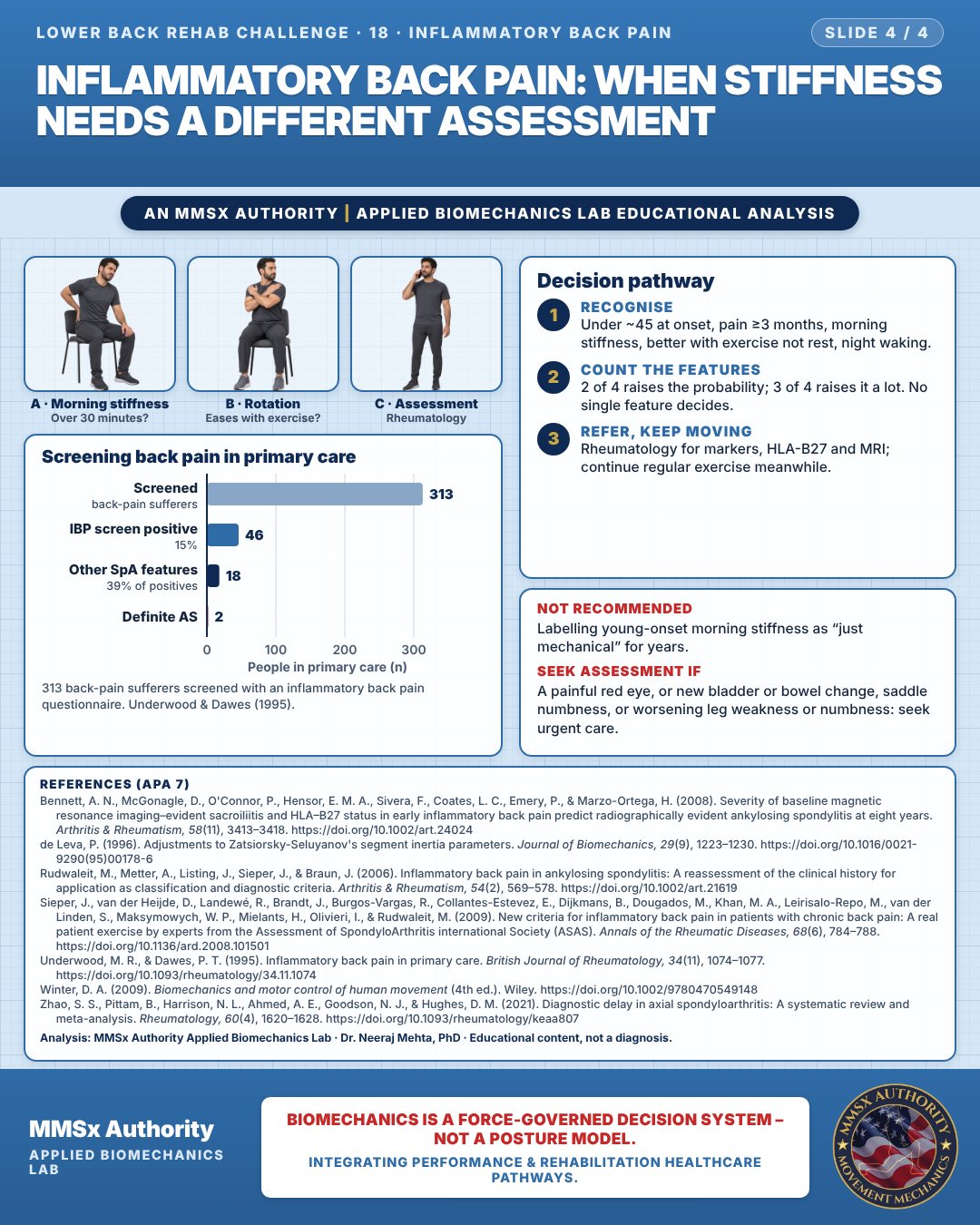
Screening back pain in primary care
Recognise
Under ~45 at onset, pain ≥3 months, morning stiffness, better with exercise not rest, night waking.
Count the features
2 of 4 raises the probability; 3 of 4 raises it a lot. No single feature decides.
Refer, keep moving
Rheumatology for markers, HLA-B27 and MRI; continue regular exercise meanwhile.
What the evidence supports
- Recognise the IBP pattern (age <50 at onset, morning stiffness >30 min, improves with exercise not rest, second-half-of-night waking, alternating buttock pain) and refer for rheumatology assessment; ≥2 of 4 features gave LR+ 3.7 and ≥3 gave LR+ 12.4 (Rudwaleit et al., 2006); ASAS IBP criteria as the current reference set (Sieper et al., 2009).
- Assessment typically includes inflammatory markers, HLA-B27 and MRI of the SIJs — severe MRI sacroiliitis with HLA-B27 strongly predicted later AS (LR 8.0) (Bennett et al., 2008).
Myth and evidence
Myth“Morning stiffness is normal back pain — it will settle with rest.”
EvidenceImprovement with exercise but NOT with rest is one of the discriminating features of inflammatory back pain (Rudwaleit et al., 2006).
Myth“If it were serious, someone would have diagnosed it by now.”
EvidenceAverage delay to axSpA diagnosis is 6.7 years (Zhao et al., 2021).
Cautions
Not recommended
Labelling young-onset morning stiffness as “just mechanical” for years.
Seek assessment if
A painful red eye, or new bladder or bowel change, saddle numbness, or worsening leg weakness or numbness: seek urgent care.
Methods note
2-D estimates from pose landmarks on an illustrated figure; CoM from de Leva (1996) segment parameters; cm for a 1.70 m adult (Winter, 2009). Seated reference image (oblique view): joint angles not reported. Pelvic tilt from left and right hip points in the front view. These are educational estimates, not a diagnosis.
References
- Bennett, A. N., McGonagle, D., O'Connor, P., Hensor, E. M. A., Sivera, F., Coates, L. C., Emery, P., & Marzo-Ortega, H. (2008). Severity of baseline magnetic resonance imaging–evident sacroiliitis and HLA–B27 status in early inflammatory back pain predict radiographically evident ankylosing spondylitis at eight years. Arthritis & Rheumatism, 58(11), 3413–3418. https://doi.org/10.1002/art.24024
- de Leva, P. (1996). Adjustments to Zatsiorsky-Seluyanov's segment inertia parameters. Journal of Biomechanics, 29(9), 1223–1230. https://doi.org/10.1016/0021-9290(95)00178-6
- Rudwaleit, M., Metter, A., Listing, J., Sieper, J., & Braun, J. (2006). Inflammatory back pain in ankylosing spondylitis: A reassessment of the clinical history for application as classification and diagnostic criteria. Arthritis & Rheumatism, 54(2), 569–578. https://doi.org/10.1002/art.21619
- Sieper, J., van der Heijde, D., Landewé, R., Brandt, J., Burgos-Vargas, R., Collantes-Estevez, E., Dijkmans, B., Dougados, M., Khan, M. A., Leirisalo-Repo, M., van der Linden, S., Maksymowych, W. P., Mielants, H., Olivieri, I., & Rudwaleit, M. (2009). New criteria for inflammatory back pain in patients with chronic back pain: A real patient exercise by experts from the Assessment of SpondyloArthritis international Society (ASAS). Annals of the Rheumatic Diseases, 68(6), 784–788. https://doi.org/10.1136/ard.2008.101501
- Underwood, M. R., & Dawes, P. T. (1995). Inflammatory back pain in primary care. British Journal of Rheumatology, 34(11), 1074–1077. https://doi.org/10.1093/rheumatology/34.11.1074
- Winter, D. A. (2009). Biomechanics and motor control of human movement (4th ed.). Wiley. https://doi.org/10.1002/9780470549148
- Zhao, S. S., Pittam, B., Harrison, N. L., Ahmed, A. E., Goodson, N. J., & Hughes, D. M. (2021). Diagnostic delay in axial spondyloarthritis: A systematic review and meta-analysis. Rheumatology, 60(4), 1620–1628. https://doi.org/10.1093/rheumatology/keaa807
Cite this article
Mehta, N. (2026, October 23). Inflammatory back pain: when stiffness needs a different assessment. MMSx Authority Applied Biomechanics Lab. https://mmsxauthority.org/edu/analysis/lower-back/18-inflammatory-back-pain-when-stiffness-needs-a-different-assessment/
Part of the collection
Mehta, N. (2026). Lower Back Rehabilitation: 50 Evidence-Based Biomechanics Analyses [Collection]. MMSx Authority Applied Biomechanics Lab. Zenodo. https://doi.org/10.5281/zenodo.23735778
All Lower Back Rehab Challenge articles · Rehabilitation Library