Lower Back Rehab Challenge · 16
Lumbar spinal stenosis: why walking can hurt and how rehabilitation may help
Lumbar spinal stenosis (LSS) is narrowing of the central canal, lateral recesses or intervertebral foramina, usually from age-related changes (disc…
Key points
- Use posture. Flexed options (rollator, poles, uphill, cycling) extend tolerance while capacity builds.
- Interval walks. Walk to mild symptoms, sit to settle, repeat; lengthen bouts week by week.
- Multimodal care. Education, individual exercise and manual therapy first; discuss surgery for persistent disability.
What it is
Lumbar spinal stenosis (LSS) is narrowing of the central canal, lateral recesses or intervertebral foramina, usually from age-related changes (disc bulging, facet and ligamentum flavum hypertrophy). The typical clinical picture is neurogenic claudication: buttock/leg pain, heaviness or tingling brought on by standing and walking (lumbar extension) and eased by sitting or bending forward (flexion). Imaging narrowing alone, without these symptoms, is not the clinical syndrome.
How we analysed the movement
Three movements relevant to this topic were analysed from illustrated reference figures. Joint centres were located with two-dimensional pose estimation; joint angles, the whole-body centre of mass and, where relevant, the low-back lever (the horizontal distance from the upper-body centre of mass to the L5/S1 joint) were then calculated from standard segment parameters. The figures are educational estimates that show how position changes mechanical demand; they are not measurements of a patient. Every research value quoted below comes from the published source cited beside it.
Movement A: Walking with a rollator (side view)
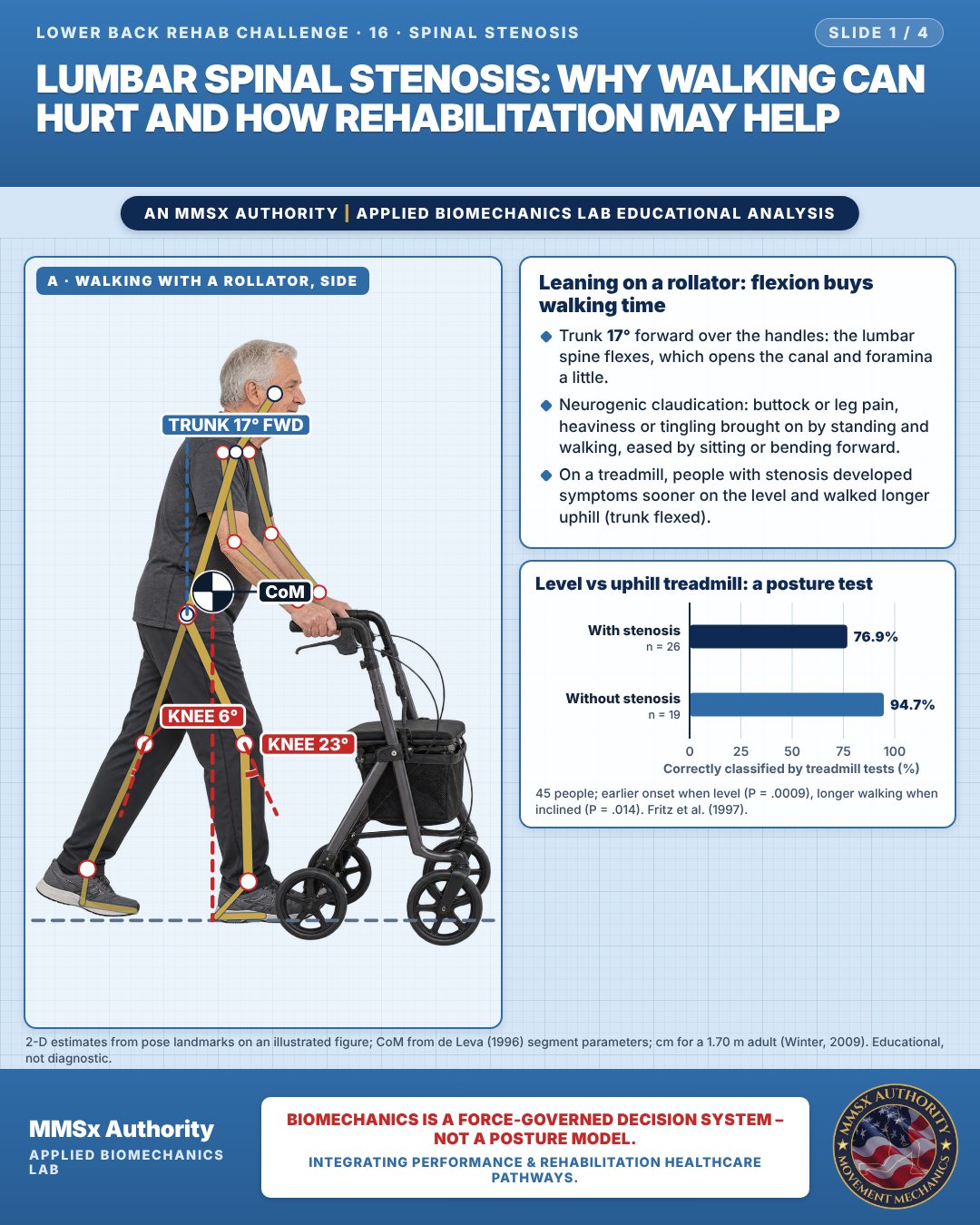
Leaning on a rollator: flexion buys walking time
Trunk 17° forward over the handles: the lumbar spine flexes, which opens the canal and foramina a little.
Neurogenic claudication: buttock or leg pain, heaviness or tingling brought on by standing and walking, eased by sitting or bending forward.
On a treadmill, people with stenosis developed symptoms sooner on the level and walked longer uphill (trunk flexed).
Level vs uphill treadmill: a posture test
Movement B: Seated rest (side view)
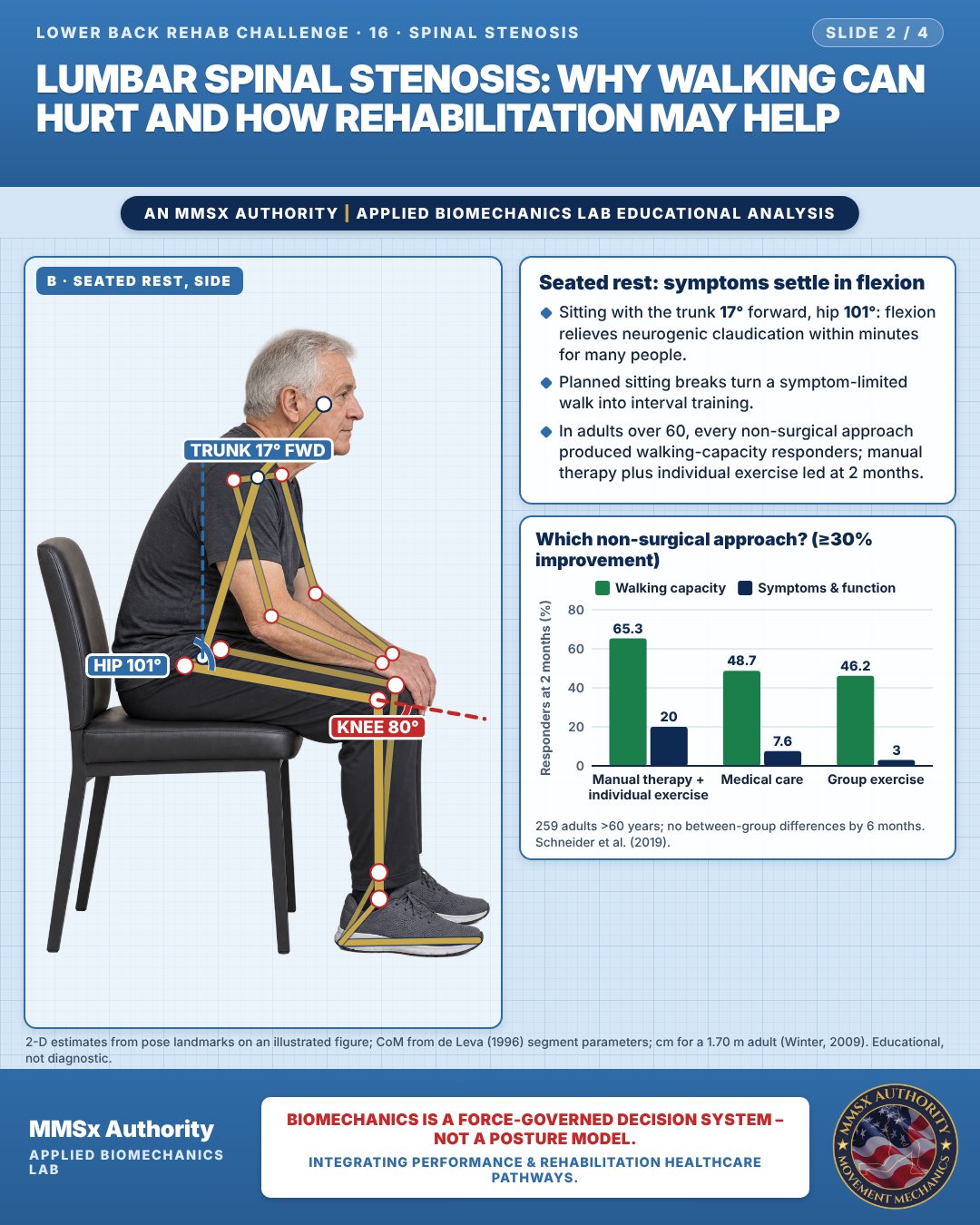
Seated rest: symptoms settle in flexion
Sitting with the trunk 17° forward, hip 101°: flexion relieves neurogenic claudication within minutes for many people.
Planned sitting breaks turn a symptom-limited walk into interval training.
In adults over 60, every non-surgical approach produced walking-capacity responders; manual therapy plus individual exercise led at 2 months.
Which non-surgical approach? (≥30% improvement)
Movement C: Stationary cycling (side view)
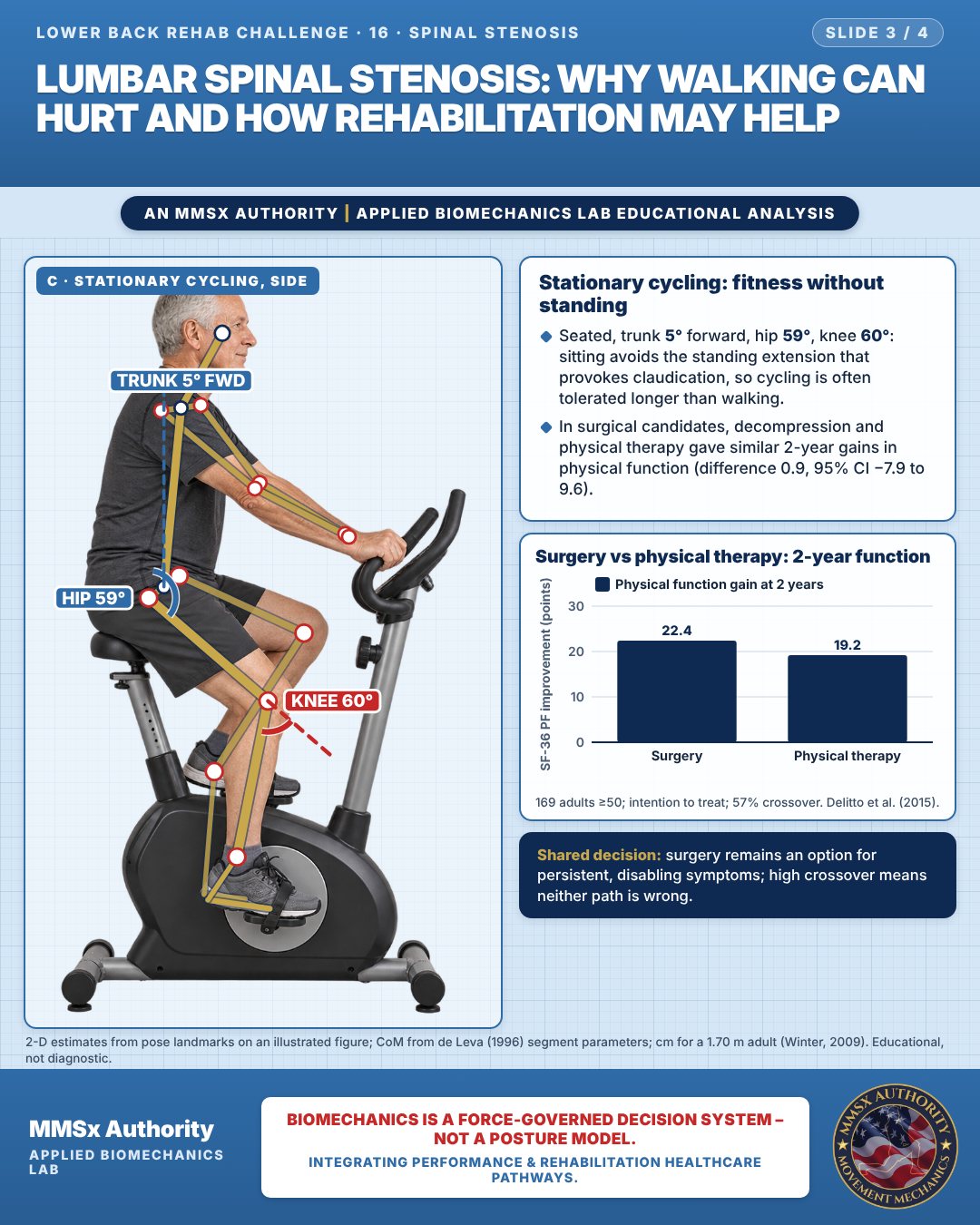
Stationary cycling: fitness without standing
Seated, trunk 5° forward, hip 59°, knee 60°: sitting avoids the standing extension that provokes claudication, so cycling is often tolerated longer than walking.
In surgical candidates, decompression and physical therapy gave similar 2-year gains in physical function (difference 0.9, 95% CI −7.9 to 9.6).
Surgery vs physical therapy: 2-year function
Decision pathway
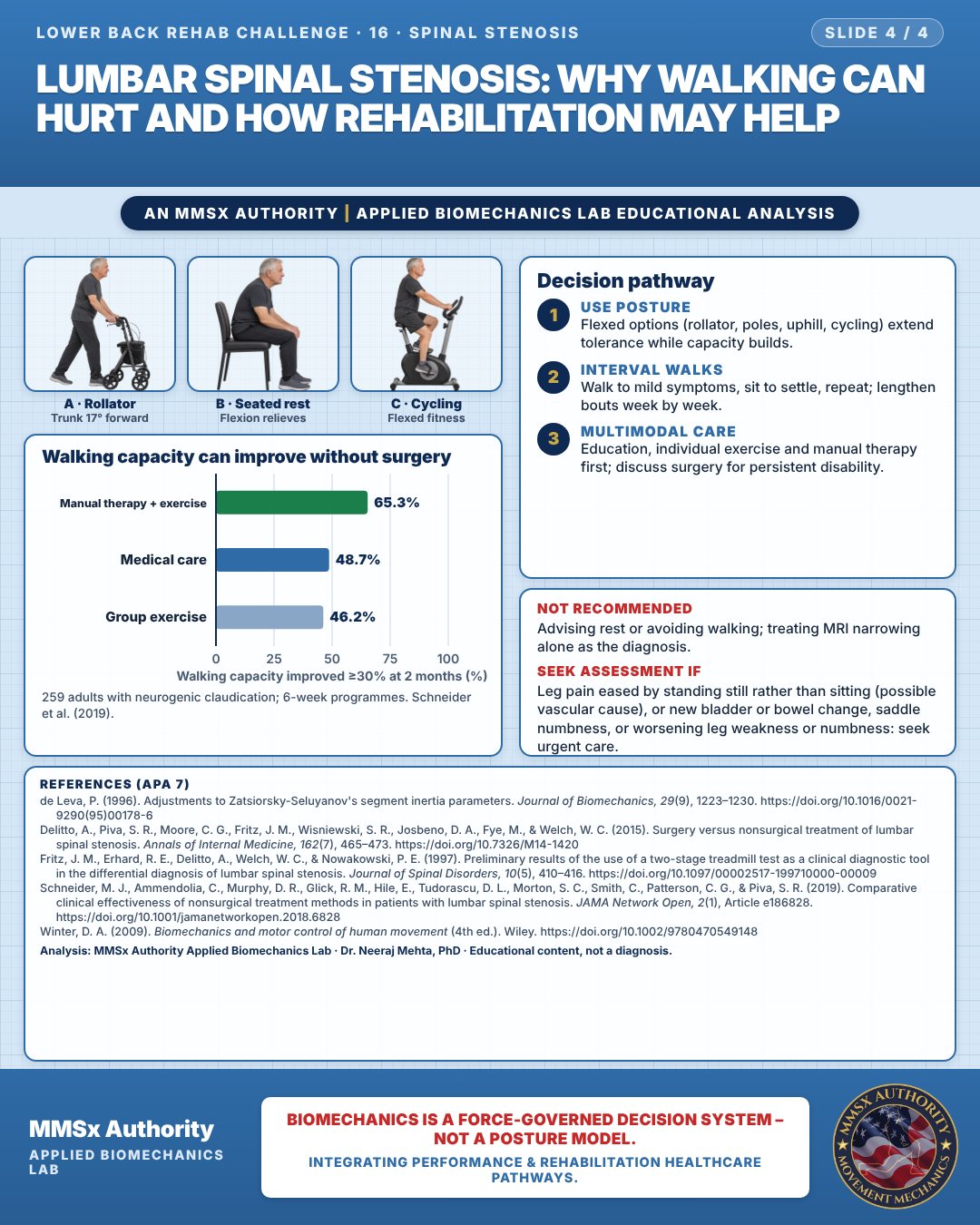
Walking capacity can improve without surgery
Use posture
Flexed options (rollator, poles, uphill, cycling) extend tolerance while capacity builds.
Interval walks
Walk to mild symptoms, sit to settle, repeat; lengthen bouts week by week.
Multimodal care
Education, individual exercise and manual therapy first; discuss surgery for persistent disability.
What the evidence supports
- Offer a multimodal, individualised programme (education, flexion-biased and general exercise, manual therapy, walking/cycling progression) as first-line care; manual therapy + individualised exercise gave greater short-term gains than medical care or group exercise (Schneider et al., 2019).
- Use posture strategically to build walking tolerance: inclined walking or supported forward-lean (e.g. trolley, poles) and interval walking with sitting breaks [mechanism: Fritz et al., 1997].
- Discuss surgery through shared decision-making for persistent, disabling symptoms; PT and surgery gave similar ITT outcomes at 2 years, but crossover was high (Delitto et al., 2015).
Myth and evidence
Myth“Stenosis always needs surgery.”
EvidencePT achieved 2-year function gains similar to surgery (19.2 vs 22.4; difference 0.9, 95% CI −7.9 to 9.6) (Delitto et al., 2015).
Myth“If walking hurts, stop walking.”
EvidenceWalking capacity improved by ≥30% in 46–65% of participants across non-surgical approaches at 2 months (Schneider et al., 2019); posture (inclined) prolongs tolerance (Fritz et al., 1997).
Cautions
Not recommended
Advising rest or avoiding walking; treating MRI narrowing alone as the diagnosis.
Seek assessment if
Leg pain eased by standing still rather than sitting (possible vascular cause), or new bladder or bowel change, saddle numbness, or worsening leg weakness or numbness: seek urgent care.
Methods note
2-D estimates from pose landmarks on an illustrated figure; CoM from de Leva (1996) segment parameters; cm for a 1.70 m adult (Winter, 2009). These are educational estimates, not a diagnosis.
References
- de Leva, P. (1996). Adjustments to Zatsiorsky-Seluyanov's segment inertia parameters. Journal of Biomechanics, 29(9), 1223–1230. https://doi.org/10.1016/0021-9290(95)00178-6
- Delitto, A., Piva, S. R., Moore, C. G., Fritz, J. M., Wisniewski, S. R., Josbeno, D. A., Fye, M., & Welch, W. C. (2015). Surgery versus nonsurgical treatment of lumbar spinal stenosis. Annals of Internal Medicine, 162(7), 465–473. https://doi.org/10.7326/M14-1420
- Fritz, J. M., Erhard, R. E., Delitto, A., Welch, W. C., & Nowakowski, P. E. (1997). Preliminary results of the use of a two-stage treadmill test as a clinical diagnostic tool in the differential diagnosis of lumbar spinal stenosis. Journal of Spinal Disorders, 10(5), 410–416. https://doi.org/10.1097/00002517-199710000-00009
- Schneider, M. J., Ammendolia, C., Murphy, D. R., Glick, R. M., Hile, E., Tudorascu, D. L., Morton, S. C., Smith, C., Patterson, C. G., & Piva, S. R. (2019). Comparative clinical effectiveness of nonsurgical treatment methods in patients with lumbar spinal stenosis. JAMA Network Open, 2(1), Article e186828. https://doi.org/10.1001/jamanetworkopen.2018.6828
- Winter, D. A. (2009). Biomechanics and motor control of human movement (4th ed.). Wiley. https://doi.org/10.1002/9780470549148
Cite this article
Mehta, N. (2026, October 23). Lumbar spinal stenosis: why walking can hurt and how rehabilitation may help. MMSx Authority Applied Biomechanics Lab. https://mmsxauthority.org/edu/analysis/lower-back/16-lumbar-spinal-stenosis-why-walking-can-hurt-and-how-rehabilitation-may/
Part of the collection
Mehta, N. (2026). Lower Back Rehabilitation: 50 Evidence-Based Biomechanics Analyses [Collection]. MMSx Authority Applied Biomechanics Lab. Zenodo. https://doi.org/10.5281/zenodo.23735778
All Lower Back Rehab Challenge articles · Rehabilitation Library