Lower Back Rehab Challenge · 15
McKenzie exercises for back pain: does everyone need back extensions?
The McKenzie method (Mechanical Diagnosis and Therapy, MDT) is an assessment-led approach in which repeated end-range movements or sustained…
Key points
- Assess the response. Test repeated movements in different directions; record where the symptoms go.
- Match the direction. If a preference exists, use it; extension suits some people, flexion or side-shift others.
- No preference? change tack. About 1 in 4 have none: use other active approaches and review progress closely.
What it is
The McKenzie method (Mechanical Diagnosis and Therapy, MDT) is an assessment-led approach in which repeated end-range movements or sustained positions are tested and the symptom response guides exercise. A directional preference (DP) is a direction of movement (e.g. extension, flexion or lateral shift) that, when repeated, reduces or centralises symptoms and/or improves movement; the preferred direction differs between people.
How we analysed the movement
Three movements relevant to this topic were analysed from illustrated reference figures. Joint centres were located with two-dimensional pose estimation; joint angles, the whole-body centre of mass and, where relevant, the low-back lever (the horizontal distance from the upper-body centre of mass to the L5/S1 joint) were then calculated from standard segment parameters. The figures are educational estimates that show how position changes mechanical demand; they are not measurements of a patient. Every research value quoted below comes from the published source cited beside it.
Movement A: Prone lying (side view)
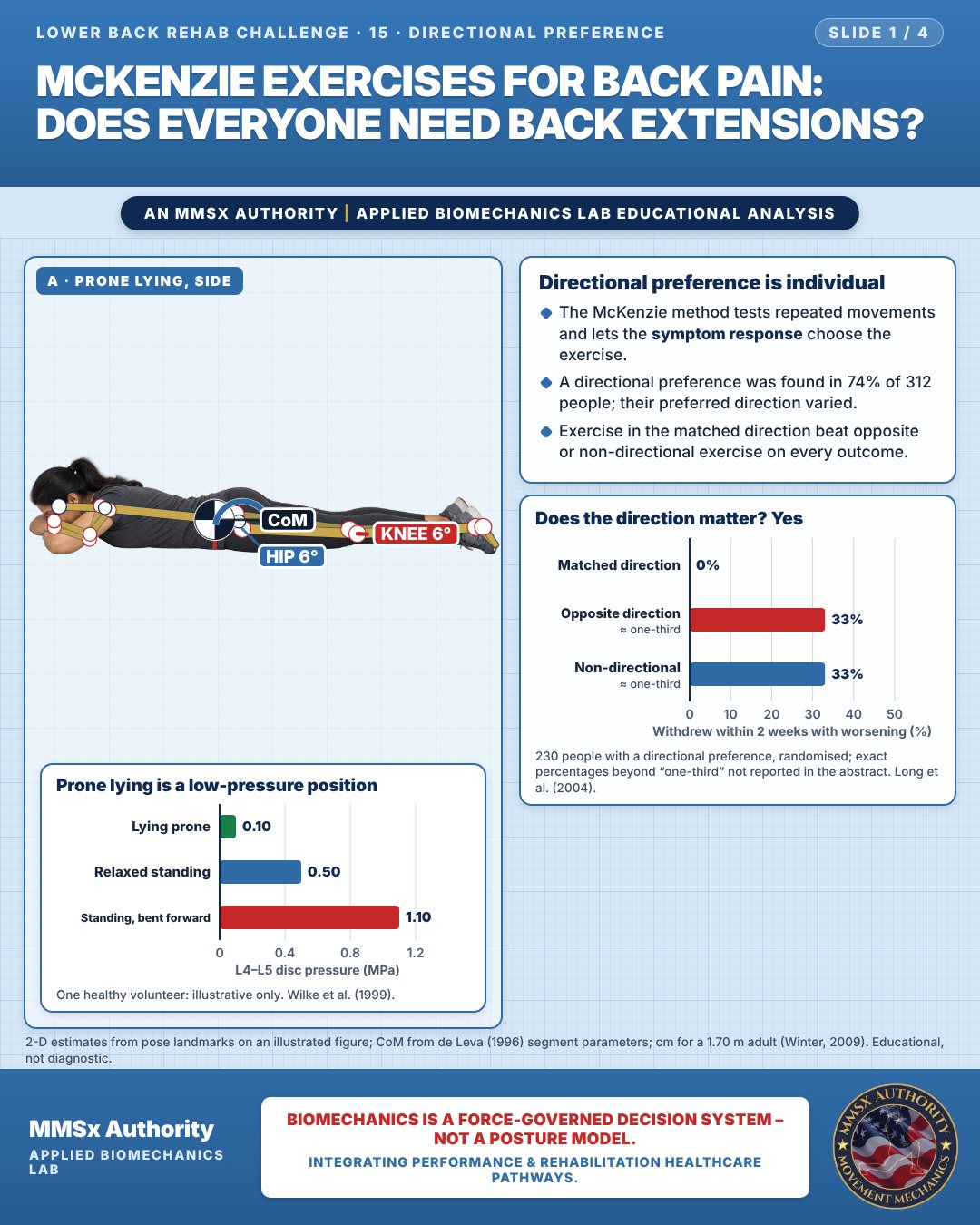
Prone lying is a low-pressure position
Directional preference is individual
The McKenzie method tests repeated movements and lets the symptom response choose the exercise.
A directional preference was found in 74% of 312 people; their preferred direction varied.
Exercise in the matched direction beat opposite or non-directional exercise on every outcome.
Does the direction matter? Yes
Movement B: Prone on elbows (side view)
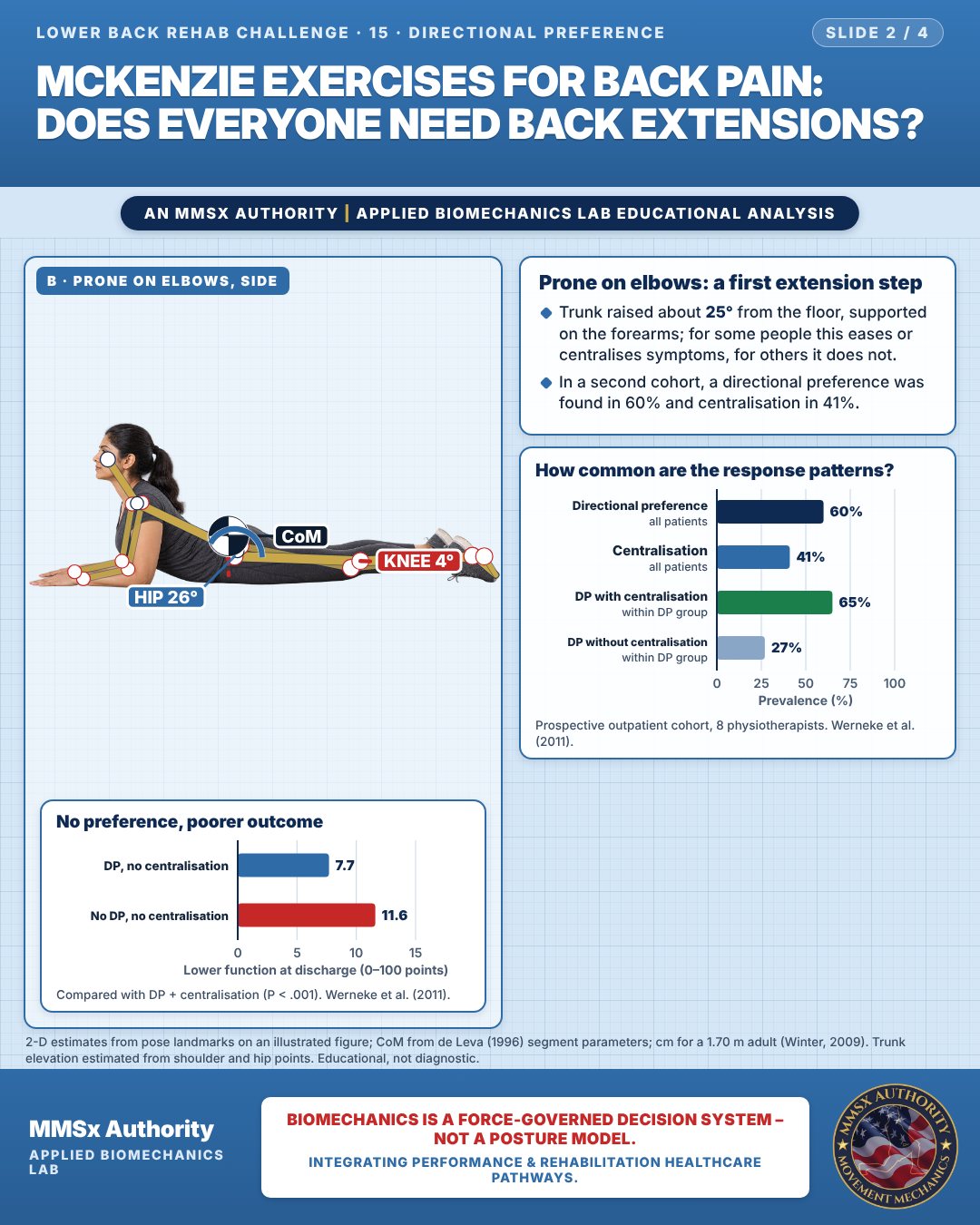
No preference, poorer outcome
Prone on elbows: a first extension step
Trunk raised about 25° from the floor, supported on the forearms; for some people this eases or centralises symptoms, for others it does not.
In a second cohort, a directional preference was found in 60% and centralisation in 41%.
How common are the response patterns?
Movement C: Partial press-up (side view)
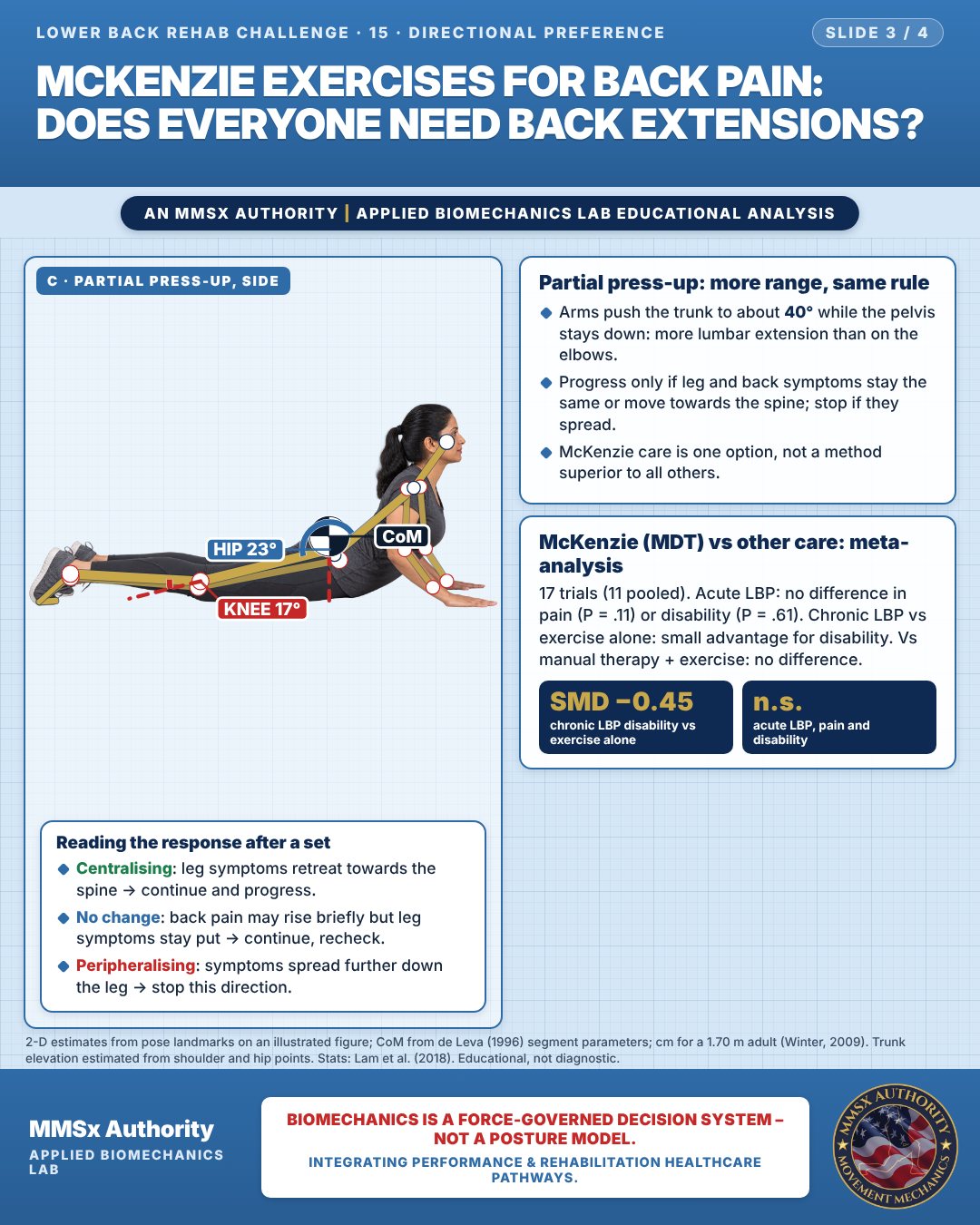
Reading the response after a set
Centralising: leg symptoms retreat towards the spine → continue and progress.
No change: back pain may rise briefly but leg symptoms stay put → continue, recheck.
Peripheralising: symptoms spread further down the leg → stop this direction.
Partial press-up: more range, same rule
Arms push the trunk to about 40° while the pelvis stays down: more lumbar extension than on the elbows.
Progress only if leg and back symptoms stay the same or move towards the spine; stop if they spread.
McKenzie care is one option, not a method superior to all others.
McKenzie (MDT) vs other care: meta-analysis
17 trials (11 pooled). Acute LBP: no difference in pain (P = .11) or disability (P = .61). Chronic LBP vs exercise alone: small advantage for disability. Vs manual therapy + exercise: no difference.
Decision pathway
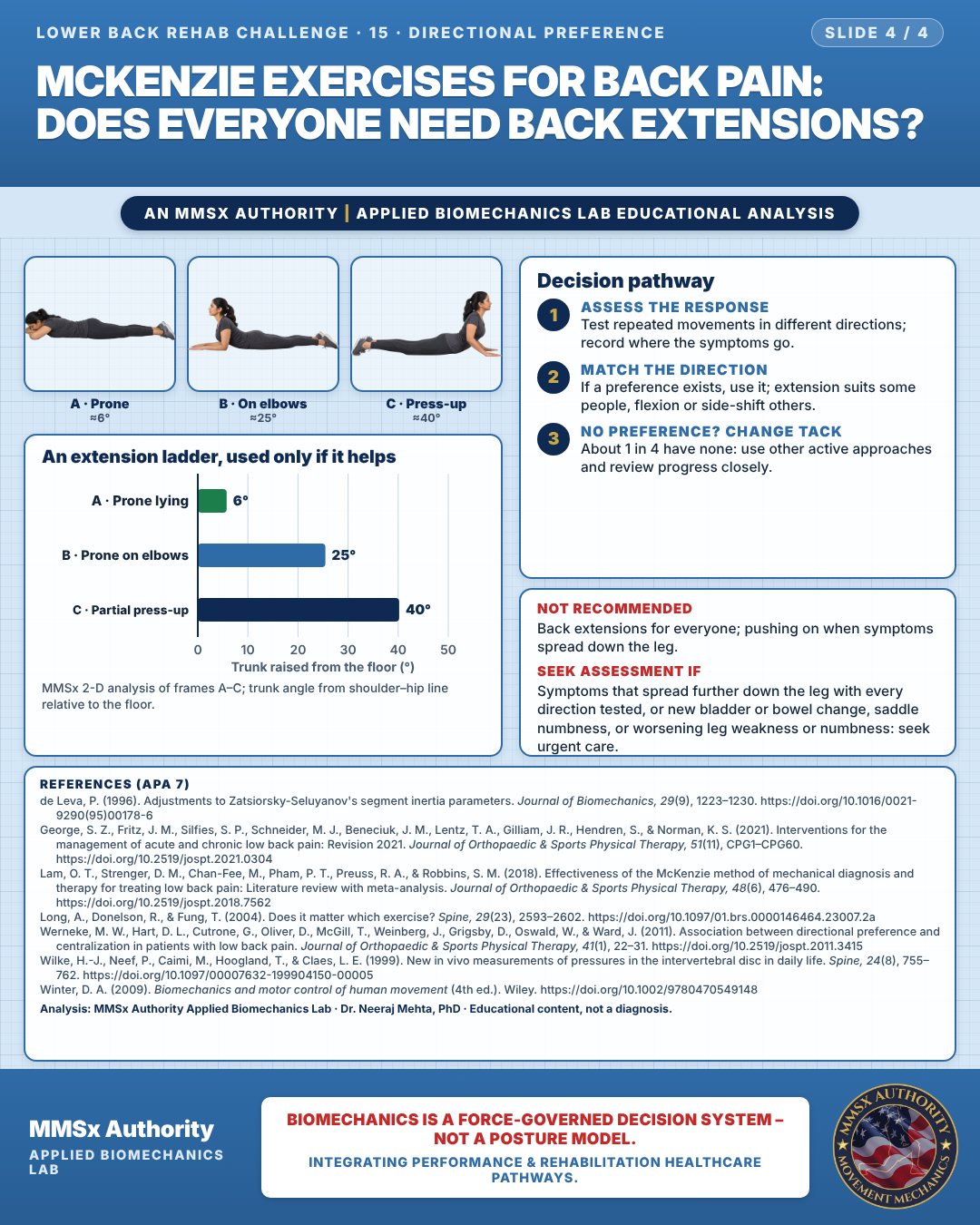
An extension ladder, used only if it helps
Assess the response
Test repeated movements in different directions; record where the symptoms go.
Match the direction
If a preference exists, use it; extension suits some people, flexion or side-shift others.
No preference? change tack
About 1 in 4 have none: use other active approaches and review progress closely.
What the evidence supports
- Use repeated-movement assessment to identify whether a person has a directional preference; prescribe the matching direction when one exists (matched exercise outperformed opposite or non-directional in DP patients) (Long et al., 2004).
- If no DP or no centralisation is found (about 26–40% of people), use other active approaches; outcomes in these groups tend to be poorer and need closer review (Long et al., 2004; Werneke et al., 2011).
- MDT is one evidence-supported option, not a superior method for all (Lam et al., 2018); clinical practice guideline framework for classification-based care (George et al., 2021).
Myth and evidence
Myth“McKenzie = back extensions for everyone.”
EvidenceA DP was found in 74% (and in another cohort 60%), and the preferred direction varies; mismatched exercise led to ≈one-third withdrawing due to worsening (Long et al., 2004; Werneke et al., 2011).
Myth“McKenzie is better than every other treatment.”
EvidenceNo significant differences in acute LBP and vs manual therapy + exercise (Lam et al., 2018).
Cautions
Not recommended
Back extensions for everyone; pushing on when symptoms spread down the leg.
Seek assessment if
Symptoms that spread further down the leg with every direction tested, or new bladder or bowel change, saddle numbness, or worsening leg weakness or numbness: seek urgent care.
Methods note
2-D estimates from pose landmarks on an illustrated figure; CoM from de Leva (1996) segment parameters; cm for a 1.70 m adult (Winter, 2009). Trunk elevation estimated from shoulder and hip points. Stats: Lam et al. (2018). These are educational estimates, not a diagnosis.
References
- de Leva, P. (1996). Adjustments to Zatsiorsky-Seluyanov's segment inertia parameters. Journal of Biomechanics, 29(9), 1223–1230. https://doi.org/10.1016/0021-9290(95)00178-6
- George, S. Z., Fritz, J. M., Silfies, S. P., Schneider, M. J., Beneciuk, J. M., Lentz, T. A., Gilliam, J. R., Hendren, S., & Norman, K. S. (2021). Interventions for the management of acute and chronic low back pain: Revision 2021. Journal of Orthopaedic & Sports Physical Therapy, 51(11), CPG1–CPG60. https://doi.org/10.2519/jospt.2021.0304
- Lam, O. T., Strenger, D. M., Chan-Fee, M., Pham, P. T., Preuss, R. A., & Robbins, S. M. (2018). Effectiveness of the McKenzie method of mechanical diagnosis and therapy for treating low back pain: Literature review with meta-analysis. Journal of Orthopaedic & Sports Physical Therapy, 48(6), 476–490. https://doi.org/10.2519/jospt.2018.7562
- Long, A., Donelson, R., & Fung, T. (2004). Does it matter which exercise? Spine, 29(23), 2593–2602. https://doi.org/10.1097/01.brs.0000146464.23007.2a
- Werneke, M. W., Hart, D. L., Cutrone, G., Oliver, D., McGill, T., Weinberg, J., Grigsby, D., Oswald, W., & Ward, J. (2011). Association between directional preference and centralization in patients with low back pain. Journal of Orthopaedic & Sports Physical Therapy, 41(1), 22–31. https://doi.org/10.2519/jospt.2011.3415
- Wilke, H.-J., Neef, P., Caimi, M., Hoogland, T., & Claes, L. E. (1999). New in vivo measurements of pressures in the intervertebral disc in daily life. Spine, 24(8), 755–762. https://doi.org/10.1097/00007632-199904150-00005
- Winter, D. A. (2009). Biomechanics and motor control of human movement (4th ed.). Wiley. https://doi.org/10.1002/9780470549148
Cite this article
Mehta, N. (2026, October 23). McKenzie exercises for back pain: does everyone need back extensions? MMSx Authority Applied Biomechanics Lab. https://mmsxauthority.org/edu/analysis/lower-back/15-mckenzie-exercises-for-back-pain-does-everyone-need-back-extensions/
Part of the collection
Mehta, N. (2026). Lower Back Rehabilitation: 50 Evidence-Based Biomechanics Analyses [Collection]. MMSx Authority Applied Biomechanics Lab. Zenodo. https://doi.org/10.5281/zenodo.23735778
All Lower Back Rehab Challenge articles · Rehabilitation Library