Lower Back Rehab Challenge · 14
Nerve glides for sciatica: when they may help and when to reassess
Neural mobilisation ("nerve glides", neurodynamic exercises) are movements of the spine and limbs designed to move or load a peripheral nerve and its…
Key points
- Select. Consider glides for leg symptoms that are sensitive to nerve-loading positions (e.g. slump or straight-leg raise).
- Start with sliders. Small, slow sliders when symptoms are irritable; progress to tensioners only if well tolerated.
- Add, don’t replace. Use glides as an adjunct within an active programme; reassess if leg symptoms spread.
What it is
Neural mobilisation ("nerve glides", neurodynamic exercises) are movements of the spine and limbs designed to move or load a peripheral nerve and its surrounding tissues. "Sliders" lengthen the nerve bed at one joint while shortening it at another (more nerve excursion, less tension); "tensioners" lengthen the nerve bed at both ends at once (more tension, less excursion). They are used for people whose leg symptoms are sensitive to nerve-loading positions (e.g. a positive slump or straight-leg-raise test).
How we analysed the movement
Three movements relevant to this topic were analysed from illustrated reference figures. Joint centres were located with two-dimensional pose estimation; joint angles, the whole-body centre of mass and, where relevant, the low-back lever (the horizontal distance from the upper-body centre of mass to the L5/S1 joint) were then calculated from standard segment parameters. The figures are educational estimates that show how position changes mechanical demand; they are not measurements of a patient. Every research value quoted below comes from the published source cited beside it.
Movement A: Slider start (side view)
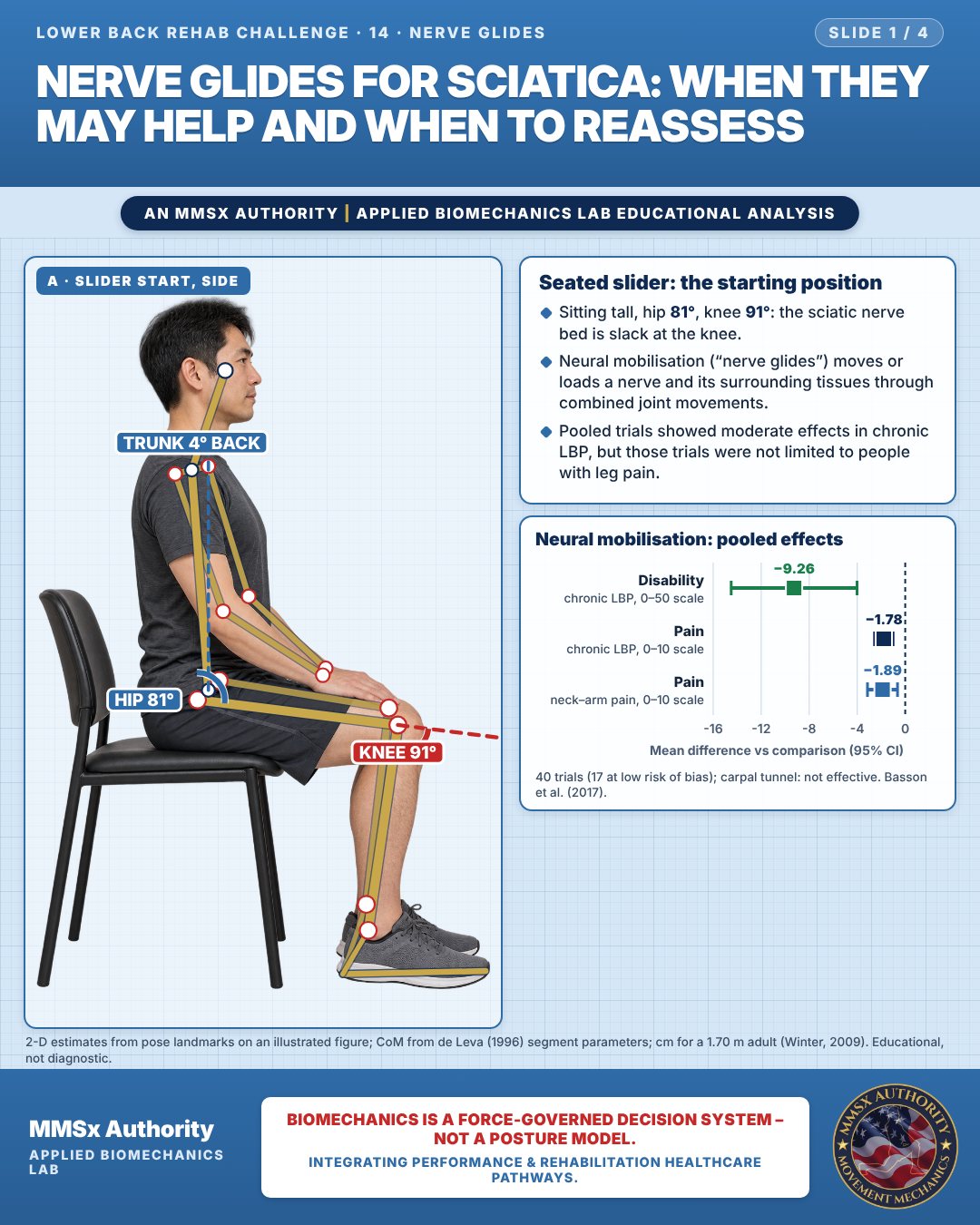
Seated slider: the starting position
Sitting tall, hip 81°, knee 91°: the sciatic nerve bed is slack at the knee.
Neural mobilisation (“nerve glides”) moves or loads a nerve and its surrounding tissues through combined joint movements.
Pooled trials showed moderate effects in chronic LBP, but those trials were not limited to people with leg pain.
Neural mobilisation: pooled effects
Movement B: Knee extends (side view)
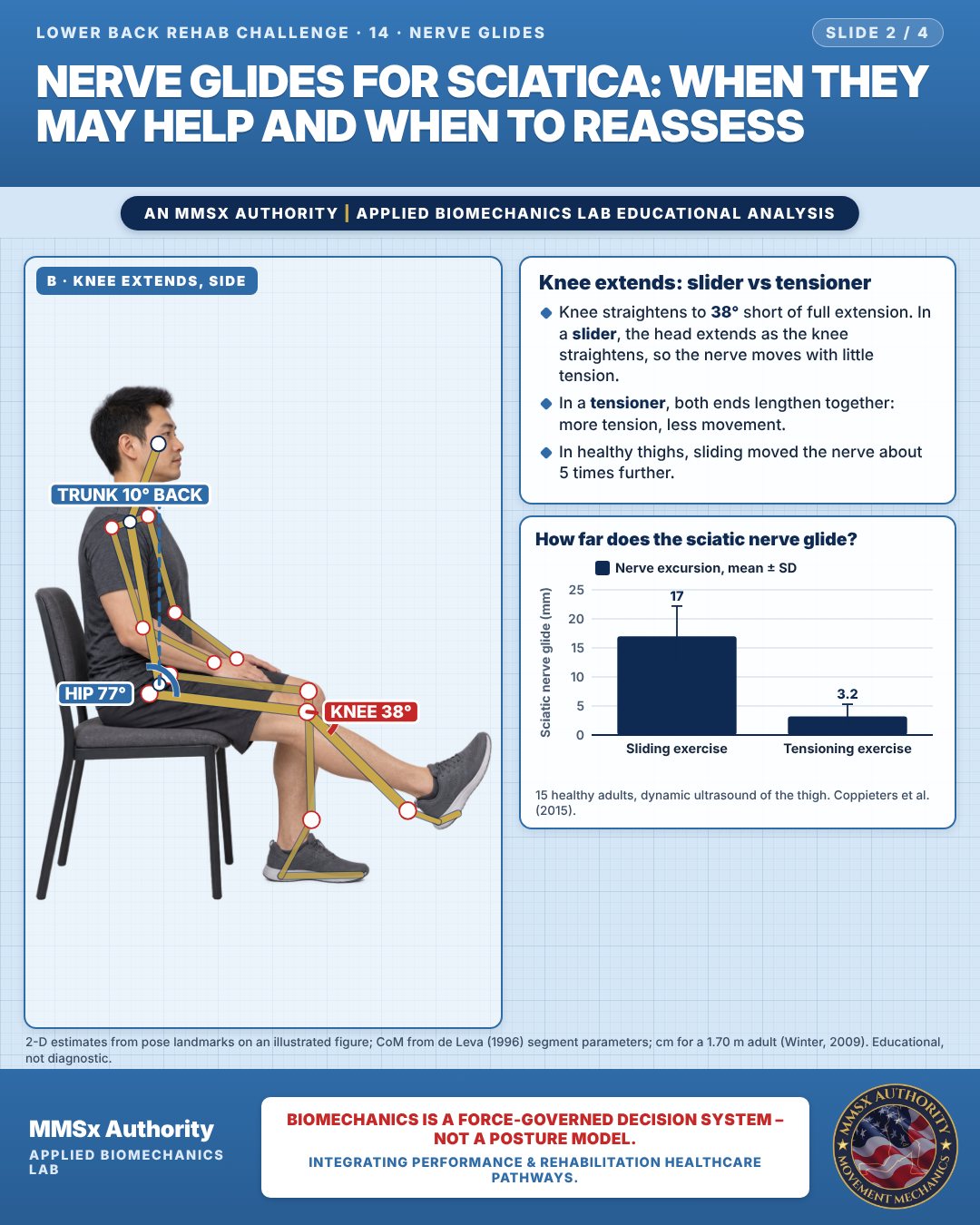
Knee extends: slider vs tensioner
Knee straightens to 38° short of full extension. In a slider, the head extends as the knee straightens, so the nerve moves with little tension.
In a tensioner, both ends lengthen together: more tension, less movement.
In healthy thighs, sliding moved the nerve about 5 times further.
How far does the sciatic nerve glide?
Movement C: Return (side view)
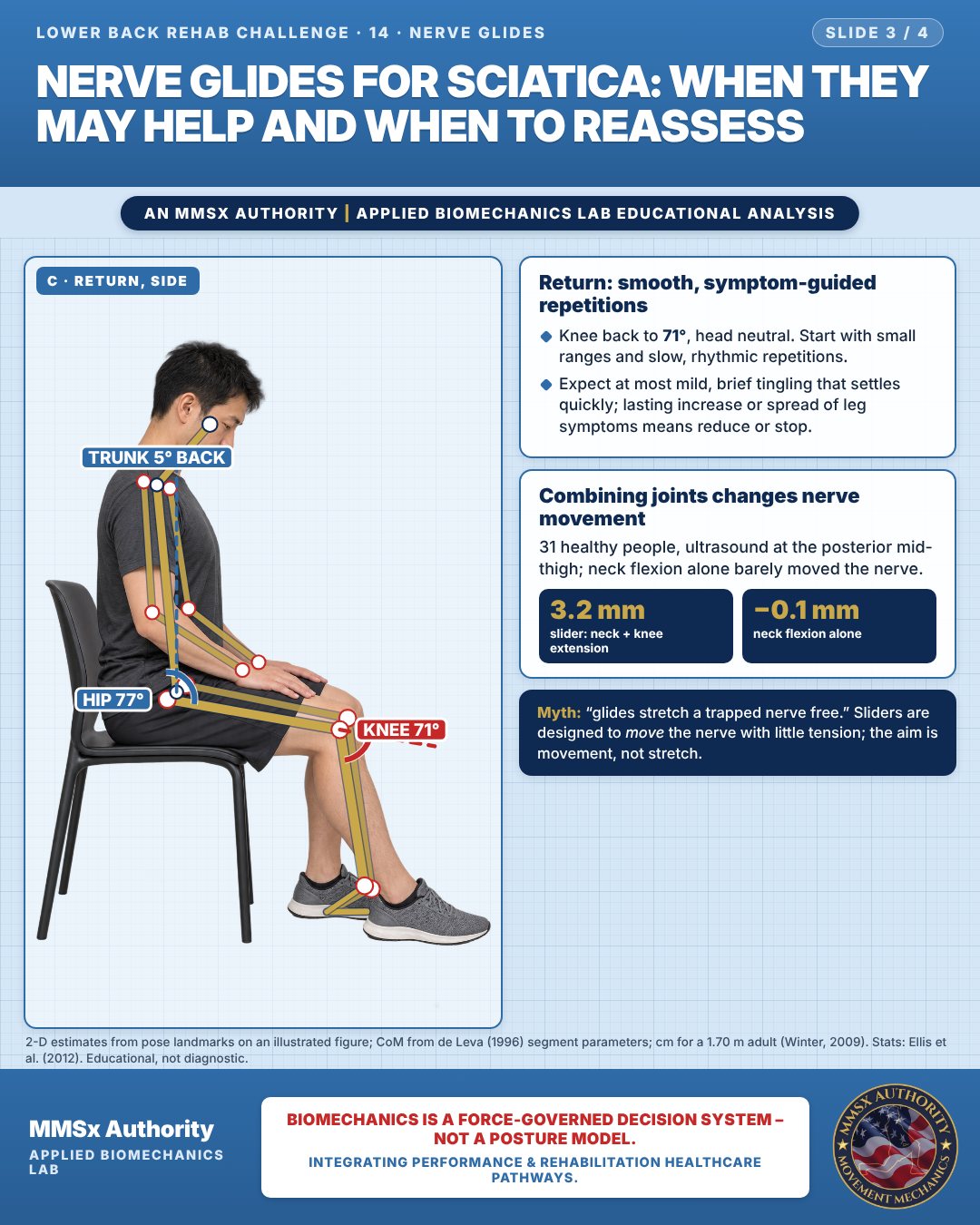
Return: smooth, symptom-guided repetitions
Knee back to 71°, head neutral. Start with small ranges and slow, rhythmic repetitions.
Expect at most mild, brief tingling that settles quickly; lasting increase or spread of leg symptoms means reduce or stop.
Combining joints changes nerve movement
31 healthy people, ultrasound at the posterior mid-thigh; neck flexion alone barely moved the nerve.
Decision pathway
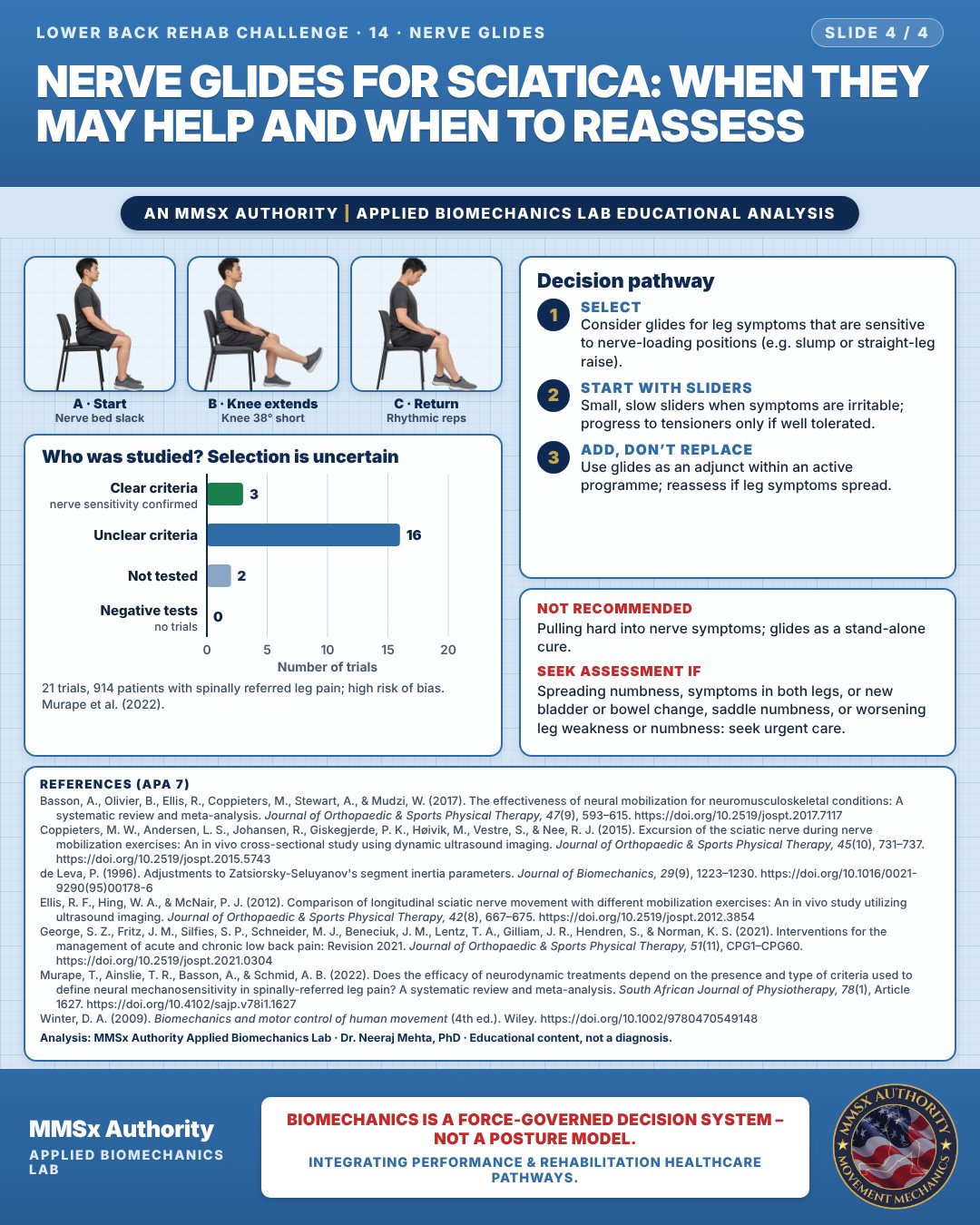
Who was studied? Selection is uncertain
Select
Consider glides for leg symptoms that are sensitive to nerve-loading positions (e.g. slump or straight-leg raise).
Start with sliders
Small, slow sliders when symptoms are irritable; progress to tensioners only if well tolerated.
Add, don’t replace
Use glides as an adjunct within an active programme; reassess if leg symptoms spread.
What the evidence supports
- Neural mobilisation may be offered as an adjunct within an active programme for selected people with nerve-related leg symptoms (moderate pooled effects in chronic LBP; uncertain criteria for selection) (Basson et al., 2017; Murape et al., 2022); clinical practice guideline provides the classification framework (George et al., 2021).
Myth and evidence
Myth“Nerve glides work for everyone with leg pain.”
EvidenceNo trial included people without nerve sensitivity, and selection criteria were unclear in 16 of 21 trials (Murape et al., 2022).
Cautions
Not recommended
Pulling hard into nerve symptoms; glides as a stand-alone cure.
Seek assessment if
Spreading numbness, symptoms in both legs, or new bladder or bowel change, saddle numbness, or worsening leg weakness or numbness: seek urgent care.
Methods note
2-D estimates from pose landmarks on an illustrated figure; CoM from de Leva (1996) segment parameters; cm for a 1.70 m adult (Winter, 2009). Stats: Ellis et al. (2012). These are educational estimates, not a diagnosis.
References
- Basson, A., Olivier, B., Ellis, R., Coppieters, M., Stewart, A., & Mudzi, W. (2017). The effectiveness of neural mobilization for neuromusculoskeletal conditions: A systematic review and meta-analysis. Journal of Orthopaedic & Sports Physical Therapy, 47(9), 593–615. https://doi.org/10.2519/jospt.2017.7117
- Coppieters, M. W., Andersen, L. S., Johansen, R., Giskegjerde, P. K., Høivik, M., Vestre, S., & Nee, R. J. (2015). Excursion of the sciatic nerve during nerve mobilization exercises: An in vivo cross-sectional study using dynamic ultrasound imaging. Journal of Orthopaedic & Sports Physical Therapy, 45(10), 731–737. https://doi.org/10.2519/jospt.2015.5743
- de Leva, P. (1996). Adjustments to Zatsiorsky-Seluyanov's segment inertia parameters. Journal of Biomechanics, 29(9), 1223–1230. https://doi.org/10.1016/0021-9290(95)00178-6
- Ellis, R. F., Hing, W. A., & McNair, P. J. (2012). Comparison of longitudinal sciatic nerve movement with different mobilization exercises: An in vivo study utilizing ultrasound imaging. Journal of Orthopaedic & Sports Physical Therapy, 42(8), 667–675. https://doi.org/10.2519/jospt.2012.3854
- George, S. Z., Fritz, J. M., Silfies, S. P., Schneider, M. J., Beneciuk, J. M., Lentz, T. A., Gilliam, J. R., Hendren, S., & Norman, K. S. (2021). Interventions for the management of acute and chronic low back pain: Revision 2021. Journal of Orthopaedic & Sports Physical Therapy, 51(11), CPG1–CPG60. https://doi.org/10.2519/jospt.2021.0304
- Murape, T., Ainslie, T. R., Basson, A., & Schmid, A. B. (2022). Does the efficacy of neurodynamic treatments depend on the presence and type of criteria used to define neural mechanosensitivity in spinally-referred leg pain? A systematic review and meta-analysis. South African Journal of Physiotherapy, 78(1), Article 1627. https://doi.org/10.4102/sajp.v78i1.1627
- Winter, D. A. (2009). Biomechanics and motor control of human movement (4th ed.). Wiley. https://doi.org/10.1002/9780470549148
Cite this article
Mehta, N. (2026, October 23). Nerve glides for sciatica: when they may help and when to reassess. MMSx Authority Applied Biomechanics Lab. https://mmsxauthority.org/edu/analysis/lower-back/14-nerve-glides-for-sciatica-when-they-may-help-and-when-to-reassess/
Part of the collection
Mehta, N. (2026). Lower Back Rehabilitation: 50 Evidence-Based Biomechanics Analyses [Collection]. MMSx Authority Applied Biomechanics Lab. Zenodo. https://doi.org/10.5281/zenodo.23735778
All Lower Back Rehab Challenge articles · Rehabilitation Library