Lower Back Rehab Challenge · 13
Sciatica exercises: why your symptom response matters
Sciatica is pain radiating into the leg in the distribution of a lumbosacral nerve root (most often L5 or S1), commonly with numbness, pins and…
Key points
- Monitor three things. Leg-symptom distribution, function (walking, sitting tolerance) and neurological signs.
- Keep what centralises. Continue exercises that centralise or do not spread symptoms; modify those that peripheralise.
- One person, one plan. Exercise is an option chosen for the individual, not one routine for everyone.
What it is
Sciatica is pain radiating into the leg in the distribution of a lumbosacral nerve root (most often L5 or S1), commonly with numbness, pins and needles or weakness; a lumbar disc herniation is the most frequent cause. "Symptom response" means how the distribution and intensity of leg symptoms change during and after a movement or exercise: centralisation (moving back toward the spine), peripheralisation (spreading further down the leg) or no change.
How we analysed the movement
Three movements relevant to this topic were analysed from illustrated reference figures. Joint centres were located with two-dimensional pose estimation; joint angles, the whole-body centre of mass and, where relevant, the low-back lever (the horizontal distance from the upper-body centre of mass to the L5/S1 joint) were then calculated from standard segment parameters. The figures are educational estimates that show how position changes mechanical demand; they are not measurements of a patient. Every research value quoted below comes from the published source cited beside it.
Movement A: Symptom check, seated
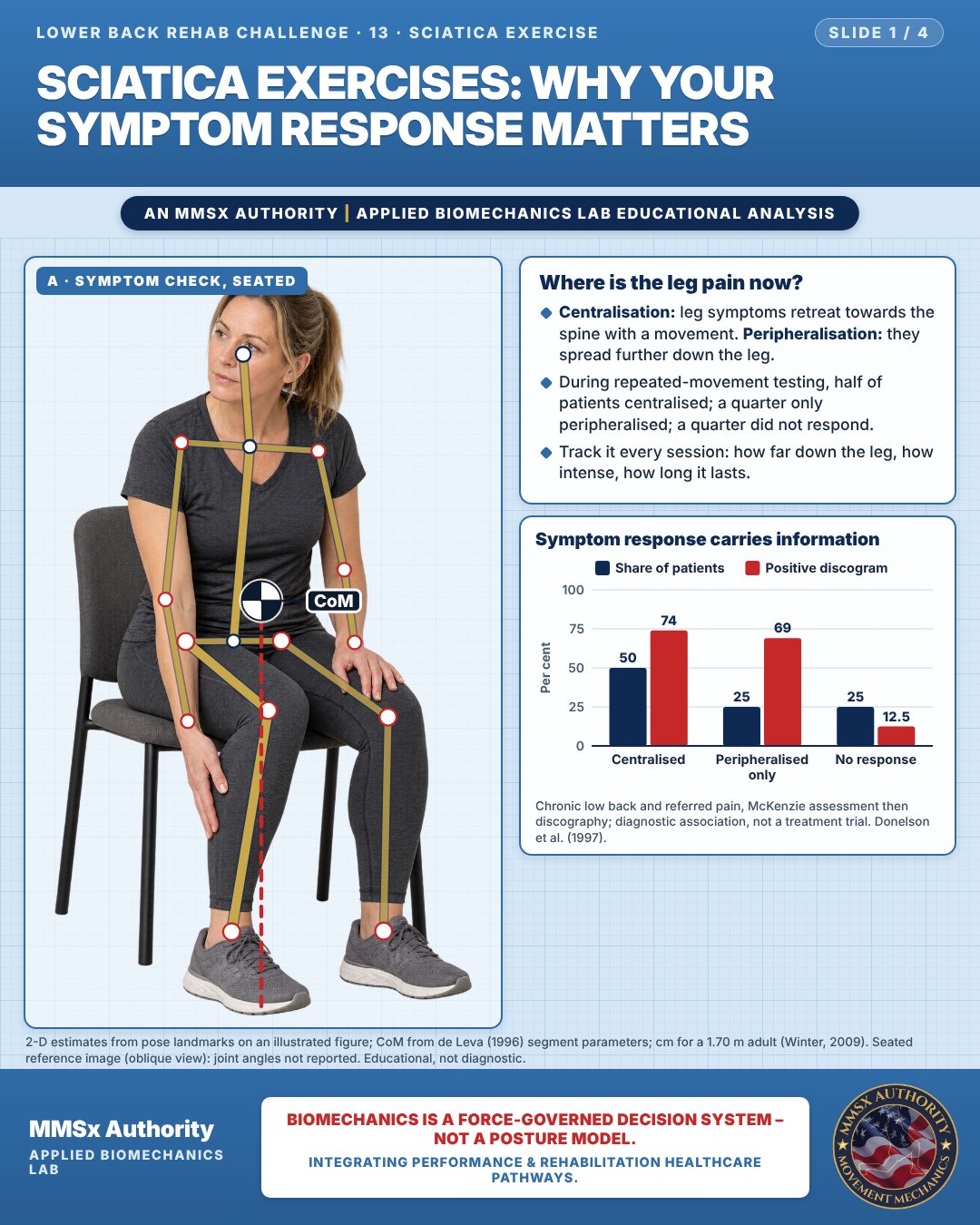
Where is the leg pain now?
Centralisation: leg symptoms retreat towards the spine with a movement. Peripheralisation: they spread further down the leg.
During repeated-movement testing, half of patients centralised; a quarter only peripheralised; a quarter did not respond.
Track it every session: how far down the leg, how intense, how long it lasts.
Symptom response carries information
Movement B: Supported standing (side view)
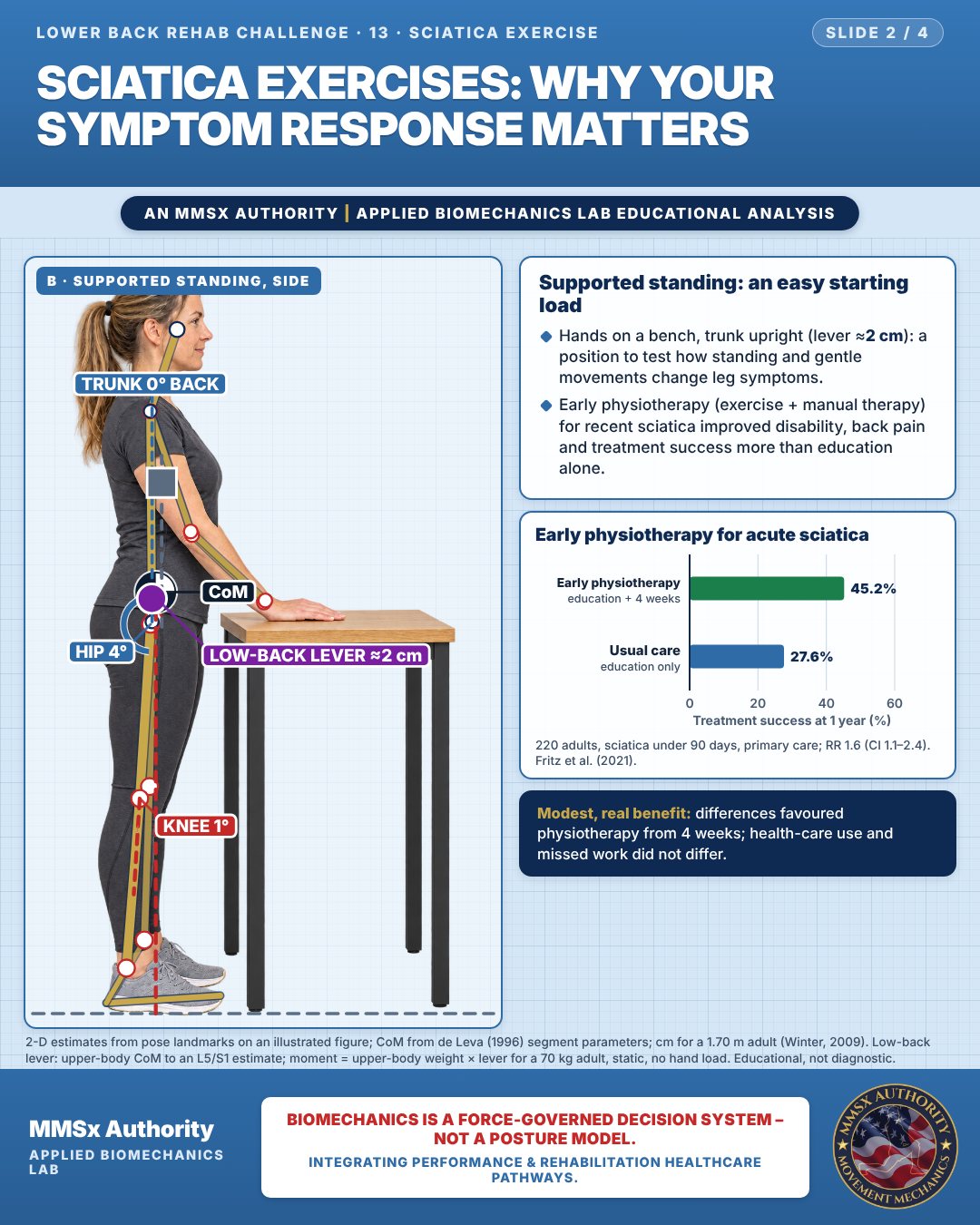
Supported standing: an easy starting load
Hands on a bench, trunk upright (lever ≈2 cm): a position to test how standing and gentle movements change leg symptoms.
Early physiotherapy (exercise + manual therapy) for recent sciatica improved disability, back pain and treatment success more than education alone.
Early physiotherapy for acute sciatica
Movement C: Heel slide (side view)
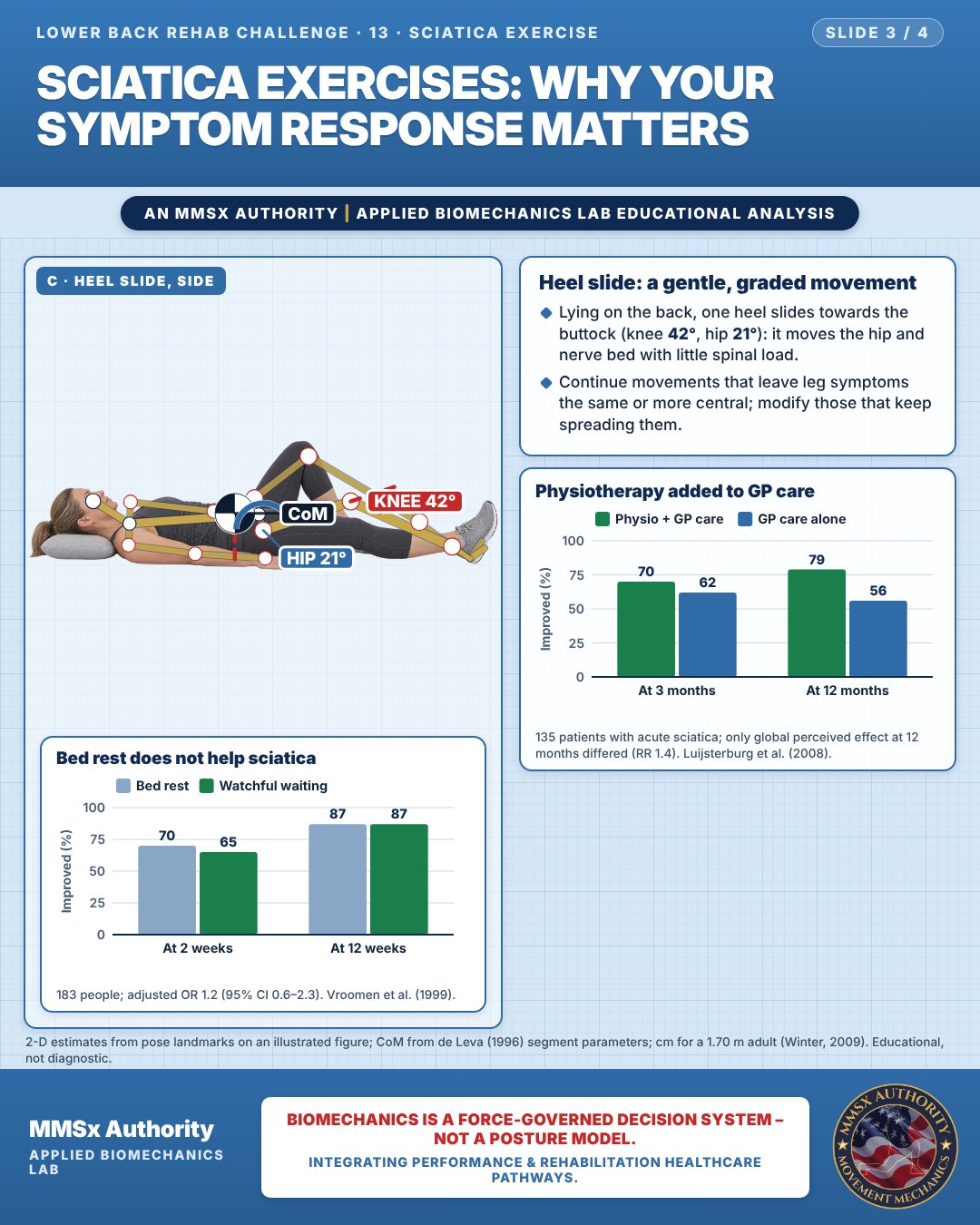
Bed rest does not help sciatica
Heel slide: a gentle, graded movement
Lying on the back, one heel slides towards the buttock (knee 42°, hip 21°): it moves the hip and nerve bed with little spinal load.
Continue movements that leave leg symptoms the same or more central; modify those that keep spreading them.
Physiotherapy added to GP care
Decision pathway
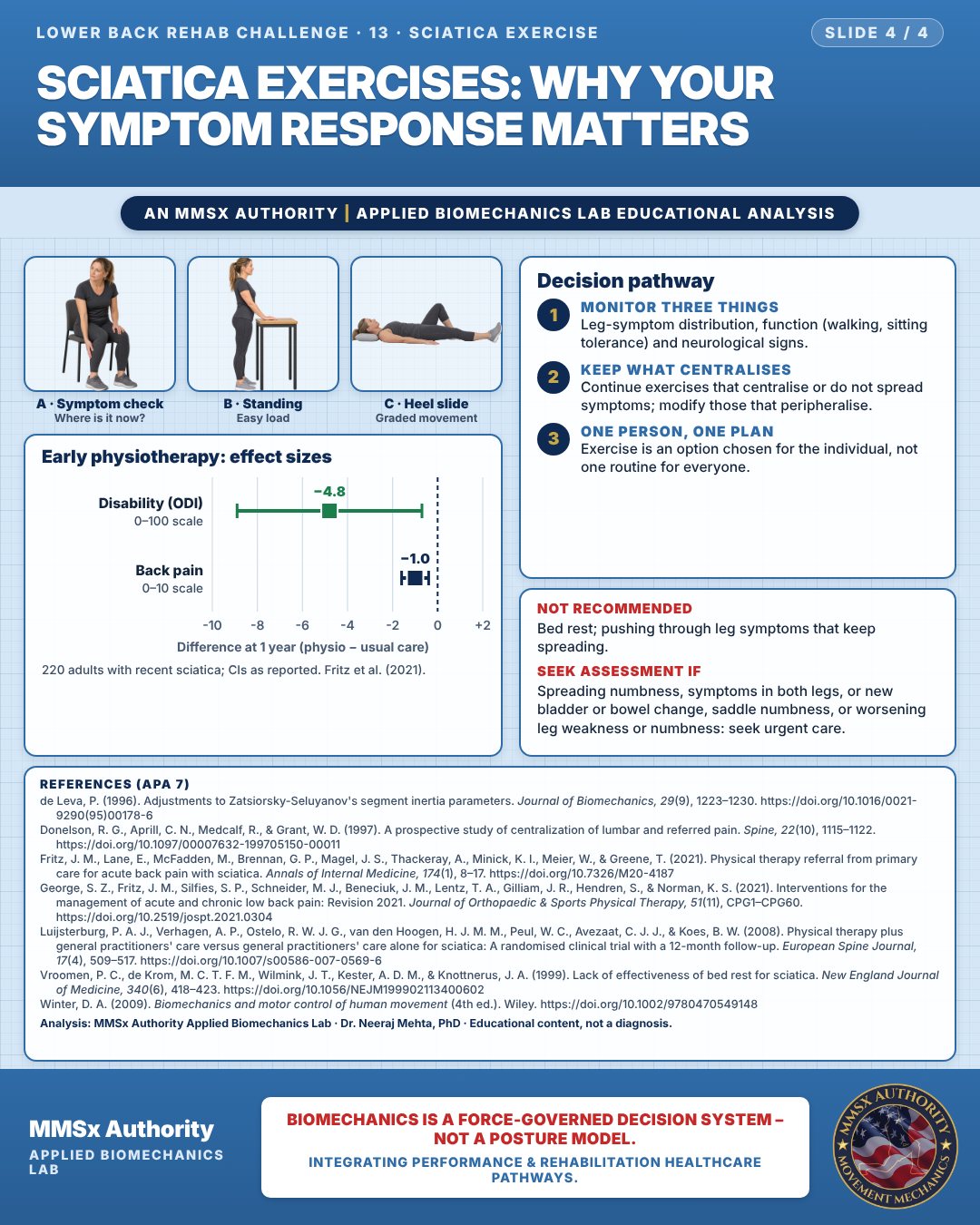
Early physiotherapy: effect sizes
Monitor three things
Leg-symptom distribution, function (walking, sitting tolerance) and neurological signs.
Keep what centralises
Continue exercises that centralise or do not spread symptoms; modify those that peripheralise.
One person, one plan
Exercise is an option chosen for the individual, not one routine for everyone.
What the evidence supports
- Recommended framework: stay active; offer exercise matched to the person's symptom response and goals; consider early physiotherapy (modest benefits in disability and perceived success) (Fritz et al., 2021; Luijsterburg et al., 2008); clinical practice guideline as starting framework for exercise selection and classification (George et al., 2021).
- Monitoring each session: (1) leg-symptom distribution (centralising vs peripheralising), (2) function (e.g. ODI, walking/sitting tolerance), (3) neurological signs (strength, sensation, reflexes). Exercises that centralise or do not spread leg symptoms are usually continued; those that progressively peripheralise symptoms are modified [Donelson et al., 1997 — association data; clinical reasoning].
- Do NOT recommend bed rest (no benefit; OR 1.2, 95% CI 0.6–2.3) (Vroomen et al., 1999).
Myth and evidence
Myth“With sciatica you should rest in bed until it settles.”
EvidenceNo difference vs staying up (87% improved in both groups at 12 weeks) (Vroomen et al., 1999).
Myth“One sciatica exercise routine suits everyone.”
EvidencePatients split into different symptom-response groups (50% centralised, 25% peripheralised, 25% no response) (Donelson et al., 1997); exercise is chosen and adjusted by response.
Cautions
Not recommended
Bed rest; pushing through leg symptoms that keep spreading.
Seek assessment if
Spreading numbness, symptoms in both legs, or new bladder or bowel change, saddle numbness, or worsening leg weakness or numbness: seek urgent care.
Methods note
2-D estimates from pose landmarks on an illustrated figure; CoM from de Leva (1996) segment parameters; cm for a 1.70 m adult (Winter, 2009). Seated reference image (oblique view): joint angles not reported. Low-back lever: upper-body CoM to an L5/S1 estimate; moment = upper-body weight × lever for a 70 kg adult, static, no hand load. These are educational estimates, not a diagnosis.
References
- de Leva, P. (1996). Adjustments to Zatsiorsky-Seluyanov's segment inertia parameters. Journal of Biomechanics, 29(9), 1223–1230. https://doi.org/10.1016/0021-9290(95)00178-6
- Donelson, R. G., Aprill, C. N., Medcalf, R., & Grant, W. D. (1997). A prospective study of centralization of lumbar and referred pain. Spine, 22(10), 1115–1122. https://doi.org/10.1097/00007632-199705150-00011
- Fritz, J. M., Lane, E., McFadden, M., Brennan, G. P., Magel, J. S., Thackeray, A., Minick, K. I., Meier, W., & Greene, T. (2021). Physical therapy referral from primary care for acute back pain with sciatica. Annals of Internal Medicine, 174(1), 8–17. https://doi.org/10.7326/M20-4187
- George, S. Z., Fritz, J. M., Silfies, S. P., Schneider, M. J., Beneciuk, J. M., Lentz, T. A., Gilliam, J. R., Hendren, S., & Norman, K. S. (2021). Interventions for the management of acute and chronic low back pain: Revision 2021. Journal of Orthopaedic & Sports Physical Therapy, 51(11), CPG1–CPG60. https://doi.org/10.2519/jospt.2021.0304
- Luijsterburg, P. A. J., Verhagen, A. P., Ostelo, R. W. J. G., van den Hoogen, H. J. M. M., Peul, W. C., Avezaat, C. J. J., & Koes, B. W. (2008). Physical therapy plus general practitioners' care versus general practitioners' care alone for sciatica: A randomised clinical trial with a 12-month follow-up. European Spine Journal, 17(4), 509–517. https://doi.org/10.1007/s00586-007-0569-6
- Vroomen, P. C., de Krom, M. C. T. F. M., Wilmink, J. T., Kester, A. D. M., & Knottnerus, J. A. (1999). Lack of effectiveness of bed rest for sciatica. New England Journal of Medicine, 340(6), 418–423. https://doi.org/10.1056/NEJM199902113400602
- Winter, D. A. (2009). Biomechanics and motor control of human movement (4th ed.). Wiley. https://doi.org/10.1002/9780470549148
Cite this article
Mehta, N. (2026, October 23). Sciatica exercises: why your symptom response matters. MMSx Authority Applied Biomechanics Lab. https://mmsxauthority.org/edu/analysis/lower-back/13-sciatica-exercises-why-your-symptom-response-matters/
Part of the collection
Mehta, N. (2026). Lower Back Rehabilitation: 50 Evidence-Based Biomechanics Analyses [Collection]. MMSx Authority Applied Biomechanics Lab. Zenodo. https://doi.org/10.5281/zenodo.23735778
All Lower Back Rehab Challenge articles · Rehabilitation Library