Lower Back Rehab Challenge · 11
Herniated lumbar disc: what recovery without surgery can involve
A lumbar disc herniation is a localised displacement of disc material (nucleus and/or annulus) beyond the normal margins of the intervertebral disc space.
Key points
- Explain. Many herniations regress; most people recover with or without surgery by one year.
- Adjust, don’t stop. Stay active within tolerance; in flares, limit long flexed loading and heavy loads held away from the body.
- Know when to escalate. Persistent disabling leg pain, progressive weakness or cauda equina signs: specialist review.
What it is
A lumbar disc herniation is a localised displacement of disc material (nucleus and/or annulus) beyond the normal margins of the intervertebral disc space; it is graded by shape and extent (bulge, protrusion, extrusion, sequestration). It may be symptom-free, or it may compress/irritate a nerve root and cause radicular leg pain (sciatica), sensory change or weakness.
How we analysed the movement
Three movements relevant to this topic were analysed from illustrated reference figures. Joint centres were located with two-dimensional pose estimation; joint angles, the whole-body centre of mass and, where relevant, the low-back lever (the horizontal distance from the upper-body centre of mass to the L5/S1 joint) were then calculated from standard segment parameters. The figures are educational estimates that show how position changes mechanical demand; they are not measurements of a patient. Every research value quoted below comes from the published source cited beside it.
Movement A: Comfortable rest (side view)
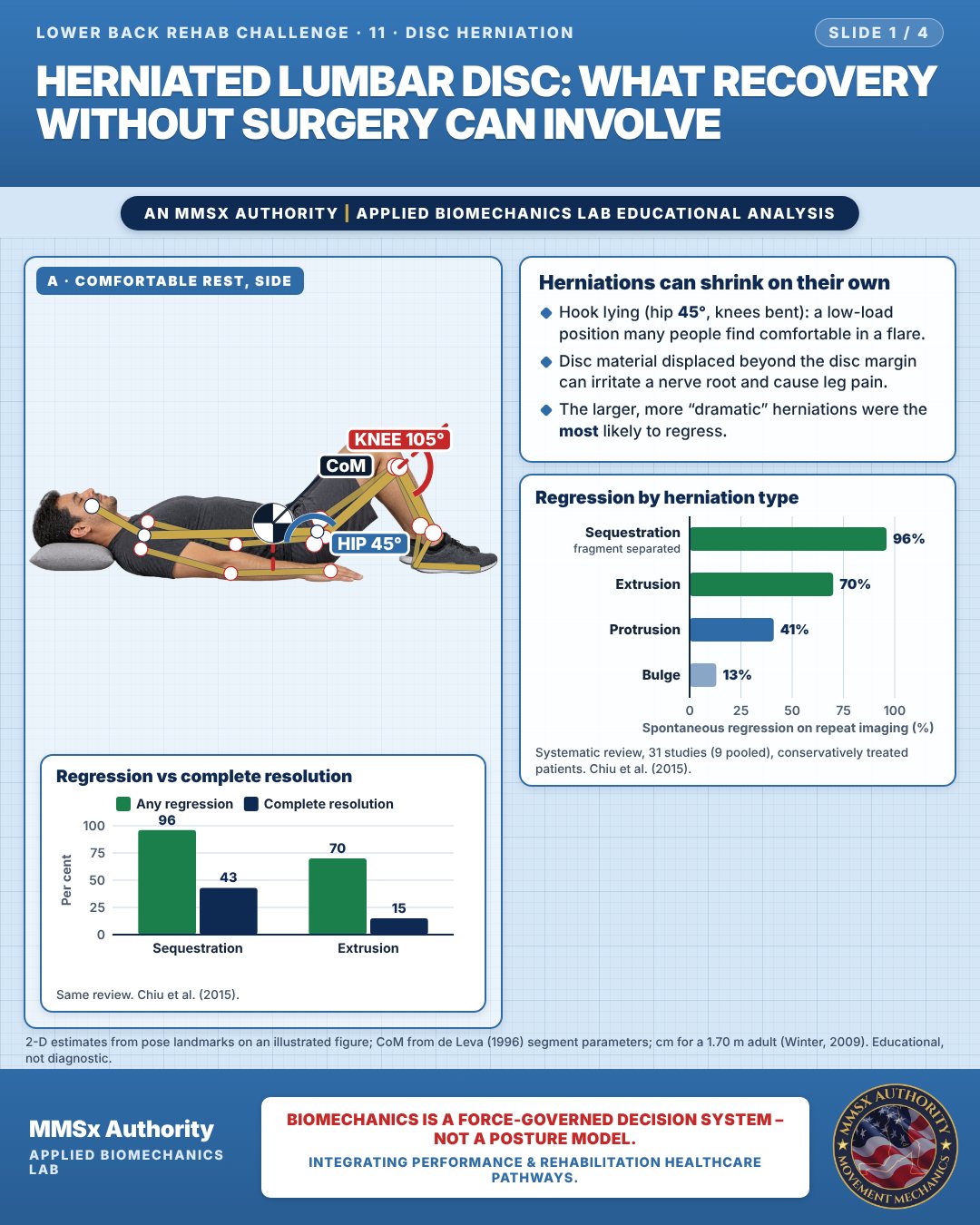
Regression vs complete resolution
Herniations can shrink on their own
Hook lying (hip 45°, knees bent): a low-load position many people find comfortable in a flare.
Disc material displaced beyond the disc margin can irritate a nerve root and cause leg pain.
The larger, more “dramatic” herniations were the most likely to regress.
Regression by herniation type
Movement B: Supported hip hinge (side view)
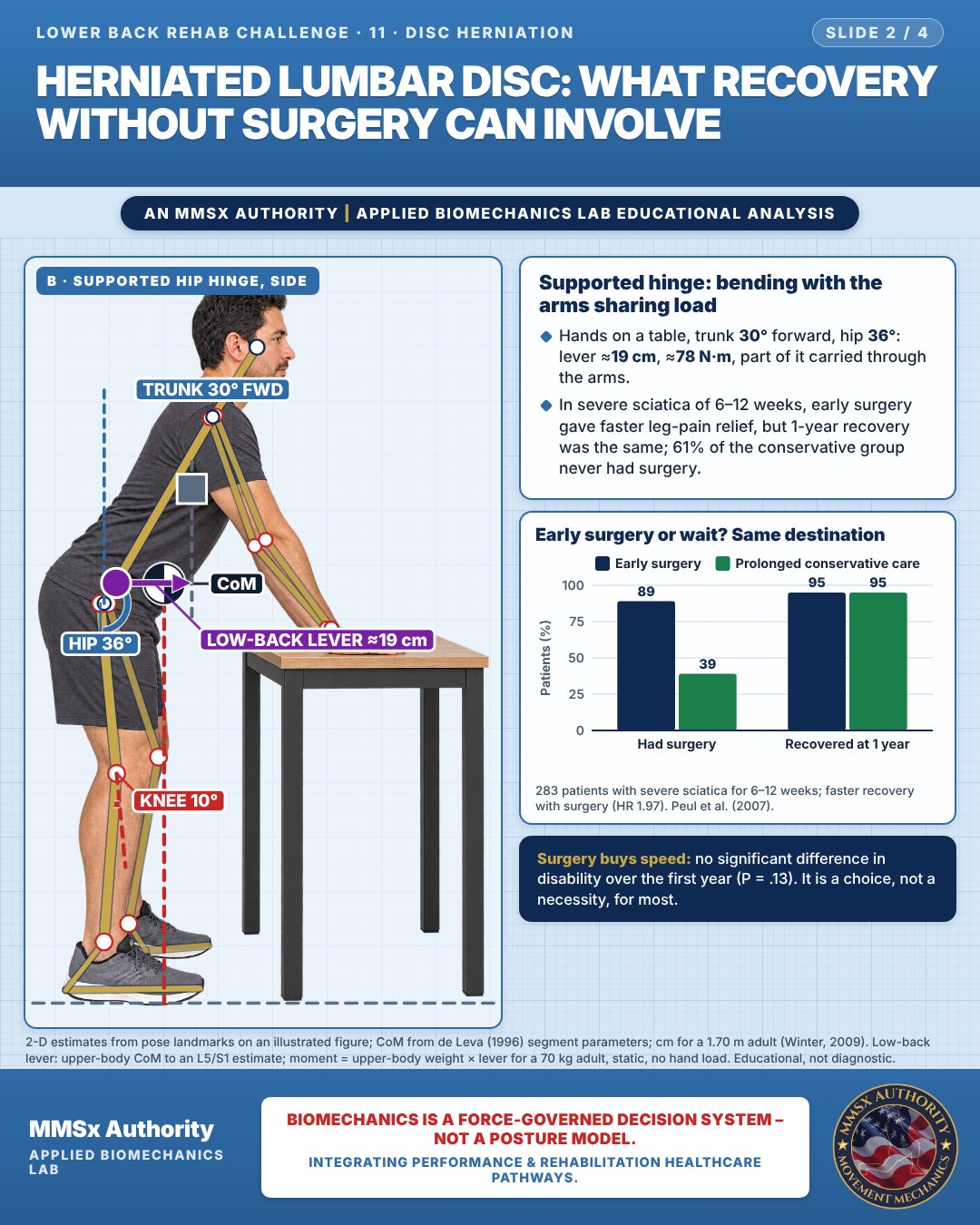
Supported hinge: bending with the arms sharing load
Hands on a table, trunk 30° forward, hip 36°: lever ≈19 cm, ≈78 N·m, part of it carried through the arms.
In severe sciatica of 6–12 weeks, early surgery gave faster leg-pain relief, but 1-year recovery was the same; 61% of the conservative group never had surgery.
Early surgery or wait? Same destination
Movement C: Return to walking
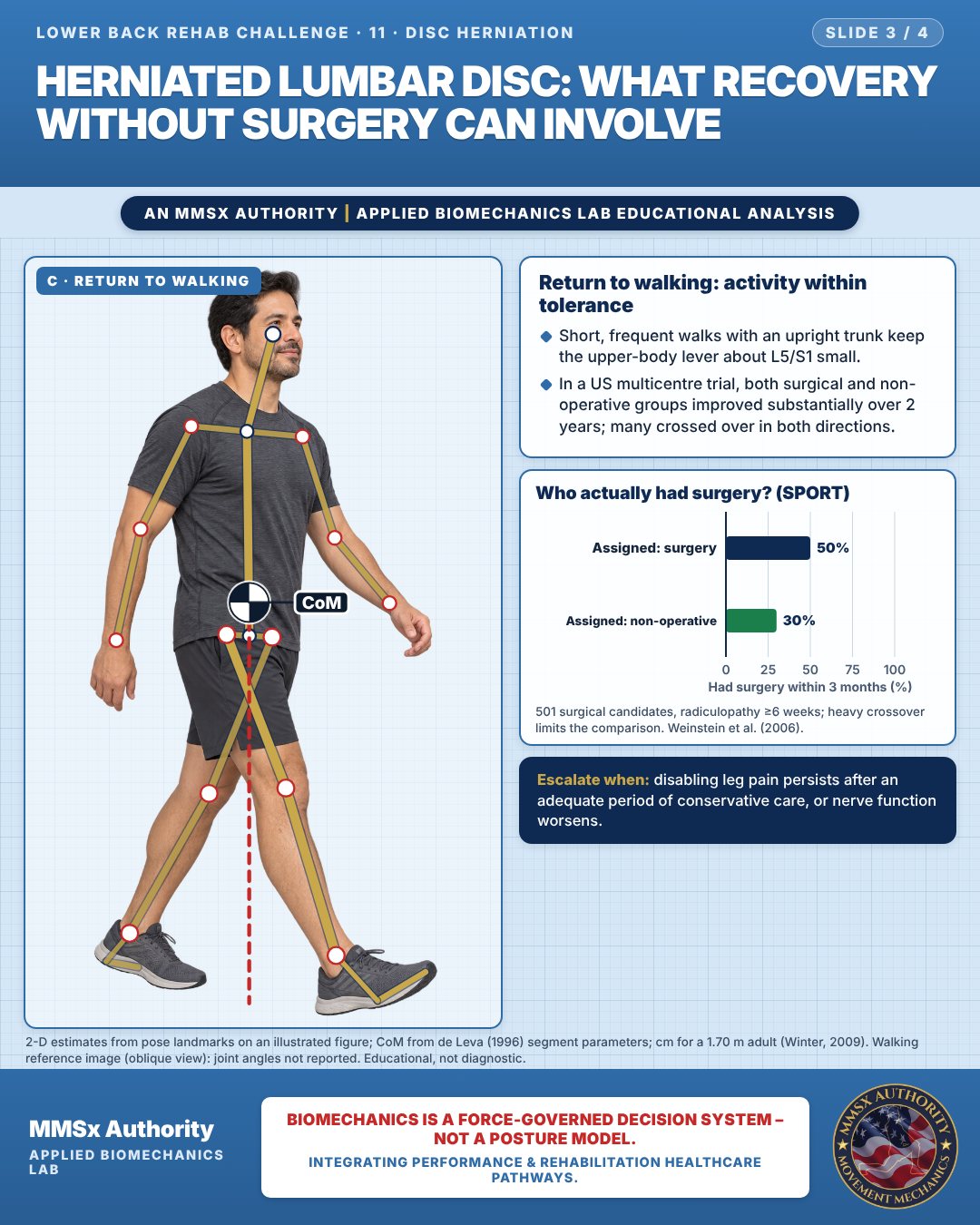
Return to walking: activity within tolerance
Short, frequent walks with an upright trunk keep the upper-body lever about L5/S1 small.
In a US multicentre trial, both surgical and non-operative groups improved substantially over 2 years; many crossed over in both directions.
Who actually had surgery? (SPORT)
Decision pathway
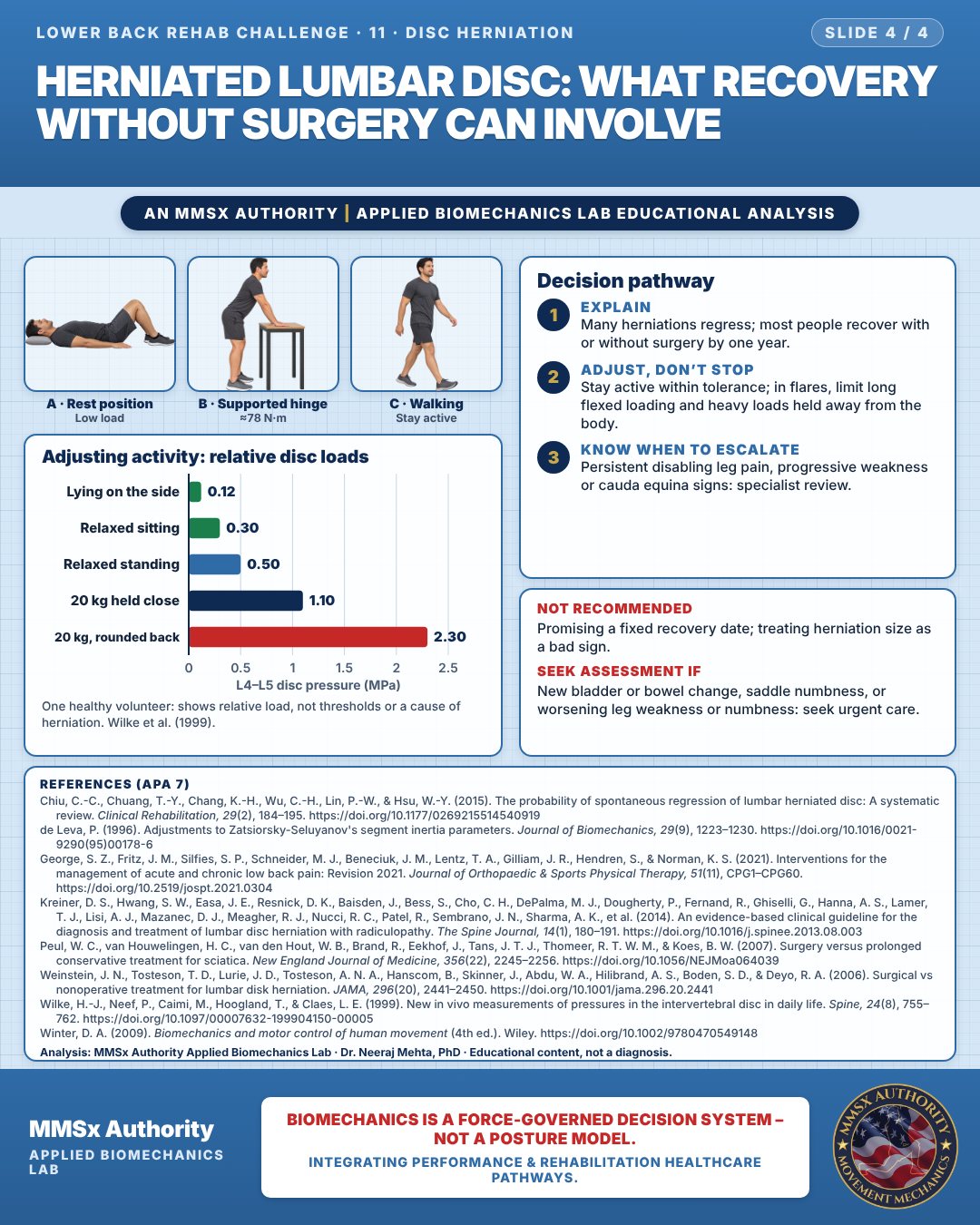
Adjusting activity: relative disc loads
Explain
Many herniations regress; most people recover with or without surgery by one year.
Adjust, don’t stop
Stay active within tolerance; in flares, limit long flexed loading and heavy loads held away from the body.
Know when to escalate
Persistent disabling leg pain, progressive weakness or cauda equina signs: specialist review.
What the evidence supports
- Conservative care is a reasonable first option for most people with disc-related sciatica without serious neurological deficit: favourable 1-year recovery with either strategy (95%) (Peul et al., 2007); substantial improvement with both surgical and non-operative care at 2 years (Weinstein et al., 2006); high regression rates for extrusions and sequestrations (Chiu et al., 2015).
- Activity adjustment: stay active within tolerance; reduce prolonged flexed loading and heavy loads held away from the body during flare-ups (relative disc loads in 11-B) (Wilke et al., 1999).
- Surgery (discectomy) is an option for persistent, disabling radicular pain where faster leg-pain relief is valued (HR 1.97 for faster perceived recovery) (Peul et al., 2007).
- Guidelines: the North American Spine Society guideline on lumbar disc herniation with radiculopathy (Kreiner et al., 2014) and the clinical practice guideline (George et al., 2021) are the reference frameworks.
Myth and evidence
Myth“A herniated disc never heals without surgery.”
Evidence70% of extrusions and 96% of sequestrations regressed spontaneously (Chiu et al., 2015); 95% perceived recovery at 1 year with prolonged conservative care (Peul et al., 2007).
Myth“Surgery gives a better long-term result for everyone.”
EvidenceNo significant difference in first-year disability (P = .13) — the gain is speed of recovery (Peul et al., 2007).
Cautions
Not recommended
Promising a fixed recovery date; treating herniation size as a bad sign.
Seek assessment if
New bladder or bowel change, saddle numbness, or worsening leg weakness or numbness: seek urgent care.
Methods note
2-D estimates from pose landmarks on an illustrated figure; CoM from de Leva (1996) segment parameters; cm for a 1.70 m adult (Winter, 2009). Low-back lever: upper-body CoM to an L5/S1 estimate; moment = upper-body weight × lever for a 70 kg adult, static, no hand load. Walking reference image (oblique view): joint angles not reported. These are educational estimates, not a diagnosis.
References
- Chiu, C.-C., Chuang, T.-Y., Chang, K.-H., Wu, C.-H., Lin, P.-W., & Hsu, W.-Y. (2015). The probability of spontaneous regression of lumbar herniated disc: A systematic review. Clinical Rehabilitation, 29(2), 184–195. https://doi.org/10.1177/0269215514540919
- de Leva, P. (1996). Adjustments to Zatsiorsky-Seluyanov's segment inertia parameters. Journal of Biomechanics, 29(9), 1223–1230. https://doi.org/10.1016/0021-9290(95)00178-6
- George, S. Z., Fritz, J. M., Silfies, S. P., Schneider, M. J., Beneciuk, J. M., Lentz, T. A., Gilliam, J. R., Hendren, S., & Norman, K. S. (2021). Interventions for the management of acute and chronic low back pain: Revision 2021. Journal of Orthopaedic & Sports Physical Therapy, 51(11), CPG1–CPG60. https://doi.org/10.2519/jospt.2021.0304
- Kreiner, D. S., Hwang, S. W., Easa, J. E., Resnick, D. K., Baisden, J., Bess, S., Cho, C. H., DePalma, M. J., Dougherty, P., Fernand, R., Ghiselli, G., Hanna, A. S., Lamer, T. J., Lisi, A. J., Mazanec, D. J., Meagher, R. J., Nucci, R. C., Patel, R., Sembrano, J. N., Sharma, A. K., et al. (2014). An evidence-based clinical guideline for the diagnosis and treatment of lumbar disc herniation with radiculopathy. The Spine Journal, 14(1), 180–191. https://doi.org/10.1016/j.spinee.2013.08.003
- Peul, W. C., van Houwelingen, H. C., van den Hout, W. B., Brand, R., Eekhof, J., Tans, J. T. J., Thomeer, R. T. W. M., & Koes, B. W. (2007). Surgery versus prolonged conservative treatment for sciatica. New England Journal of Medicine, 356(22), 2245–2256. https://doi.org/10.1056/NEJMoa064039
- Weinstein, J. N., Tosteson, T. D., Lurie, J. D., Tosteson, A. N. A., Hanscom, B., Skinner, J., Abdu, W. A., Hilibrand, A. S., Boden, S. D., & Deyo, R. A. (2006). Surgical vs nonoperative treatment for lumbar disk herniation. JAMA, 296(20), 2441–2450. https://doi.org/10.1001/jama.296.20.2441
- Wilke, H.-J., Neef, P., Caimi, M., Hoogland, T., & Claes, L. E. (1999). New in vivo measurements of pressures in the intervertebral disc in daily life. Spine, 24(8), 755–762. https://doi.org/10.1097/00007632-199904150-00005
- Winter, D. A. (2009). Biomechanics and motor control of human movement (4th ed.). Wiley. https://doi.org/10.1002/9780470549148
Cite this article
Mehta, N. (2026, October 23). Herniated lumbar disc: what recovery without surgery can involve. MMSx Authority Applied Biomechanics Lab. https://mmsxauthority.org/edu/analysis/lower-back/11-herniated-lumbar-disc-what-recovery-without-surgery-can-involve/
Part of the collection
Mehta, N. (2026). Lower Back Rehabilitation: 50 Evidence-Based Biomechanics Analyses [Collection]. MMSx Authority Applied Biomechanics Lab. Zenodo. https://doi.org/10.5281/zenodo.23735778
All Lower Back Rehab Challenge articles · Rehabilitation Library