Lower Back Rehab Challenge · 09
Lower back pain at night: sleep comfort and symptoms worth checking
Night-time low back pain ranges from position-related discomfort when turning or after lying in one position (common in mechanical LBP and eased by…
Key points
- Comfort first. Experiment with supported positions and position changes; stay active by day; avoid bed rest.
- Address sleep. Poor sleep goes with more next-day pain: treat sleep as part of the plan.
- Check the pattern. Constant, position-independent pain with other warning features needs prompt review.
What it is
Night-time low back pain ranges from position-related discomfort when turning or after lying in one position (common in mechanical LBP and eased by changing position) to constant, unremitting pain at night that is not relieved by any position and is accompanied by other warning features (e.g., history of cancer, unexplained weight loss, fever, older age), which needs medical evaluation.
How we analysed the movement
Three movements relevant to this topic were analysed from illustrated reference figures. Joint centres were located with two-dimensional pose estimation; joint angles, the whole-body centre of mass and, where relevant, the low-back lever (the horizontal distance from the upper-body centre of mass to the L5/S1 joint) were then calculated from standard segment parameters. The figures are educational estimates that show how position changes mechanical demand; they are not measurements of a patient. Every research value quoted below comes from the published source cited beside it.
Movement A: Side-lying with pillow
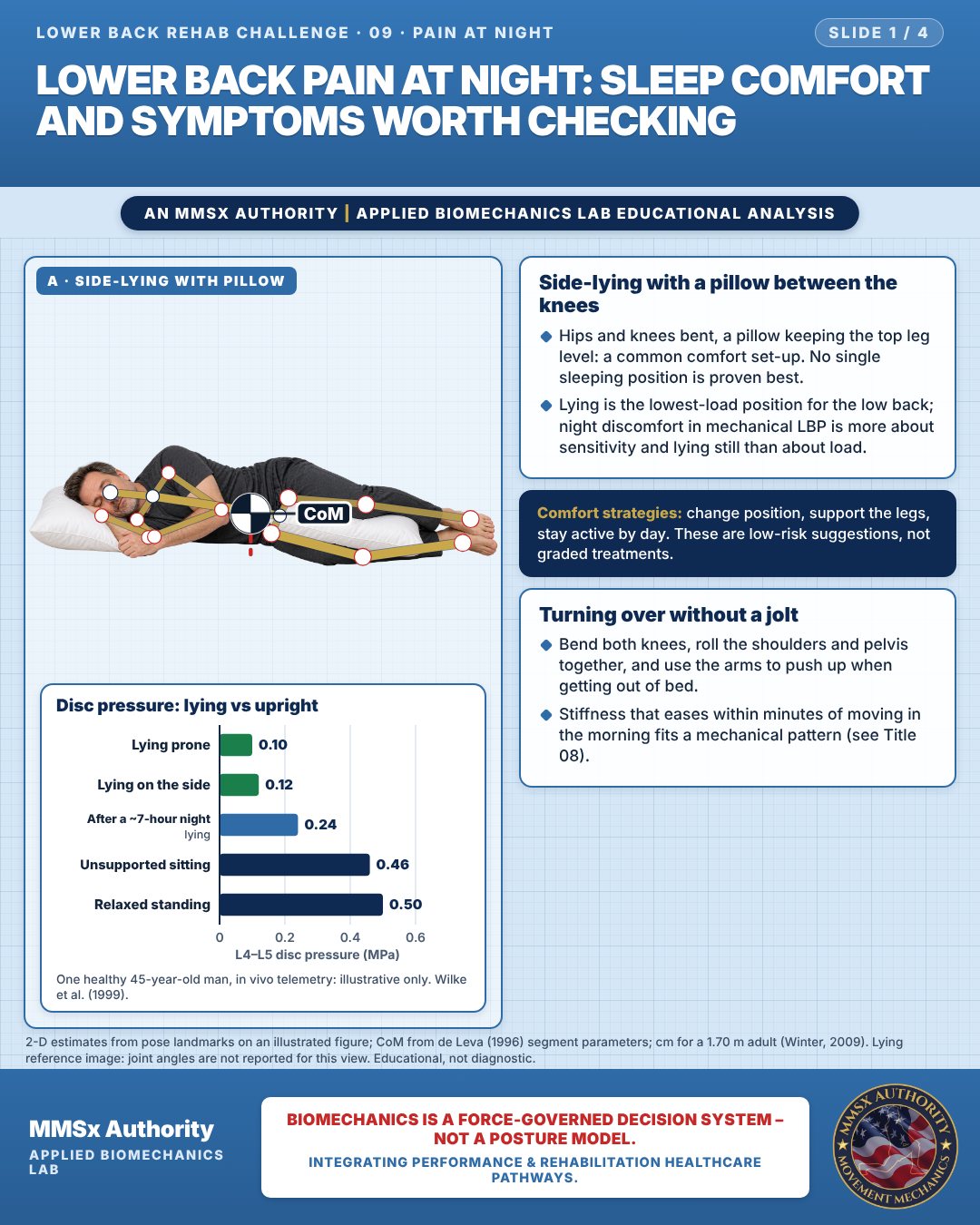
Disc pressure: lying vs upright
Side-lying with a pillow between the knees
Hips and knees bent, a pillow keeping the top leg level: a common comfort set-up. No single sleeping position is proven best.
Lying is the lowest-load position for the low back; night discomfort in mechanical LBP is more about sensitivity and lying still than about load.
Turning over without a jolt
Bend both knees, roll the shoulders and pelvis together, and use the arms to push up when getting out of bed.
Stiffness that eases within minutes of moving in the morning fits a mechanical pattern (see Title 08).
Movement B: On the back, knees supported
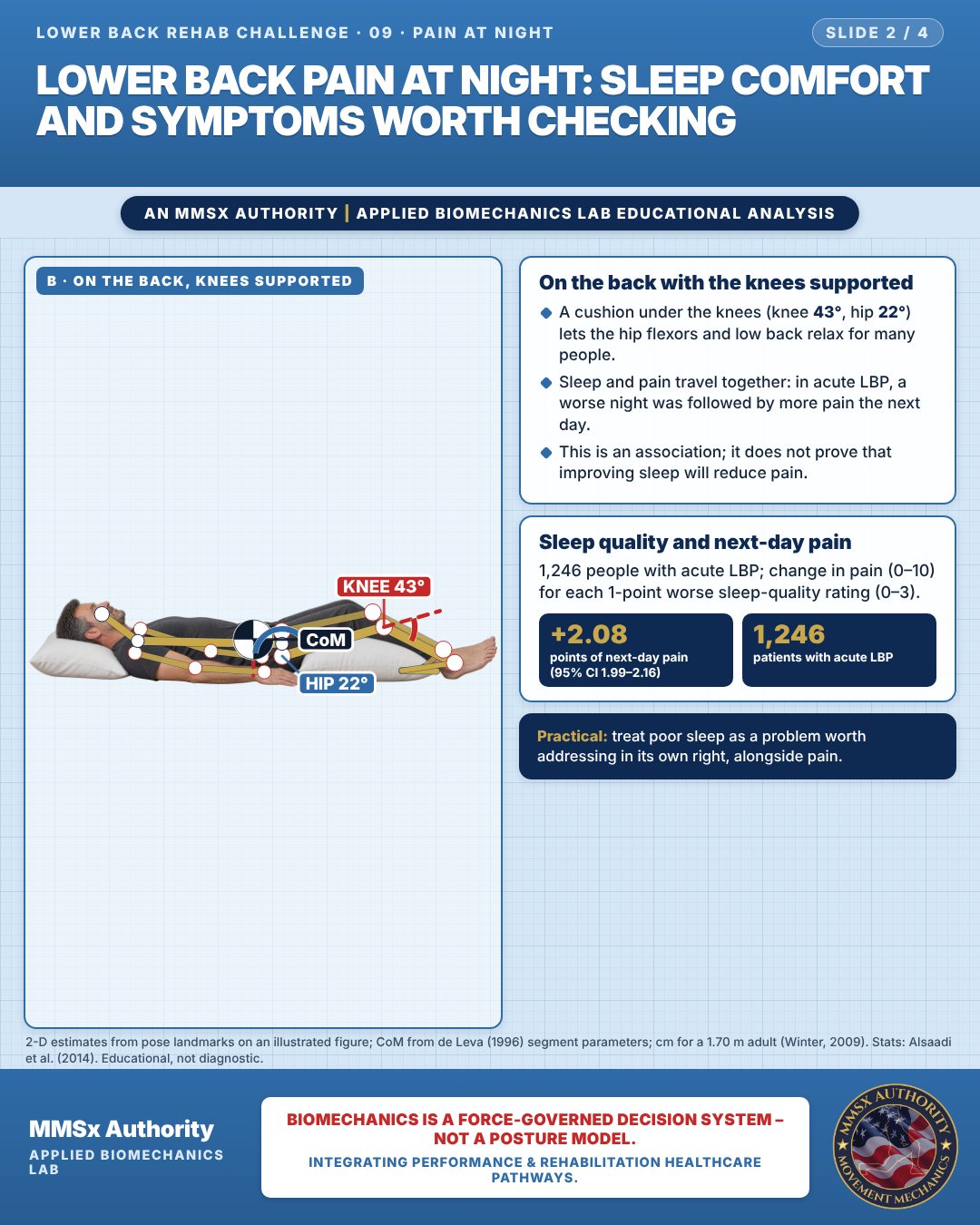
On the back with the knees supported
A cushion under the knees (knee 43°, hip 22°) lets the hip flexors and low back relax for many people.
Sleep and pain travel together: in acute LBP, a worse night was followed by more pain the next day.
This is an association; it does not prove that improving sleep will reduce pain.
Sleep quality and next-day pain
1,246 people with acute LBP; change in pain (0–10) for each 1-point worse sleep-quality rating (0–3).
Movement C: Reviewing symptoms, seated
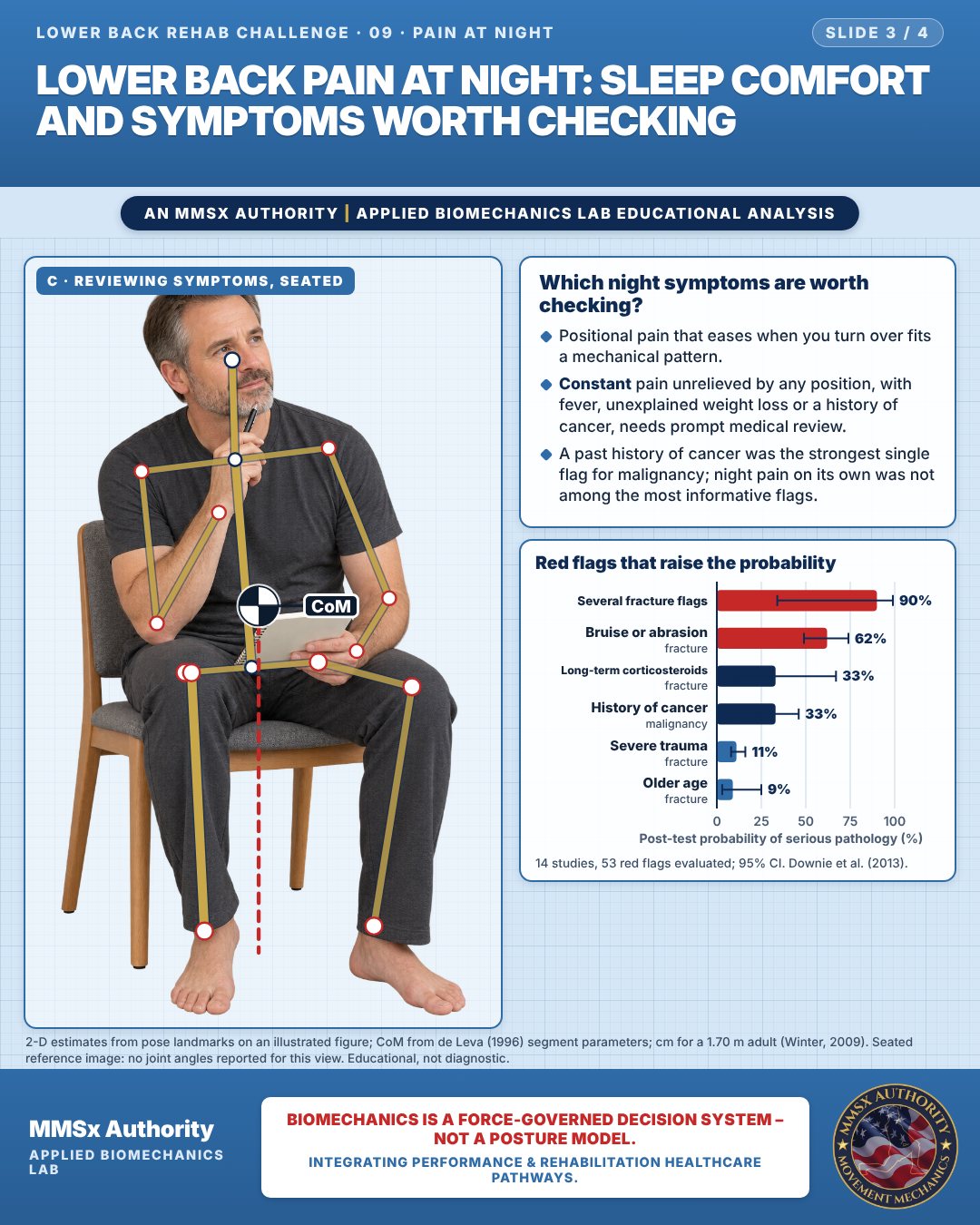
Which night symptoms are worth checking?
Positional pain that eases when you turn over fits a mechanical pattern.
Constant pain unrelieved by any position, with fever, unexplained weight loss or a history of cancer, needs prompt medical review.
A past history of cancer was the strongest single flag for malignancy; night pain on its own was not among the most informative flags.
Red flags that raise the probability
Decision pathway
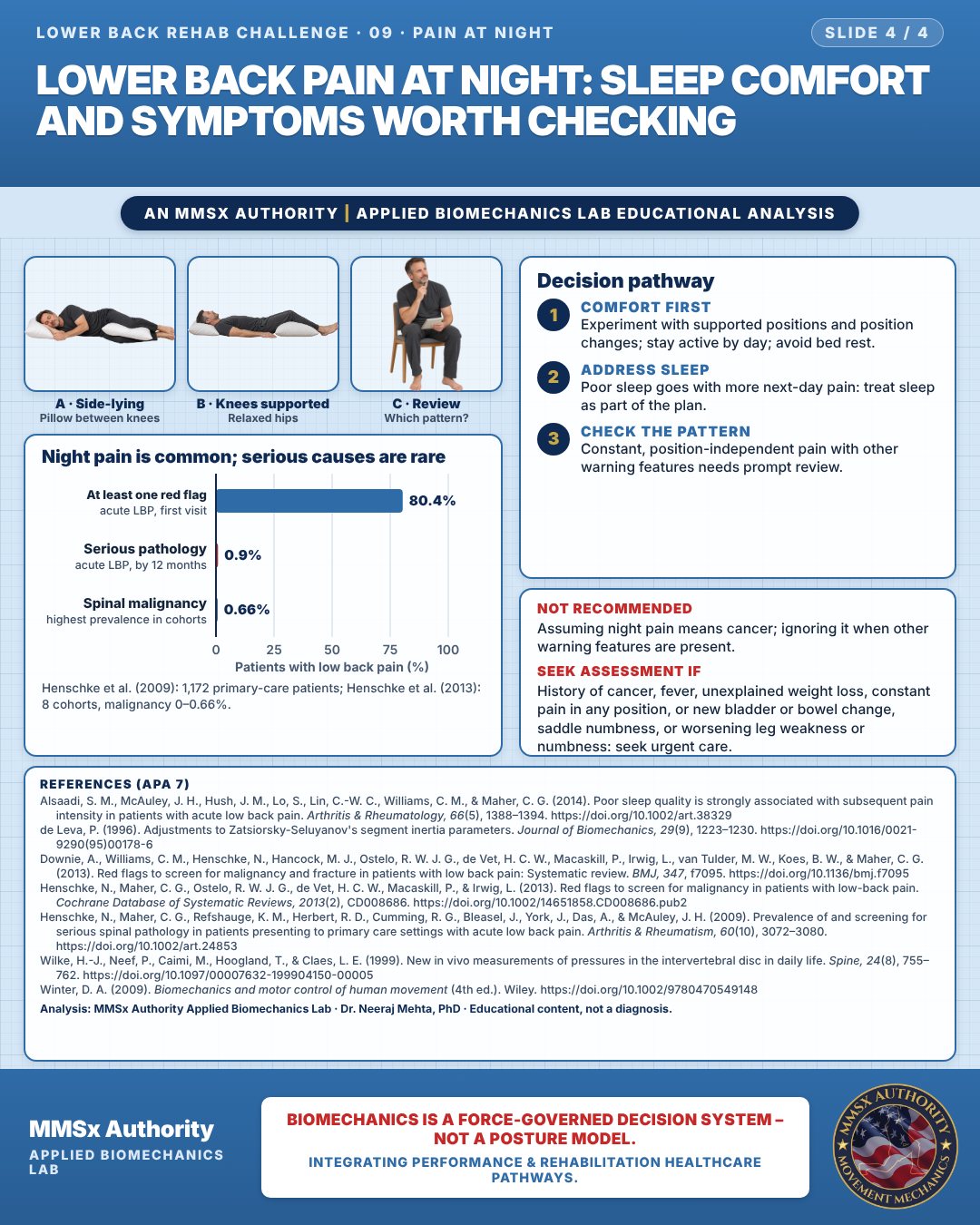
Night pain is common; serious causes are rare
Comfort first
Experiment with supported positions and position changes; stay active by day; avoid bed rest.
Address sleep
Poor sleep goes with more next-day pain: treat sleep as part of the plan.
Check the pattern
Constant, position-independent pain with other warning features needs prompt review.
What the evidence supports
- Address sleep alongside pain, because poor sleep quality is associated with higher subsequent pain. (Alsaadi et al., 2014)
Myth and evidence
Myth“Back pain at night always means cancer.”
EvidenceSpinal malignancy prevalence was 0–0.66% in LBP cohorts, and history of malignancy — not night pain alone — carried the highest post-test probability. (Henschke et al., 2013; Downie et al., 2013)
Cautions
Not recommended
Assuming night pain means cancer; ignoring it when other warning features are present.
Seek assessment if
History of cancer, fever, unexplained weight loss, constant pain in any position, or new bladder or bowel change, saddle numbness, or worsening leg weakness or numbness: seek urgent care.
Methods note
2-D estimates from pose landmarks on an illustrated figure; CoM from de Leva (1996) segment parameters; cm for a 1.70 m adult (Winter, 2009). Lying reference image: joint angles are not reported for this view. Stats: Alsaadi et al. (2014). Seated reference image: no joint angles reported for this view. These are educational estimates, not a diagnosis.
References
- Alsaadi, S. M., McAuley, J. H., Hush, J. M., Lo, S., Lin, C.-W. C., Williams, C. M., & Maher, C. G. (2014). Poor sleep quality is strongly associated with subsequent pain intensity in patients with acute low back pain. Arthritis & Rheumatology, 66(5), 1388–1394. https://doi.org/10.1002/art.38329
- de Leva, P. (1996). Adjustments to Zatsiorsky-Seluyanov's segment inertia parameters. Journal of Biomechanics, 29(9), 1223–1230. https://doi.org/10.1016/0021-9290(95)00178-6
- Downie, A., Williams, C. M., Henschke, N., Hancock, M. J., Ostelo, R. W. J. G., de Vet, H. C. W., Macaskill, P., Irwig, L., van Tulder, M. W., Koes, B. W., & Maher, C. G. (2013). Red flags to screen for malignancy and fracture in patients with low back pain: Systematic review. BMJ, 347, f7095. https://doi.org/10.1136/bmj.f7095
- Henschke, N., Maher, C. G., Ostelo, R. W. J. G., de Vet, H. C. W., Macaskill, P., & Irwig, L. (2013). Red flags to screen for malignancy in patients with low-back pain. Cochrane Database of Systematic Reviews, 2013(2), CD008686. https://doi.org/10.1002/14651858.CD008686.pub2
- Henschke, N., Maher, C. G., Refshauge, K. M., Herbert, R. D., Cumming, R. G., Bleasel, J., York, J., Das, A., & McAuley, J. H. (2009). Prevalence of and screening for serious spinal pathology in patients presenting to primary care settings with acute low back pain. Arthritis & Rheumatism, 60(10), 3072–3080. https://doi.org/10.1002/art.24853
- Wilke, H.-J., Neef, P., Caimi, M., Hoogland, T., & Claes, L. E. (1999). New in vivo measurements of pressures in the intervertebral disc in daily life. Spine, 24(8), 755–762. https://doi.org/10.1097/00007632-199904150-00005
- Winter, D. A. (2009). Biomechanics and motor control of human movement (4th ed.). Wiley. https://doi.org/10.1002/9780470549148
Cite this article
Mehta, N. (2026, October 23). Lower back pain at night: sleep comfort and symptoms worth checking. MMSx Authority Applied Biomechanics Lab. https://mmsxauthority.org/edu/analysis/lower-back/09-lower-back-pain-at-night-sleep-comfort-and-symptoms-worth-checking/
Part of the collection
Mehta, N. (2026). Lower Back Rehabilitation: 50 Evidence-Based Biomechanics Analyses [Collection]. MMSx Authority Applied Biomechanics Lab. Zenodo. https://doi.org/10.5281/zenodo.23735778
All Lower Back Rehab Challenge articles · Rehabilitation Library