Lower Back Rehab Challenge · 08
Morning lower back stiffness: what your symptom pattern can tell you
Morning low back stiffness is a sensation of restricted, effortful spinal movement on waking.
Key points
- Time it. Minutes and easing with movement fits a mechanical pattern; over 30 minutes is a cue to look further.
- Look for the pattern. Under ~45 with pain over 3 months, better with exercise not rest, second-half-of-night waking: think inflammatory.
- Refer when it fits. 2–3 features, family history or a strong NSAID response: ask for rheumatology assessment.
What it is
Morning low back stiffness is a sensation of restricted, effortful spinal movement on waking. Short-lived stiffness (minutes) that eases quickly with movement is common in mechanical (non-specific) LBP; stiffness lasting more than 30 minutes, improving with exercise but not with rest, with night waking in the second half of the night, in a person who developed chronic back pain before about age 45, suggests inflammatory back pain and warrants assessment for axial spondyloarthritis (axSpA).
How we analysed the movement
Three movements relevant to this topic were analysed from illustrated reference figures. Joint centres were located with two-dimensional pose estimation; joint angles, the whole-body centre of mass and, where relevant, the low-back lever (the horizontal distance from the upper-body centre of mass to the L5/S1 joint) were then calculated from standard segment parameters. The figures are educational estimates that show how position changes mechanical demand; they are not measurements of a patient. Every research value quoted below comes from the published source cited beside it.
Movement A: Stiff on waking, seated
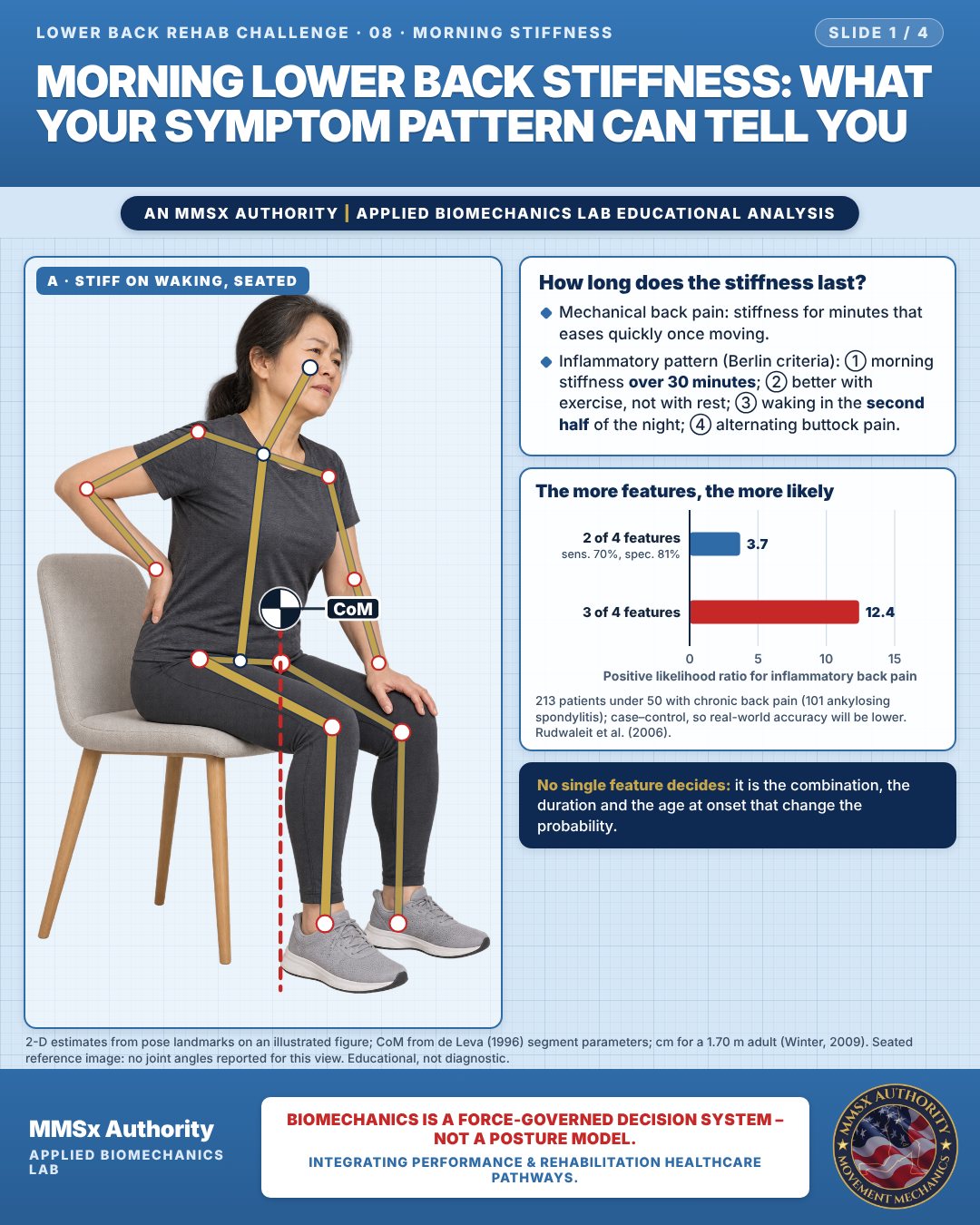
How long does the stiffness last?
Mechanical back pain: stiffness for minutes that eases quickly once moving.
Inflammatory pattern (Berlin criteria): ① morning stiffness over 30 minutes; ② better with exercise, not with rest; ③ waking in the second half of the night; ④ alternating buttock pain.
The more features, the more likely
Movement B: Pelvic tilts (side view)
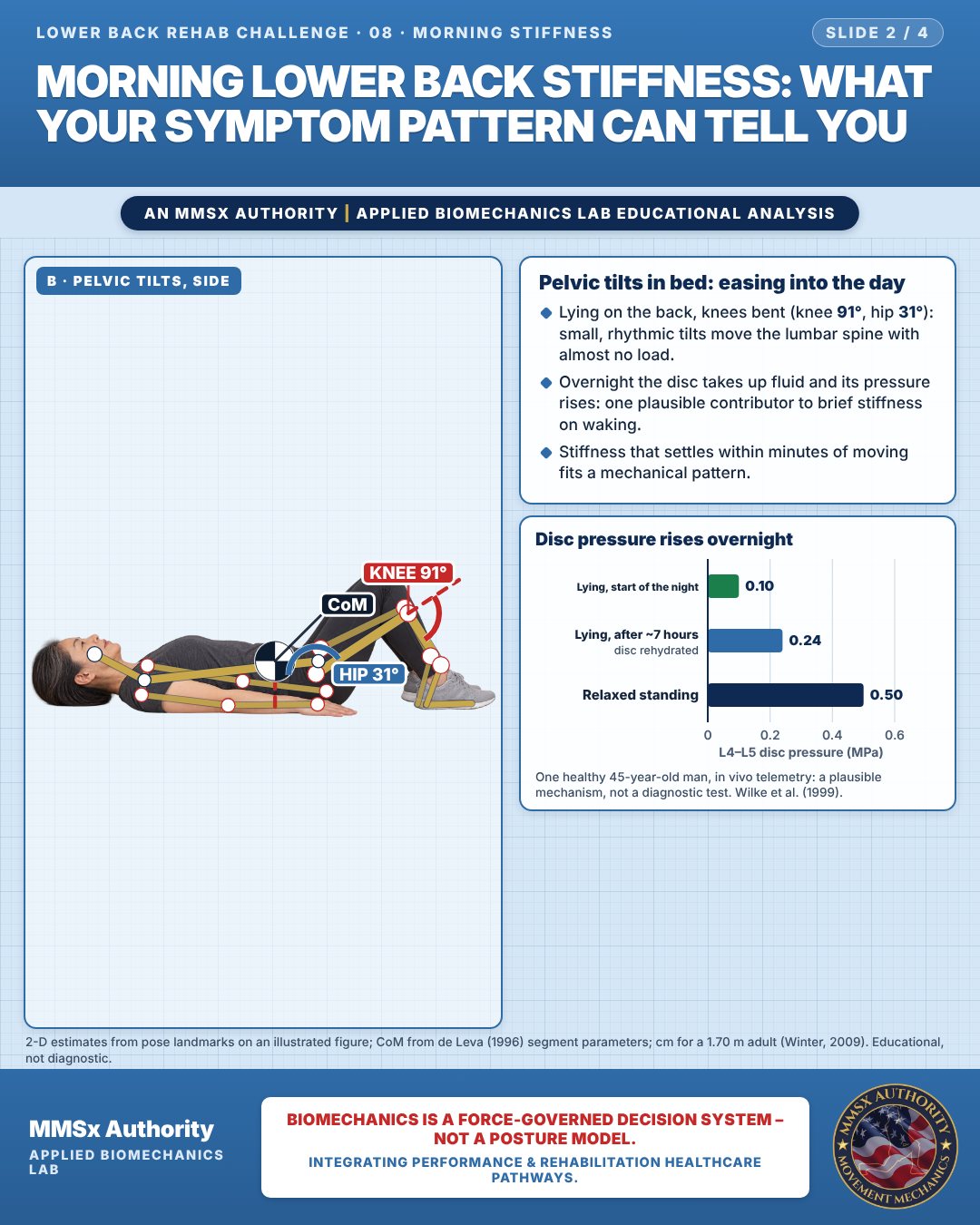
Pelvic tilts in bed: easing into the day
Lying on the back, knees bent (knee 91°, hip 31°): small, rhythmic tilts move the lumbar spine with almost no load.
Overnight the disc takes up fluid and its pressure rises: one plausible contributor to brief stiffness on waking.
Stiffness that settles within minutes of moving fits a mechanical pattern.
Disc pressure rises overnight
Movement C: Easy standing reach (front view)
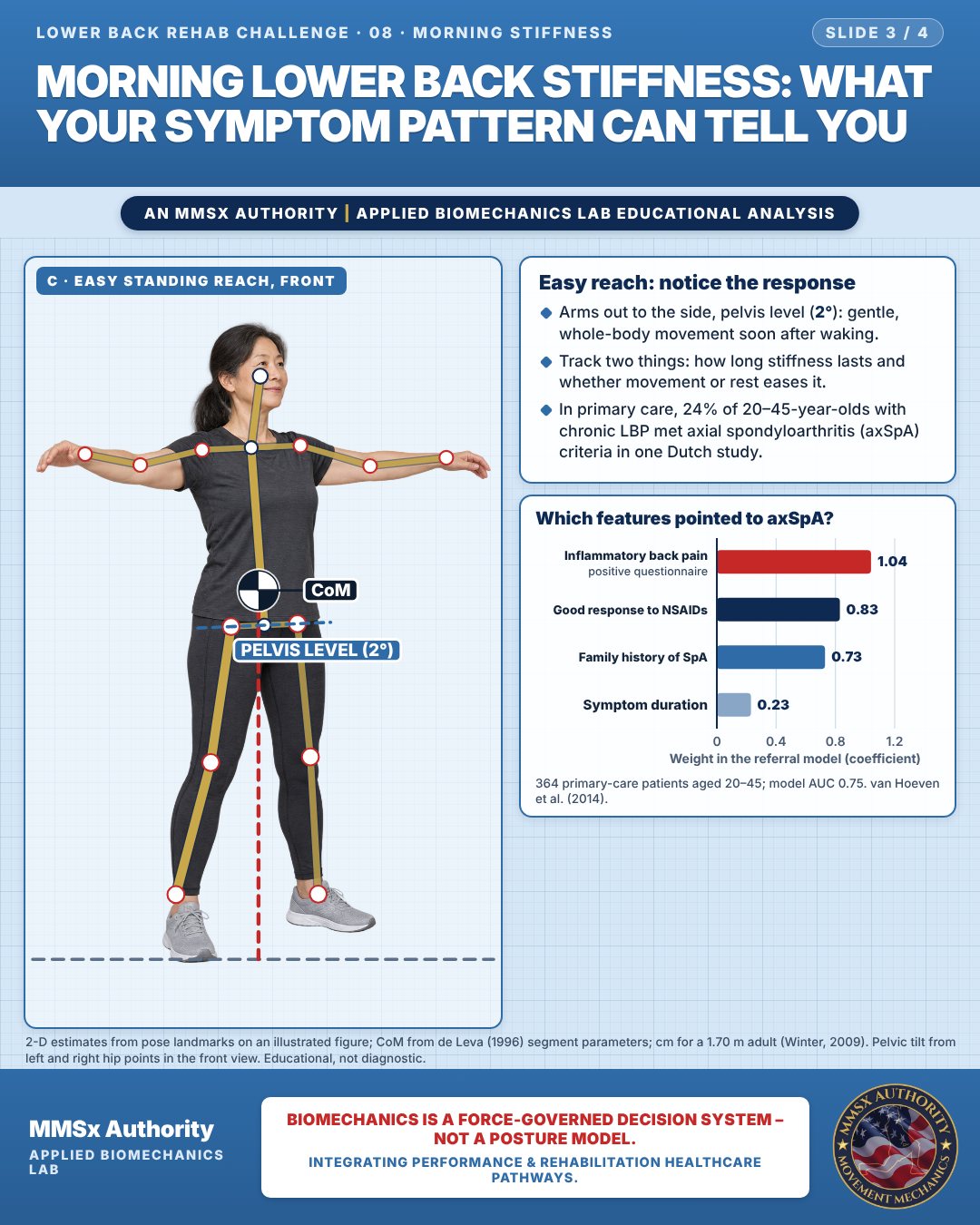
Easy reach: notice the response
Arms out to the side, pelvis level (2°): gentle, whole-body movement soon after waking.
Track two things: how long stiffness lasts and whether movement or rest eases it.
In primary care, 24% of 20–45-year-olds with chronic LBP met axial spondyloarthritis (axSpA) criteria in one Dutch study.
Which features pointed to axSpA?
Decision pathway
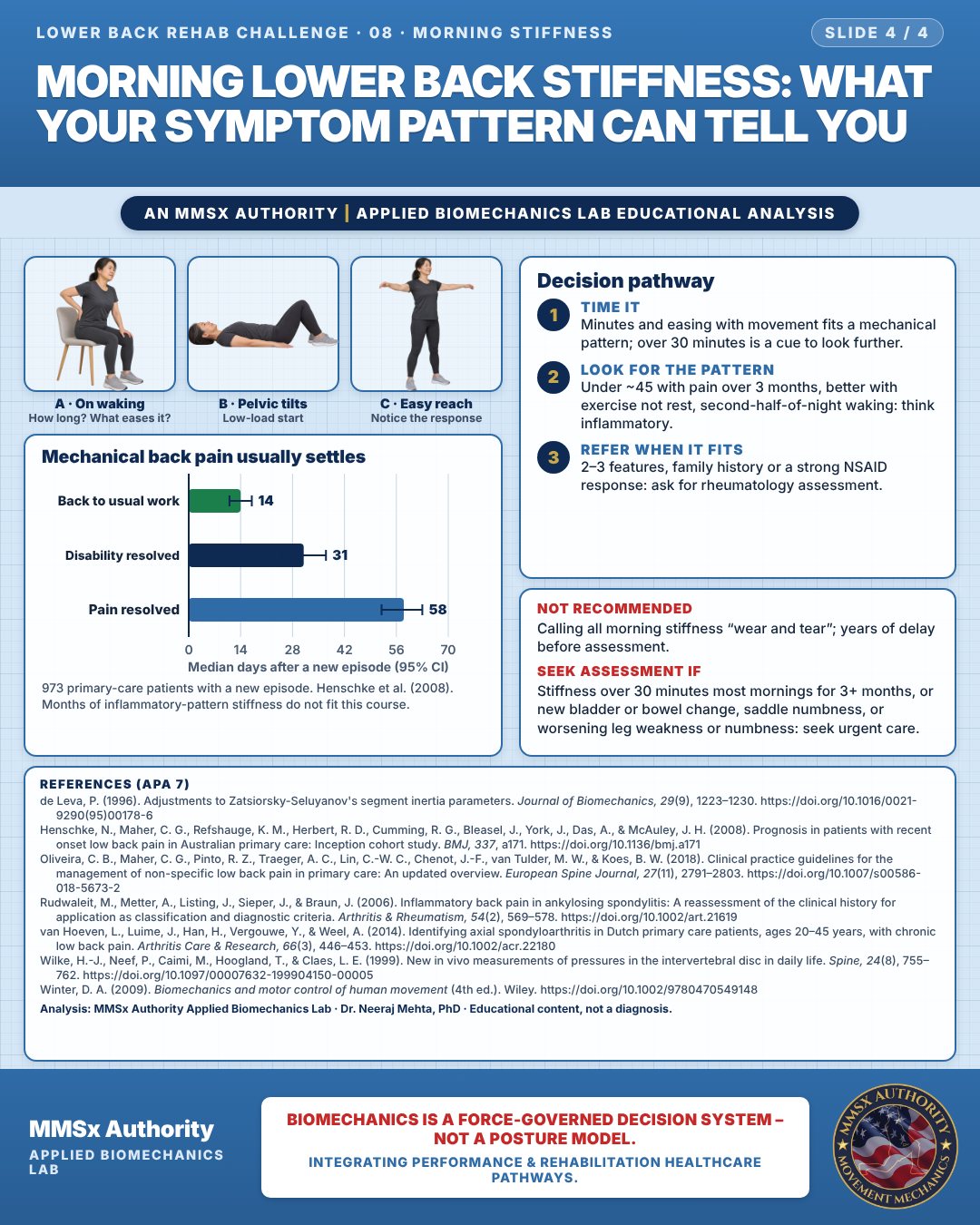
Mechanical back pain usually settles
Time it
Minutes and easing with movement fits a mechanical pattern; over 30 minutes is a cue to look further.
Look for the pattern
Under ~45 with pain over 3 months, better with exercise not rest, second-half-of-night waking: think inflammatory.
Refer when it fits
2–3 features, family history or a strong NSAID response: ask for rheumatology assessment.
What the evidence supports
- Guidelines recommend referral when a specific pathology is suspected. (Oliveira et al., 2018)
Myth and evidence
Myth“All morning stiffness is just wear and tear.”
EvidenceAmong younger primary-care patients with chronic LBP, about 1 in 4 met axSpA criteria in one Dutch study. [van Hoeven et al., 2014]
Myth“Morning stiffness alone means arthritis of the spine.”
EvidenceNo single feature separated AS from mechanical LBP; the combination and duration matter (LR+ 3.7 for ≥2 features, 12.4 for ≥3). (Rudwaleit et al., 2006)
Cautions
Not recommended
Calling all morning stiffness “wear and tear”; years of delay before assessment.
Seek assessment if
Stiffness over 30 minutes most mornings for 3+ months, or new bladder or bowel change, saddle numbness, or worsening leg weakness or numbness: seek urgent care.
Methods note
2-D estimates from pose landmarks on an illustrated figure; CoM from de Leva (1996) segment parameters; cm for a 1.70 m adult (Winter, 2009). Seated reference image: no joint angles reported for this view. Pelvic tilt from left and right hip points in the front view. These are educational estimates, not a diagnosis.
References
- de Leva, P. (1996). Adjustments to Zatsiorsky-Seluyanov's segment inertia parameters. Journal of Biomechanics, 29(9), 1223–1230. https://doi.org/10.1016/0021-9290(95)00178-6
- Henschke, N., Maher, C. G., Refshauge, K. M., Herbert, R. D., Cumming, R. G., Bleasel, J., York, J., Das, A., & McAuley, J. H. (2008). Prognosis in patients with recent onset low back pain in Australian primary care: Inception cohort study. BMJ, 337, a171. https://doi.org/10.1136/bmj.a171
- Oliveira, C. B., Maher, C. G., Pinto, R. Z., Traeger, A. C., Lin, C.-W. C., Chenot, J.-F., van Tulder, M. W., & Koes, B. W. (2018). Clinical practice guidelines for the management of non-specific low back pain in primary care: An updated overview. European Spine Journal, 27(11), 2791–2803. https://doi.org/10.1007/s00586-018-5673-2
- Rudwaleit, M., Metter, A., Listing, J., Sieper, J., & Braun, J. (2006). Inflammatory back pain in ankylosing spondylitis: A reassessment of the clinical history for application as classification and diagnostic criteria. Arthritis & Rheumatism, 54(2), 569–578. https://doi.org/10.1002/art.21619
- van Hoeven, L., Luime, J., Han, H., Vergouwe, Y., & Weel, A. (2014). Identifying axial spondyloarthritis in Dutch primary care patients, ages 20–45 years, with chronic low back pain. Arthritis Care & Research, 66(3), 446–453. https://doi.org/10.1002/acr.22180
- Wilke, H.-J., Neef, P., Caimi, M., Hoogland, T., & Claes, L. E. (1999). New in vivo measurements of pressures in the intervertebral disc in daily life. Spine, 24(8), 755–762. https://doi.org/10.1097/00007632-199904150-00005
- Winter, D. A. (2009). Biomechanics and motor control of human movement (4th ed.). Wiley. https://doi.org/10.1002/9780470549148
Cite this article
Mehta, N. (2026, October 23). Morning lower back stiffness: what your symptom pattern can tell you. MMSx Authority Applied Biomechanics Lab. https://mmsxauthority.org/edu/analysis/lower-back/08-morning-lower-back-stiffness-what-your-symptom-pattern-can-tell-you/
Part of the collection
Mehta, N. (2026). Lower Back Rehabilitation: 50 Evidence-Based Biomechanics Analyses [Collection]. MMSx Authority Applied Biomechanics Lab. Zenodo. https://doi.org/10.5281/zenodo.23735778
All Lower Back Rehab Challenge articles · Rehabilitation Library