Lower Back Rehab Challenge · 07
Lower back pain after lifting: how to return to everyday loads
Lifting-associated low back pain is an episode whose onset the person links to lifting or handling a load.
Key points
- Assess the episode. Check for red flags and nerve signs; most lifting-related episodes are non-specific.
- Keep loads in the day. Stay active and keep working where possible; use raised start heights and close loads early.
- Progress the lift. Height lower → weight up → distance out, guided by symptoms that evening and the next day.
What it is
Lifting-associated low back pain is an episode whose onset the person links to lifting or handling a load; most such episodes are non-specific and self-limiting, and recovery is guided by triage, staying active and graded re-exposure to the loads of daily life and work rather than by load avoidance.
How we analysed the movement
Three movements relevant to this topic were analysed from illustrated reference figures. Joint centres were located with two-dimensional pose estimation; joint angles, the whole-body centre of mass and, where relevant, the low-back lever (the horizontal distance from the upper-body centre of mass to the L5/S1 joint) were then calculated from standard segment parameters. The figures are educational estimates that show how position changes mechanical demand; they are not measurements of a patient. Every research value quoted below comes from the published source cited beside it.
Movement A: Pick-up from a stool (side view)
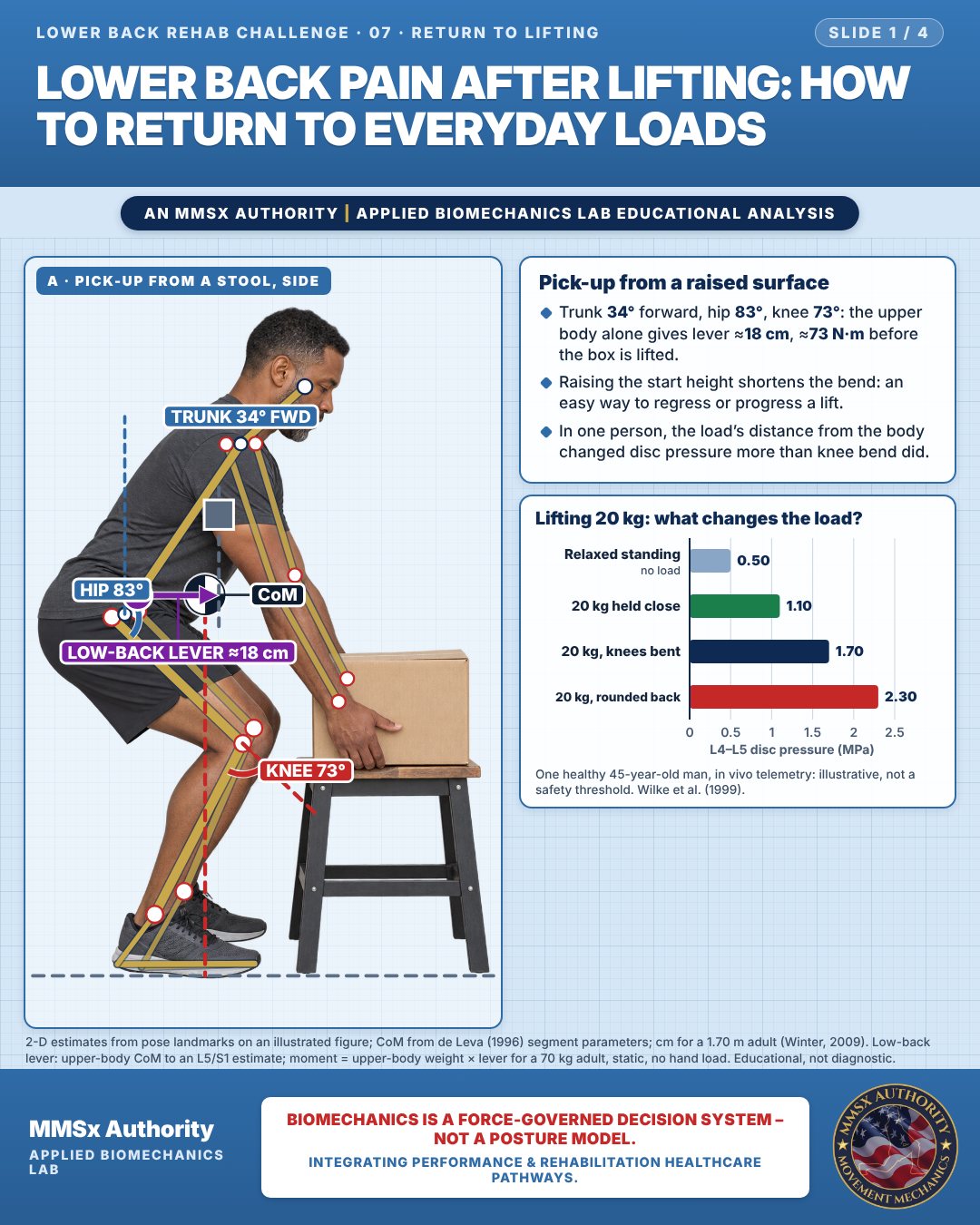
Pick-up from a raised surface
Trunk 34° forward, hip 83°, knee 73°: the upper body alone gives lever ≈18 cm, ≈73 N·m before the box is lifted.
Raising the start height shortens the bend: an easy way to regress or progress a lift.
In one person, the load’s distance from the body changed disc pressure more than knee bend did.
Lifting 20 kg: what changes the load?
Movement B: Box held close (front view)
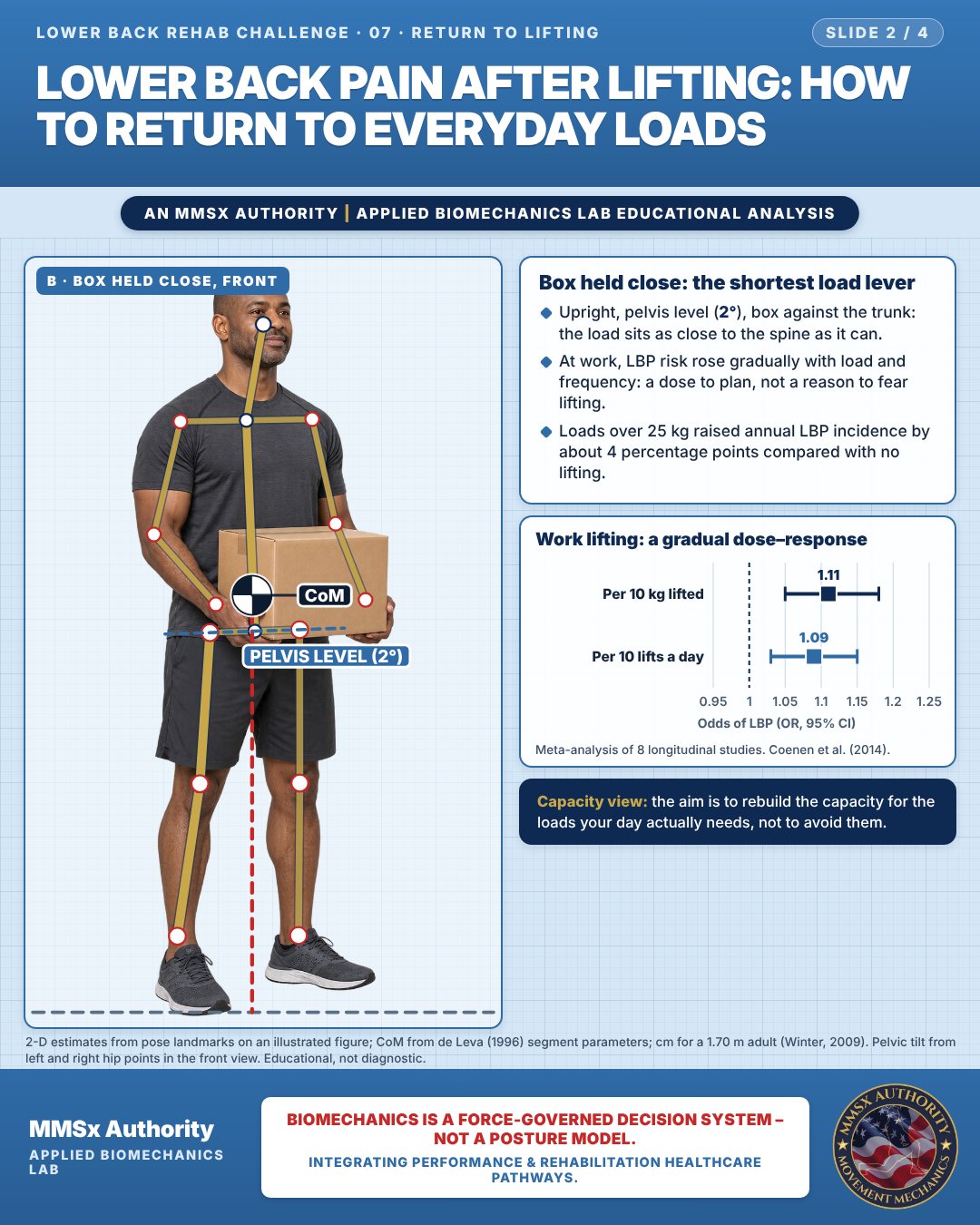
Box held close: the shortest load lever
Upright, pelvis level (2°), box against the trunk: the load sits as close to the spine as it can.
At work, LBP risk rose gradually with load and frequency: a dose to plan, not a reason to fear lifting.
Loads over 25 kg raised annual LBP incidence by about 4 percentage points compared with no lifting.
Work lifting: a gradual dose–response
Movement C: Light carry (side view)
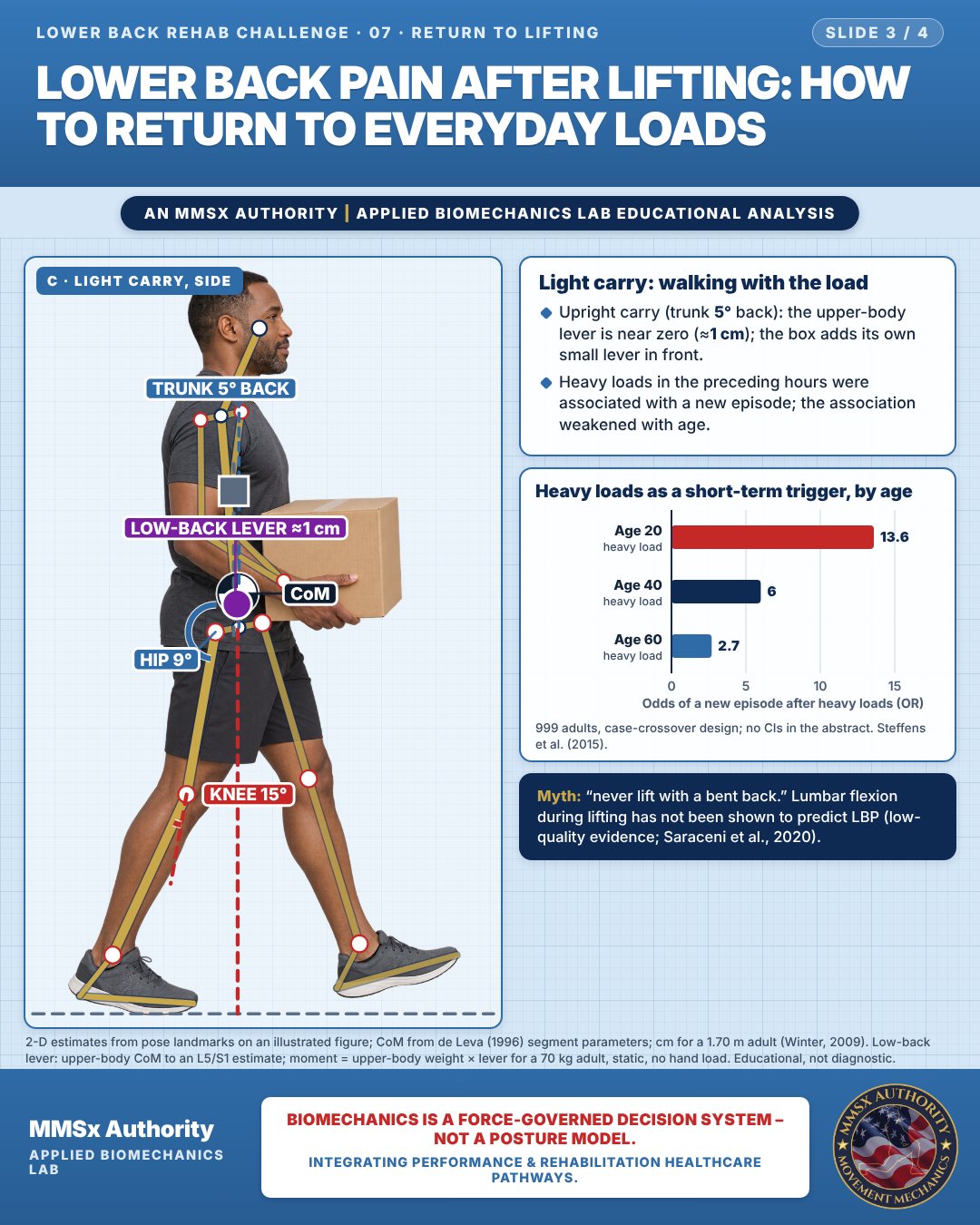
Light carry: walking with the load
Upright carry (trunk 5° back): the upper-body lever is near zero (≈1 cm); the box adds its own small lever in front.
Heavy loads in the preceding hours were associated with a new episode; the association weakened with age.
Heavy loads as a short-term trigger, by age
Decision pathway
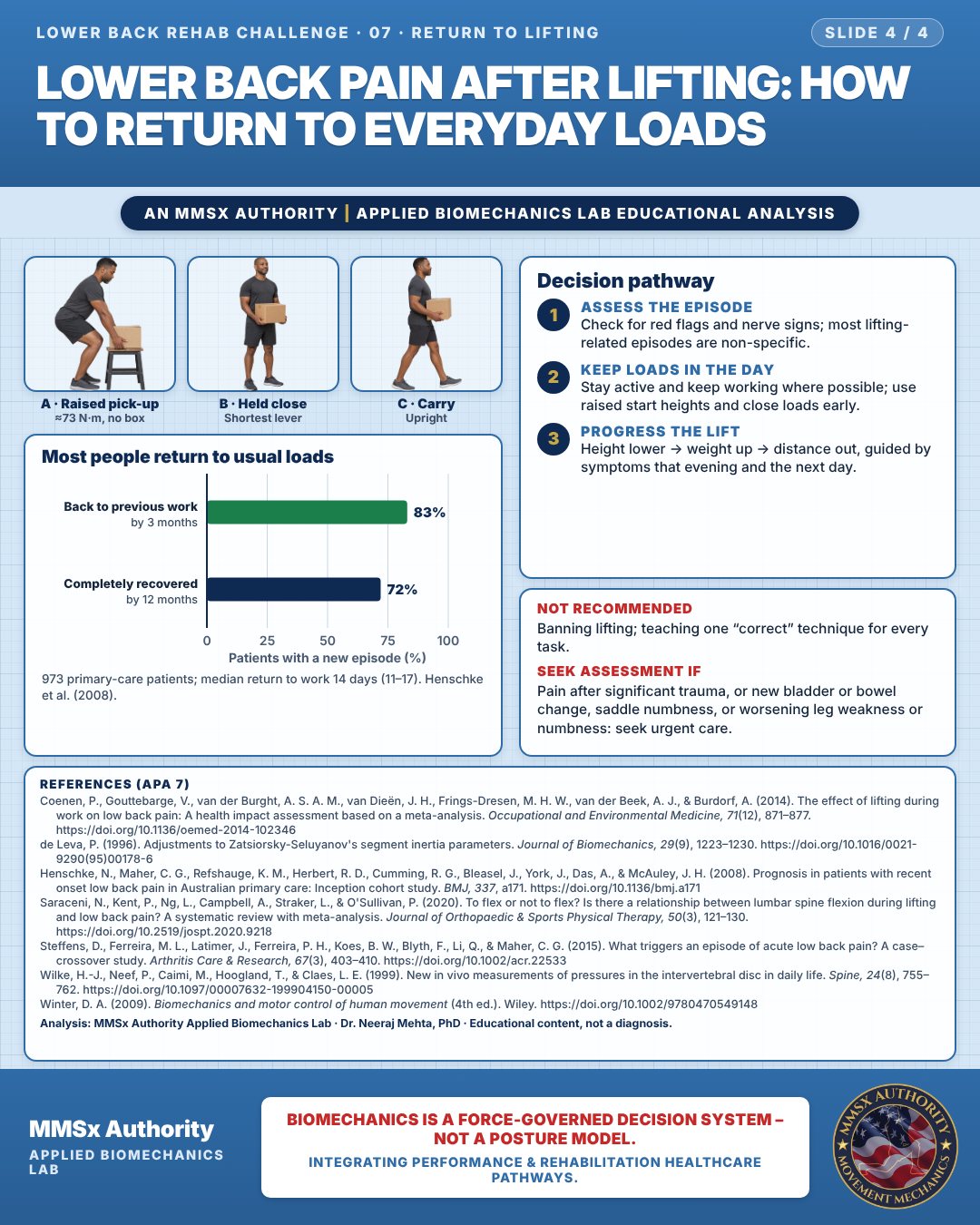
Most people return to usual loads
Assess the episode
Check for red flags and nerve signs; most lifting-related episodes are non-specific.
Keep loads in the day
Stay active and keep working where possible; use raised start heights and close loads early.
Progress the lift
Height lower → weight up → distance out, guided by symptoms that evening and the next day.
What the evidence supports
- Lifting flexion itself was not shown to be a risk factor for LBP (low-quality evidence) — coach load proximity, preparation and gradual exposure rather than one "correct" technique. (Saraceni et al., 2020; Wilke et al., 1999)
Myth and evidence
Myth“Pain after lifting means I injured my disc, so I must stop lifting.”
EvidenceHalf of people who reduced work returned to normal work within 14 days and 83% by 3 months. (Henschke et al., 2008)
Myth“Never lift with a bent back.”
EvidenceRounded-back lifting raised measured disc pressure in one participant, but lumbar flexion during lifting has not been shown to predict LBP. (Wilke et al., 1999; Saraceni et al., 2020)
Cautions
Not recommended
Banning lifting; teaching one “correct” technique for every task.
Seek assessment if
Pain after significant trauma, or new bladder or bowel change, saddle numbness, or worsening leg weakness or numbness: seek urgent care.
Methods note
2-D estimates from pose landmarks on an illustrated figure; CoM from de Leva (1996) segment parameters; cm for a 1.70 m adult (Winter, 2009). Low-back lever: upper-body CoM to an L5/S1 estimate; moment = upper-body weight × lever for a 70 kg adult, static, no hand load. Pelvic tilt from left and right hip points in the front view. These are educational estimates, not a diagnosis.
References
- Coenen, P., Gouttebarge, V., van der Burght, A. S. A. M., van Dieën, J. H., Frings-Dresen, M. H. W., van der Beek, A. J., & Burdorf, A. (2014). The effect of lifting during work on low back pain: A health impact assessment based on a meta-analysis. Occupational and Environmental Medicine, 71(12), 871–877. https://doi.org/10.1136/oemed-2014-102346
- de Leva, P. (1996). Adjustments to Zatsiorsky-Seluyanov's segment inertia parameters. Journal of Biomechanics, 29(9), 1223–1230. https://doi.org/10.1016/0021-9290(95)00178-6
- Henschke, N., Maher, C. G., Refshauge, K. M., Herbert, R. D., Cumming, R. G., Bleasel, J., York, J., Das, A., & McAuley, J. H. (2008). Prognosis in patients with recent onset low back pain in Australian primary care: Inception cohort study. BMJ, 337, a171. https://doi.org/10.1136/bmj.a171
- Saraceni, N., Kent, P., Ng, L., Campbell, A., Straker, L., & O'Sullivan, P. (2020). To flex or not to flex? Is there a relationship between lumbar spine flexion during lifting and low back pain? A systematic review with meta-analysis. Journal of Orthopaedic & Sports Physical Therapy, 50(3), 121–130. https://doi.org/10.2519/jospt.2020.9218
- Steffens, D., Ferreira, M. L., Latimer, J., Ferreira, P. H., Koes, B. W., Blyth, F., Li, Q., & Maher, C. G. (2015). What triggers an episode of acute low back pain? A case–crossover study. Arthritis Care & Research, 67(3), 403–410. https://doi.org/10.1002/acr.22533
- Wilke, H.-J., Neef, P., Caimi, M., Hoogland, T., & Claes, L. E. (1999). New in vivo measurements of pressures in the intervertebral disc in daily life. Spine, 24(8), 755–762. https://doi.org/10.1097/00007632-199904150-00005
- Winter, D. A. (2009). Biomechanics and motor control of human movement (4th ed.). Wiley. https://doi.org/10.1002/9780470549148
Cite this article
Mehta, N. (2026, October 23). Lower back pain after lifting: how to return to everyday loads. MMSx Authority Applied Biomechanics Lab. https://mmsxauthority.org/edu/analysis/lower-back/07-lower-back-pain-after-lifting-how-to-return-to-everyday-loads/
Part of the collection
Mehta, N. (2026). Lower Back Rehabilitation: 50 Evidence-Based Biomechanics Analyses [Collection]. MMSx Authority Applied Biomechanics Lab. Zenodo. https://doi.org/10.5281/zenodo.23735778
All Lower Back Rehab Challenge articles · Rehabilitation Library