Lower Back Rehab Challenge · 06
Lower back pain when bending: how to rebuild movement confidence
Bending-related (flexion-sensitive) low back pain is pain provoked by forward bending of the trunk.
Key points
- Range. Start with supported, part-range bends that feel safe; add range as the response allows.
- Repetition. Build the number of bends across the day before adding speed or weight.
- Load. Add light objects close to the body, then heavier or further away, guided by the next-day response.
What it is
Bending-related (flexion-sensitive) low back pain is pain provoked by forward bending of the trunk; in non-specific LBP it reflects current tissue and nervous-system sensitivity and movement confidence rather than proof of structural damage, and bending tolerance can usually be rebuilt by graded exposure to range, repetitions and load.
How we analysed the movement
Three movements relevant to this topic were analysed from illustrated reference figures. Joint centres were located with two-dimensional pose estimation; joint angles, the whole-body centre of mass and, where relevant, the low-back lever (the horizontal distance from the upper-body centre of mass to the L5/S1 joint) were then calculated from standard segment parameters. The figures are educational estimates that show how position changes mechanical demand; they are not measurements of a patient. Every research value quoted below comes from the published source cited beside it.
Movement A: Supported hip hinge (side view)
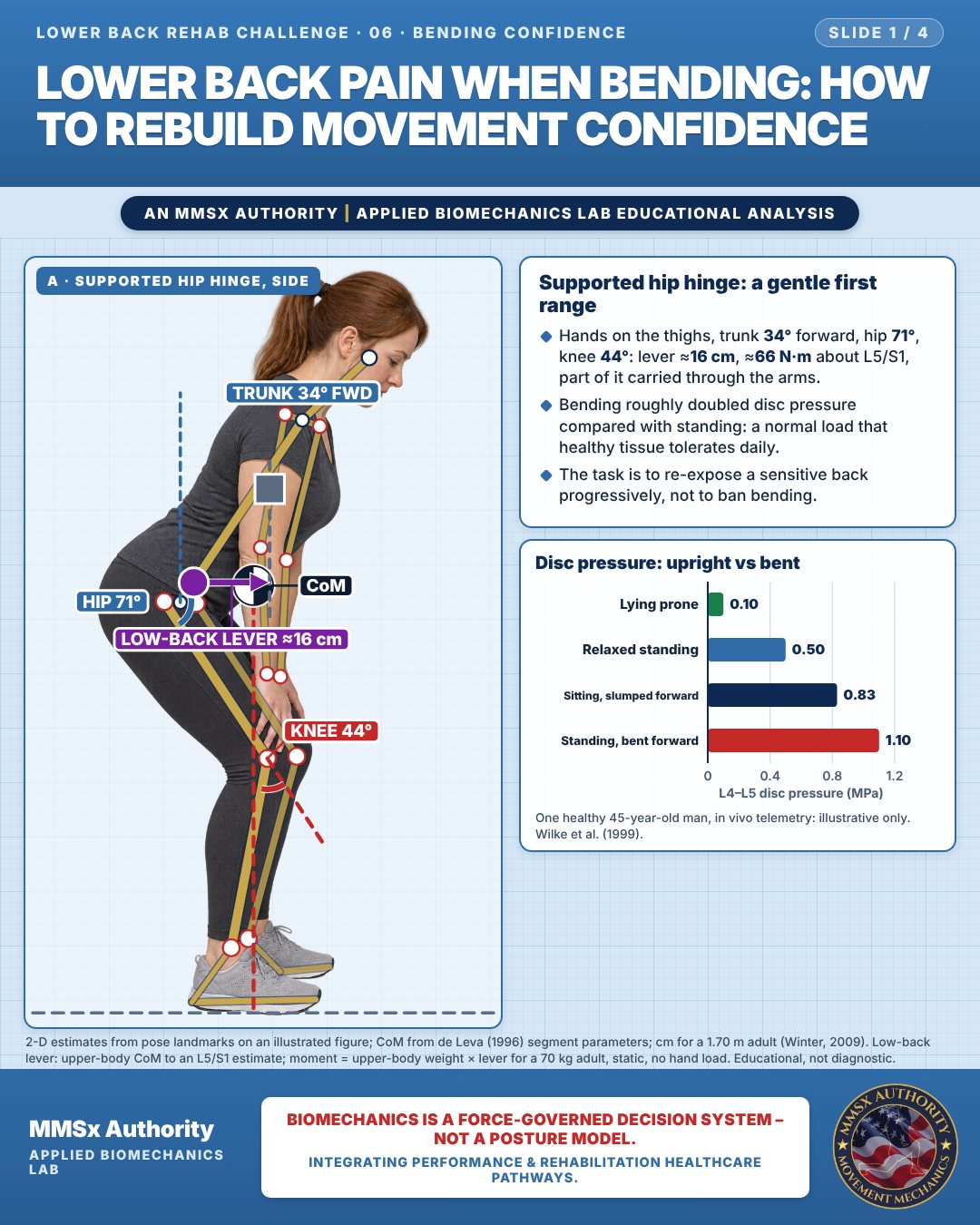
Supported hip hinge: a gentle first range
Hands on the thighs, trunk 34° forward, hip 71°, knee 44°: lever ≈16 cm, ≈66 N·m about L5/S1, part of it carried through the arms.
Bending roughly doubled disc pressure compared with standing: a normal load that healthy tissue tolerates daily.
The task is to re-expose a sensitive back progressively, not to ban bending.
Disc pressure: upright vs bent
Movement B: Reach to a stool (side view)
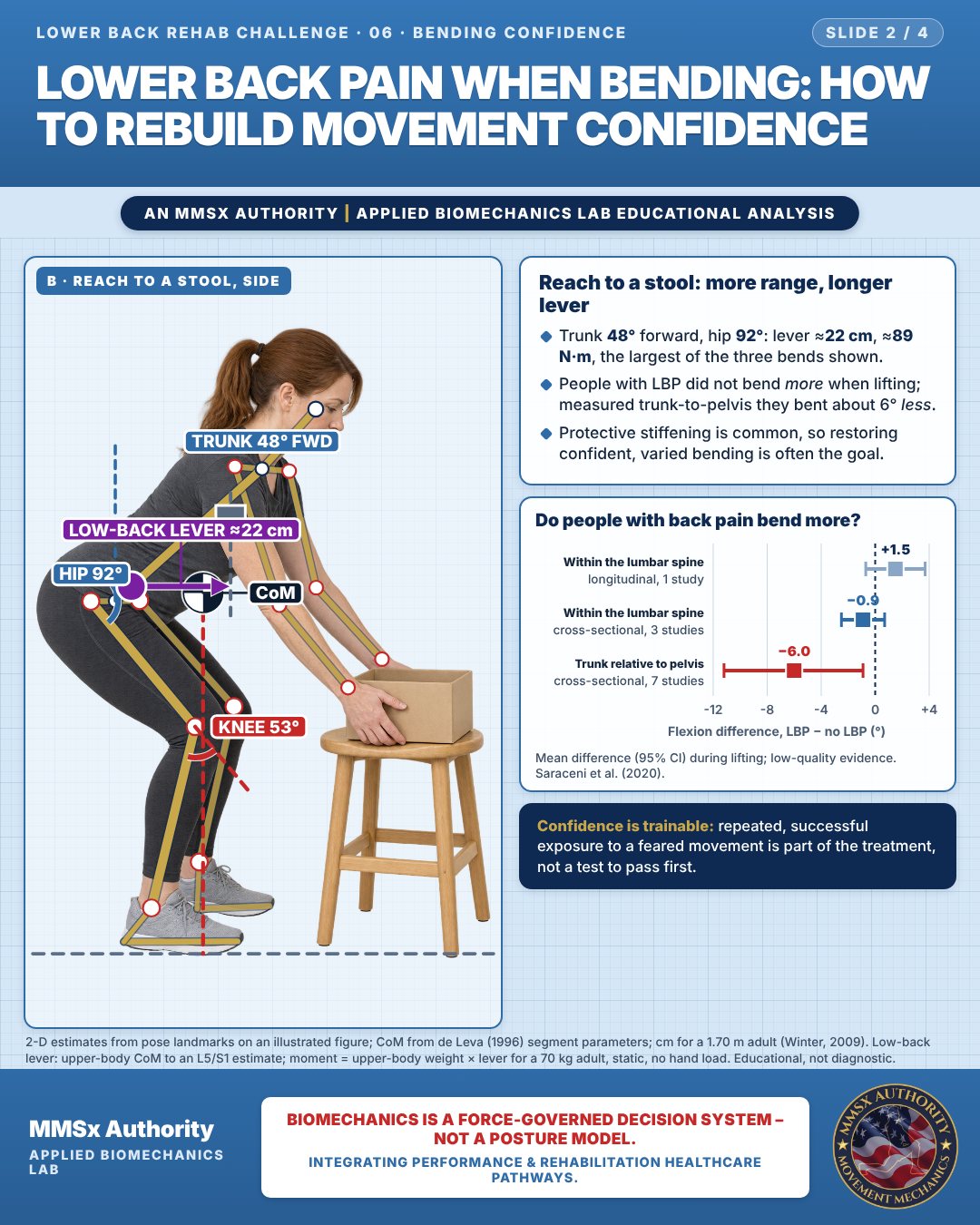
Reach to a stool: more range, longer lever
Trunk 48° forward, hip 92°: lever ≈22 cm, ≈89 N·m, the largest of the three bends shown.
People with LBP did not bend more when lifting; measured trunk-to-pelvis they bent about 6° less.
Protective stiffening is common, so restoring confident, varied bending is often the goal.
Do people with back pain bend more?
Movement C: Bend, hands to knees (side view)
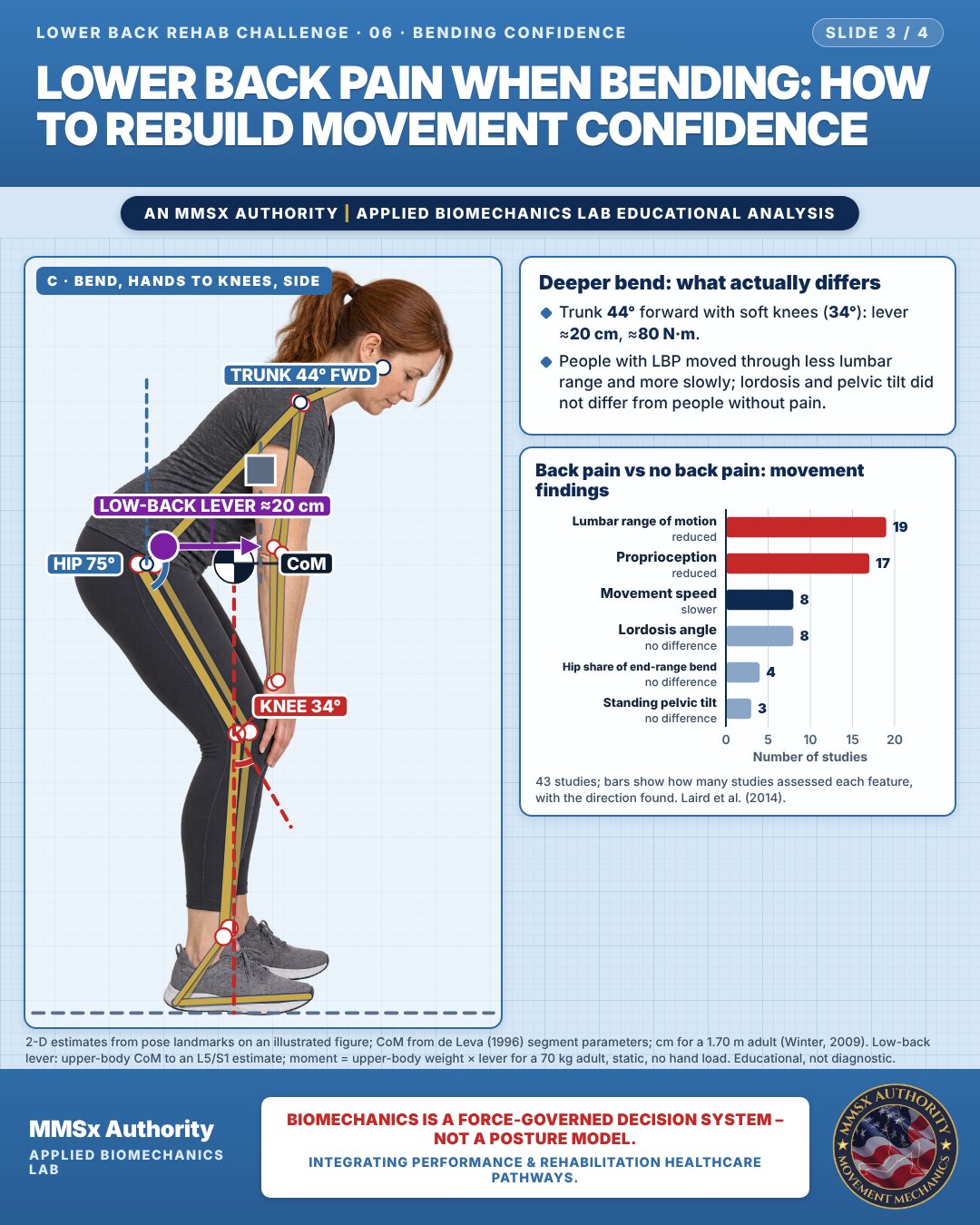
Deeper bend: what actually differs
Trunk 44° forward with soft knees (34°): lever ≈20 cm, ≈80 N·m.
People with LBP moved through less lumbar range and more slowly; lordosis and pelvic tilt did not differ from people without pain.
Back pain vs no back pain: movement findings
Decision pathway
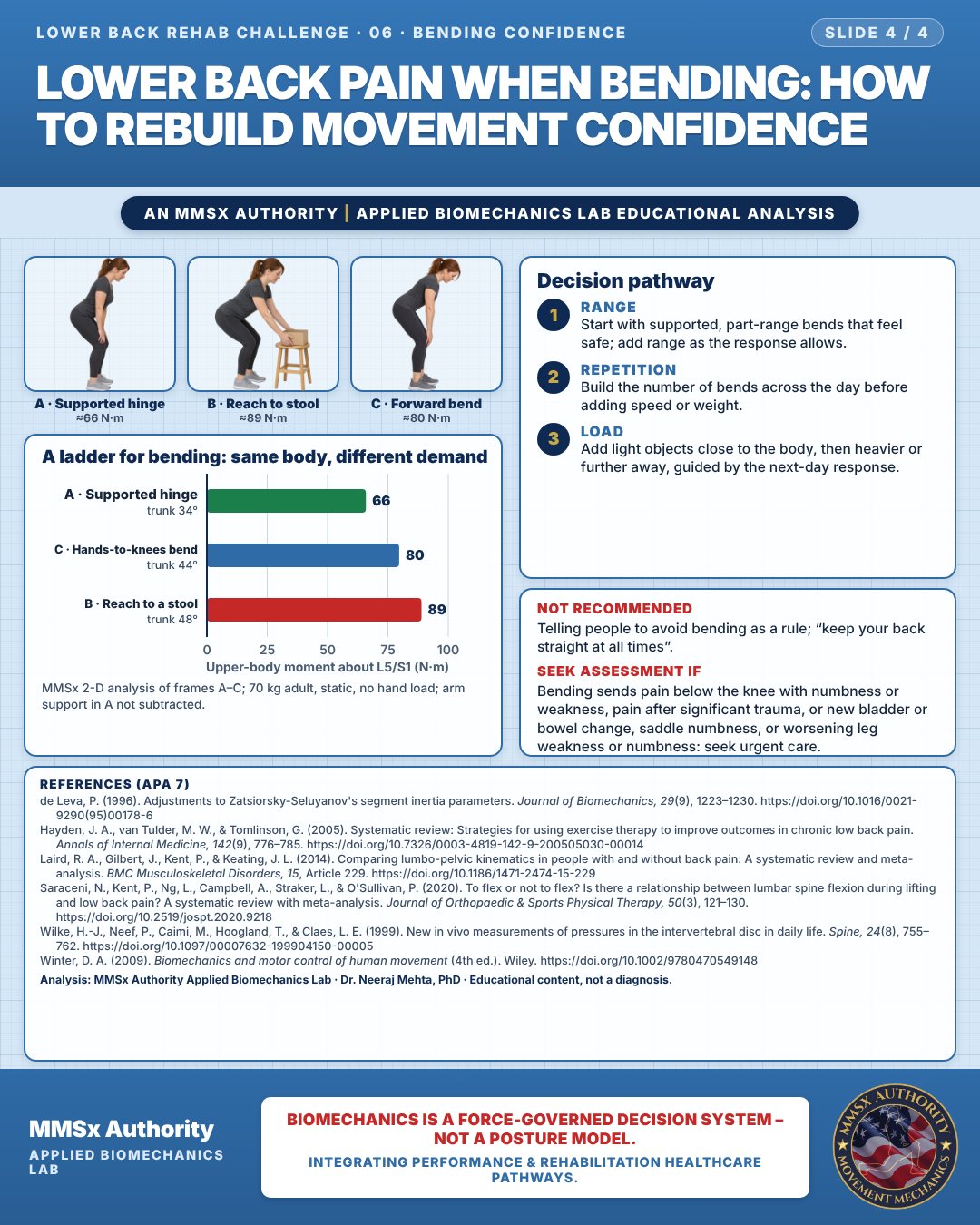
A ladder for bending: same body, different demand
Range
Start with supported, part-range bends that feel safe; add range as the response allows.
Repetition
Build the number of bends across the day before adding speed or weight.
Load
Add light objects close to the body, then heavier or further away, guided by the next-day response.
What the evidence supports
- Not supported: advising people to avoid bending as a general rule — lumbar flexion during lifting was not shown to be a risk factor (low-quality evidence). (Saraceni et al., 2020)
Myth and evidence
Myth“People with back pain bend too much — keep your back straight at all times.”
EvidenceMeta-analysis found people with LBP flex the same or about 6° less during lifting. (Saraceni et al., 2020)
Myth“A flat or exaggerated lordosis explains my pain.”
EvidenceNo difference in lordosis angle or standing pelvic tilt between people with and without LBP. (Laird et al., 2014)
Cautions
Not recommended
Telling people to avoid bending as a rule; “keep your back straight at all times”.
Seek assessment if
Bending sends pain below the knee with numbness or weakness, pain after significant trauma, or new bladder or bowel change, saddle numbness, or worsening leg weakness or numbness: seek urgent care.
Methods note
2-D estimates from pose landmarks on an illustrated figure; CoM from de Leva (1996) segment parameters; cm for a 1.70 m adult (Winter, 2009). Low-back lever: upper-body CoM to an L5/S1 estimate; moment = upper-body weight × lever for a 70 kg adult, static, no hand load. These are educational estimates, not a diagnosis.
References
- de Leva, P. (1996). Adjustments to Zatsiorsky-Seluyanov's segment inertia parameters. Journal of Biomechanics, 29(9), 1223–1230. https://doi.org/10.1016/0021-9290(95)00178-6
- Hayden, J. A., van Tulder, M. W., & Tomlinson, G. (2005). Systematic review: Strategies for using exercise therapy to improve outcomes in chronic low back pain. Annals of Internal Medicine, 142(9), 776–785. https://doi.org/10.7326/0003-4819-142-9-200505030-00014
- Laird, R. A., Gilbert, J., Kent, P., & Keating, J. L. (2014). Comparing lumbo-pelvic kinematics in people with and without back pain: A systematic review and meta-analysis. BMC Musculoskeletal Disorders, 15, Article 229. https://doi.org/10.1186/1471-2474-15-229
- Saraceni, N., Kent, P., Ng, L., Campbell, A., Straker, L., & O'Sullivan, P. (2020). To flex or not to flex? Is there a relationship between lumbar spine flexion during lifting and low back pain? A systematic review with meta-analysis. Journal of Orthopaedic & Sports Physical Therapy, 50(3), 121–130. https://doi.org/10.2519/jospt.2020.9218
- Wilke, H.-J., Neef, P., Caimi, M., Hoogland, T., & Claes, L. E. (1999). New in vivo measurements of pressures in the intervertebral disc in daily life. Spine, 24(8), 755–762. https://doi.org/10.1097/00007632-199904150-00005
- Winter, D. A. (2009). Biomechanics and motor control of human movement (4th ed.). Wiley. https://doi.org/10.1002/9780470549148
Cite this article
Mehta, N. (2026, October 23). Lower back pain when bending: how to rebuild movement confidence. MMSx Authority Applied Biomechanics Lab. https://mmsxauthority.org/edu/analysis/lower-back/06-lower-back-pain-when-bending-how-to-rebuild-movement-confidence/
Part of the collection
Mehta, N. (2026). Lower Back Rehabilitation: 50 Evidence-Based Biomechanics Analyses [Collection]. MMSx Authority Applied Biomechanics Lab. Zenodo. https://doi.org/10.5281/zenodo.23735778
All Lower Back Rehab Challenge articles · Rehabilitation Library