Lower Back Rehab Challenge · 05
Lower back pain when sitting: how to build sitting tolerance
Sitting-related low back pain is low back pain that is provoked or increased by sustained sitting and usually eased by changing position, standing or walking.
Key points
- Find the baseline. How long can you sit today before symptoms limit you? Start just below that.
- Vary and break. Alternate supported and forward postures; stand or walk briefly before symptoms build.
- Extend gradually. Lengthen sitting bouts week by week; add exercise for persistent pain.
What it is
Sitting-related low back pain is low back pain that is provoked or increased by sustained sitting and usually eased by changing position, standing or walking; "sitting tolerance" is the time a person can sit before symptoms reach a level that limits the task, and it can be extended gradually.
How we analysed the movement
Three movements relevant to this topic were analysed from illustrated reference figures. Joint centres were located with two-dimensional pose estimation; joint angles, the whole-body centre of mass and, where relevant, the low-back lever (the horizontal distance from the upper-body centre of mass to the L5/S1 joint) were then calculated from standard segment parameters. The figures are educational estimates that show how position changes mechanical demand; they are not measurements of a patient. Every research value quoted below comes from the published source cited beside it.
Movement A: Supported sitting (side view)
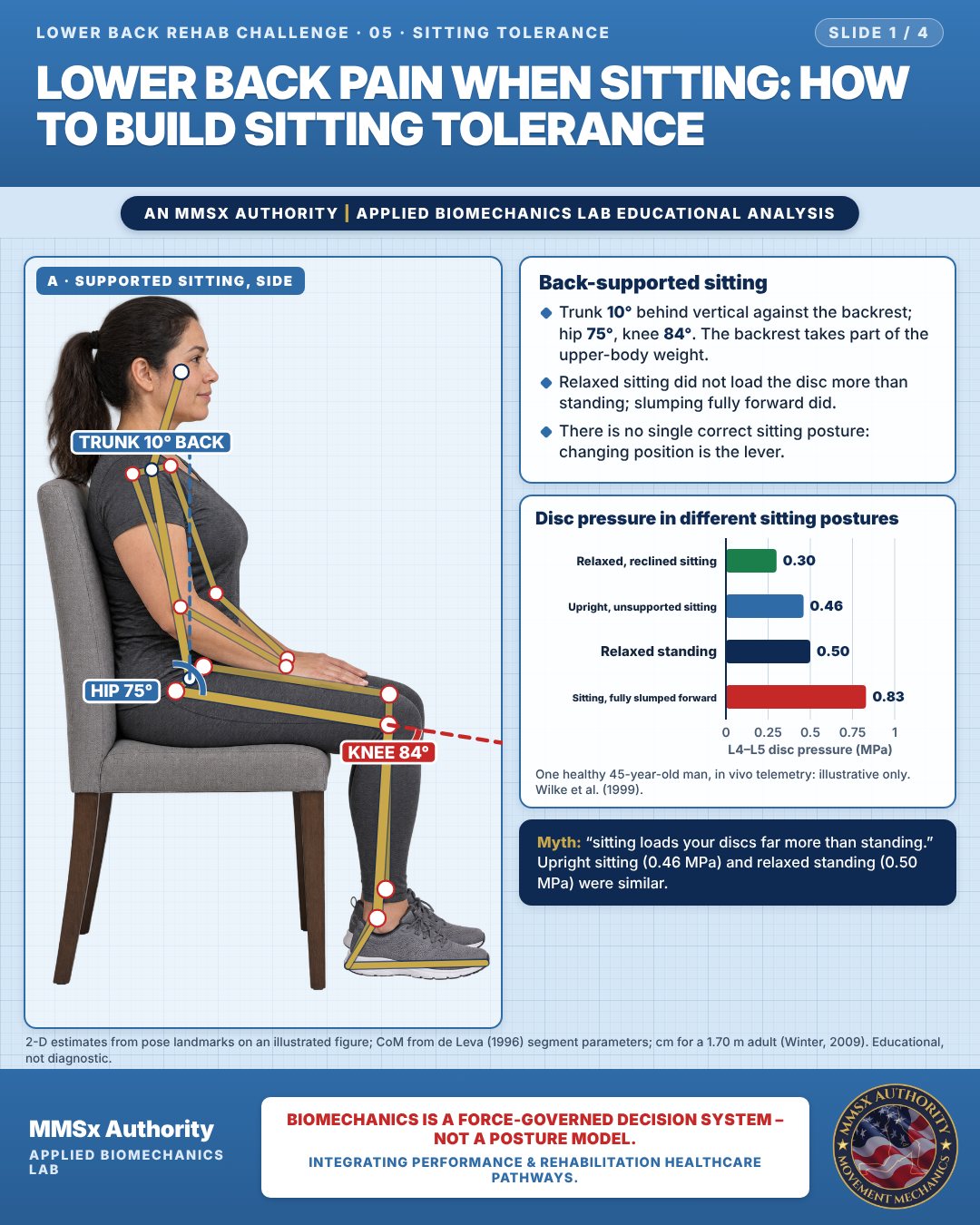
Back-supported sitting
Trunk 10° behind vertical against the backrest; hip 75°, knee 84°. The backrest takes part of the upper-body weight.
Relaxed sitting did not load the disc more than standing; slumping fully forward did.
There is no single correct sitting posture: changing position is the lever.
Disc pressure in different sitting postures
Movement B: Forward sitting (side view)
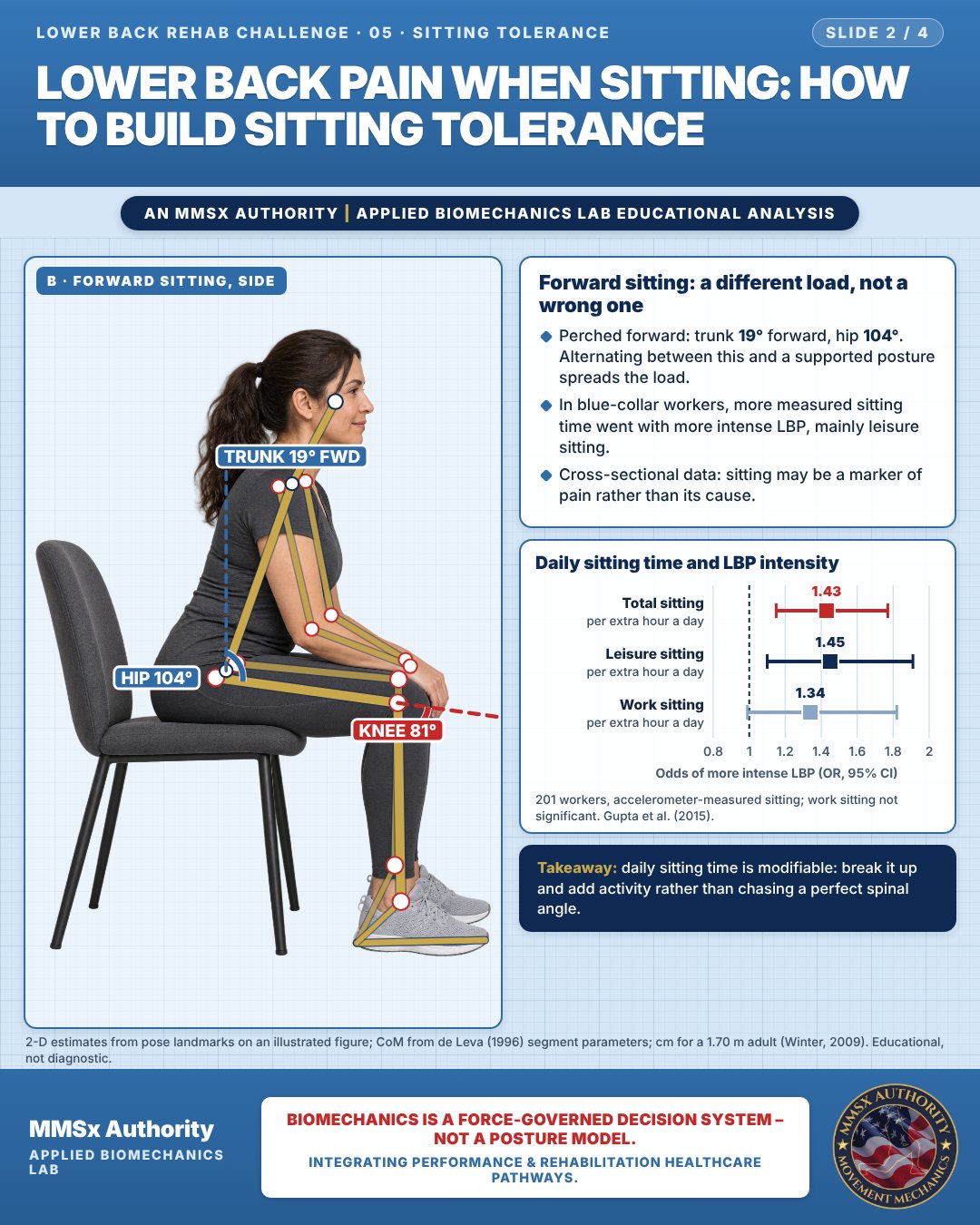
Forward sitting: a different load, not a wrong one
Perched forward: trunk 19° forward, hip 104°. Alternating between this and a supported posture spreads the load.
In blue-collar workers, more measured sitting time went with more intense LBP, mainly leisure sitting.
Cross-sectional data: sitting may be a marker of pain rather than its cause.
Daily sitting time and LBP intensity
Movement C: Movement break (front view)
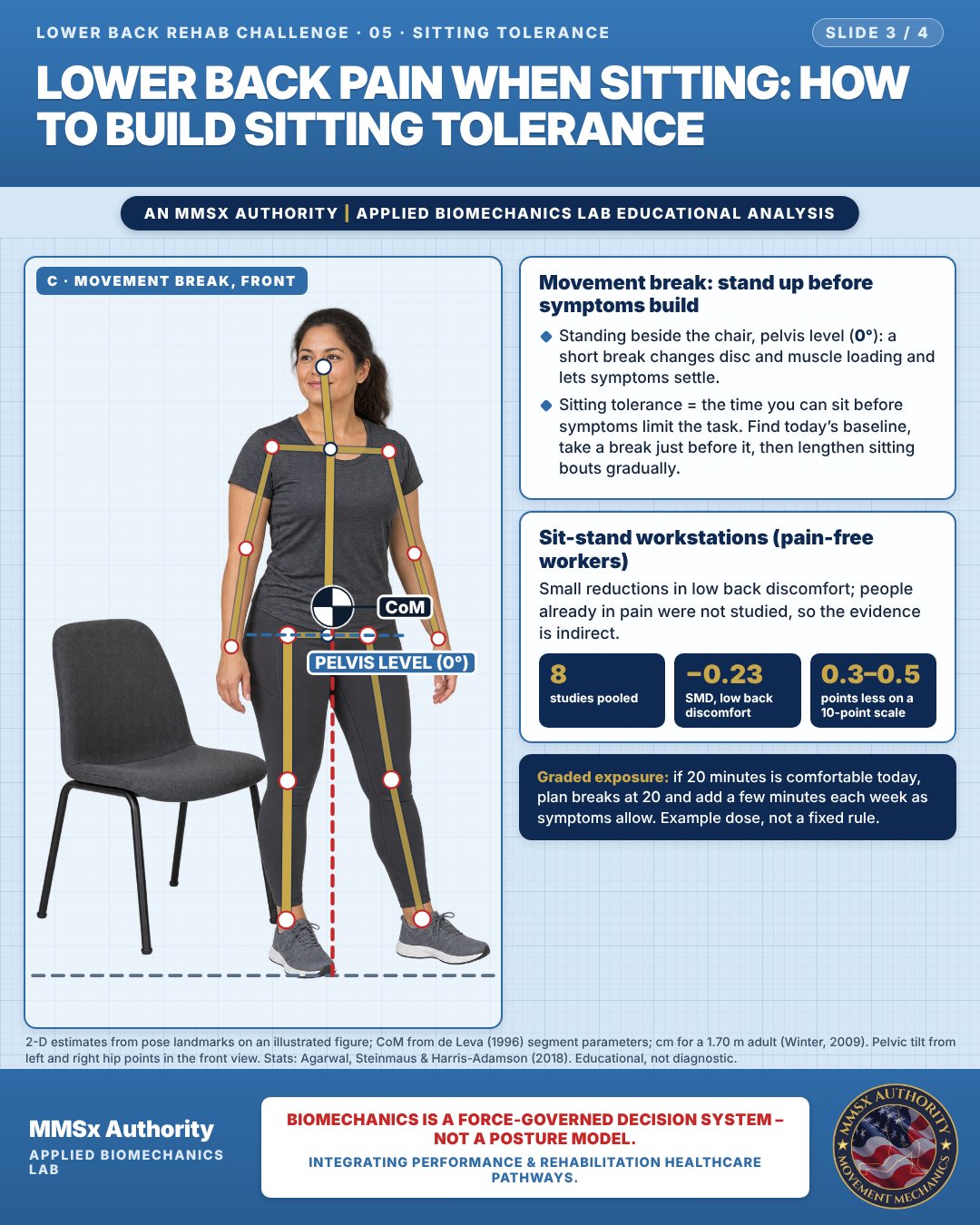
Movement break: stand up before symptoms build
Standing beside the chair, pelvis level (0°): a short break changes disc and muscle loading and lets symptoms settle.
Sitting tolerance = the time you can sit before symptoms limit the task. Find today’s baseline, take a break just before it, then lengthen sitting bouts gradually.
Sit-stand workstations (pain-free workers)
Small reductions in low back discomfort; people already in pain were not studied, so the evidence is indirect.
Decision pathway
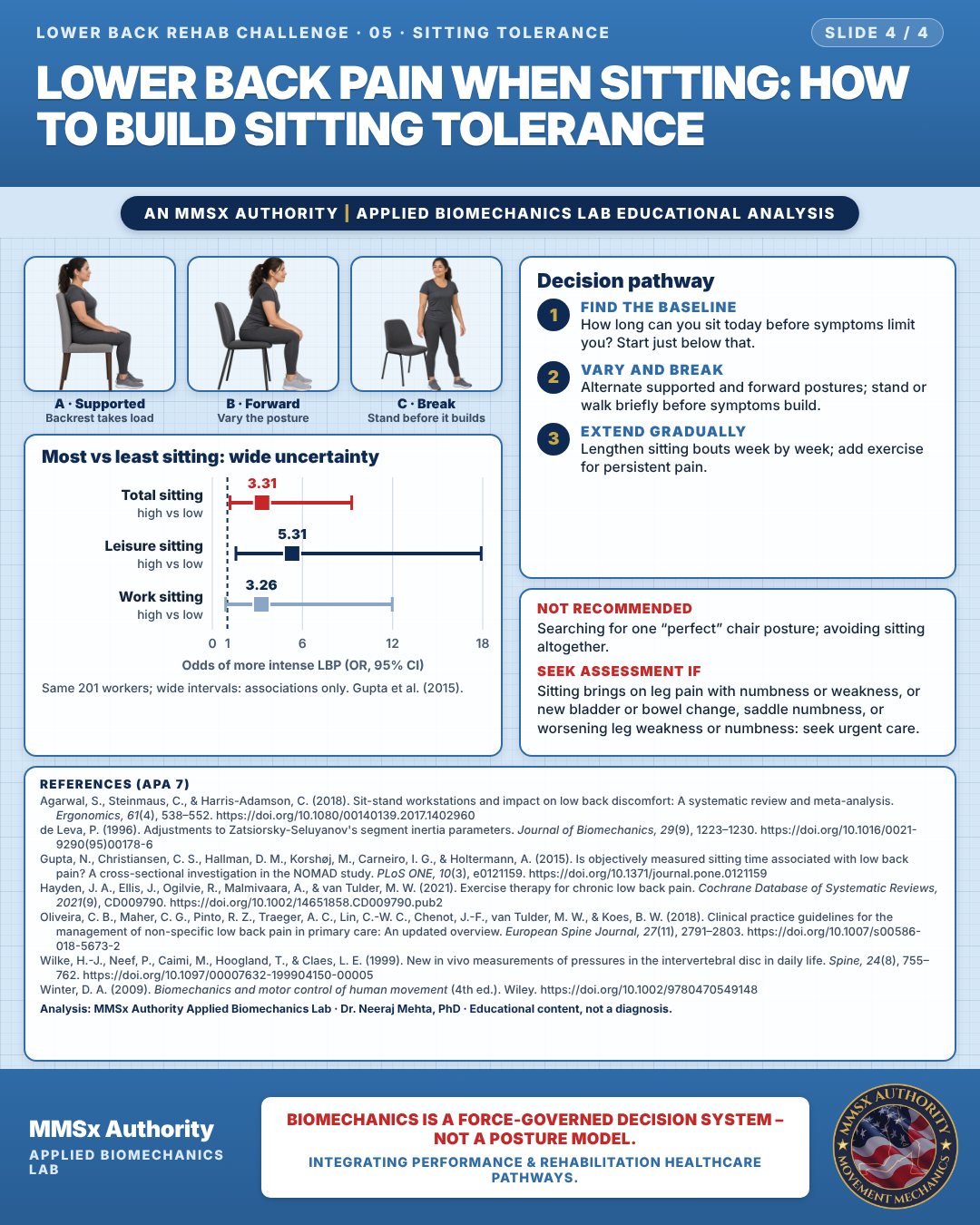
Most vs least sitting: wide uncertainty
Find the baseline
How long can you sit today before symptoms limit you? Start just below that.
Vary and break
Alternate supported and forward postures; stand or walk briefly before symptoms build.
Extend gradually
Lengthen sitting bouts week by week; add exercise for persistent pain.
What the evidence supports
- Keep active and return to normal activities (including work) with reassurance; avoid bed rest. (Oliveira et al., 2018)
Myth and evidence
Myth“Sitting puts far more load on your discs than standing.”
EvidenceIn the in-vivo measurement, unsupported sitting (0.46 MPa) and relaxed standing (0.50 MPa) were similar, and relaxed slouched sitting was lower (0.30 MPa). (Wilke et al., 1999)
Cautions
Not recommended
Searching for one “perfect” chair posture; avoiding sitting altogether.
Seek assessment if
Sitting brings on leg pain with numbness or weakness, or new bladder or bowel change, saddle numbness, or worsening leg weakness or numbness: seek urgent care.
Methods note
2-D estimates from pose landmarks on an illustrated figure; CoM from de Leva (1996) segment parameters; cm for a 1.70 m adult (Winter, 2009). Pelvic tilt from left and right hip points in the front view. Stats: Agarwal, Steinmaus & Harris-Adamson (2018). These are educational estimates, not a diagnosis.
References
- Agarwal, S., Steinmaus, C., & Harris-Adamson, C. (2018). Sit-stand workstations and impact on low back discomfort: A systematic review and meta-analysis. Ergonomics, 61(4), 538–552. https://doi.org/10.1080/00140139.2017.1402960
- de Leva, P. (1996). Adjustments to Zatsiorsky-Seluyanov's segment inertia parameters. Journal of Biomechanics, 29(9), 1223–1230. https://doi.org/10.1016/0021-9290(95)00178-6
- Gupta, N., Christiansen, C. S., Hallman, D. M., Korshøj, M., Carneiro, I. G., & Holtermann, A. (2015). Is objectively measured sitting time associated with low back pain? A cross-sectional investigation in the NOMAD study. PLoS ONE, 10(3), e0121159. https://doi.org/10.1371/journal.pone.0121159
- Hayden, J. A., Ellis, J., Ogilvie, R., Malmivaara, A., & van Tulder, M. W. (2021). Exercise therapy for chronic low back pain. Cochrane Database of Systematic Reviews, 2021(9), CD009790. https://doi.org/10.1002/14651858.CD009790.pub2
- Oliveira, C. B., Maher, C. G., Pinto, R. Z., Traeger, A. C., Lin, C.-W. C., Chenot, J.-F., van Tulder, M. W., & Koes, B. W. (2018). Clinical practice guidelines for the management of non-specific low back pain in primary care: An updated overview. European Spine Journal, 27(11), 2791–2803. https://doi.org/10.1007/s00586-018-5673-2
- Wilke, H.-J., Neef, P., Caimi, M., Hoogland, T., & Claes, L. E. (1999). New in vivo measurements of pressures in the intervertebral disc in daily life. Spine, 24(8), 755–762. https://doi.org/10.1097/00007632-199904150-00005
- Winter, D. A. (2009). Biomechanics and motor control of human movement (4th ed.). Wiley. https://doi.org/10.1002/9780470549148
Cite this article
Mehta, N. (2026, October 23). Lower back pain when sitting: how to build sitting tolerance. MMSx Authority Applied Biomechanics Lab. https://mmsxauthority.org/edu/analysis/lower-back/05-lower-back-pain-when-sitting-how-to-build-sitting-tolerance/
Part of the collection
Mehta, N. (2026). Lower Back Rehabilitation: 50 Evidence-Based Biomechanics Analyses [Collection]. MMSx Authority Applied Biomechanics Lab. Zenodo. https://doi.org/10.5281/zenodo.23735778
All Lower Back Rehab Challenge articles · Rehabilitation Library