Lower Back Rehab Challenge · 04
Lower back pain or sciatica? Why the difference matters
Sciatica (lumbar radicular pain) is leg pain in a nerve-root distribution, usually radiating below the knee, caused by irritation or compression of a…
Key points
- Map the symptoms. Back only, referred into the thigh, or below the knee in a nerve-root pattern?
- Examine. Strength, sensation, reflexes and SLR: a negative SLR argues against, a positive crossed SLR for, disc-related radiculopathy.
- Stay active, review. Bed rest is no better than staying active in sciatica; refer if deficits progress or no improvement by ~4 weeks.
What it is
Sciatica (lumbar radicular pain) is leg pain in a nerve-root distribution, usually radiating below the knee, caused by irritation or compression of a lumbosacral nerve root (most often by disc herniation) and sometimes accompanied by sensory change, weakness or reflex change (radiculopathy). Somatic referred leg pain arises from lumbar structures without nerve-root involvement and is typically vaguer and less likely to spread below the knee.
How we analysed the movement
Three movements relevant to this topic were analysed from illustrated reference figures. Joint centres were located with two-dimensional pose estimation; joint angles, the whole-body centre of mass and, where relevant, the low-back lever (the horizontal distance from the upper-body centre of mass to the L5/S1 joint) were then calculated from standard segment parameters. The figures are educational estimates that show how position changes mechanical demand; they are not measurements of a patient. Every research value quoted below comes from the published source cited beside it.
Movement A: Local back pain (rear view)
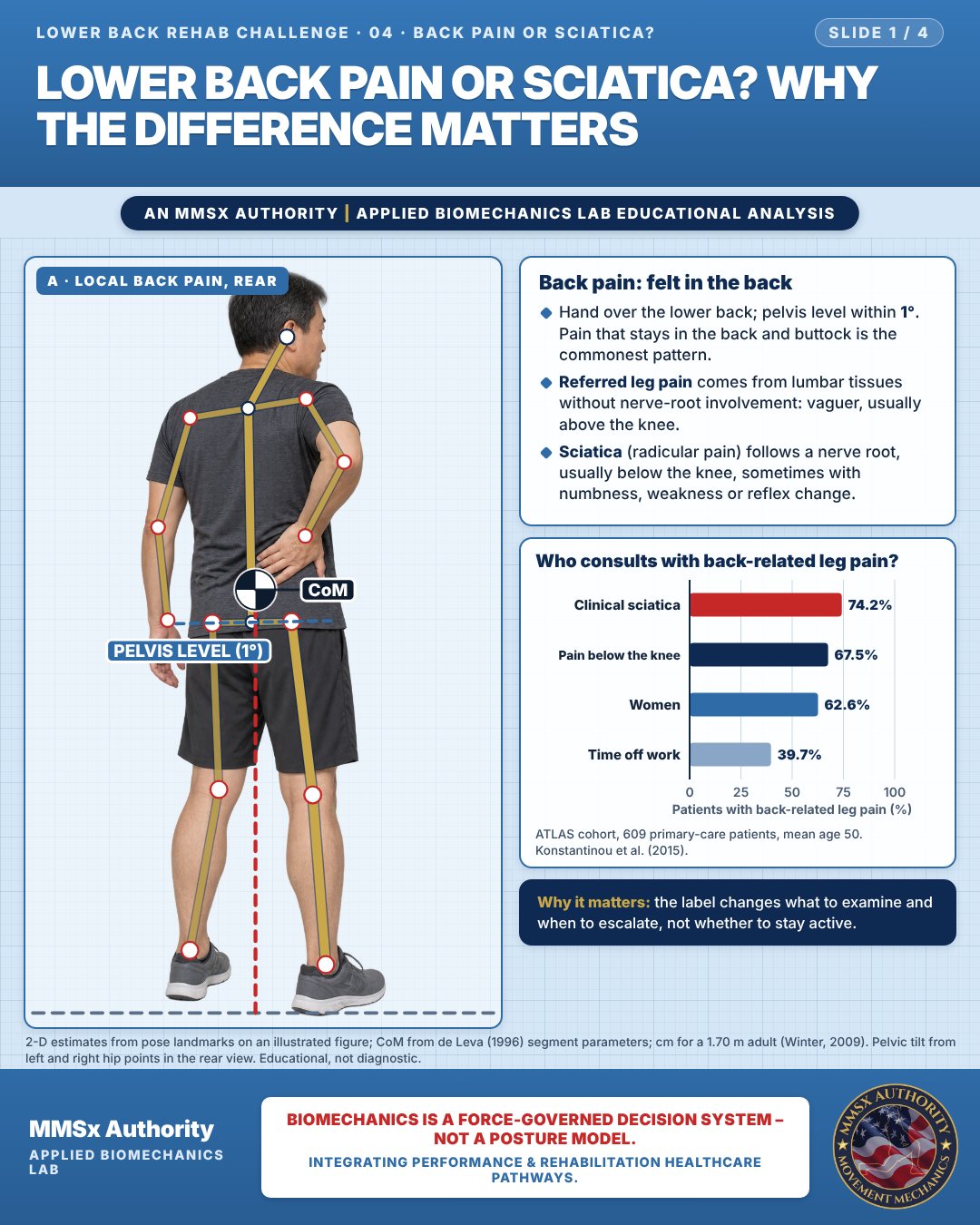
Back pain: felt in the back
Hand over the lower back; pelvis level within 1°. Pain that stays in the back and buttock is the commonest pattern.
Referred leg pain comes from lumbar tissues without nerve-root involvement: vaguer, usually above the knee.
Sciatica (radicular pain) follows a nerve root, usually below the knee, sometimes with numbness, weakness or reflex change.
Who consults with back-related leg pain?
Movement B: Leg symptoms (side view)
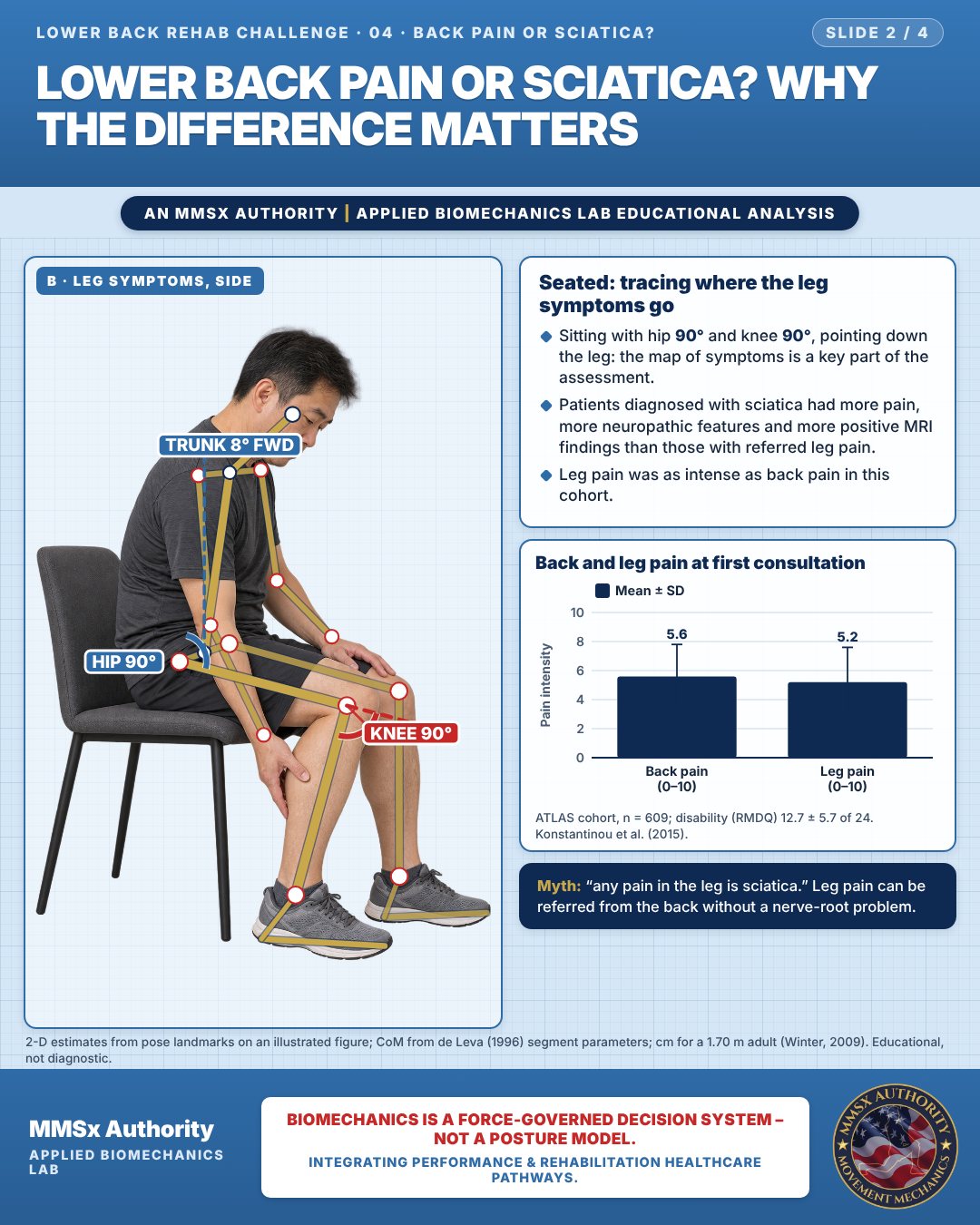
Seated: tracing where the leg symptoms go
Sitting with hip 90° and knee 90°, pointing down the leg: the map of symptoms is a key part of the assessment.
Patients diagnosed with sciatica had more pain, more neuropathic features and more positive MRI findings than those with referred leg pain.
Leg pain was as intense as back pain in this cohort.
Back and leg pain at first consultation
Movement C: Heel walk (front view)
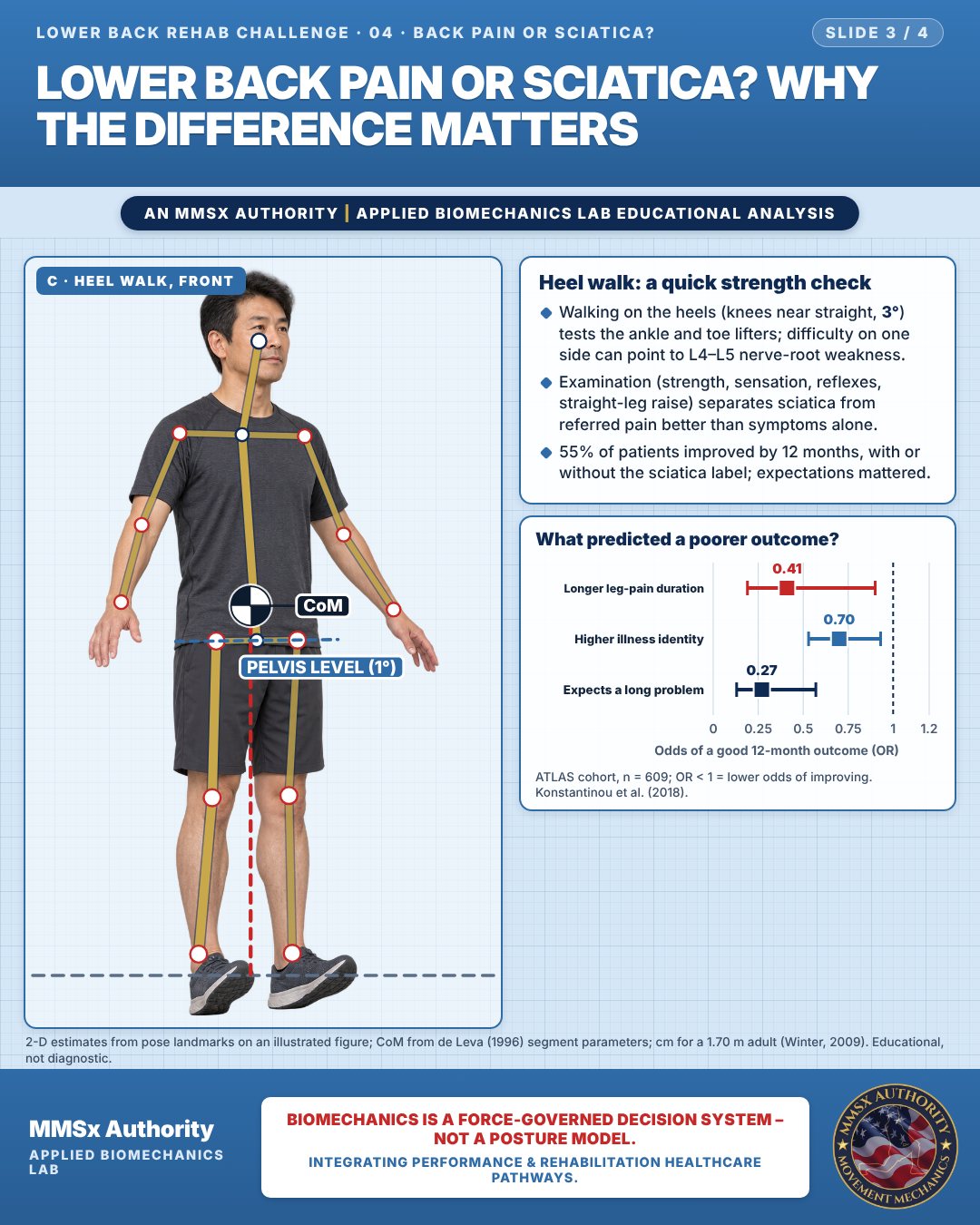
Heel walk: a quick strength check
Walking on the heels (knees near straight, 3°) tests the ankle and toe lifters; difficulty on one side can point to L4–L5 nerve-root weakness.
Examination (strength, sensation, reflexes, straight-leg raise) separates sciatica from referred pain better than symptoms alone.
55% of patients improved by 12 months, with or without the sciatica label; expectations mattered.
What predicted a poorer outcome?
Decision pathway
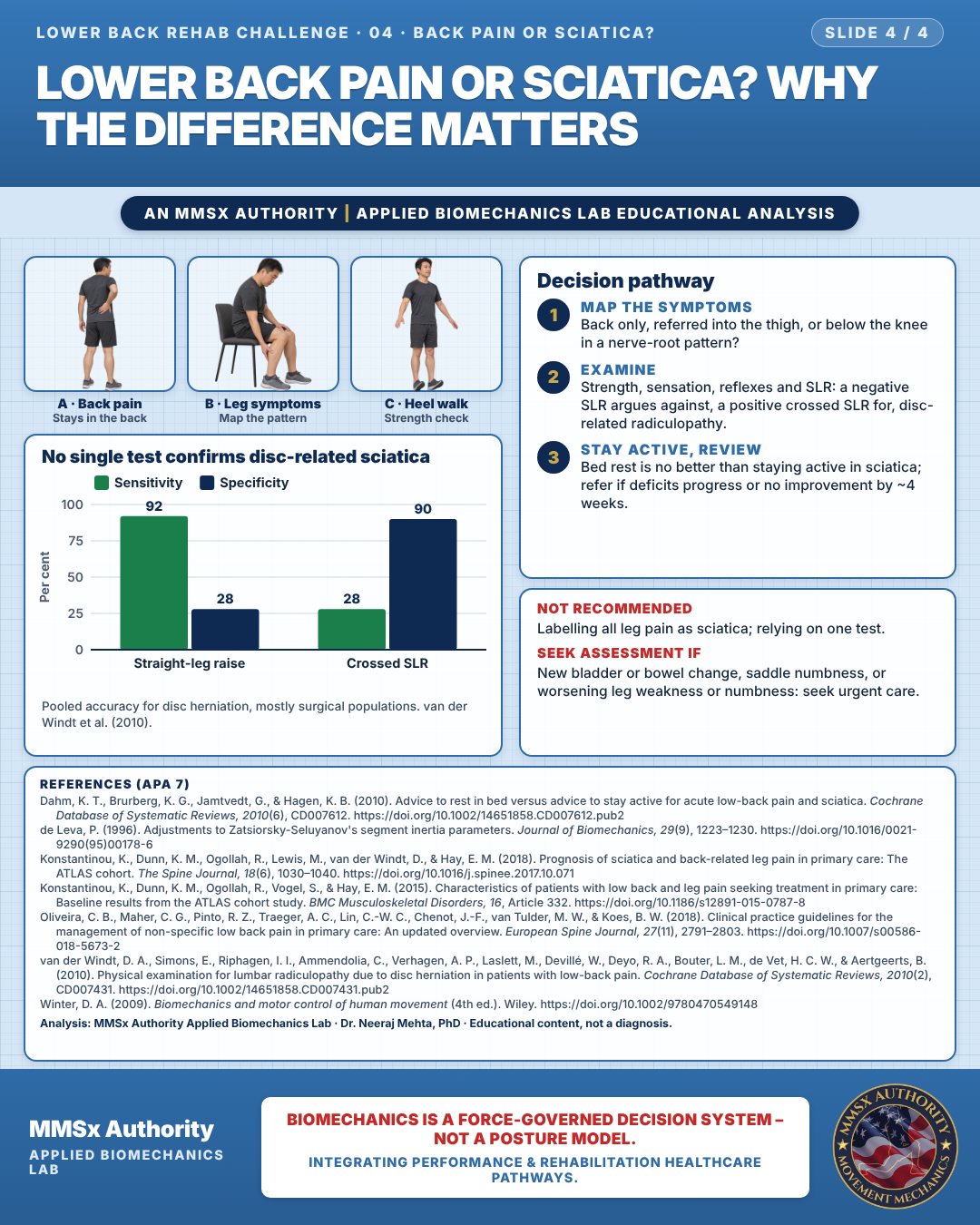
No single test confirms disc-related sciatica
Map the symptoms
Back only, referred into the thigh, or below the knee in a nerve-root pattern?
Examine
Strength, sensation, reflexes and SLR: a negative SLR argues against, a positive crossed SLR for, disc-related radiculopathy.
Stay active, review
Bed rest is no better than staying active in sciatica; refer if deficits progress or no improvement by ~4 weeks.
What the evidence supports
- Guidelines recommend neurological testing to identify radicular syndrome and referral to a specialist if a specific pathology such as radiculopathy is suspected or there is no improvement after about 4 weeks. (Oliveira et al., 2018)
- Bed rest offers no advantage for acute sciatica. (Dahm et al., 2010)
- Reassure and address expectations — the belief that the problem will last a long time was associated with lower odds of a good outcome. (Konstantinou et al., 2018)
Myth and evidence
Myth“Any pain in the leg is sciatica.”
EvidenceLeg pain can be somatic referred pain; sciatica is a clinical diagnosis based on pattern and examination, and a positive SLR alone has low specificity (0.28). [van der Windt et al., 2010; Konstantinou et al., 2015]
Myth“Sciatica means surgery.”
Evidence55% of primary-care patients with back-related leg pain (including the sciatica subgroup) improved by 12 months. (Konstantinou et al., 2018)
Cautions
Not recommended
Labelling all leg pain as sciatica; relying on one test.
Seek assessment if
New bladder or bowel change, saddle numbness, or worsening leg weakness or numbness: seek urgent care.
Methods note
2-D estimates from pose landmarks on an illustrated figure; CoM from de Leva (1996) segment parameters; cm for a 1.70 m adult (Winter, 2009). Pelvic tilt from left and right hip points in the rear view. These are educational estimates, not a diagnosis.
References
- Dahm, K. T., Brurberg, K. G., Jamtvedt, G., & Hagen, K. B. (2010). Advice to rest in bed versus advice to stay active for acute low-back pain and sciatica. Cochrane Database of Systematic Reviews, 2010(6), CD007612. https://doi.org/10.1002/14651858.CD007612.pub2
- de Leva, P. (1996). Adjustments to Zatsiorsky-Seluyanov's segment inertia parameters. Journal of Biomechanics, 29(9), 1223–1230. https://doi.org/10.1016/0021-9290(95)00178-6
- Konstantinou, K., Dunn, K. M., Ogollah, R., Lewis, M., van der Windt, D., & Hay, E. M. (2018). Prognosis of sciatica and back-related leg pain in primary care: The ATLAS cohort. The Spine Journal, 18(6), 1030–1040. https://doi.org/10.1016/j.spinee.2017.10.071
- Konstantinou, K., Dunn, K. M., Ogollah, R., Vogel, S., & Hay, E. M. (2015). Characteristics of patients with low back and leg pain seeking treatment in primary care: Baseline results from the ATLAS cohort study. BMC Musculoskeletal Disorders, 16, Article 332. https://doi.org/10.1186/s12891-015-0787-8
- Oliveira, C. B., Maher, C. G., Pinto, R. Z., Traeger, A. C., Lin, C.-W. C., Chenot, J.-F., van Tulder, M. W., & Koes, B. W. (2018). Clinical practice guidelines for the management of non-specific low back pain in primary care: An updated overview. European Spine Journal, 27(11), 2791–2803. https://doi.org/10.1007/s00586-018-5673-2
- van der Windt, D. A., Simons, E., Riphagen, I. I., Ammendolia, C., Verhagen, A. P., Laslett, M., Devillé, W., Deyo, R. A., Bouter, L. M., de Vet, H. C. W., & Aertgeerts, B. (2010). Physical examination for lumbar radiculopathy due to disc herniation in patients with low-back pain. Cochrane Database of Systematic Reviews, 2010(2), CD007431. https://doi.org/10.1002/14651858.CD007431.pub2
- Winter, D. A. (2009). Biomechanics and motor control of human movement (4th ed.). Wiley. https://doi.org/10.1002/9780470549148
Cite this article
Mehta, N. (2026, October 23). Lower back pain or sciatica? Why the difference matters. MMSx Authority Applied Biomechanics Lab. https://mmsxauthority.org/edu/analysis/lower-back/04-lower-back-pain-or-sciatica-why-the-difference-matters/
Part of the collection
Mehta, N. (2026). Lower Back Rehabilitation: 50 Evidence-Based Biomechanics Analyses [Collection]. MMSx Authority Applied Biomechanics Lab. Zenodo. https://doi.org/10.5281/zenodo.23735778
All Lower Back Rehab Challenge articles · Rehabilitation Library