Lower Back Rehab Challenge · 03
Sudden lower back pain: what to do in the first few days
Acute low back pain is a new episode of low back pain of less than 6 weeks' duration (commonly after a pain-free period).
Key points
- Screen. Check for red flags and neurological signs; most new episodes have no serious cause (0.9% did).
- Keep moving. Reassure, stay active, use positions and heat for comfort; continue work and daily tasks where possible.
- Reassess. Review if not improving after about 4 weeks, sooner if symptoms spread or worsen.
What it is
Acute low back pain is a new episode of low back pain of less than 6 weeks' duration (commonly after a pain-free period); in most people no serious cause is present and the early priorities are triage for red flags, reassurance, staying as active as tolerated, and reassessment if recovery stalls.
How we analysed the movement
Three movements relevant to this topic were analysed from illustrated reference figures. Joint centres were located with two-dimensional pose estimation; joint angles, the whole-body centre of mass and, where relevant, the low-back lever (the horizontal distance from the upper-body centre of mass to the L5/S1 joint) were then calculated from standard segment parameters. The figures are educational estimates that show how position changes mechanical demand; they are not measurements of a patient. Every research value quoted below comes from the published source cited beside it.
Movement A: Supported standing (side view)
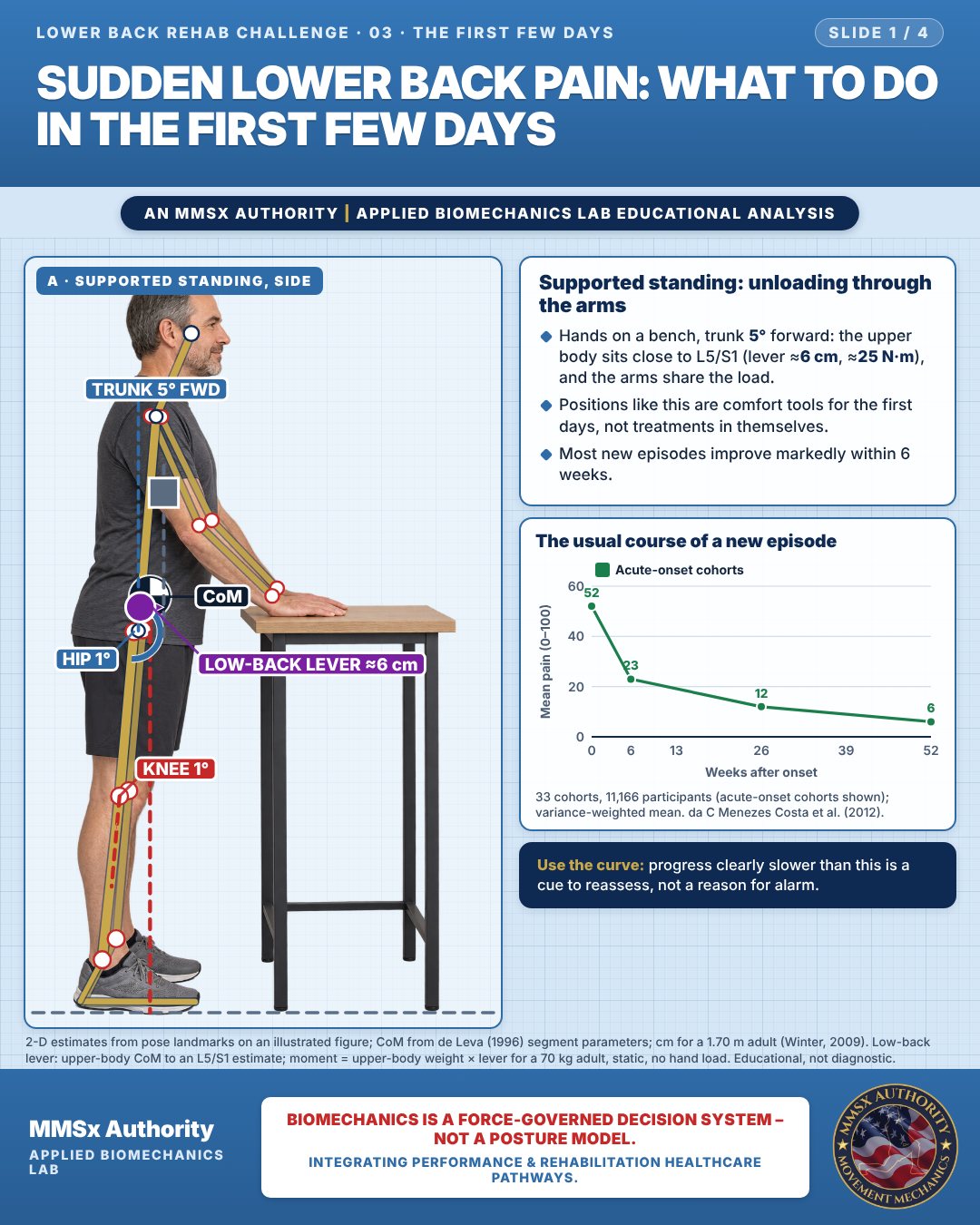
Supported standing: unloading through the arms
Hands on a bench, trunk 5° forward: the upper body sits close to L5/S1 (lever ≈6 cm, ≈25 N·m), and the arms share the load.
Positions like this are comfort tools for the first days, not treatments in themselves.
Most new episodes improve markedly within 6 weeks.
The usual course of a new episode
Movement B: Short steps (front view)
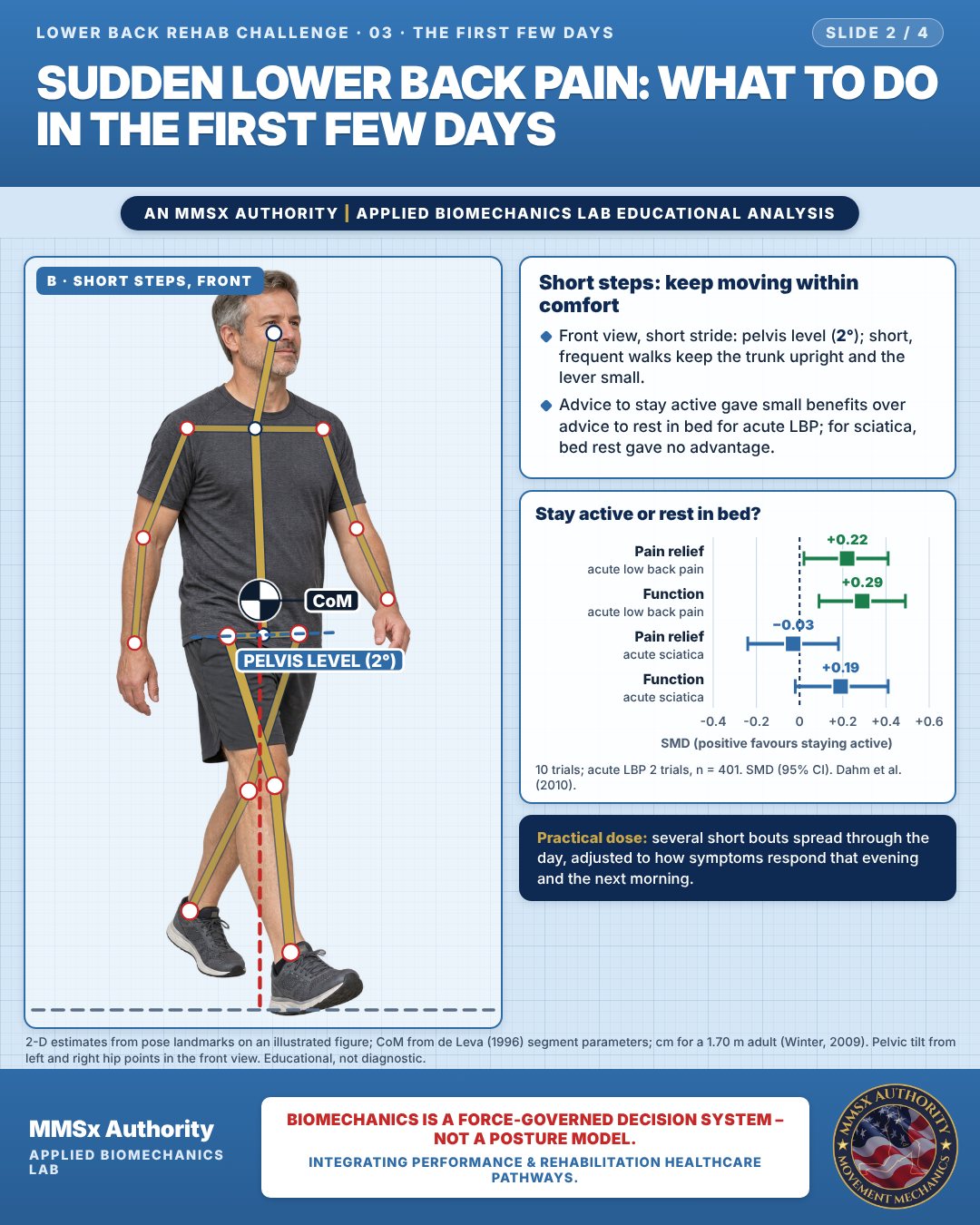
Short steps: keep moving within comfort
Front view, short stride: pelvis level (2°); short, frequent walks keep the trunk upright and the lever small.
Advice to stay active gave small benefits over advice to rest in bed for acute LBP; for sciatica, bed rest gave no advantage.
Stay active or rest in bed?
Movement C: Hook lying (side view)
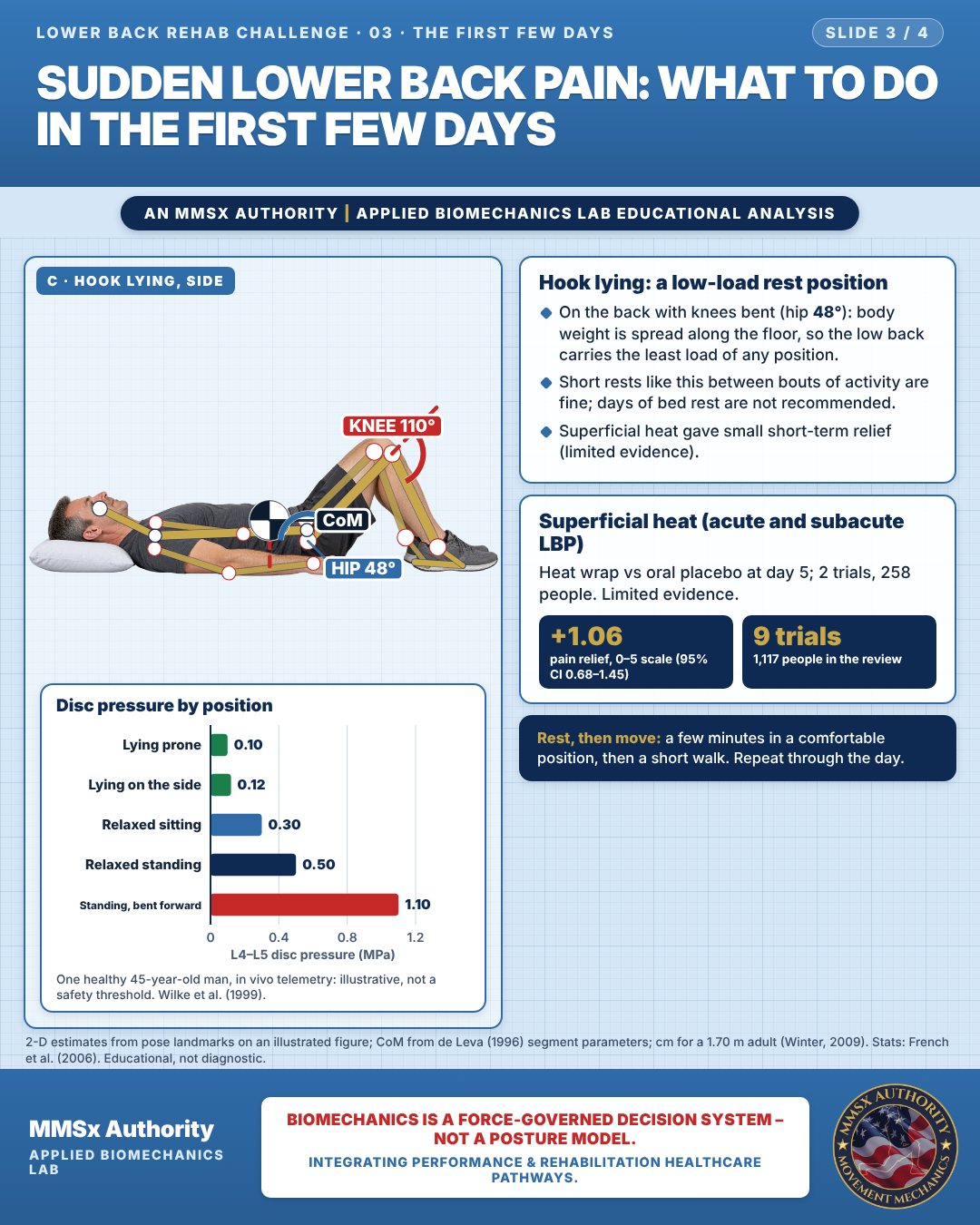
Disc pressure by position
Hook lying: a low-load rest position
On the back with knees bent (hip 48°): body weight is spread along the floor, so the low back carries the least load of any position.
Short rests like this between bouts of activity are fine; days of bed rest are not recommended.
Superficial heat gave small short-term relief (limited evidence).
Superficial heat (acute and subacute LBP)
Heat wrap vs oral placebo at day 5; 2 trials, 258 people. Limited evidence.
Decision pathway
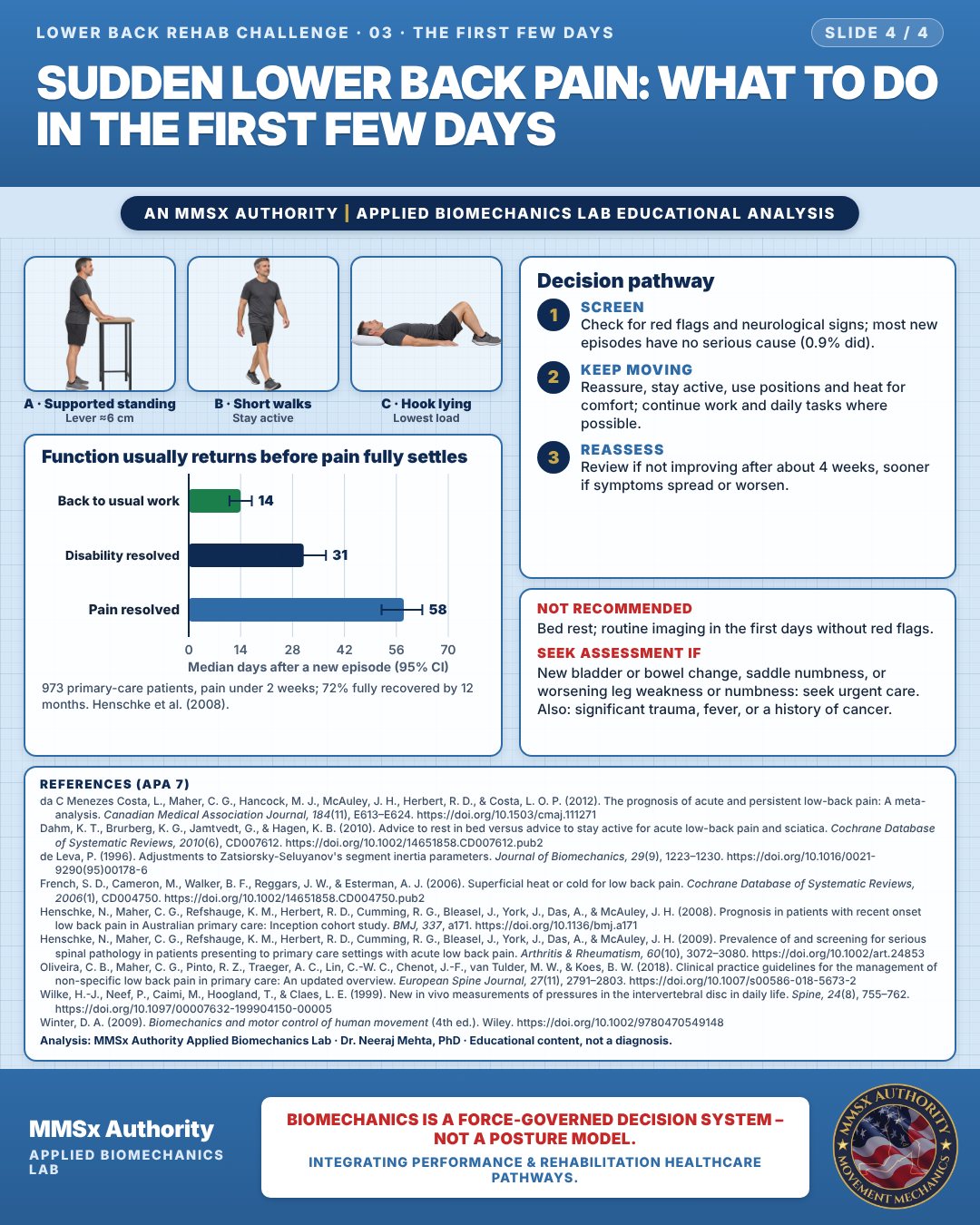
Function usually returns before pain fully settles
Screen
Check for red flags and neurological signs; most new episodes have no serious cause (0.9% did).
Keep moving
Reassure, stay active, use positions and heat for comfort; continue work and daily tasks where possible.
Reassess
Review if not improving after about 4 weeks, sooner if symptoms spread or worsen.
What the evidence supports
- Reassure about the favourable prognosis; advise return to normal activities and avoidance of bed rest; short-term NSAIDs/medication decisions sit with the prescribing clinician. (Oliveira et al., 2018)
- Superficial heat is a reasonable short-term comfort option (limited evidence). (French et al., 2006)
- NOT recommended: bed rest; routine imaging. (Oliveira et al., 2018; Dahm et al., 2010)
- Reassess / refer if no improvement after about 4 weeks or if specific pathology is suspected. (Oliveira et al., 2018)
Myth and evidence
Myth“Rest in bed until it settles.”
EvidenceStaying active gave small but better pain (SMD 0.22) and function (SMD 0.29) outcomes than bed rest advice. (Dahm et al., 2010)
Myth“Sudden severe pain means serious damage.”
EvidenceMost acute episodes improve markedly within 6 weeks; serious pathology is uncommon. [da C Menezes Costa et al., 2012; Henschke et al., 2009]
Cautions
Not recommended
Bed rest; routine imaging in the first days without red flags.
Seek assessment if
New bladder or bowel change, saddle numbness, or worsening leg weakness or numbness: seek urgent care. Also: significant trauma, fever, or a history of cancer.
Methods note
2-D estimates from pose landmarks on an illustrated figure; CoM from de Leva (1996) segment parameters; cm for a 1.70 m adult (Winter, 2009). Low-back lever: upper-body CoM to an L5/S1 estimate; moment = upper-body weight × lever for a 70 kg adult, static, no hand load. Pelvic tilt from left and right hip points in the front view. Stats: French et al. (2006). These are educational estimates, not a diagnosis.
References
- da C Menezes Costa, L., Maher, C. G., Hancock, M. J., McAuley, J. H., Herbert, R. D., & Costa, L. O. P. (2012). The prognosis of acute and persistent low-back pain: A meta-analysis. Canadian Medical Association Journal, 184(11), E613–E624. https://doi.org/10.1503/cmaj.111271
- Dahm, K. T., Brurberg, K. G., Jamtvedt, G., & Hagen, K. B. (2010). Advice to rest in bed versus advice to stay active for acute low-back pain and sciatica. Cochrane Database of Systematic Reviews, 2010(6), CD007612. https://doi.org/10.1002/14651858.CD007612.pub2
- de Leva, P. (1996). Adjustments to Zatsiorsky-Seluyanov's segment inertia parameters. Journal of Biomechanics, 29(9), 1223–1230. https://doi.org/10.1016/0021-9290(95)00178-6
- French, S. D., Cameron, M., Walker, B. F., Reggars, J. W., & Esterman, A. J. (2006). Superficial heat or cold for low back pain. Cochrane Database of Systematic Reviews, 2006(1), CD004750. https://doi.org/10.1002/14651858.CD004750.pub2
- Henschke, N., Maher, C. G., Refshauge, K. M., Herbert, R. D., Cumming, R. G., Bleasel, J., York, J., Das, A., & McAuley, J. H. (2008). Prognosis in patients with recent onset low back pain in Australian primary care: Inception cohort study. BMJ, 337, a171. https://doi.org/10.1136/bmj.a171
- Henschke, N., Maher, C. G., Refshauge, K. M., Herbert, R. D., Cumming, R. G., Bleasel, J., York, J., Das, A., & McAuley, J. H. (2009). Prevalence of and screening for serious spinal pathology in patients presenting to primary care settings with acute low back pain. Arthritis & Rheumatism, 60(10), 3072–3080. https://doi.org/10.1002/art.24853
- Oliveira, C. B., Maher, C. G., Pinto, R. Z., Traeger, A. C., Lin, C.-W. C., Chenot, J.-F., van Tulder, M. W., & Koes, B. W. (2018). Clinical practice guidelines for the management of non-specific low back pain in primary care: An updated overview. European Spine Journal, 27(11), 2791–2803. https://doi.org/10.1007/s00586-018-5673-2
- Wilke, H.-J., Neef, P., Caimi, M., Hoogland, T., & Claes, L. E. (1999). New in vivo measurements of pressures in the intervertebral disc in daily life. Spine, 24(8), 755–762. https://doi.org/10.1097/00007632-199904150-00005
- Winter, D. A. (2009). Biomechanics and motor control of human movement (4th ed.). Wiley. https://doi.org/10.1002/9780470549148
Cite this article
Mehta, N. (2026, October 23). Sudden lower back pain: what to do in the first few days. MMSx Authority Applied Biomechanics Lab. https://mmsxauthority.org/edu/analysis/lower-back/03-sudden-lower-back-pain-what-to-do-in-the-first-few-days/
Part of the collection
Mehta, N. (2026). Lower Back Rehabilitation: 50 Evidence-Based Biomechanics Analyses [Collection]. MMSx Authority Applied Biomechanics Lab. Zenodo. https://doi.org/10.5281/zenodo.23735778
All Lower Back Rehab Challenge articles · Rehabilitation Library