Lower Back Rehab Challenge · 02
Best exercises for lower back pain: how to choose what fits your symptoms
Exercise therapy for low back pain is a planned programme of physical activity (e.g., strengthening, motor control/stabilisation, aerobic, Pilates,…
Key points
- Match the goal. Pain, function, fitness or confidence: choose a mode the person can do and wants to do.
- Start where tolerated. Pick a starting level by symptom response during and the day after exercise.
- Individualise, supervise. Tailored, supervised programmes gained more; review progress over weeks to months.
What it is
Exercise therapy for low back pain is a planned programme of physical activity (e.g., strengthening, motor control/stabilisation, aerobic, Pilates, yoga, stretching) prescribed to reduce pain and activity limitation; evidence supports exercise as a category, with no single type proven best for everyone.
How we analysed the movement
Three movements relevant to this topic were analysed from illustrated reference figures. Joint centres were located with two-dimensional pose estimation; joint angles, the whole-body centre of mass and, where relevant, the low-back lever (the horizontal distance from the upper-body centre of mass to the L5/S1 joint) were then calculated from standard segment parameters. The figures are educational estimates that show how position changes mechanical demand; they are not measurements of a patient. Every research value quoted below comes from the published source cited beside it.
Movement A: Chair rise (side view)
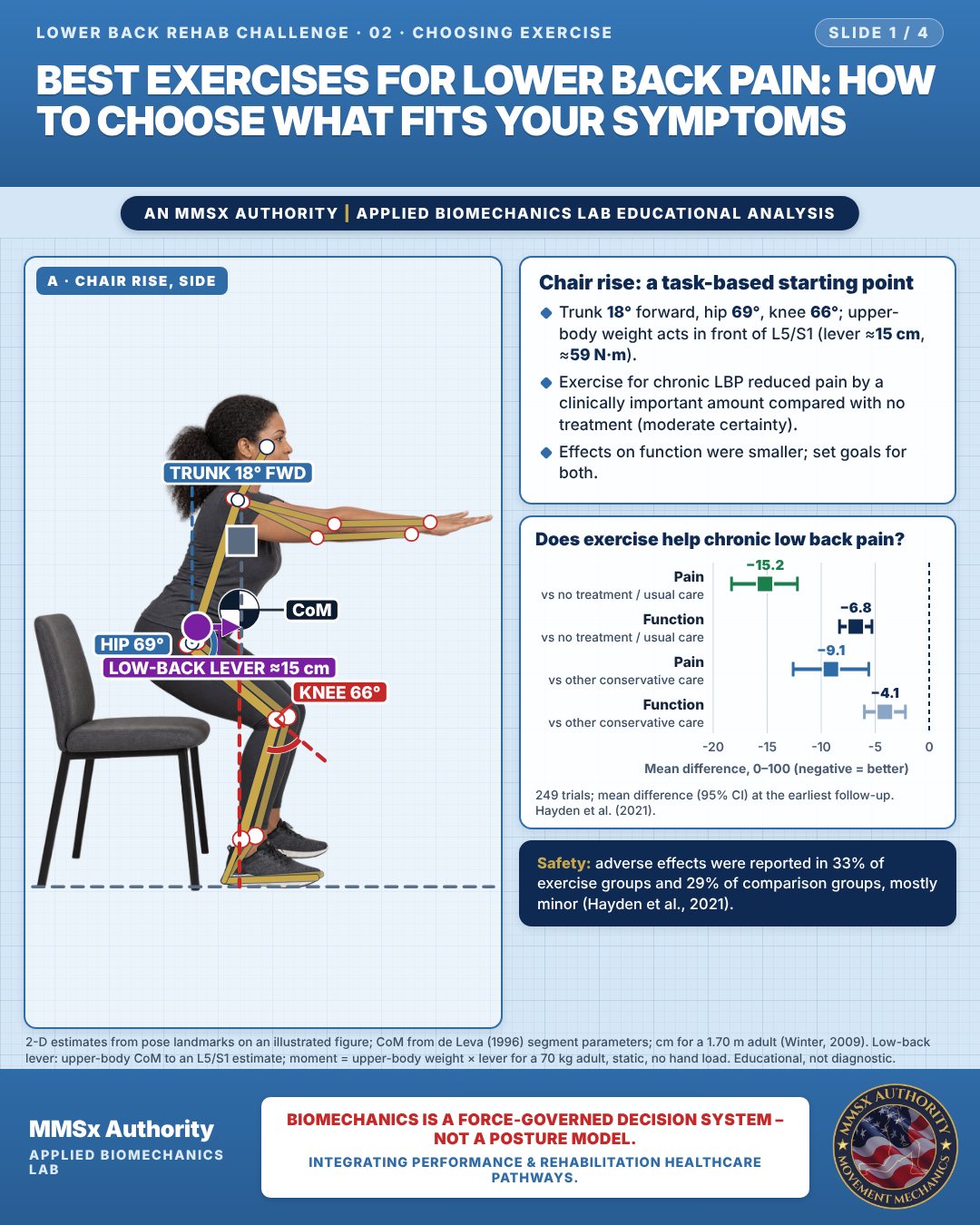
Chair rise: a task-based starting point
Trunk 18° forward, hip 69°, knee 66°; upper-body weight acts in front of L5/S1 (lever ≈15 cm, ≈59 N·m).
Exercise for chronic LBP reduced pain by a clinically important amount compared with no treatment (moderate certainty).
Effects on function were smaller; set goals for both.
Does exercise help chronic low back pain?
Movement B: Quadruped (side view)
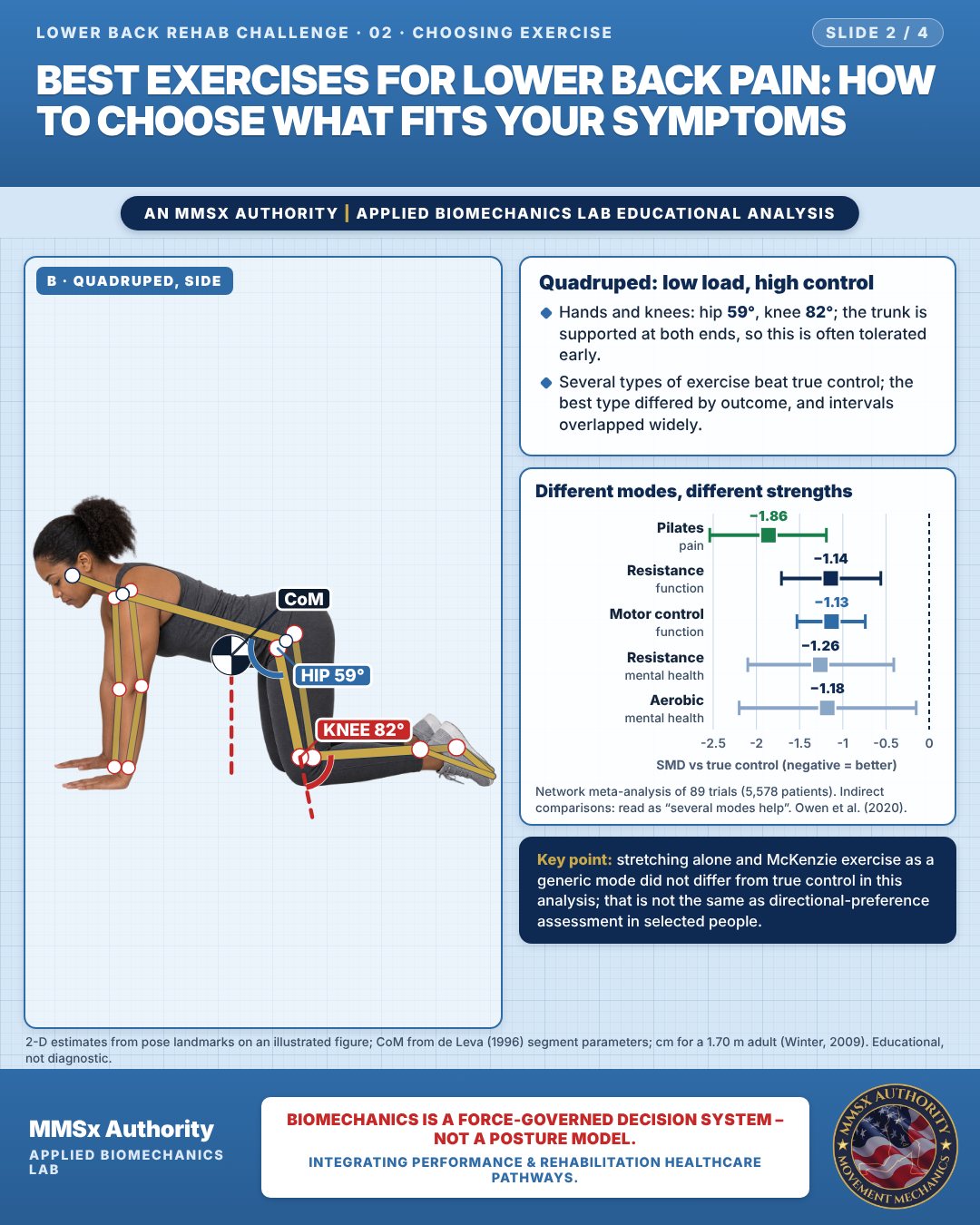
Quadruped: low load, high control
Hands and knees: hip 59°, knee 82°; the trunk is supported at both ends, so this is often tolerated early.
Several types of exercise beat true control; the best type differed by outcome, and intervals overlapped widely.
Different modes, different strengths
Movement C: Supported march (side view)
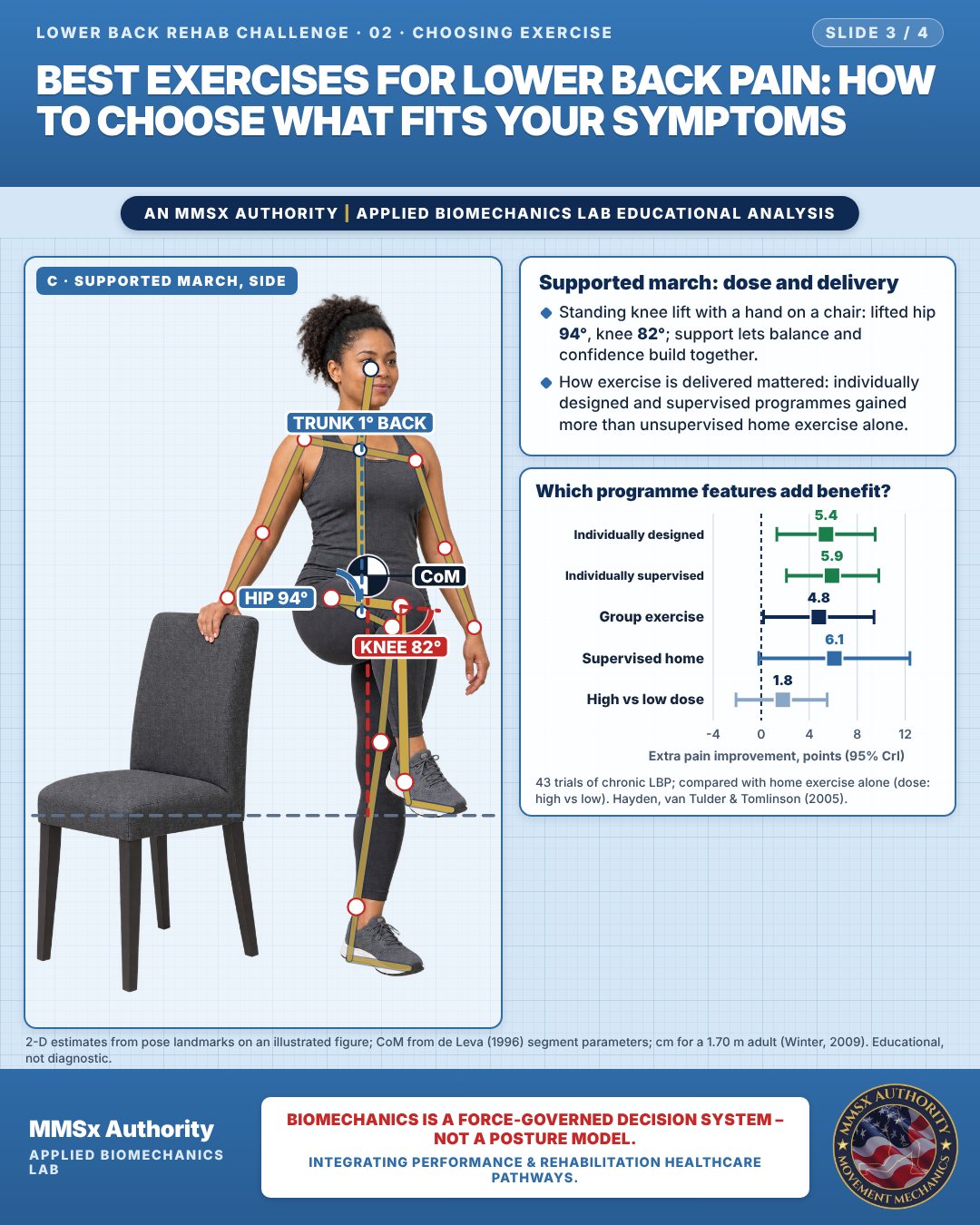
Supported march: dose and delivery
Standing knee lift with a hand on a chair: lifted hip 94°, knee 82°; support lets balance and confidence build together.
How exercise is delivered mattered: individually designed and supervised programmes gained more than unsupervised home exercise alone.
Which programme features add benefit?
Decision pathway
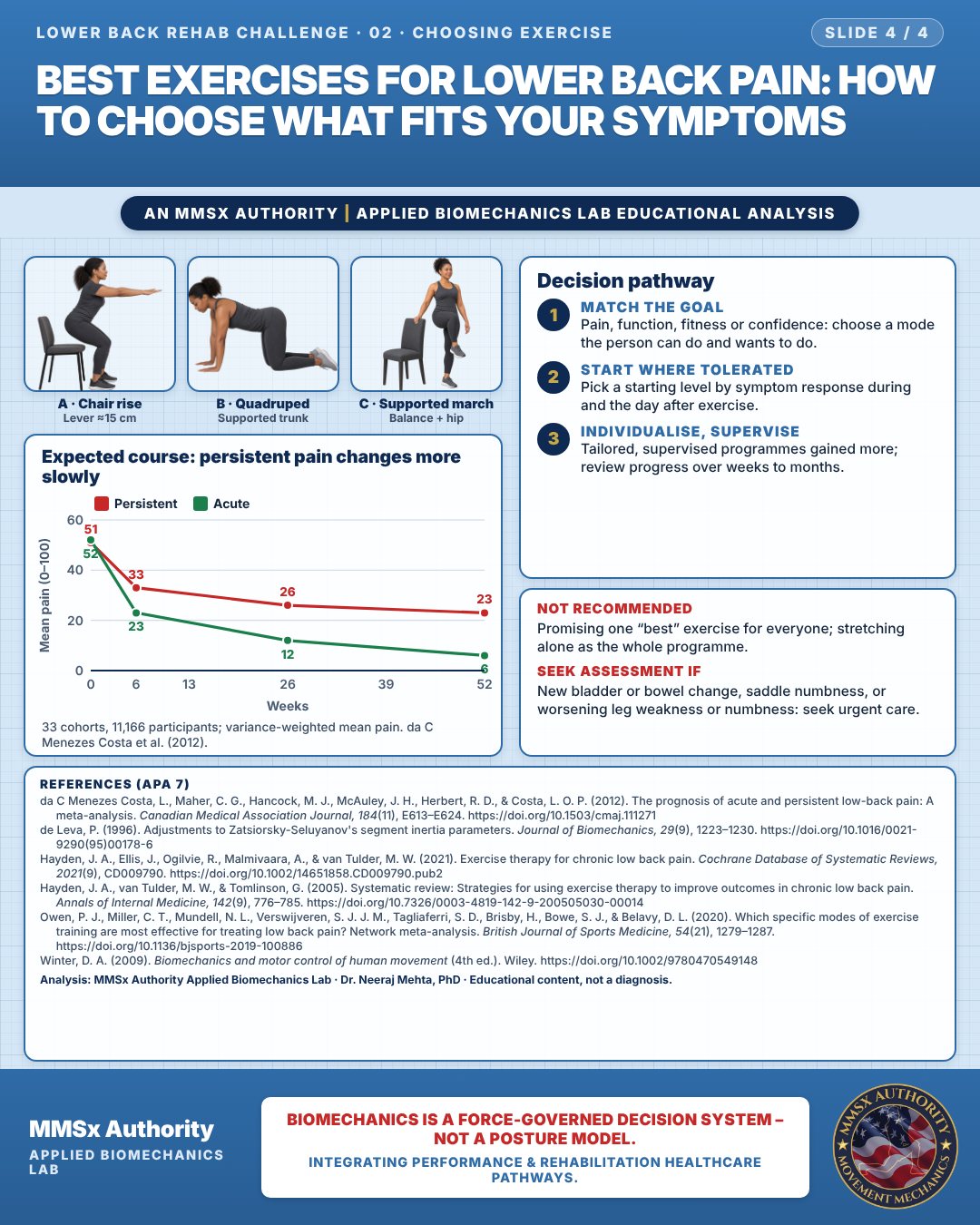
Expected course: persistent pain changes more slowly
Match the goal
Pain, function, fitness or confidence: choose a mode the person can do and wants to do.
Start where tolerated
Pick a starting level by symptom response during and the day after exercise.
Individualise, supervise
Tailored, supervised programmes gained more; review progress over weeks to months.
What the evidence supports
- Exercise vs no treatment: clinically important pain benefit (moderate certainty). (Hayden et al., 2021)
- Practical selection: individually designed and supervised programmes show larger effects than unsupervised home programmes. (Hayden et al., 2005)
Myth and evidence
Myth“There is one best exercise for back pain.”
EvidenceSeveral modes (Pilates, resistance, motor control, aerobic) outperform true control, with wide, overlapping intervals; the way exercise is delivered (individual design, supervision) also changes outcomes. (Owen et al., 2020; Hayden et al., 2005)
Myth“Exercise will hurt my back.”
EvidenceAdverse effects were reported at similar rates in exercise and comparison groups (33% vs 29% of groups), mostly minor. (Hayden et al., 2021)
Cautions
Not recommended
Promising one “best” exercise for everyone; stretching alone as the whole programme.
Seek assessment if
New bladder or bowel change, saddle numbness, or worsening leg weakness or numbness: seek urgent care.
Methods note
2-D estimates from pose landmarks on an illustrated figure; CoM from de Leva (1996) segment parameters; cm for a 1.70 m adult (Winter, 2009). Low-back lever: upper-body CoM to an L5/S1 estimate; moment = upper-body weight × lever for a 70 kg adult, static, no hand load. These are educational estimates, not a diagnosis.
References
- da C Menezes Costa, L., Maher, C. G., Hancock, M. J., McAuley, J. H., Herbert, R. D., & Costa, L. O. P. (2012). The prognosis of acute and persistent low-back pain: A meta-analysis. Canadian Medical Association Journal, 184(11), E613–E624. https://doi.org/10.1503/cmaj.111271
- de Leva, P. (1996). Adjustments to Zatsiorsky-Seluyanov's segment inertia parameters. Journal of Biomechanics, 29(9), 1223–1230. https://doi.org/10.1016/0021-9290(95)00178-6
- Hayden, J. A., Ellis, J., Ogilvie, R., Malmivaara, A., & van Tulder, M. W. (2021). Exercise therapy for chronic low back pain. Cochrane Database of Systematic Reviews, 2021(9), CD009790. https://doi.org/10.1002/14651858.CD009790.pub2
- Hayden, J. A., van Tulder, M. W., & Tomlinson, G. (2005). Systematic review: Strategies for using exercise therapy to improve outcomes in chronic low back pain. Annals of Internal Medicine, 142(9), 776–785. https://doi.org/10.7326/0003-4819-142-9-200505030-00014
- Owen, P. J., Miller, C. T., Mundell, N. L., Verswijveren, S. J. J. M., Tagliaferri, S. D., Brisby, H., Bowe, S. J., & Belavy, D. L. (2020). Which specific modes of exercise training are most effective for treating low back pain? Network meta-analysis. British Journal of Sports Medicine, 54(21), 1279–1287. https://doi.org/10.1136/bjsports-2019-100886
- Winter, D. A. (2009). Biomechanics and motor control of human movement (4th ed.). Wiley. https://doi.org/10.1002/9780470549148
Cite this article
Mehta, N. (2026, October 23). Best exercises for lower back pain: how to choose what fits your symptoms. MMSx Authority Applied Biomechanics Lab. https://mmsxauthority.org/edu/analysis/lower-back/02-best-exercises-for-lower-back-pain-how-to-choose-what-fits-your/
Part of the collection
Mehta, N. (2026). Lower Back Rehabilitation: 50 Evidence-Based Biomechanics Analyses [Collection]. MMSx Authority Applied Biomechanics Lab. Zenodo. https://doi.org/10.5281/zenodo.23735778
All Lower Back Rehab Challenge articles · Rehabilitation Library