Lower Back Rehab Challenge · 01
Why does my lower back hurt? Understanding common causes and movement sensitivity
Non-specific low back pain is pain between the lower ribs and the buttock creases (with or without leg pain) for which no specific pathoanatomical…
Key points
- Screen. History and examination first: neurological signs, fracture risk, and how pain affects daily life.
- Explain. Most back pain is non-specific; scan findings are common in pain-free people; the outlook is usually good.
- Stay active, review. Return to normal activities as tolerated; reassess if there is no improvement after about 4 weeks.
What it is
Non-specific low back pain is pain between the lower ribs and the buttock creases (with or without leg pain) for which no specific pathoanatomical cause (fracture, infection, malignancy, inflammatory disease, cauda equina syndrome or radicular compression) can be confidently identified; it is classified by duration (acute, subacute, chronic) and treated by its features and impact rather than by a single "damaged structure".
How we analysed the movement
Three movements relevant to this topic were analysed from illustrated reference figures. Joint centres were located with two-dimensional pose estimation; joint angles, the whole-body centre of mass and, where relevant, the low-back lever (the horizontal distance from the upper-body centre of mass to the L5/S1 joint) were then calculated from standard segment parameters. The figures are educational estimates that show how position changes mechanical demand; they are not measurements of a patient. Every research value quoted below comes from the published source cited beside it.
Movement A: Where IT hurts (rear view)
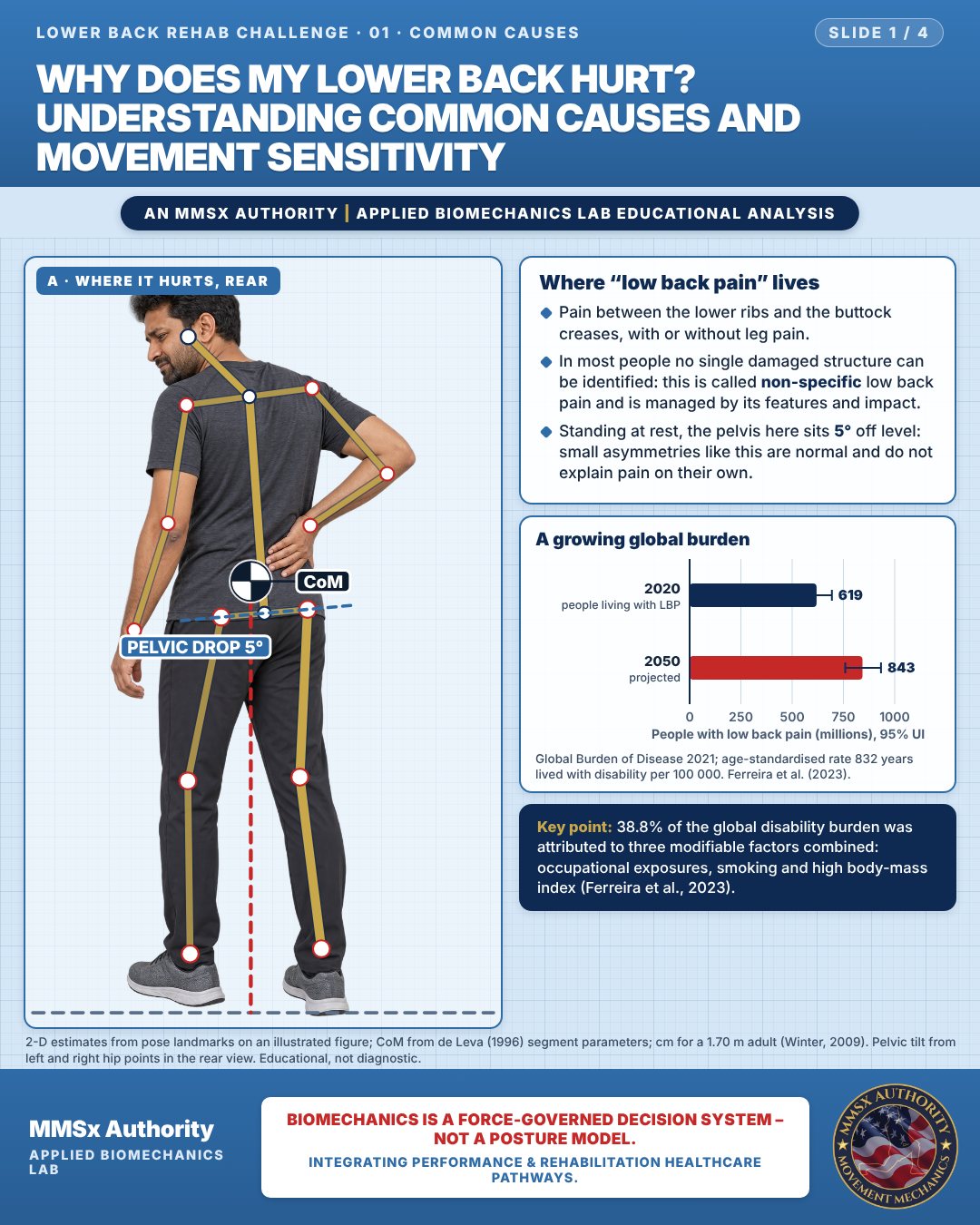
Where “low back pain” lives
Pain between the lower ribs and the buttock creases, with or without leg pain.
In most people no single damaged structure can be identified: this is called non-specific low back pain and is managed by its features and impact.
Standing at rest, the pelvis here sits 5° off level: small asymmetries like this are normal and do not explain pain on their own.
A growing global burden
Movement B: Quiet standing (side view)
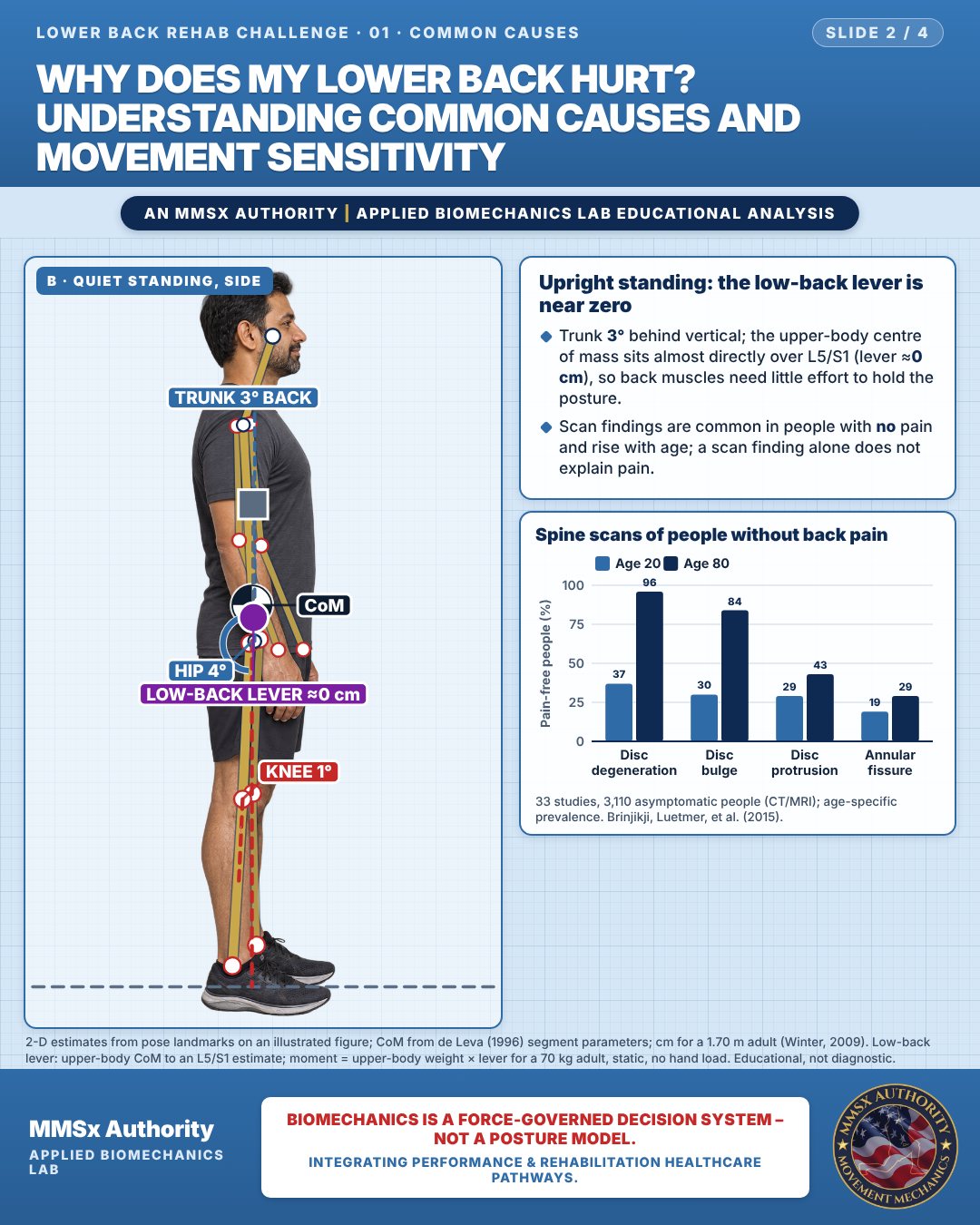
Upright standing: the low-back lever is near zero
Trunk 3° behind vertical; the upper-body centre of mass sits almost directly over L5/S1 (lever ≈0 cm), so back muscles need little effort to hold the posture.
Scan findings are common in people with no pain and rise with age; a scan finding alone does not explain pain.
Spine scans of people without back pain
Movement C: Walking (side view)
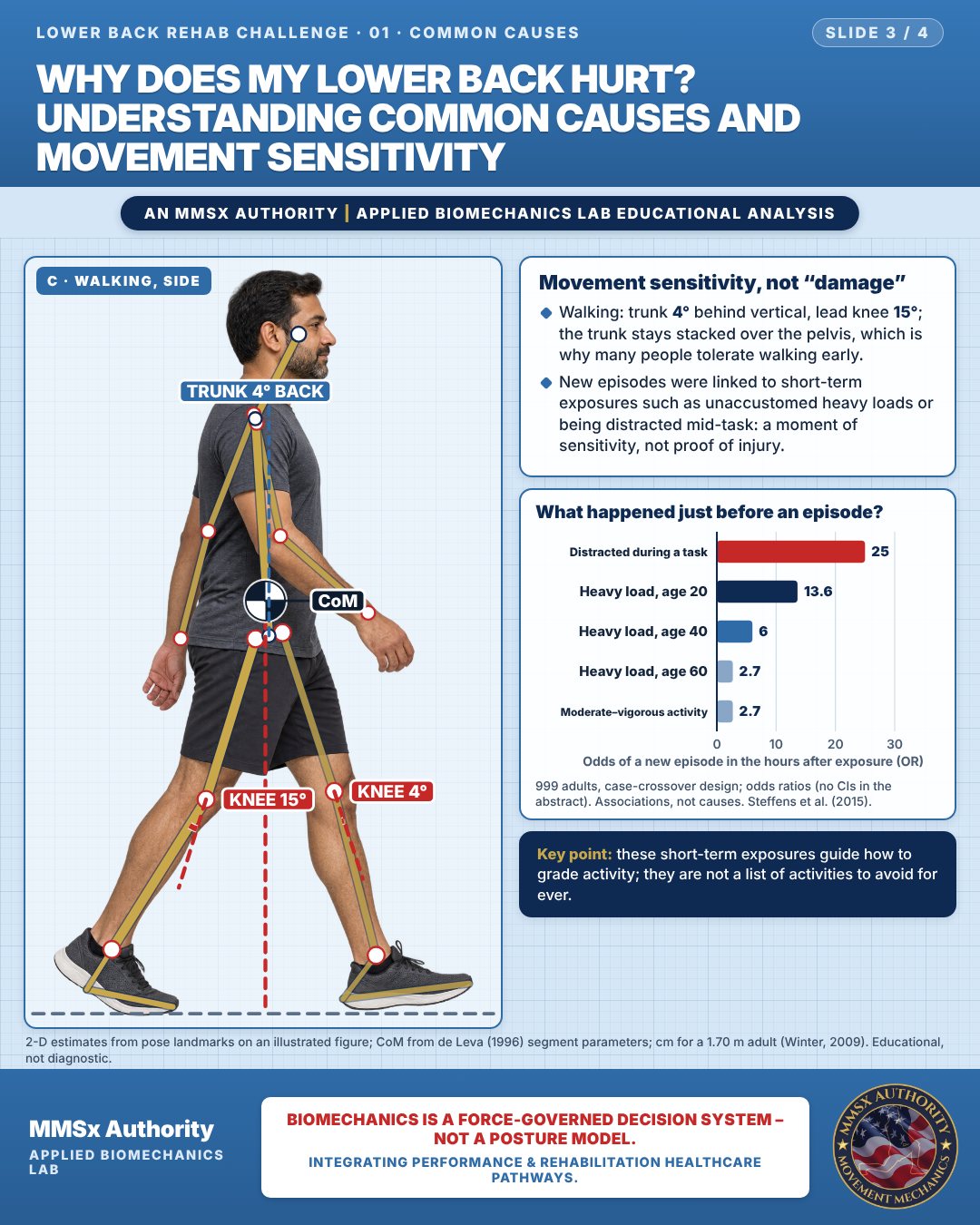
Movement sensitivity, not “damage”
Walking: trunk 4° behind vertical, lead knee 15°; the trunk stays stacked over the pelvis, which is why many people tolerate walking early.
New episodes were linked to short-term exposures such as unaccustomed heavy loads or being distracted mid-task: a moment of sensitivity, not proof of injury.
What happened just before an episode?
Decision pathway
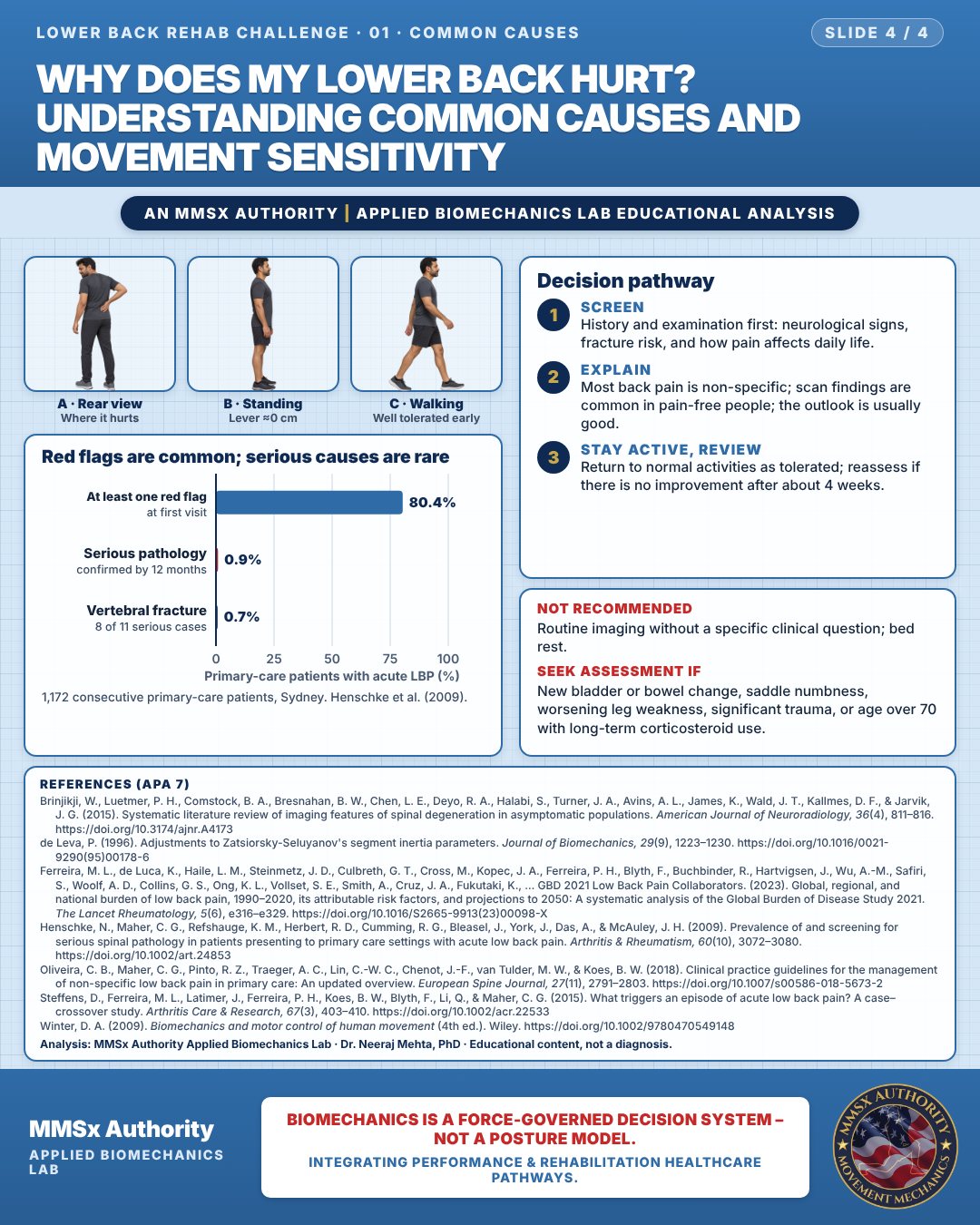
Red flags are common; serious causes are rare
Screen
History and examination first: neurological signs, fracture risk, and how pain affects daily life.
Explain
Most back pain is non-specific; scan findings are common in pain-free people; the outlook is usually good.
Stay active, review
Return to normal activities as tolerated; reassess if there is no improvement after about 4 weeks.
What the evidence supports
- Overview of 15 primary-care clinical practice guidelines: diagnosis and triage by history and physical examination to identify red flags; neurological testing to identify radicular syndrome; assess psychosocial factors; imaging only if serious pathology is suspected; reassure about the favourable prognosis; advise return to normal activity. (Oliveira et al., 2018)
- NOT recommended: routine imaging; bed rest. (Oliveira et al., 2018)
Myth and evidence
Myth“My scan shows wear and tear, so that is the cause.”
EvidenceIn pain-free 20-year-olds 37% already show disc degeneration, rising to 96% at 80. (Brinjikji et al., 2015b)
Myth“Back pain means something serious is damaged.”
EvidenceSerious pathology was found in 0.9% of primary-care presentations. (Henschke et al., 2009)
Cautions
Not recommended
Routine imaging without a specific clinical question; bed rest.
Seek assessment if
New bladder or bowel change, saddle numbness, worsening leg weakness, significant trauma, or age over 70 with long-term corticosteroid use.
Methods note
2-D estimates from pose landmarks on an illustrated figure; CoM from de Leva (1996) segment parameters; cm for a 1.70 m adult (Winter, 2009). Pelvic tilt from left and right hip points in the rear view. Low-back lever: upper-body CoM to an L5/S1 estimate; moment = upper-body weight × lever for a 70 kg adult, static, no hand load. These are educational estimates, not a diagnosis.
References
- Brinjikji, W., Luetmer, P. H., Comstock, B. A., Bresnahan, B. W., Chen, L. E., Deyo, R. A., Halabi, S., Turner, J. A., Avins, A. L., James, K., Wald, J. T., Kallmes, D. F., & Jarvik, J. G. (2015). Systematic literature review of imaging features of spinal degeneration in asymptomatic populations. American Journal of Neuroradiology, 36(4), 811–816. https://doi.org/10.3174/ajnr.A4173
- de Leva, P. (1996). Adjustments to Zatsiorsky-Seluyanov's segment inertia parameters. Journal of Biomechanics, 29(9), 1223–1230. https://doi.org/10.1016/0021-9290(95)00178-6
- Ferreira, M. L., de Luca, K., Haile, L. M., Steinmetz, J. D., Culbreth, G. T., Cross, M., Kopec, J. A., Ferreira, P. H., Blyth, F., Buchbinder, R., Hartvigsen, J., Wu, A.-M., Safiri, S., Woolf, A. D., Collins, G. S., Ong, K. L., Vollset, S. E., Smith, A., Cruz, J. A., Fukutaki, K., … GBD 2021 Low Back Pain Collaborators. (2023). Global, regional, and national burden of low back pain, 1990–2020, its attributable risk factors, and projections to 2050: A systematic analysis of the Global Burden of Disease Study 2021. The Lancet Rheumatology, 5(6), e316–e329. https://doi.org/10.1016/S2665-9913(23)00098-X
- Henschke, N., Maher, C. G., Refshauge, K. M., Herbert, R. D., Cumming, R. G., Bleasel, J., York, J., Das, A., & McAuley, J. H. (2009). Prevalence of and screening for serious spinal pathology in patients presenting to primary care settings with acute low back pain. Arthritis & Rheumatism, 60(10), 3072–3080. https://doi.org/10.1002/art.24853
- Oliveira, C. B., Maher, C. G., Pinto, R. Z., Traeger, A. C., Lin, C.-W. C., Chenot, J.-F., van Tulder, M. W., & Koes, B. W. (2018). Clinical practice guidelines for the management of non-specific low back pain in primary care: An updated overview. European Spine Journal, 27(11), 2791–2803. https://doi.org/10.1007/s00586-018-5673-2
- Steffens, D., Ferreira, M. L., Latimer, J., Ferreira, P. H., Koes, B. W., Blyth, F., Li, Q., & Maher, C. G. (2015). What triggers an episode of acute low back pain? A case–crossover study. Arthritis Care & Research, 67(3), 403–410. https://doi.org/10.1002/acr.22533
- Winter, D. A. (2009). Biomechanics and motor control of human movement (4th ed.). Wiley. https://doi.org/10.1002/9780470549148
Cite this article
Mehta, N. (2026, October 23). Why does my lower back hurt? Understanding common causes and movement sensitivity. MMSx Authority Applied Biomechanics Lab. https://mmsxauthority.org/edu/analysis/lower-back/01-why-does-my-lower-back-hurt-understanding-common-causes-and-movement/
Part of the collection
Mehta, N. (2026). Lower Back Rehabilitation: 50 Evidence-Based Biomechanics Analyses [Collection]. MMSx Authority Applied Biomechanics Lab. Zenodo. https://doi.org/10.5281/zenodo.23735778
All Lower Back Rehab Challenge articles · Rehabilitation Library