Knee Rehab Challenge · 49
Fear of moving a painful knee: how avoidance changes movement
Kinesiophobia (fear of movement) is an excessive, irrational fear of physical movement and activity arising from a feeling of vulnerability to…
Key points
- Ask about fear. Screen early with a fear-of-movement questionnaire; psychological responses predicted return to sport after ACL surgery.
- Explain. Pain is a protective signal, not a damage meter: explanation plus exercise reduced fear more than exercise alone.
- Expose gradually. Practise the feared tasks (chair rise, turning, stairs) in small, successful steps.
What it is
Kinesiophobia (fear of movement) is an excessive, irrational fear of physical movement and activity arising from a feeling of vulnerability to painful injury or re-injury; it is commonly measured with the Tampa Scale for Kinesiophobia (TSK-17 or TSK-11, higher scores = more fear).
How we analysed the movement
Three movements relevant to this topic were analysed from illustrated reference figures. Joint centres were located with two-dimensional pose estimation; joint angles, the whole-body centre of mass and, where relevant, the ground-reaction-force line and its moment arm about the knee were then calculated from standard segment parameters. The figures are educational estimates that show how position changes mechanical demand; they are not measurements of a patient. Every research value quoted below comes from the published source cited beside it.
Movement A: Rising from a chair (side view)
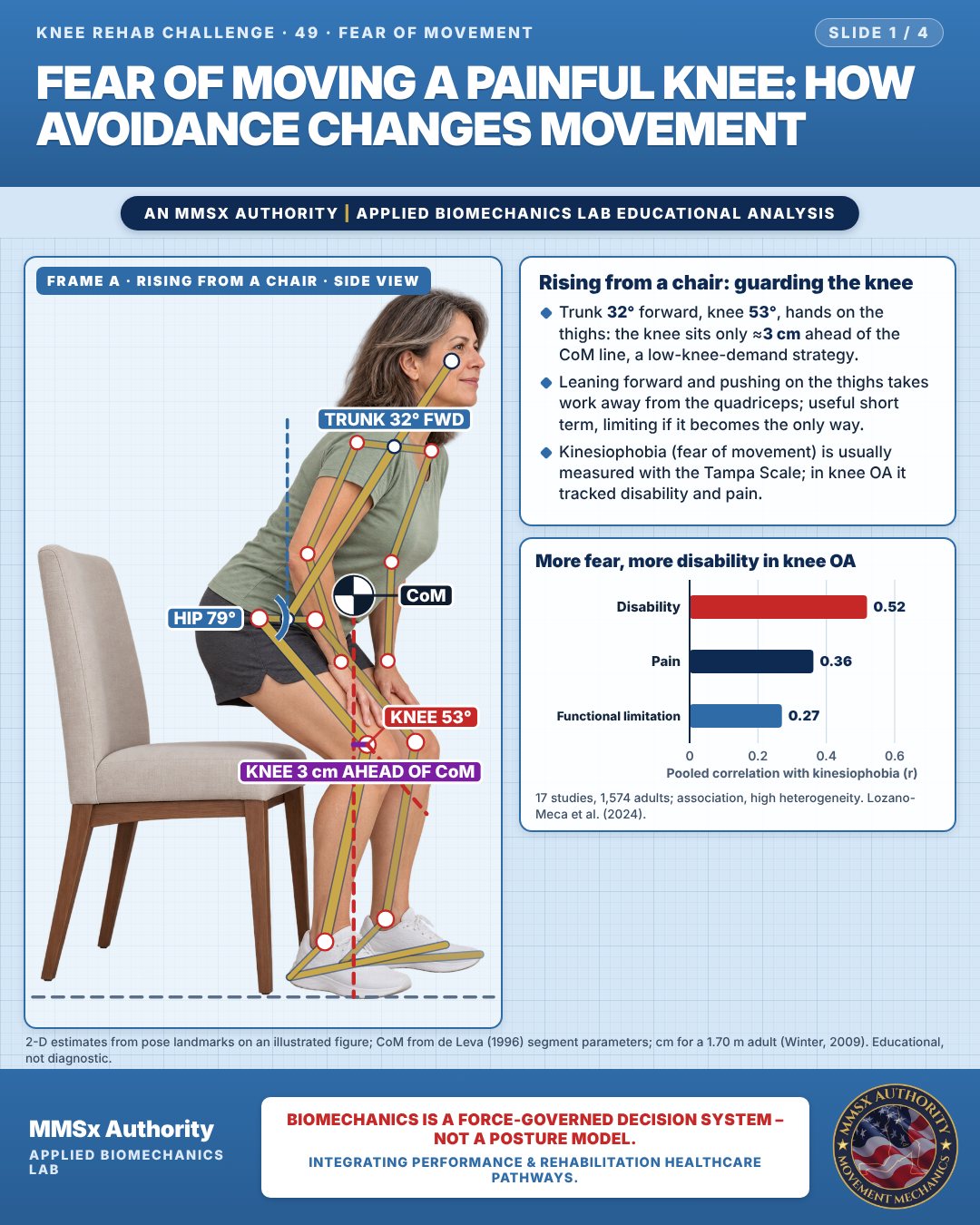
Rising from a chair: guarding the knee
Trunk 32° forward, knee 53°, hands on the thighs: the knee sits only ≈3 cm ahead of the CoM line, a low-knee-demand strategy.
Leaning forward and pushing on the thighs takes work away from the quadriceps; useful short term, limiting if it becomes the only way.
Kinesiophobia (fear of movement) is usually measured with the Tampa Scale; in knee OA it tracked disability and pain.
More fear, more disability in knee OA
Movement B: Pausing mid-turn, oblique
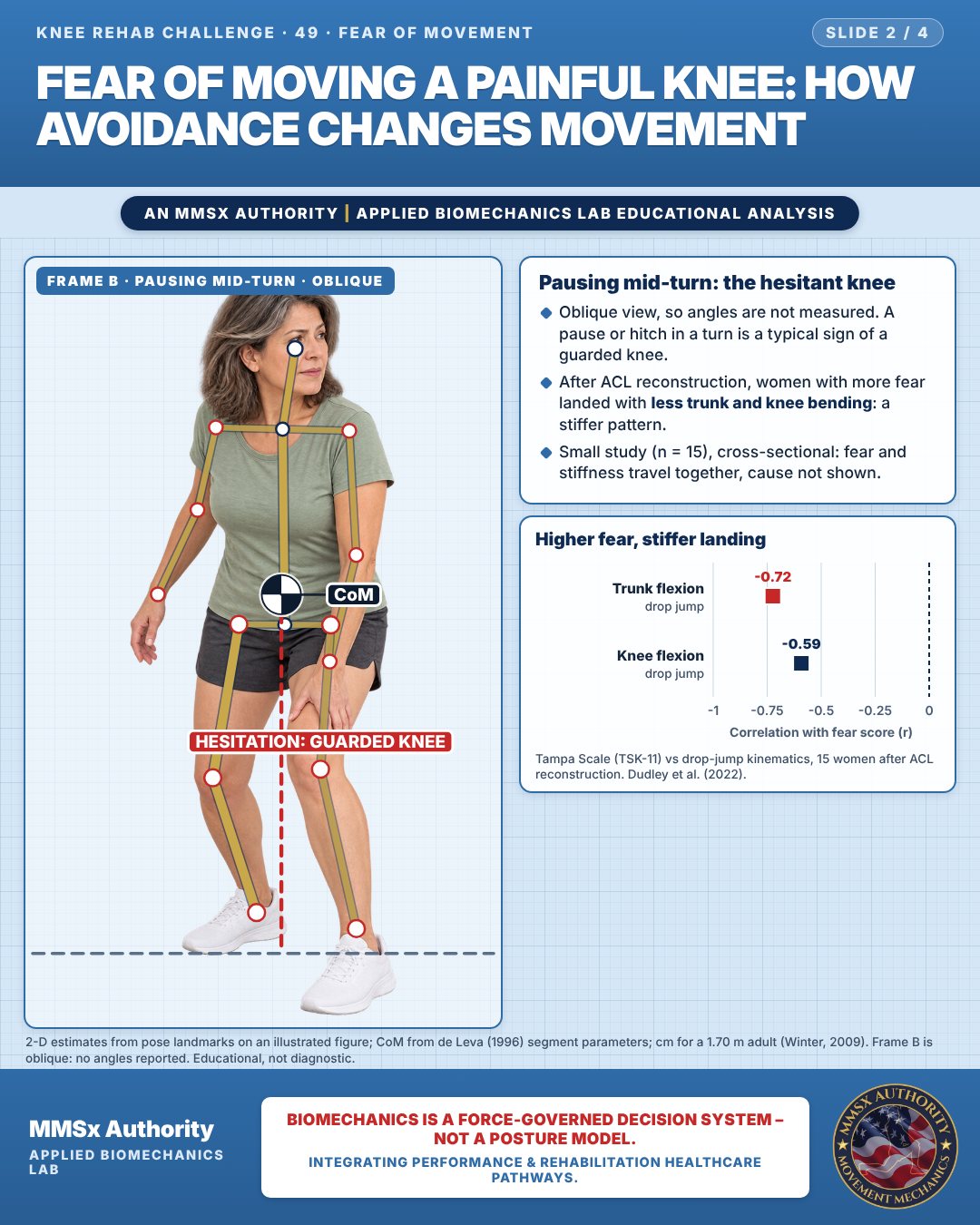
Pausing mid-turn: the hesitant knee
Oblique view, so angles are not measured. A pause or hitch in a turn is a typical sign of a guarded knee.
After ACL reconstruction, women with more fear landed with less trunk and knee bending: a stiffer pattern.
Small study (n = 15), cross-sectional: fear and stiffness travel together, cause not shown.
Higher fear, stiffer landing
Movement C: Stair descent (side view)
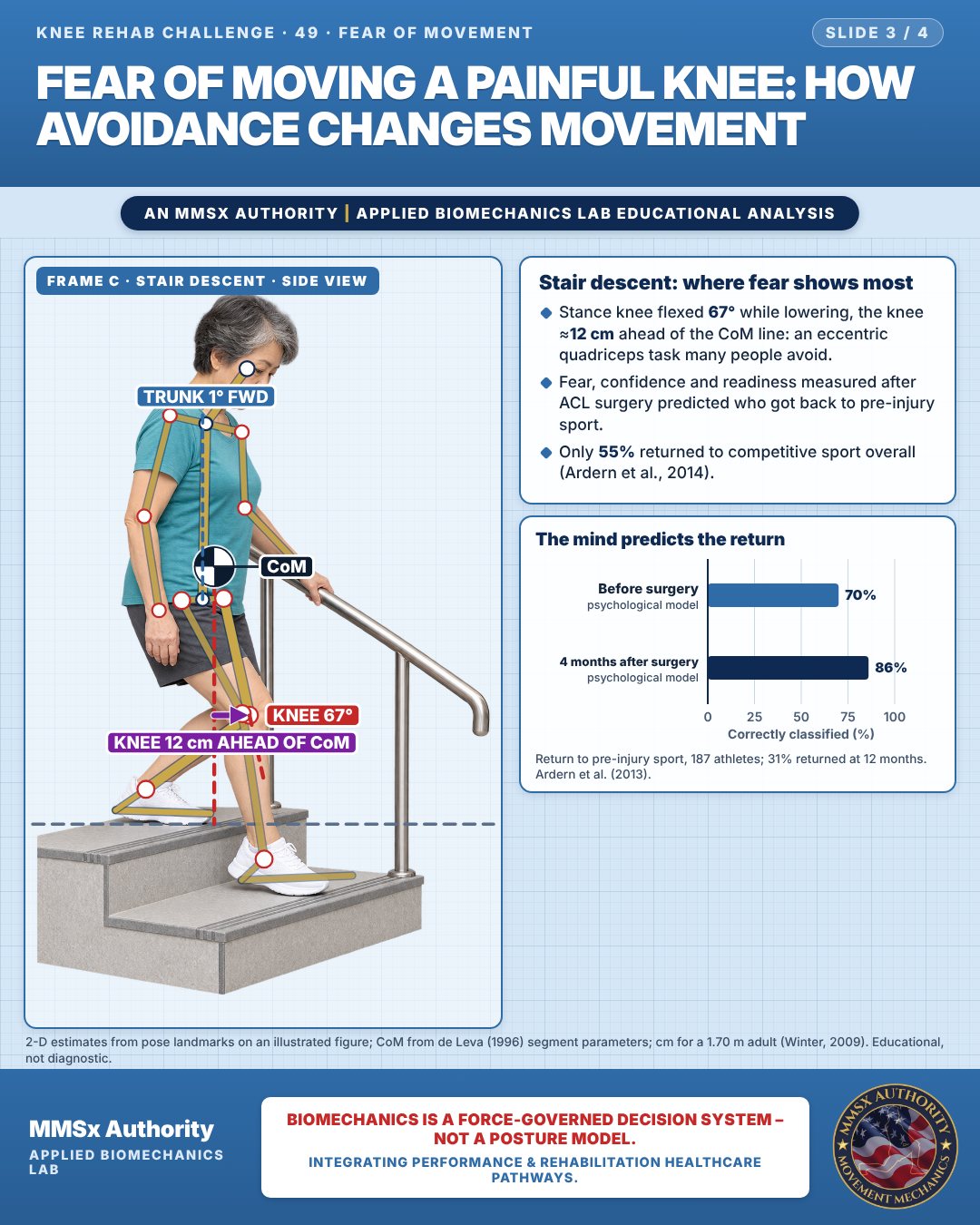
Stair descent: where fear shows most
Stance knee flexed 67° while lowering, the knee ≈12 cm ahead of the CoM line: an eccentric quadriceps task many people avoid.
Fear, confidence and readiness measured after ACL surgery predicted who got back to pre-injury sport.
Only 55% returned to competitive sport overall (Ardern et al., 2014).
The mind predicts the return
Decision pathway
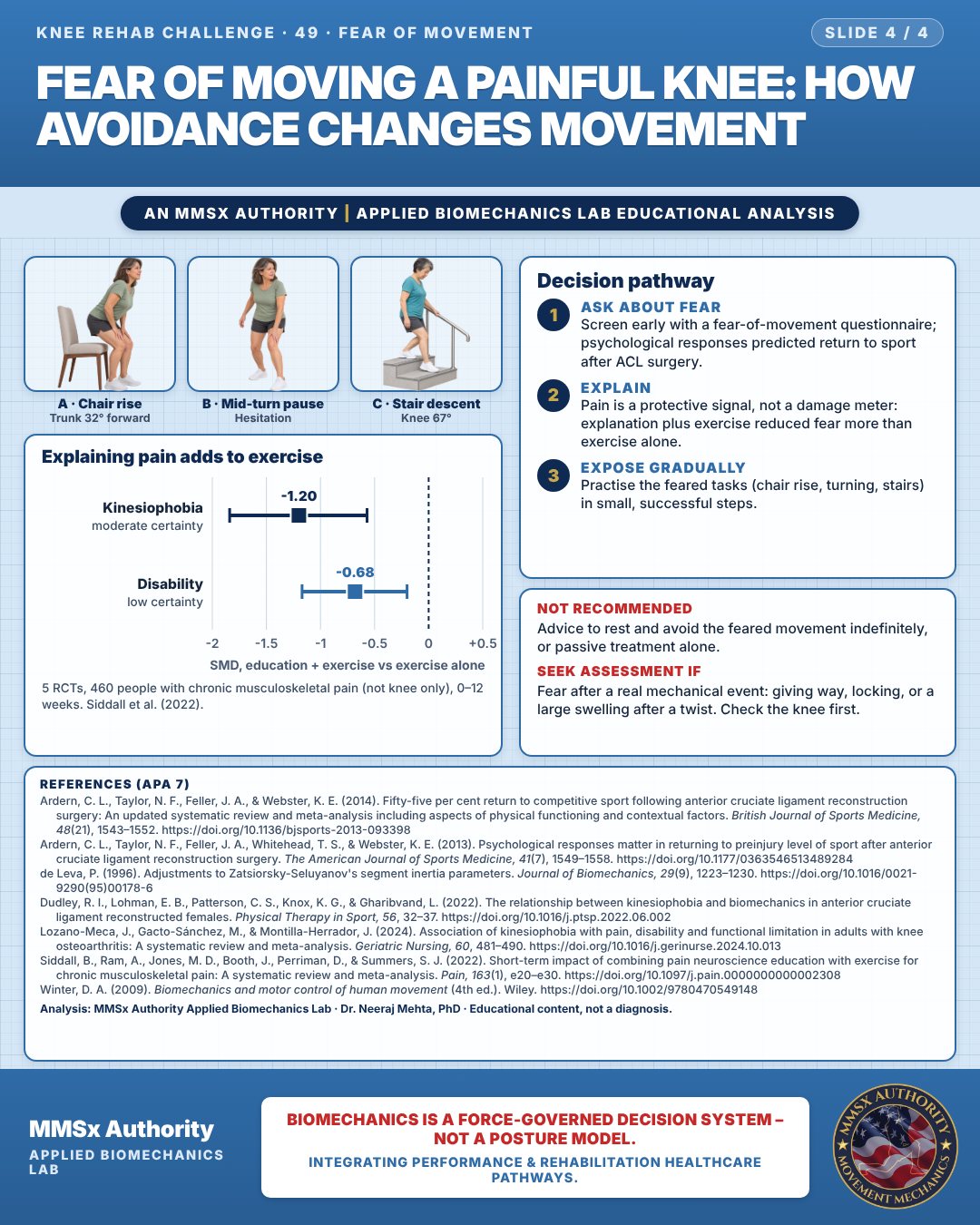
Explaining pain adds to exercise
Ask about fear
Screen early with a fear-of-movement questionnaire; psychological responses predicted return to sport after ACL surgery.
Explain
Pain is a protective signal, not a damage meter: explanation plus exercise reduced fear more than exercise alone.
Expose gradually
Practise the feared tasks (chair rise, turning, stairs) in small, successful steps.
What the evidence supports
- Screen for fear and readiness early: psychological responses measured before and 4 months after ACL reconstruction classified return to sport correctly in 70% and 86% of athletes (Ardern 2013); authors recommend early screening for maladaptive responses.
- Combine explanation (pain education) with graded, progressively loaded exercise — the combination outperformed exercise alone on kinesiophobia, disability and pain in the short term (Siddall 2022). Practise the feared tasks directly (chair rise, turning, stair descent) in graded steps.
Myth and evidence
Myth“If it hurts, it's harming — so avoid it.”
EvidenceIn knee OA, higher fear of movement is linked with more disability (r = 0.519) and pain (r = 0.362) (Lozano-Meca 2024), and adding education to exercise reduced kinesiophobia (SMD −1.20) (Siddall 2022). Associations do not prove cause, but avoidance is not a protective strategy on this evidence.
Myth“Once the knee is strong, the head follows.”
EvidenceOnly 55% returned to competitive sport after ACL reconstruction (Ardern 2014), and psychological variables independently predicted return (Ardern 2013).
Cautions
Not recommended
Advice to rest and avoid the feared movement indefinitely, or passive treatment alone.
Seek assessment if
Fear after a real mechanical event: giving way, locking, or a large swelling after a twist. Check the knee first.
Methods note
2-D estimates from pose landmarks on an illustrated figure; CoM from de Leva (1996) segment parameters; cm for a 1.70 m adult (Winter, 2009). Frame B is oblique: no angles reported. These are educational estimates, not a diagnosis.
References
- Ardern, C. L., Taylor, N. F., Feller, J. A., & Webster, K. E. (2014). Fifty-five per cent return to competitive sport following anterior cruciate ligament reconstruction surgery: An updated systematic review and meta-analysis including aspects of physical functioning and contextual factors. British Journal of Sports Medicine, 48(21), 1543–1552. https://doi.org/10.1136/bjsports-2013-093398
- Ardern, C. L., Taylor, N. F., Feller, J. A., Whitehead, T. S., & Webster, K. E. (2013). Psychological responses matter in returning to preinjury level of sport after anterior cruciate ligament reconstruction surgery. The American Journal of Sports Medicine, 41(7), 1549–1558. https://doi.org/10.1177/0363546513489284
- de Leva, P. (1996). Adjustments to Zatsiorsky-Seluyanov's segment inertia parameters. Journal of Biomechanics, 29(9), 1223–1230. https://doi.org/10.1016/0021-9290(95)00178-6
- Dudley, R. I., Lohman, E. B., Patterson, C. S., Knox, K. G., & Gharibvand, L. (2022). The relationship between kinesiophobia and biomechanics in anterior cruciate ligament reconstructed females. Physical Therapy in Sport, 56, 32–37. https://doi.org/10.1016/j.ptsp.2022.06.002
- Lozano-Meca, J., Gacto-Sánchez, M., & Montilla-Herrador, J. (2024). Association of kinesiophobia with pain, disability and functional limitation in adults with knee osteoarthritis: A systematic review and meta-analysis. Geriatric Nursing, 60, 481–490. https://doi.org/10.1016/j.gerinurse.2024.10.013
- Siddall, B., Ram, A., Jones, M. D., Booth, J., Perriman, D., & Summers, S. J. (2022). Short-term impact of combining pain neuroscience education with exercise for chronic musculoskeletal pain: A systematic review and meta-analysis. Pain, 163(1), e20–e30. https://doi.org/10.1097/j.pain.0000000000002308
- Winter, D. A. (2009). Biomechanics and motor control of human movement (4th ed.). Wiley. https://doi.org/10.1002/9780470549148
Cite this article
Mehta, N. (2026, October 23). Fear of moving a painful knee: how avoidance changes movement. MMSx Authority Applied Biomechanics Lab. https://mmsxauthority.org/edu/analysis/knee/49-fear-of-moving-a-painful-knee-how-avoidance-changes-movement/
Part of the collection
Mehta, N. (2026). Knee Rehabilitation: 50 Evidence-Based Biomechanics Analyses [Collection]. MMSx Authority Applied Biomechanics Lab. Zenodo. https://doi.org/10.5281/zenodo.23735752