Knee Rehab Challenge · 48
Returning to running after a knee injury
Return to running is the staged reintroduction of running after a knee injury or surgery, in which running load (time, distance, speed, gradient) is…
Key points
- Gate. Time plus criteria: range of motion over 95% of the other knee, pain under 2/10, strength and hop symmetry over 70%.
- Build. Start with short walk–run intervals; increase total time gradually, as a novice would.
- Adjust. If the knee is sensitive, try a 5–10% higher step rate to reduce knee load.
What it is
Return to running is the staged reintroduction of running after a knee injury or surgery, in which running load (time, distance, speed, gradient) is increased progressively once agreed time-based and clinical/performance criteria are met, while symptoms and knee response are monitored.
How we analysed the movement
Three movements relevant to this topic were analysed from illustrated reference figures. Joint centres were located with two-dimensional pose estimation; joint angles, the whole-body centre of mass and, where relevant, the ground-reaction-force line and its moment arm about the knee were then calculated from standard segment parameters. The figures are educational estimates that show how position changes mechanical demand; they are not measurements of a patient. Every research value quoted below comes from the published source cited beside it.
Movement A: Easy running (side view)
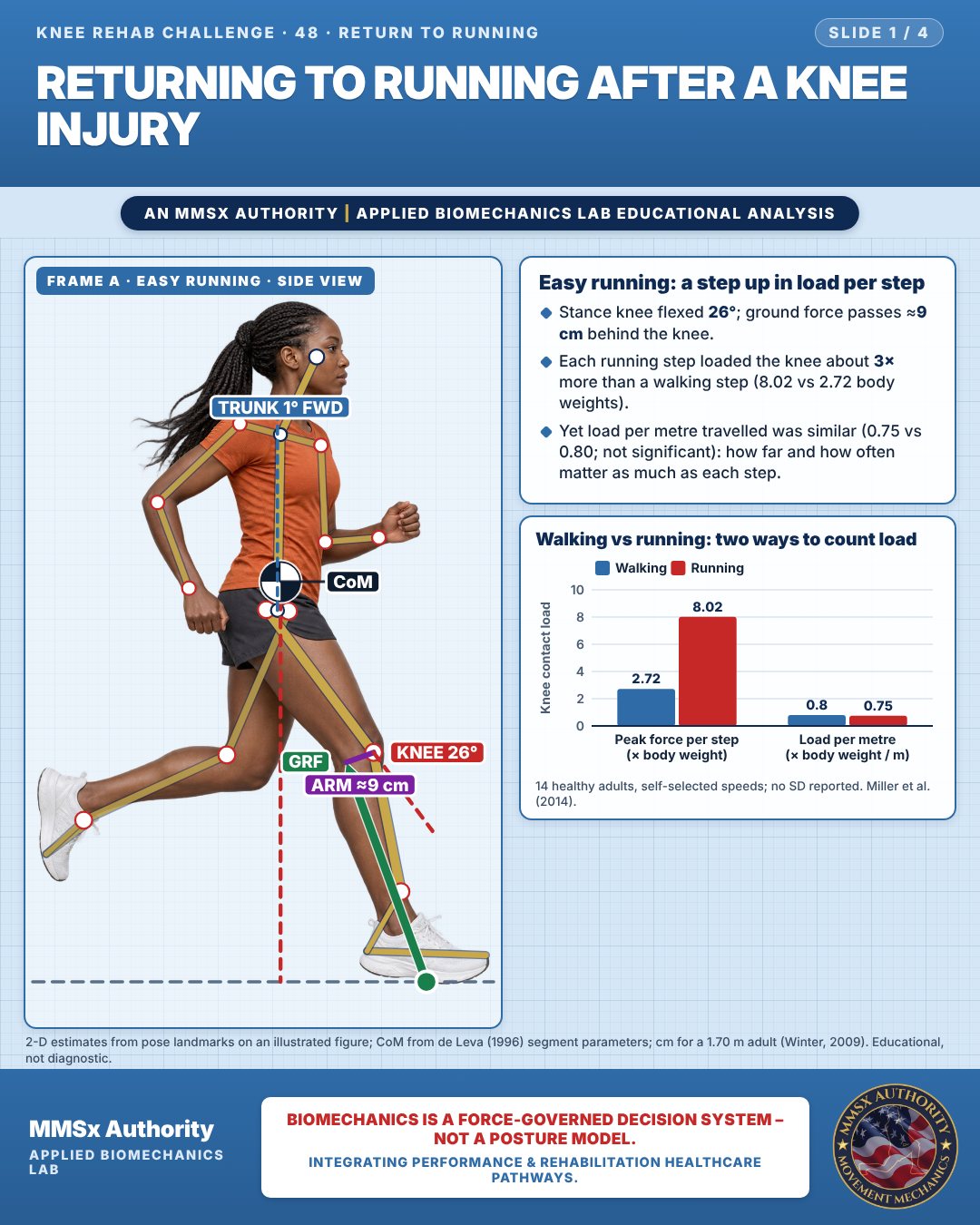
Easy running: a step up in load per step
Stance knee flexed 26°; ground force passes ≈9 cm behind the knee.
Each running step loaded the knee about 3× more than a walking step (8.02 vs 2.72 body weights).
Yet load per metre travelled was similar (0.75 vs 0.80; not significant): how far and how often matter as much as each step.
Walking vs running: two ways to count load
Movement B: Uphill running (side view)
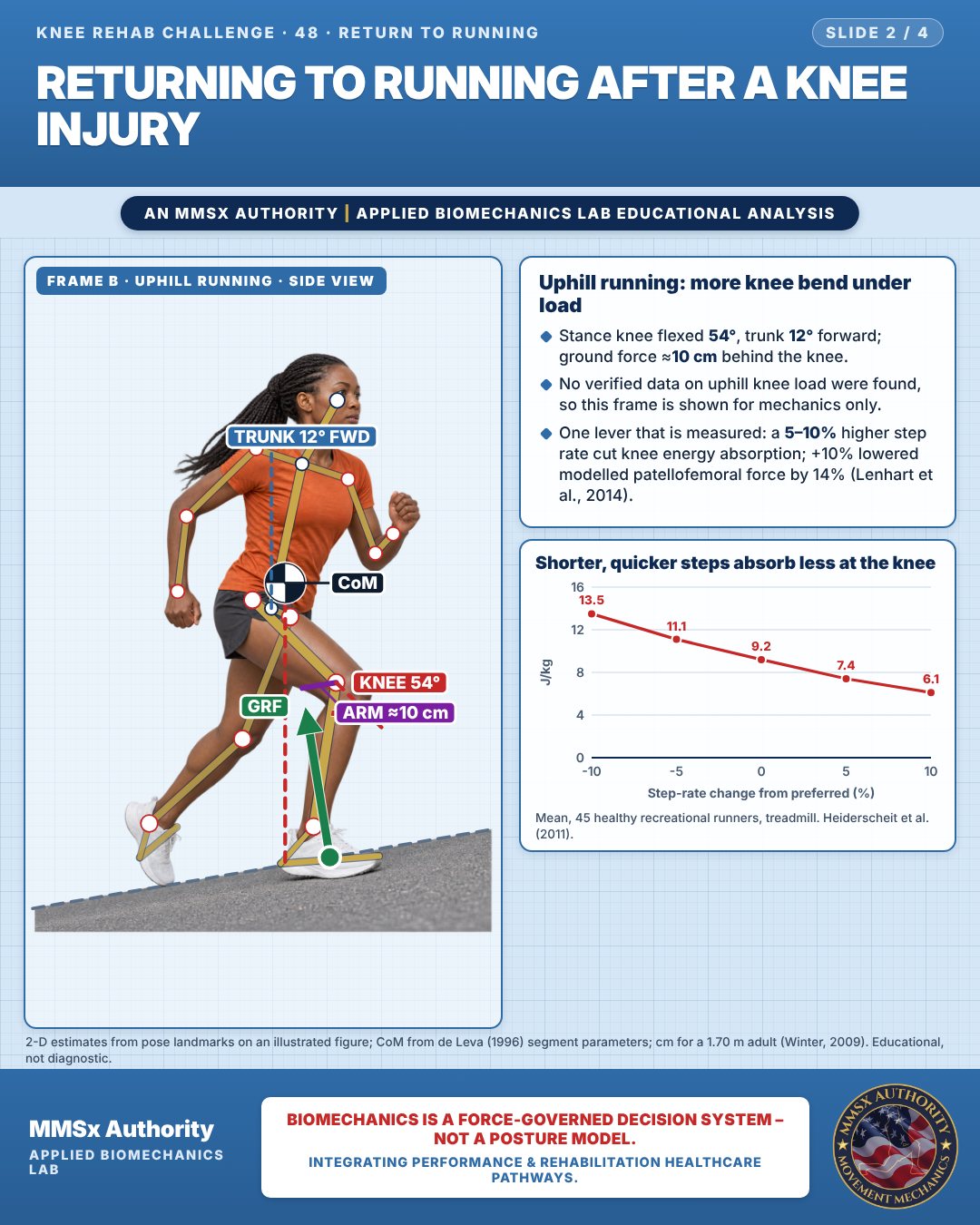
Uphill running: more knee bend under load
Stance knee flexed 54°, trunk 12° forward; ground force ≈10 cm behind the knee.
No verified data on uphill knee load were found, so this frame is shown for mechanics only.
One lever that is measured: a 5–10% higher step rate cut knee energy absorption; +10% lowered modelled patellofemoral force by 14% (Lenhart et al., 2014).
Shorter, quicker steps absorb less at the knee
Movement C: Running stance (side view)
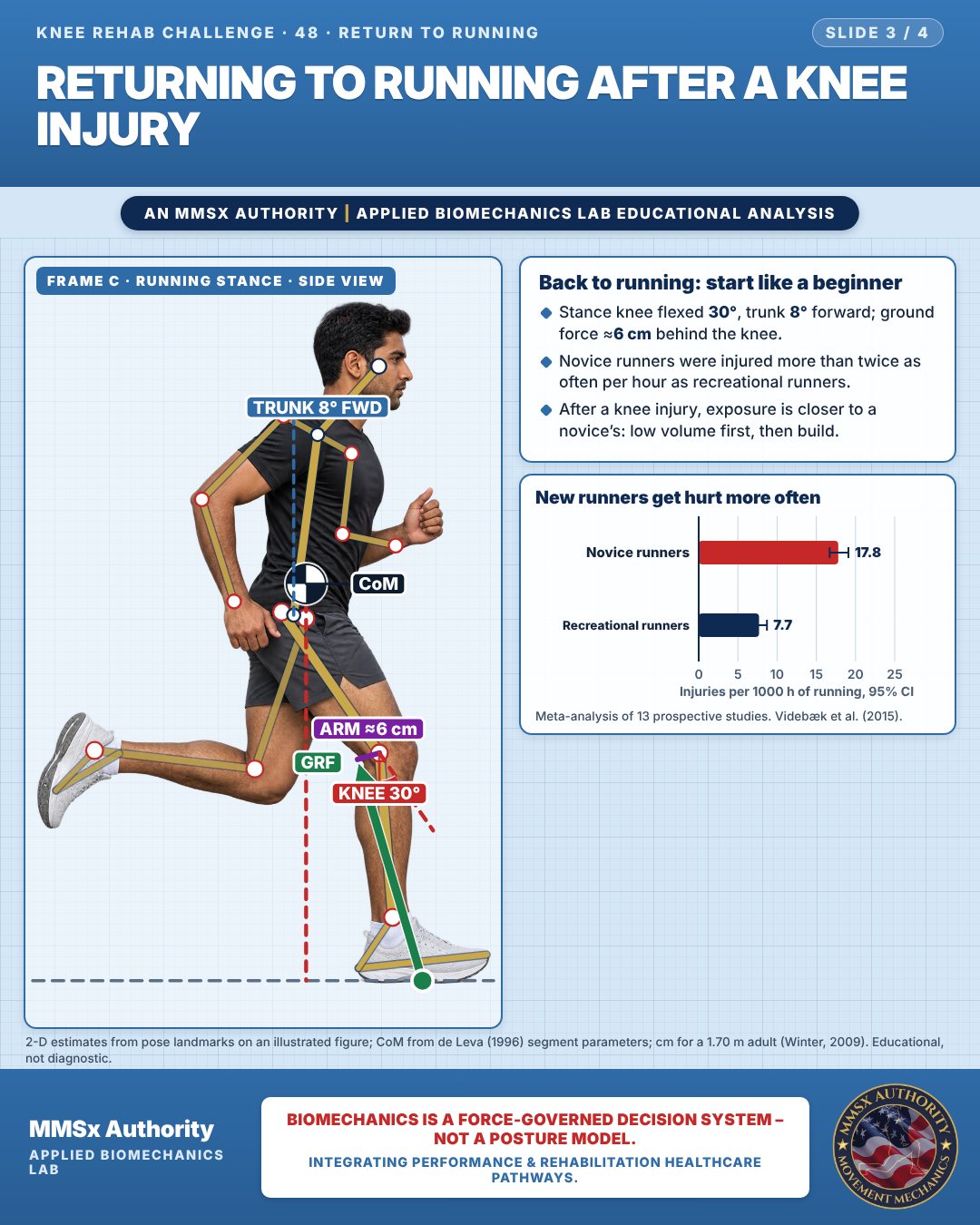
Back to running: start like a beginner
Stance knee flexed 30°, trunk 8° forward; ground force ≈6 cm behind the knee.
Novice runners were injured more than twice as often per hour as recreational runners.
After a knee injury, exposure is closer to a novice’s: low volume first, then build.
New runners get hurt more often
Decision pathway
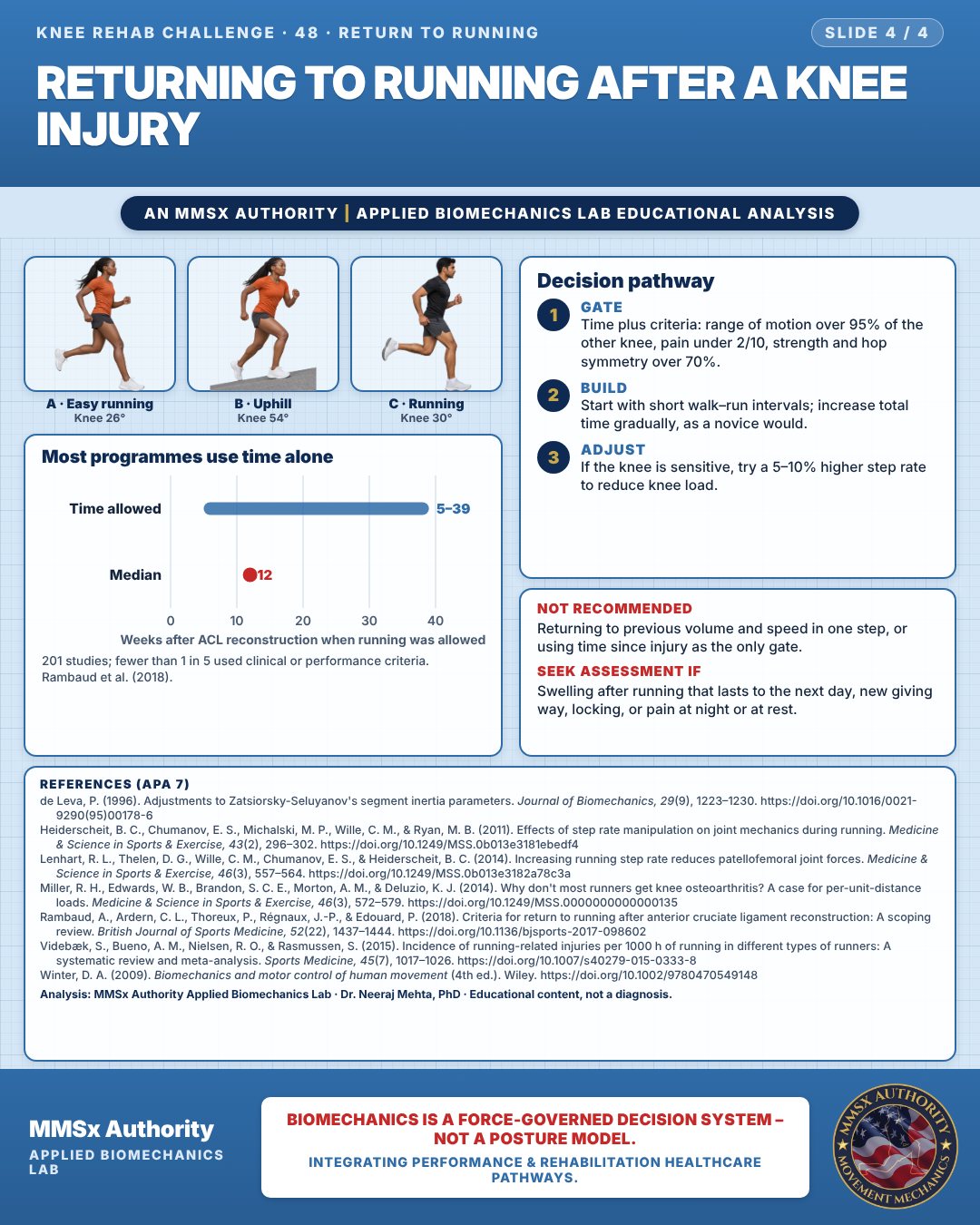
Most programmes use time alone
Gate
Time plus criteria: range of motion over 95% of the other knee, pain under 2/10, strength and hop symmetry over 70%.
Build
Start with short walk–run intervals; increase total time gradually, as a novice would.
Adjust
If the knee is sensitive, try a 5–10% higher step rate to reduce knee load.
What the evidence supports
- Use criteria plus time, not time alone, to restart running after ACL reconstruction (Rambaud 2018 conclusion).
- Graded exposure: build total running time/distance progressively; novice-level exposure carries the highest injury incidence (Videbæk 2015).
- Gait lever: a small increase in step rate (+5% to +10%) reduced knee energy absorption, peak knee flexion and knee extension moment in healthy runners (Heiderscheit 2011) and reduced modelled peak patellofemoral force by 14% at +10% (Lenhart 2014) — a candidate strategy for runners with patellofemoral symptoms; evidence comes from healthy-runner laboratory studies.
Myth and evidence
Myth“Running wears out knees.”
EvidenceRunning produced about three times the peak knee force per step of walking (8.02 vs 2.72 BW), but load per metre travelled was not different (0.75 vs 0.80 BW/m) (Miller 2014). Load dose depends on how far, how often and how the stride is organised.
Myth“Once it's 3 months, you're ready to run.”
EvidenceThe 12-week median is a convention; the review recommends adding performance criteria (Rambaud 2018).
Cautions
Not recommended
Returning to previous volume and speed in one step, or using time since injury as the only gate.
Seek assessment if
Swelling after running that lasts to the next day, new giving way, locking, or pain at night or at rest.
Methods note
2-D estimates from pose landmarks on an illustrated figure; CoM from de Leva (1996) segment parameters; cm for a 1.70 m adult (Winter, 2009). These are educational estimates, not a diagnosis.
References
- de Leva, P. (1996). Adjustments to Zatsiorsky-Seluyanov's segment inertia parameters. Journal of Biomechanics, 29(9), 1223–1230. https://doi.org/10.1016/0021-9290(95)00178-6
- Heiderscheit, B. C., Chumanov, E. S., Michalski, M. P., Wille, C. M., & Ryan, M. B. (2011). Effects of step rate manipulation on joint mechanics during running. Medicine & Science in Sports & Exercise, 43(2), 296–302. https://doi.org/10.1249/MSS.0b013e3181ebedf4
- Lenhart, R. L., Thelen, D. G., Wille, C. M., Chumanov, E. S., & Heiderscheit, B. C. (2014). Increasing running step rate reduces patellofemoral joint forces. Medicine & Science in Sports & Exercise, 46(3), 557–564. https://doi.org/10.1249/MSS.0b013e3182a78c3a
- Miller, R. H., Edwards, W. B., Brandon, S. C. E., Morton, A. M., & Deluzio, K. J. (2014). Why don't most runners get knee osteoarthritis? A case for per-unit-distance loads. Medicine & Science in Sports & Exercise, 46(3), 572–579. https://doi.org/10.1249/MSS.0000000000000135
- Rambaud, A., Ardern, C. L., Thoreux, P., Régnaux, J.-P., & Edouard, P. (2018). Criteria for return to running after anterior cruciate ligament reconstruction: A scoping review. British Journal of Sports Medicine, 52(22), 1437–1444. https://doi.org/10.1136/bjsports-2017-098602
- Videbæk, S., Bueno, A. M., Nielsen, R. O., & Rasmussen, S. (2015). Incidence of running-related injuries per 1000 h of running in different types of runners: A systematic review and meta-analysis. Sports Medicine, 45(7), 1017–1026. https://doi.org/10.1007/s40279-015-0333-8
- Winter, D. A. (2009). Biomechanics and motor control of human movement (4th ed.). Wiley. https://doi.org/10.1002/9780470549148
Cite this article
Mehta, N. (2026, October 23). Returning to running after a knee injury. MMSx Authority Applied Biomechanics Lab. https://mmsxauthority.org/edu/analysis/knee/48-returning-to-running-after-a-knee-injury/
Part of the collection
Mehta, N. (2026). Knee Rehabilitation: 50 Evidence-Based Biomechanics Analyses [Collection]. MMSx Authority Applied Biomechanics Lab. Zenodo. https://doi.org/10.5281/zenodo.23735752