Knee Rehab Challenge · 50
Knee braces, sleeves and tape: what they can and can't do
Knee braces, sleeves and tape are external supports worn on the knee. Movement analysis, verified research data and a decision pathway from the MMSx Authority
Key points
- Exercise first. Hip- and knee-strengthening is the core treatment; supports are add-ons, not substitutes.
- Use short term. Tape or foot orthoses can help symptoms short term alongside exercise; reassess and wean.
- Match the problem. Medial knee OA with instability or abnormal loading: discuss a brace or a cane; guidelines differ.
What it is
Knee braces, sleeves and tape are external supports worn on the knee. They range from compression sleeves and patellar taping to functional and unloader braces designed to alter alignment or joint loading. They act on the skin and soft tissues and on how the knee feels; they cannot remove the joint forces generated by body weight and muscle action, so they are used, if at all, as additions to exercise rather than substitutes for it.
How we analysed the movement
Three movements relevant to this topic were analysed from illustrated reference figures. Joint centres were located with two-dimensional pose estimation; joint angles, the whole-body centre of mass and, where relevant, the ground-reaction-force line and its moment arm about the knee were then calculated from standard segment parameters. The figures are educational estimates that show how position changes mechanical demand; they are not measurements of a patient. Every research value quoted below comes from the published source cited beside it.
Movement A: Step-down (side view)
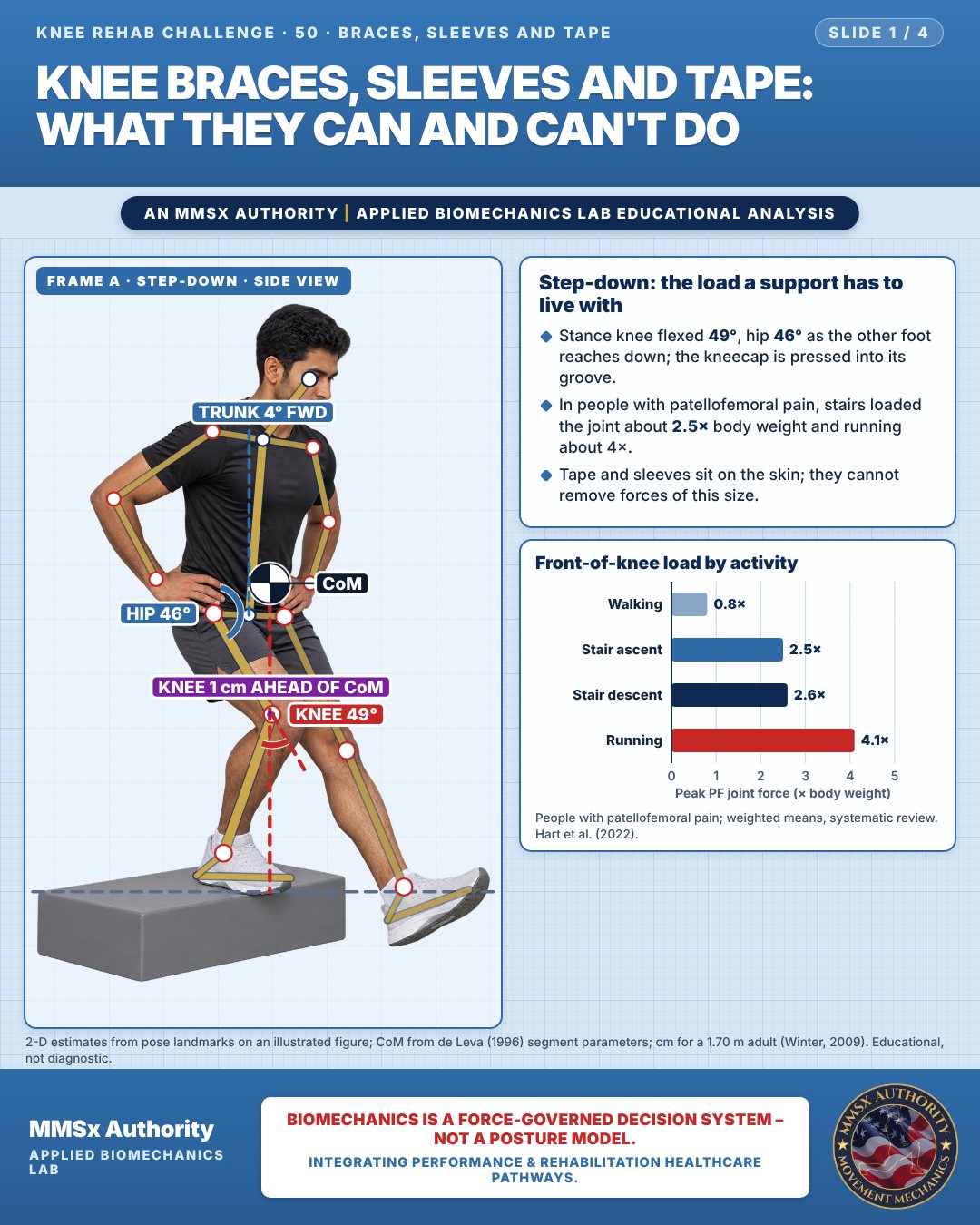
Step-down: the load a support has to live with
Stance knee flexed 49°, hip 46° as the other foot reaches down; the kneecap is pressed into its groove.
In people with patellofemoral pain, stairs loaded the joint about 2.5× body weight and running about 4×.
Tape and sleeves sit on the skin; they cannot remove forces of this size.
Front-of-knee load by activity
Movement B: Single-leg squat (front view)
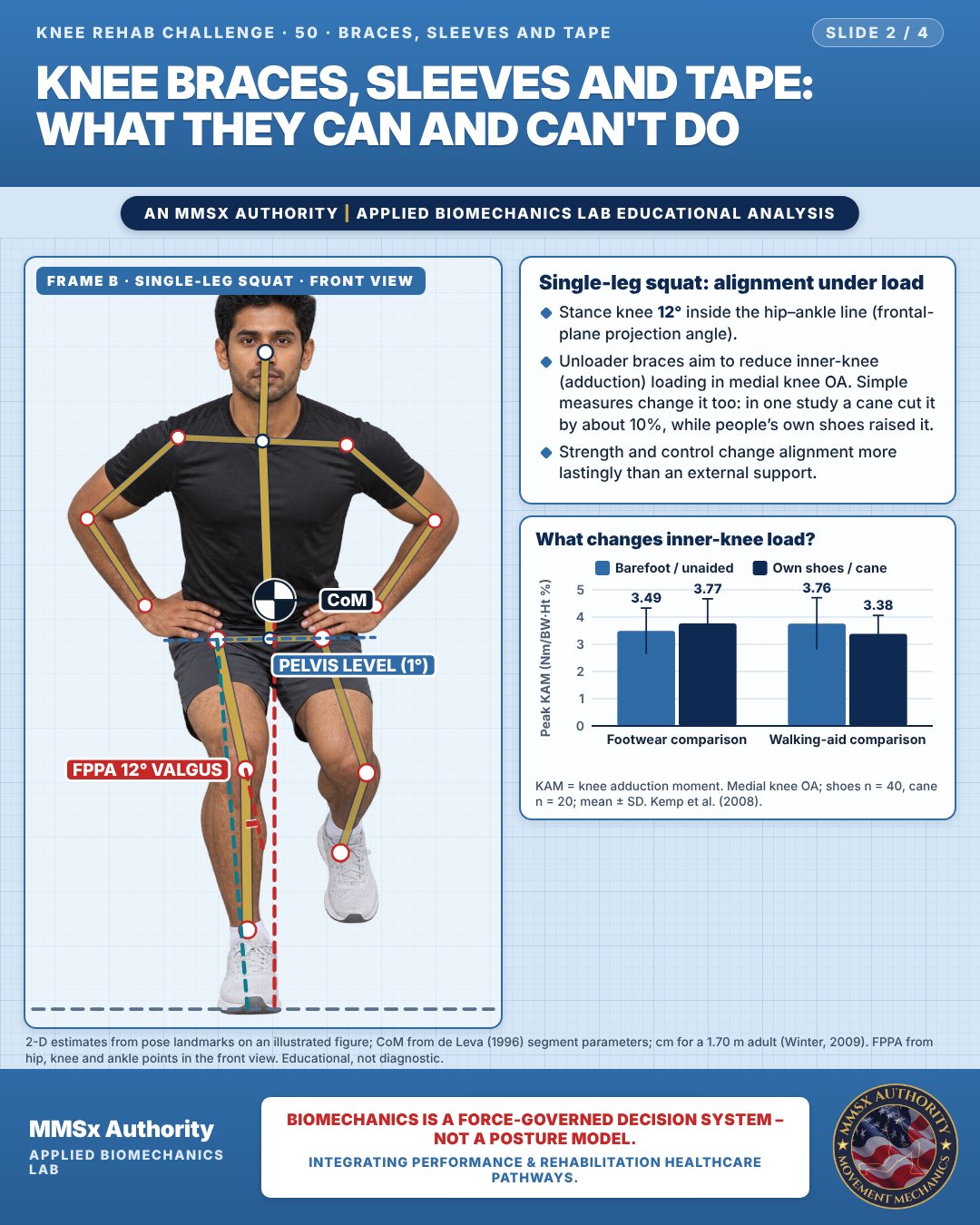
Single-leg squat: alignment under load
Stance knee 12° inside the hip–ankle line (frontal-plane projection angle).
Unloader braces aim to reduce inner-knee (adduction) loading in medial knee OA. Simple measures change it too: in one study a cane cut it by about 10%, while people’s own shoes raised it.
Strength and control change alignment more lastingly than an external support.
What changes inner-knee load?
Movement C: Seated (front view)
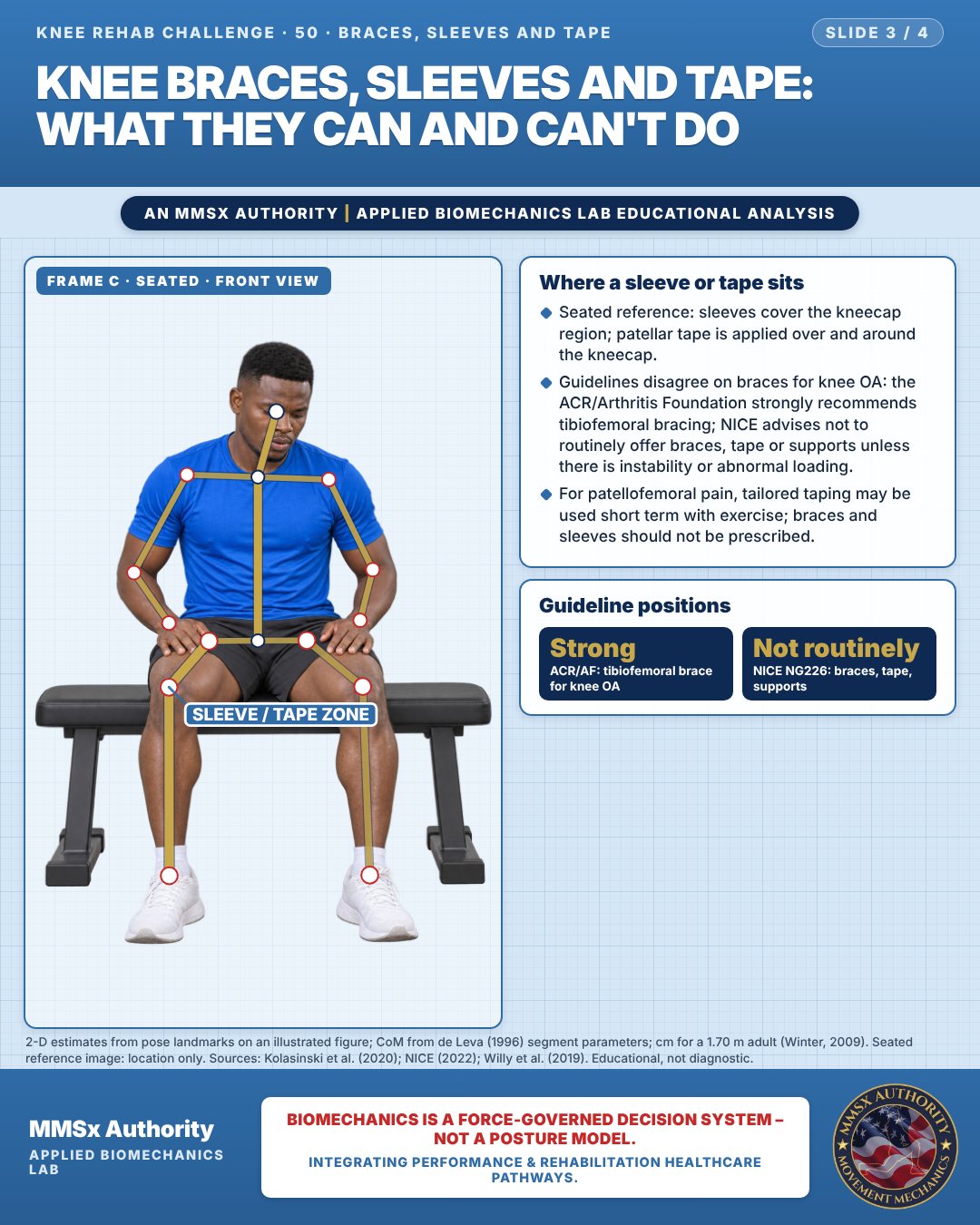
Where a sleeve or tape sits
Seated reference: sleeves cover the kneecap region; patellar tape is applied over and around the kneecap.
Guidelines disagree on braces for knee OA: the ACR/Arthritis Foundation strongly recommends tibiofemoral bracing; NICE advises not to routinely offer braces, tape or supports unless there is instability or abnormal loading.
For patellofemoral pain, tailored taping may be used short term with exercise; braces and sleeves should not be prescribed.
Guideline positions
Decision pathway
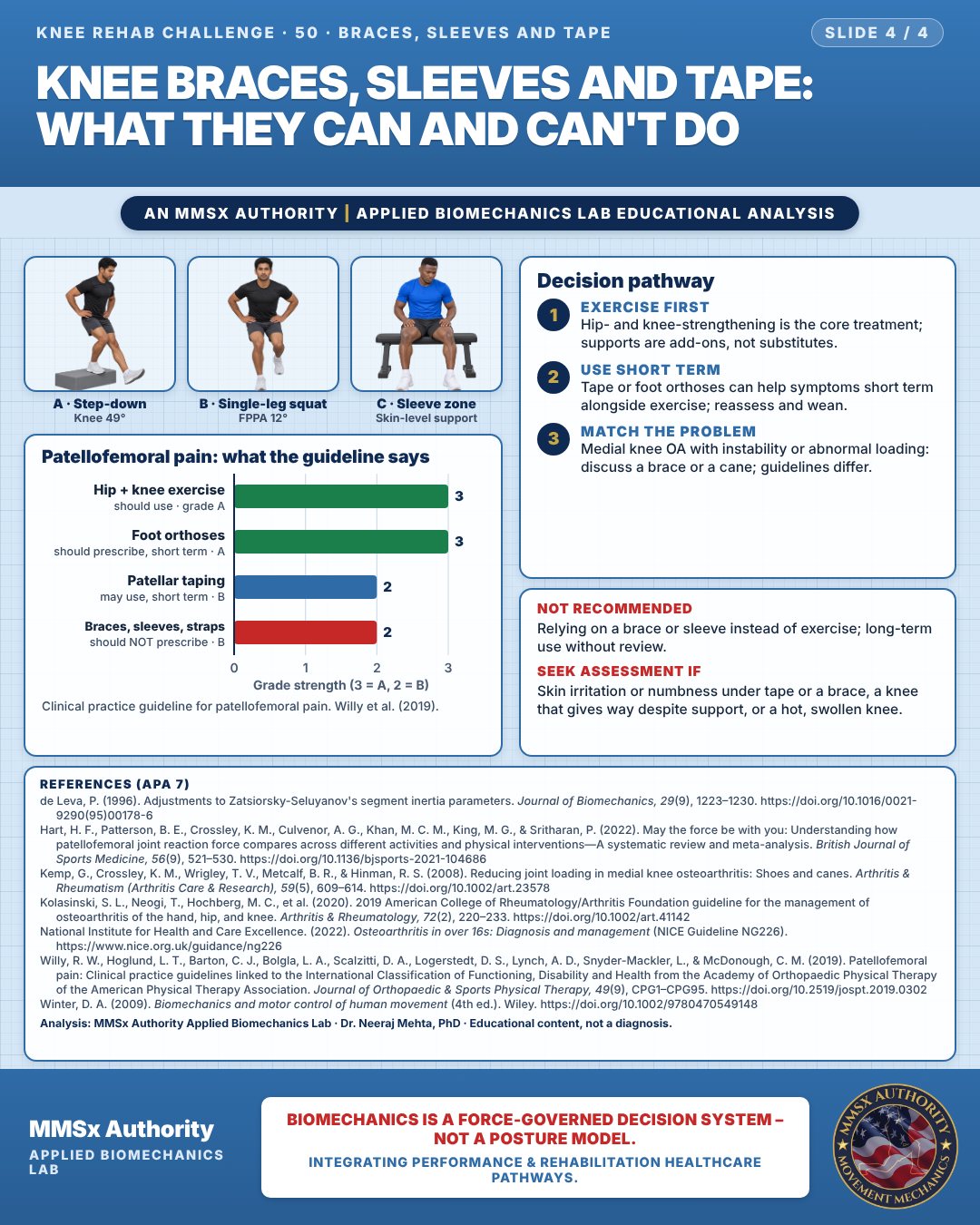
Patellofemoral pain: what the guideline says
Exercise first
Hip- and knee-strengthening is the core treatment; supports are add-ons, not substitutes.
Use short term
Tape or foot orthoses can help symptoms short term alongside exercise; reassess and wean.
Match the problem
Medial knee OA with instability or abnormal loading: discuss a brace or a cane; guidelines differ.
Cautions
Not recommended
Relying on a brace or sleeve instead of exercise; long-term use without review.
Seek assessment if
Skin irritation or numbness under tape or a brace, a knee that gives way despite support, or a hot, swollen knee.
Methods note
2-D estimates from pose landmarks on an illustrated figure; CoM from de Leva (1996) segment parameters; cm for a 1.70 m adult (Winter, 2009). FPPA from hip, knee and ankle points in the front view. Seated reference image: location only. Sources: Kolasinski et al. (2020); NICE (2022); Willy et al. (2019). These are educational estimates, not a diagnosis.
References
- de Leva, P. (1996). Adjustments to Zatsiorsky-Seluyanov's segment inertia parameters. Journal of Biomechanics, 29(9), 1223–1230. https://doi.org/10.1016/0021-9290(95)00178-6
- Hart, H. F., Patterson, B. E., Crossley, K. M., Culvenor, A. G., Khan, M. C. M., King, M. G., & Sritharan, P. (2022). May the force be with you: Understanding how patellofemoral joint reaction force compares across different activities and physical interventions—A systematic review and meta-analysis. British Journal of Sports Medicine, 56(9), 521–530. https://doi.org/10.1136/bjsports-2021-104686
- Kemp, G., Crossley, K. M., Wrigley, T. V., Metcalf, B. R., & Hinman, R. S. (2008). Reducing joint loading in medial knee osteoarthritis: Shoes and canes. Arthritis & Rheumatism (Arthritis Care & Research), 59(5), 609–614. https://doi.org/10.1002/art.23578
- Kolasinski, S. L., Neogi, T., Hochberg, M. C., et al. (2020). 2019 American College of Rheumatology/Arthritis Foundation guideline for the management of osteoarthritis of the hand, hip, and knee. Arthritis & Rheumatology, 72(2), 220–233. https://doi.org/10.1002/art.41142
- National Institute for Health and Care Excellence. (2022). Osteoarthritis in over 16s: Diagnosis and management (NICE Guideline NG226). https://www.nice.org.uk/guidance/ng226
- Willy, R. W., Hoglund, L. T., Barton, C. J., Bolgla, L. A., Scalzitti, D. A., Logerstedt, D. S., Lynch, A. D., Snyder-Mackler, L., & McDonough, C. M. (2019). Patellofemoral pain: Clinical practice guidelines linked to the International Classification of Functioning, Disability and Health from the Academy of Orthopaedic Physical Therapy of the American Physical Therapy Association. Journal of Orthopaedic & Sports Physical Therapy, 49(9), CPG1–CPG95. https://doi.org/10.2519/jospt.2019.0302
- Winter, D. A. (2009). Biomechanics and motor control of human movement (4th ed.). Wiley. https://doi.org/10.1002/9780470549148
Cite this article
Mehta, N. (2026, October 23). Knee braces, sleeves and tape: what they can and can't do. MMSx Authority Applied Biomechanics Lab. https://mmsxauthority.org/edu/analysis/knee/50-knee-braces-sleeves-and-tape-what-they-can-and-cant-do/
Part of the collection
Mehta, N. (2026). Knee Rehabilitation: 50 Evidence-Based Biomechanics Analyses [Collection]. MMSx Authority Applied Biomechanics Lab. Zenodo. https://doi.org/10.5281/zenodo.23735752