Knee Rehab Challenge · 47
After meniscus surgery: repair, removal and return to load
Meniscus surgery is either removal of the torn part of the meniscus (partial meniscectomy, usually arthroscopic) or stitching the tear so that it can…
Key points
- Match the tear. Degenerative tear in mid-life: supervised exercise first. Traumatic tear in a young knee: repair is often preferred.
- Protect a repair. Early motion and weight-bearing are common; deep loaded squats and pivoting come last. Follow the surgeon’s protocol.
- Return on criteria. Return times after repair ranged 3.3–10 months; 97% of protocols used criteria, not just time.
What it is
Meniscus surgery is either removal of the torn part of the meniscus (partial meniscectomy, usually arthroscopic) or stitching the tear so that it can heal (meniscal repair). Removal relieves a mechanical problem but reduces the cartilage area that shares load; repair preserves the load-sharing tissue but needs a longer, protected return to deep flexion and twisting load.
How we analysed the movement
Three movements relevant to this topic were analysed from illustrated reference figures. Joint centres were located with two-dimensional pose estimation; joint angles, the whole-body centre of mass and, where relevant, the ground-reaction-force line and its moment arm about the knee were then calculated from standard segment parameters. The figures are educational estimates that show how position changes mechanical demand; they are not measurements of a patient. Every research value quoted below comes from the published source cited beside it.
Movement A: Deep squat to a low shelf (side view)
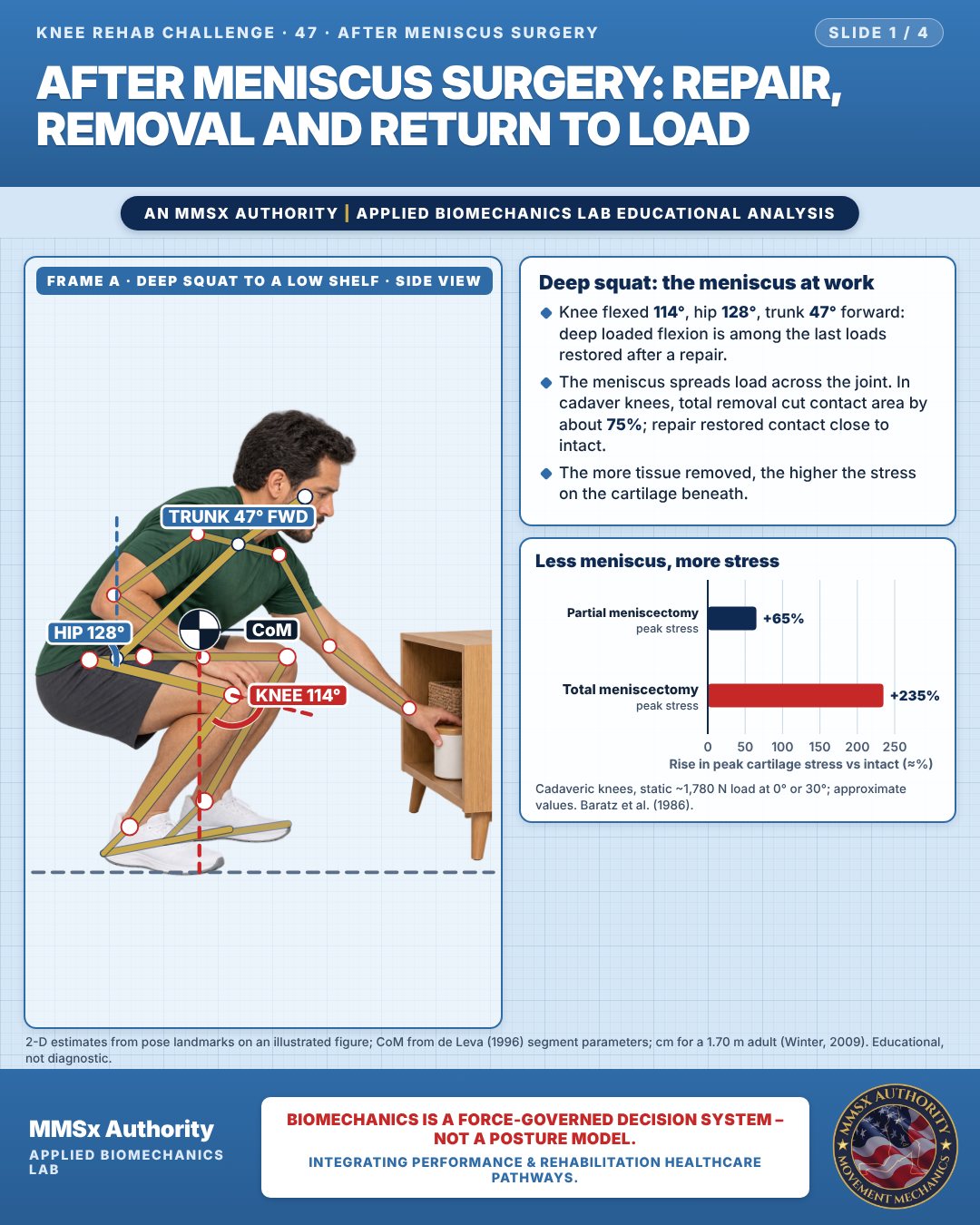
Deep squat: the meniscus at work
Knee flexed 114°, hip 128°, trunk 47° forward: deep loaded flexion is among the last loads restored after a repair.
The meniscus spreads load across the joint. In cadaver knees, total removal cut contact area by about 75%; repair restored contact close to intact.
The more tissue removed, the higher the stress on the cartilage beneath.
Less meniscus, more stress
Movement B: Planted-foot turn, oblique
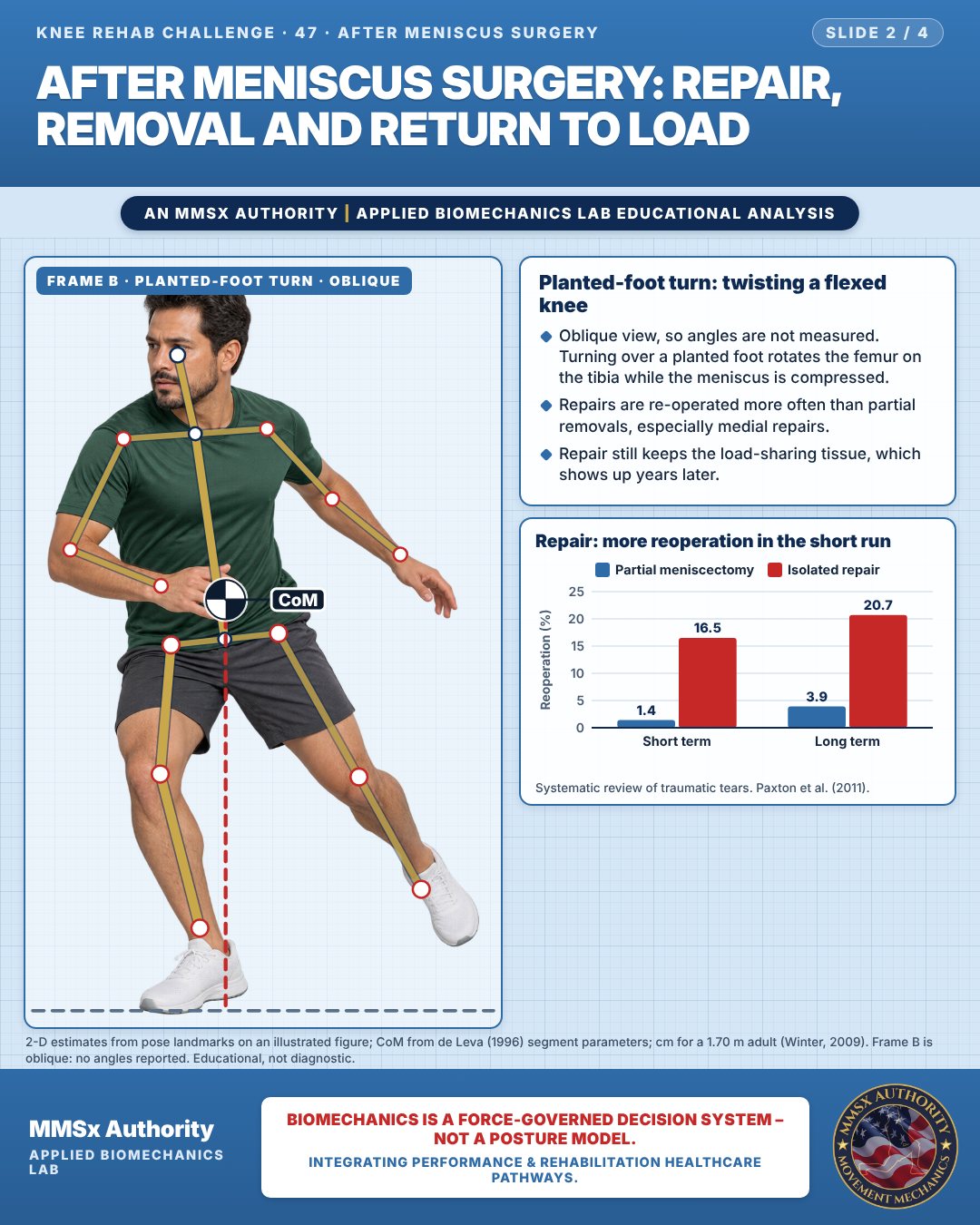
Planted-foot turn: twisting a flexed knee
Oblique view, so angles are not measured. Turning over a planted foot rotates the femur on the tibia while the meniscus is compressed.
Repairs are re-operated more often than partial removals, especially medial repairs.
Repair still keeps the load-sharing tissue, which shows up years later.
Repair: more reoperation in the short run
Movement C: Getting out of a car, oblique
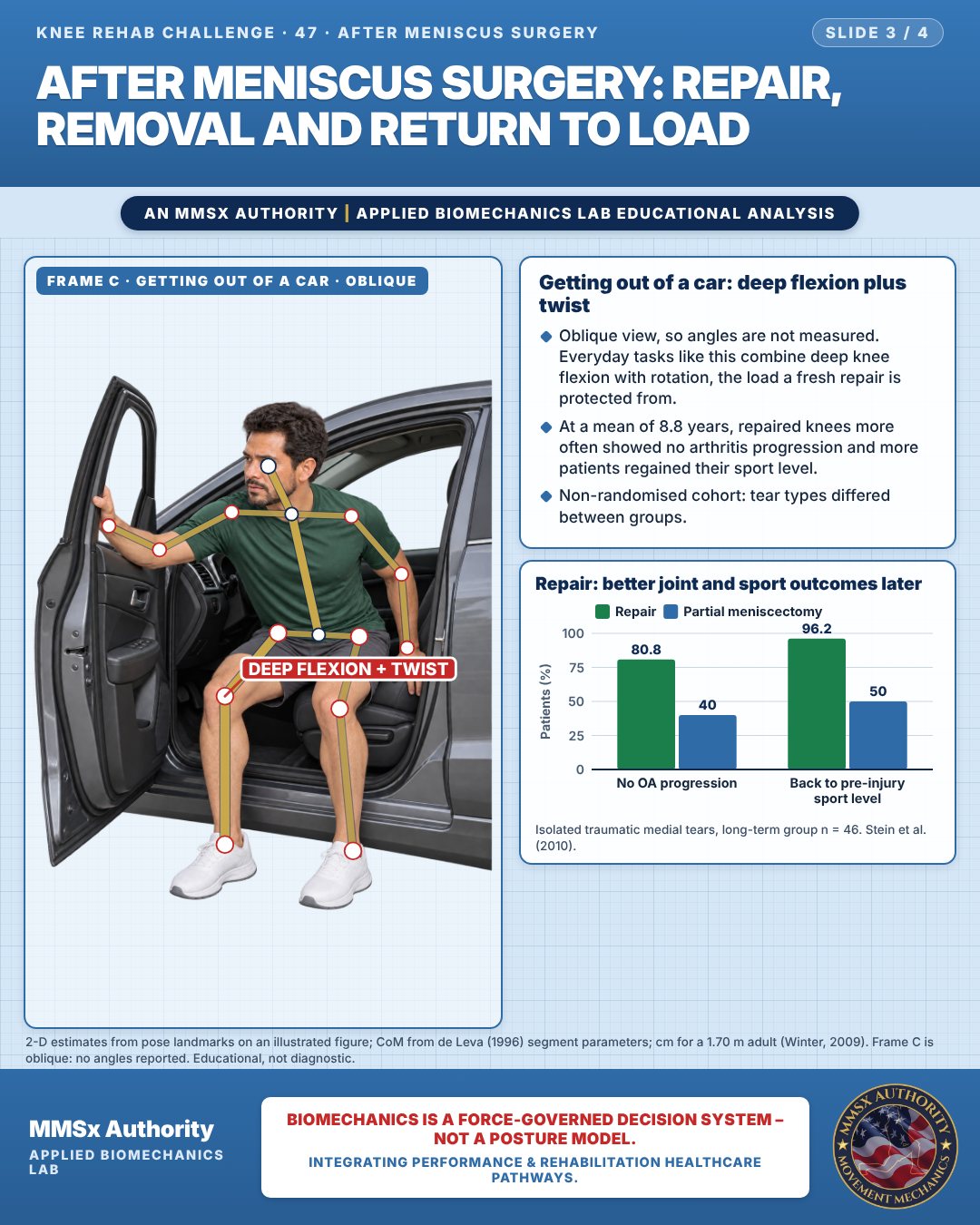
Getting out of a car: deep flexion plus twist
Oblique view, so angles are not measured. Everyday tasks like this combine deep knee flexion with rotation, the load a fresh repair is protected from.
At a mean of 8.8 years, repaired knees more often showed no arthritis progression and more patients regained their sport level.
Non-randomised cohort: tear types differed between groups.
Repair: better joint and sport outcomes later
Decision pathway
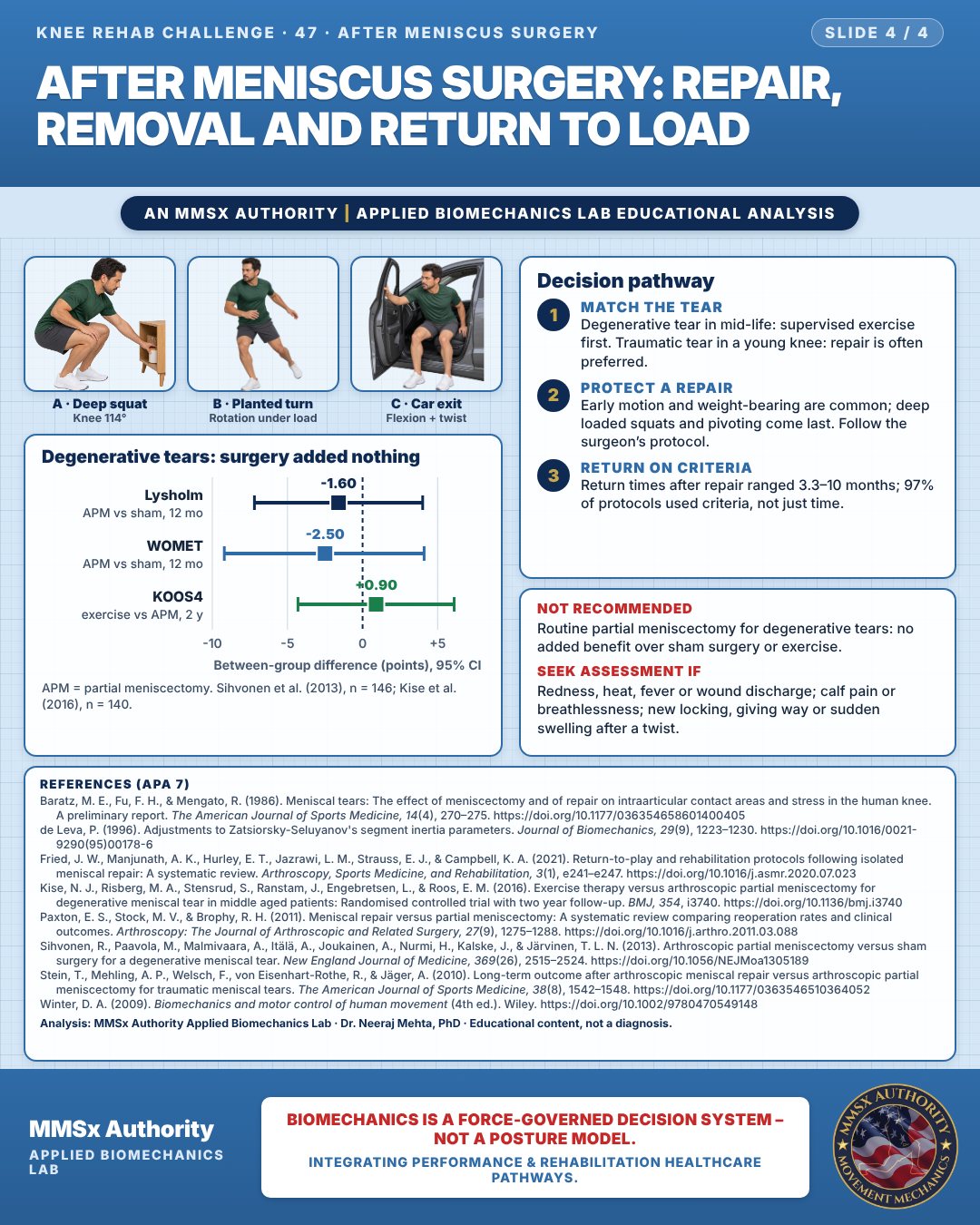
Degenerative tears: surgery added nothing
Match the tear
Degenerative tear in mid-life: supervised exercise first. Traumatic tear in a young knee: repair is often preferred.
Protect a repair
Early motion and weight-bearing are common; deep loaded squats and pivoting come last. Follow the surgeon’s protocol.
Return on criteria
Return times after repair ranged 3.3–10 months; 97% of protocols used criteria, not just time.
What the evidence supports
- Degenerative tears in middle-aged knees: supervised exercise therapy is a reasonable first option — partial meniscectomy was not superior to sham surgery (Sihvonen 2013) and not superior to 12 weeks of exercise at 2 years (Kise 2016). [both abstracts, OA]
- After repair: return to play is criteria-based in almost all protocols (97.0% of studies), with return times ranging 3.3–10 months; early range of motion and early partial weight-bearing are common (Fried 2021). Deep loaded flexion and pivoting (movements A and B) are typically the last loads restored — follow the operating surgeon's protocol.
Myth and evidence
Myth“Taking out the torn bit always fixes knee pain.”
EvidenceIn degenerative tears, partial meniscectomy gave the same 12-month improvement as sham surgery (Lysholm difference −1.6, 95% CI −7.2 to 4.0) (Sihvonen 2013) and the same 2-year outcome as exercise (KOOS4 difference 0.9, 95% CI −4.3 to 6.1) (Kise 2016).
Myth“Removing meniscus doesn't matter — it's just a cushion.”
EvidenceIn cadaveric knees total meniscectomy reduced contact area by about 75% and raised peak stress by about 235% (Baratz 1986).
Cautions
Not recommended
Routine partial meniscectomy for degenerative tears: no added benefit over sham surgery or exercise.
Seek assessment if
Redness, heat, fever or wound discharge; calf pain or breathlessness; new locking, giving way or sudden swelling after a twist.
Methods note
2-D estimates from pose landmarks on an illustrated figure; CoM from de Leva (1996) segment parameters; cm for a 1.70 m adult (Winter, 2009). Frame B is oblique: no angles reported. Frame C is oblique: no angles reported. These are educational estimates, not a diagnosis.
References
- Baratz, M. E., Fu, F. H., & Mengato, R. (1986). Meniscal tears: The effect of meniscectomy and of repair on intraarticular contact areas and stress in the human knee. A preliminary report. The American Journal of Sports Medicine, 14(4), 270–275. https://doi.org/10.1177/036354658601400405
- de Leva, P. (1996). Adjustments to Zatsiorsky-Seluyanov's segment inertia parameters. Journal of Biomechanics, 29(9), 1223–1230. https://doi.org/10.1016/0021-9290(95)00178-6
- Fried, J. W., Manjunath, A. K., Hurley, E. T., Jazrawi, L. M., Strauss, E. J., & Campbell, K. A. (2021). Return-to-play and rehabilitation protocols following isolated meniscal repair: A systematic review. Arthroscopy, Sports Medicine, and Rehabilitation, 3(1), e241–e247. https://doi.org/10.1016/j.asmr.2020.07.023
- Kise, N. J., Risberg, M. A., Stensrud, S., Ranstam, J., Engebretsen, L., & Roos, E. M. (2016). Exercise therapy versus arthroscopic partial meniscectomy for degenerative meniscal tear in middle aged patients: Randomised controlled trial with two year follow-up. BMJ, 354, i3740. https://doi.org/10.1136/bmj.i3740
- Paxton, E. S., Stock, M. V., & Brophy, R. H. (2011). Meniscal repair versus partial meniscectomy: A systematic review comparing reoperation rates and clinical outcomes. Arthroscopy: The Journal of Arthroscopic and Related Surgery, 27(9), 1275–1288. https://doi.org/10.1016/j.arthro.2011.03.088
- Sihvonen, R., Paavola, M., Malmivaara, A., Itälä, A., Joukainen, A., Nurmi, H., Kalske, J., & Järvinen, T. L. N. (2013). Arthroscopic partial meniscectomy versus sham surgery for a degenerative meniscal tear. New England Journal of Medicine, 369(26), 2515–2524. https://doi.org/10.1056/NEJMoa1305189
- Stein, T., Mehling, A. P., Welsch, F., von Eisenhart-Rothe, R., & Jäger, A. (2010). Long-term outcome after arthroscopic meniscal repair versus arthroscopic partial meniscectomy for traumatic meniscal tears. The American Journal of Sports Medicine, 38(8), 1542–1548. https://doi.org/10.1177/0363546510364052
- Winter, D. A. (2009). Biomechanics and motor control of human movement (4th ed.). Wiley. https://doi.org/10.1002/9780470549148
Cite this article
Mehta, N. (2026, October 23). After meniscus surgery: repair, removal and return to load. MMSx Authority Applied Biomechanics Lab. https://mmsxauthority.org/edu/analysis/knee/47-after-meniscus-surgery-repair-removal-and-return-to-load/
Part of the collection
Mehta, N. (2026). Knee Rehabilitation: 50 Evidence-Based Biomechanics Analyses [Collection]. MMSx Authority Applied Biomechanics Lab. Zenodo. https://doi.org/10.5281/zenodo.23735752