Knee Rehab Challenge · 46
Knee pain from standing all day
Occupational standing-related knee pain describes knee discomfort that builds during long periods of mostly static standing at work, often alongside…
Key points
- Break it up. Change position or sit briefly before about 40 min of static standing; keep mostly static standing under 3 h (Garcia et al., 2018).
- Share the load. Weight on both legs, not hanging on one; walk a few steps regularly.
- Cushion. Cushioned flooring or insoles reduced discomfort with moderate evidence (Speed et al., 2018).
What it is
Occupational standing-related knee pain describes knee discomfort that builds during long periods of mostly static standing at work, often alongside other knee-demanding tasks (kneeling, squatting, lifting, climbing). Long-term, physically demanding work — including standing for more than 2 hours a day — is associated with higher odds of knee osteoarthritis, but cross-sectional/observational data cannot show cause.
How we analysed the movement
Three movements relevant to this topic were analysed from illustrated reference figures. Joint centres were located with two-dimensional pose estimation; joint angles, the whole-body centre of mass and, where relevant, the ground-reaction-force line and its moment arm about the knee were then calculated from standard segment parameters. The figures are educational estimates that show how position changes mechanical demand; they are not measurements of a patient. Every research value quoted below comes from the published source cited beside it.
Movement A: Standing (rear view)
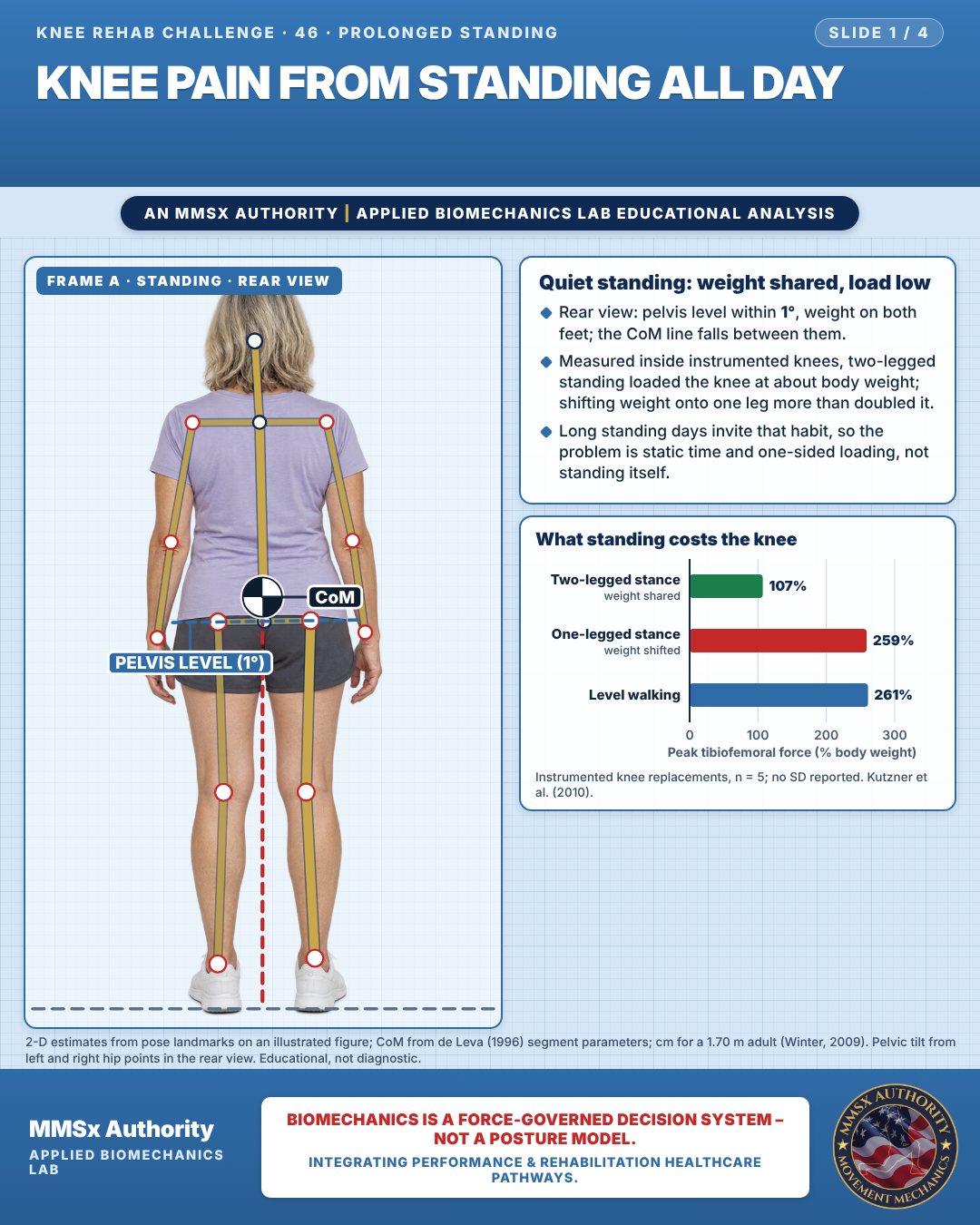
Quiet standing: weight shared, load low
Rear view: pelvis level within 1°, weight on both feet; the CoM line falls between them.
Measured inside instrumented knees, two-legged standing loaded the knee at about body weight; shifting weight onto one leg more than doubled it.
Long standing days invite that habit, so the problem is static time and one-sided loading, not standing itself.
What standing costs the knee
Movement B: Standing after activity (front view)
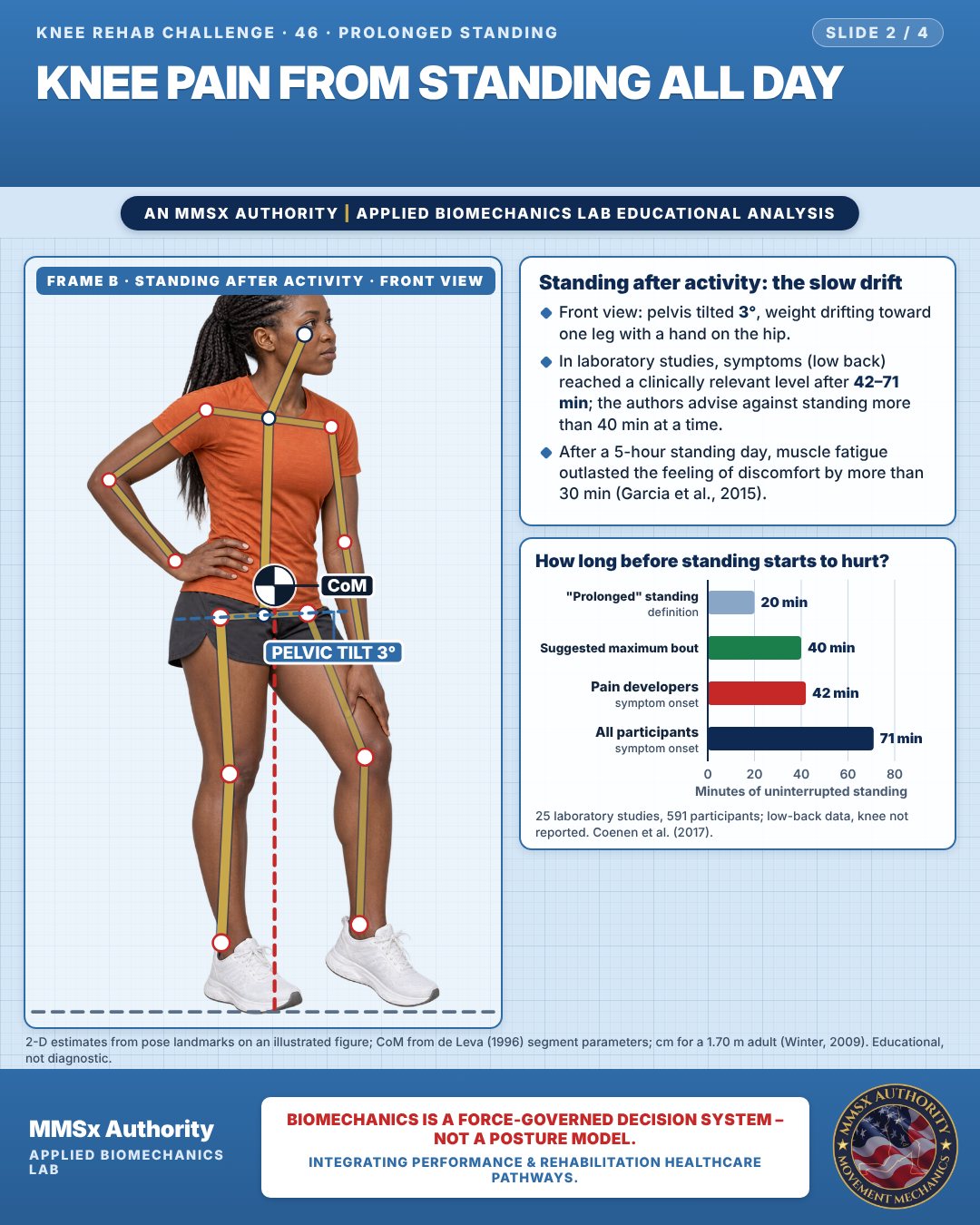
Standing after activity: the slow drift
Front view: pelvis tilted 3°, weight drifting toward one leg with a hand on the hip.
In laboratory studies, symptoms (low back) reached a clinically relevant level after 42–71 min; the authors advise against standing more than 40 min at a time.
After a 5-hour standing day, muscle fatigue outlasted the feeling of discomfort by more than 30 min (Garcia et al., 2015).
How long before standing starts to hurt?
Movement C: Seated at a desk (side view)
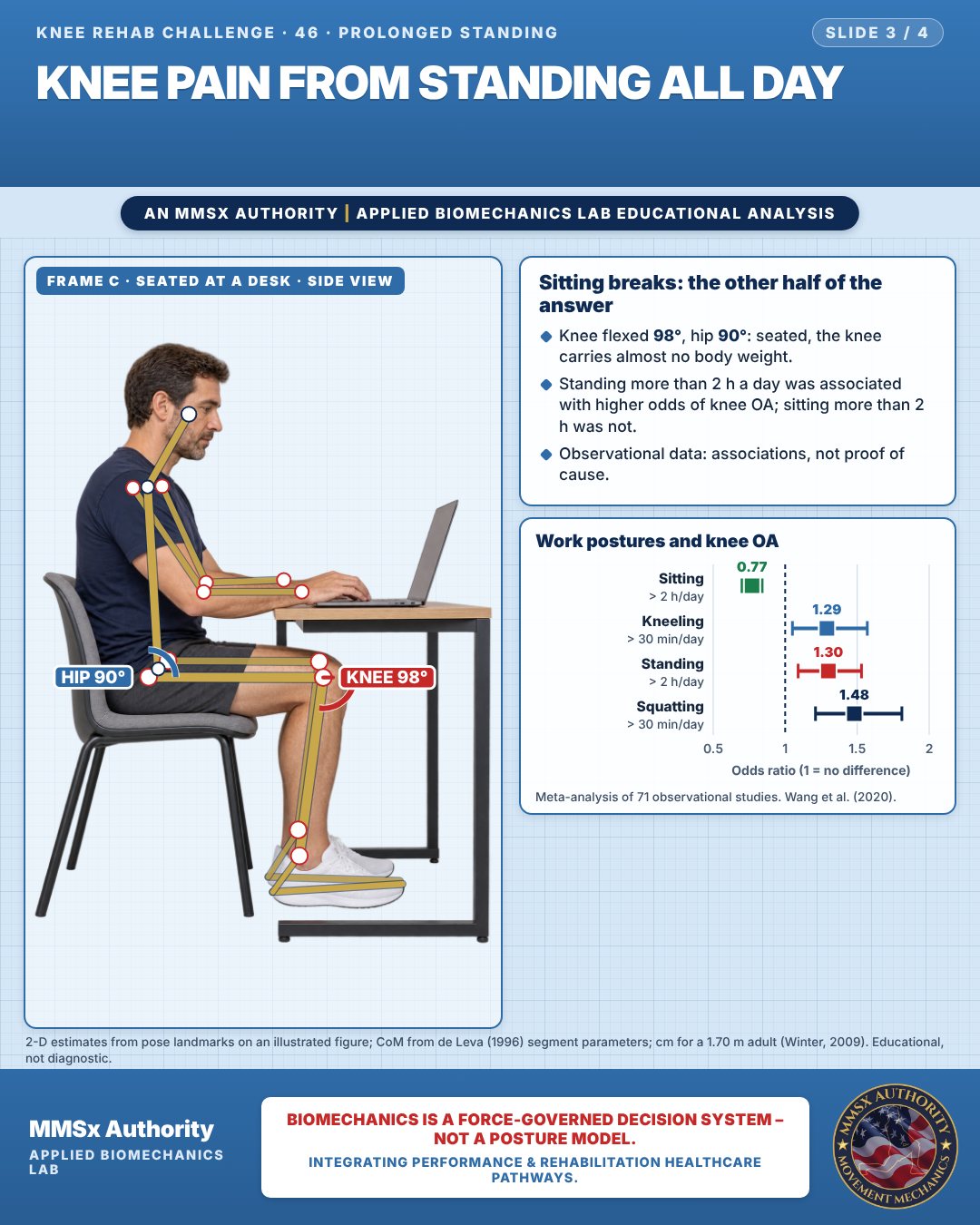
Sitting breaks: the other half of the answer
Knee flexed 98°, hip 90°: seated, the knee carries almost no body weight.
Standing more than 2 h a day was associated with higher odds of knee OA; sitting more than 2 h was not.
Observational data: associations, not proof of cause.
Work postures and knee OA
Decision pathway
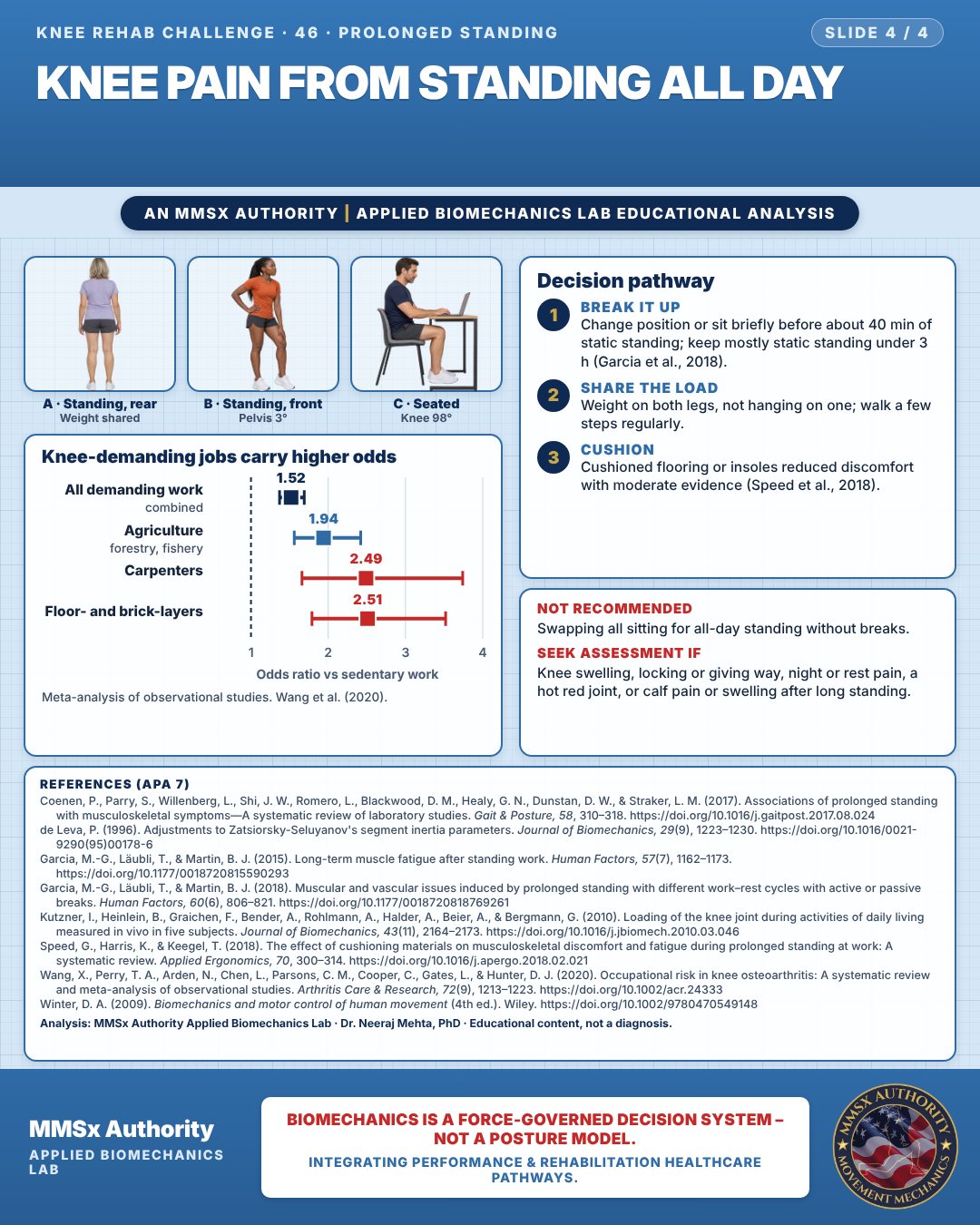
Knee-demanding jobs carry higher odds
Break it up
Change position or sit briefly before about 40 min of static standing; keep mostly static standing under 3 h (Garcia et al., 2018).
Share the load
Weight on both legs, not hanging on one; walk a few steps regularly.
Cushion
Cushioned flooring or insoles reduced discomfort with moderate evidence (Speed et al., 2018).
What the evidence supports
- Recommend: break up static standing (change posture or sit for a short period before ~40 min), alternate sitting and standing across the day, and keep weight shared between both legs (Coenen 2017; Kutzner 2010).
- Recommend: cushioned flooring or cushioned insoles for workers who must stand [Speed 2018 — moderate evidence].
Myth and evidence
Myth“Standing is always healthier than sitting, so stand all day.”
EvidenceStanding >2 h/day was associated with higher knee-OA odds (OR 1.30) whereas sitting >2 h/day was not (OR 0.77) (Wang 2020); prolonged standing produces symptoms within about 40–70 min in the laboratory (Coenen 2017). The healthier pattern is variety — alternating positions and moving.
Cautions
Not recommended
Swapping all sitting for all-day standing without breaks.
Seek assessment if
Knee swelling, locking or giving way, night or rest pain, a hot red joint, or calf pain or swelling after long standing.
Methods note
2-D estimates from pose landmarks on an illustrated figure; CoM from de Leva (1996) segment parameters; cm for a 1.70 m adult (Winter, 2009). Pelvic tilt from left and right hip points in the rear view. These are educational estimates, not a diagnosis.
References
- Coenen, P., Parry, S., Willenberg, L., Shi, J. W., Romero, L., Blackwood, D. M., Healy, G. N., Dunstan, D. W., & Straker, L. M. (2017). Associations of prolonged standing with musculoskeletal symptoms—A systematic review of laboratory studies. Gait & Posture, 58, 310–318. https://doi.org/10.1016/j.gaitpost.2017.08.024
- de Leva, P. (1996). Adjustments to Zatsiorsky-Seluyanov's segment inertia parameters. Journal of Biomechanics, 29(9), 1223–1230. https://doi.org/10.1016/0021-9290(95)00178-6
- Garcia, M.-G., Läubli, T., & Martin, B. J. (2015). Long-term muscle fatigue after standing work. Human Factors, 57(7), 1162–1173. https://doi.org/10.1177/0018720815590293
- Garcia, M.-G., Läubli, T., & Martin, B. J. (2018). Muscular and vascular issues induced by prolonged standing with different work–rest cycles with active or passive breaks. Human Factors, 60(6), 806–821. https://doi.org/10.1177/0018720818769261
- Kutzner, I., Heinlein, B., Graichen, F., Bender, A., Rohlmann, A., Halder, A., Beier, A., & Bergmann, G. (2010). Loading of the knee joint during activities of daily living measured in vivo in five subjects. Journal of Biomechanics, 43(11), 2164–2173. https://doi.org/10.1016/j.jbiomech.2010.03.046
- Speed, G., Harris, K., & Keegel, T. (2018). The effect of cushioning materials on musculoskeletal discomfort and fatigue during prolonged standing at work: A systematic review. Applied Ergonomics, 70, 300–314. https://doi.org/10.1016/j.apergo.2018.02.021
- Wang, X., Perry, T. A., Arden, N., Chen, L., Parsons, C. M., Cooper, C., Gates, L., & Hunter, D. J. (2020). Occupational risk in knee osteoarthritis: A systematic review and meta-analysis of observational studies. Arthritis Care & Research, 72(9), 1213–1223. https://doi.org/10.1002/acr.24333
- Winter, D. A. (2009). Biomechanics and motor control of human movement (4th ed.). Wiley. https://doi.org/10.1002/9780470549148
Cite this article
Mehta, N. (2026, October 23). Knee pain from standing all day. MMSx Authority Applied Biomechanics Lab. https://mmsxauthority.org/edu/analysis/knee/46-knee-pain-from-standing-all-day/
Part of the collection
Mehta, N. (2026). Knee Rehabilitation: 50 Evidence-Based Biomechanics Analyses [Collection]. MMSx Authority Applied Biomechanics Lab. Zenodo. https://doi.org/10.5281/zenodo.23735752