Knee Rehab Challenge · 45
Sinding-Larsen-Johansson: lower kneecap pain in children
Sinding-Larsen-Johansson disease (SLJ) is a traction apophysitis (osteochondrosis) at the lower pole of the patella, where the patellar tendon…
Key points
- Explain. Common in growing, active children and usually settles; recovery takes months, not weeks.
- Modify load. Pain-guided: cut jumping, sprinting and deep single-leg work for a while; cushion kneeling.
- Strengthen, then return. Progressive quadriceps and hip strengthening, then graded running and jumping.
What it is
Sinding-Larsen-Johansson disease (SLJ) is a traction apophysitis (osteochondrosis) at the lower pole of the patella, where the patellar tendon attaches, seen in active, growing children and early adolescents; it is a close relative of Osgood-Schlatter disease (OSD), which affects the tibial tuberosity at the other end of the same tendon. Evidence specific to SLJ is limited (mainly case reports), so OSD and adolescent knee-pain cohorts are used for epidemiology and management below and must be labelled as such.
How we analysed the movement
Three movements relevant to this topic were analysed from illustrated reference figures. Joint centres were located with two-dimensional pose estimation; joint angles, the whole-body centre of mass and, where relevant, the ground-reaction-force line and its moment arm about the knee were then calculated from standard segment parameters. The figures are educational estimates that show how position changes mechanical demand; they are not measurements of a patient. Every research value quoted below comes from the published source cited beside it.
Movement A: Adolescent running (side view)
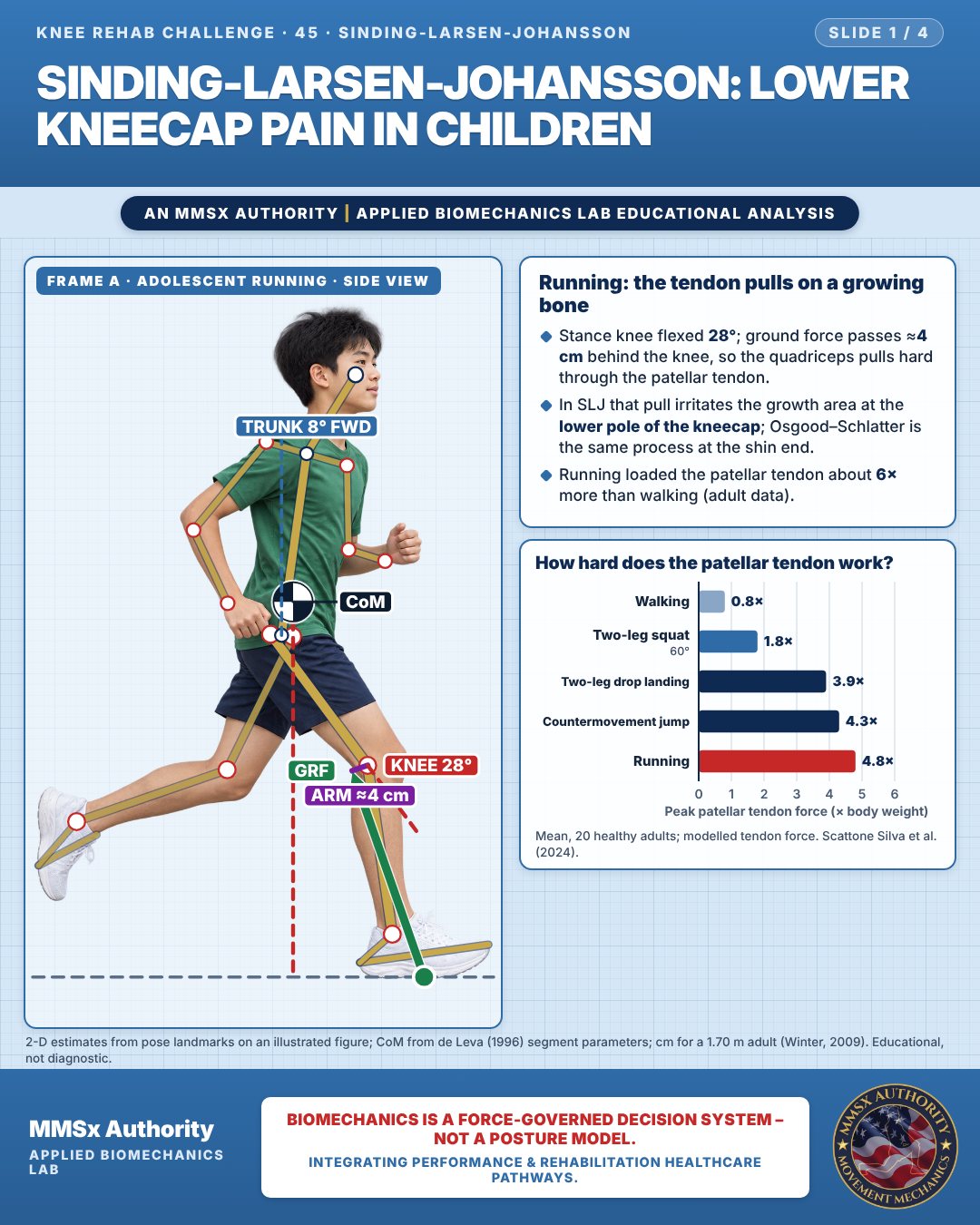
Running: the tendon pulls on a growing bone
Stance knee flexed 28°; ground force passes ≈4 cm behind the knee, so the quadriceps pulls hard through the patellar tendon.
In SLJ that pull irritates the growth area at the lower pole of the kneecap; Osgood–Schlatter is the same process at the shin end.
Running loaded the patellar tendon about 6× more than walking (adult data).
How hard does the patellar tendon work?
Movement B: Jump preparation (side view)
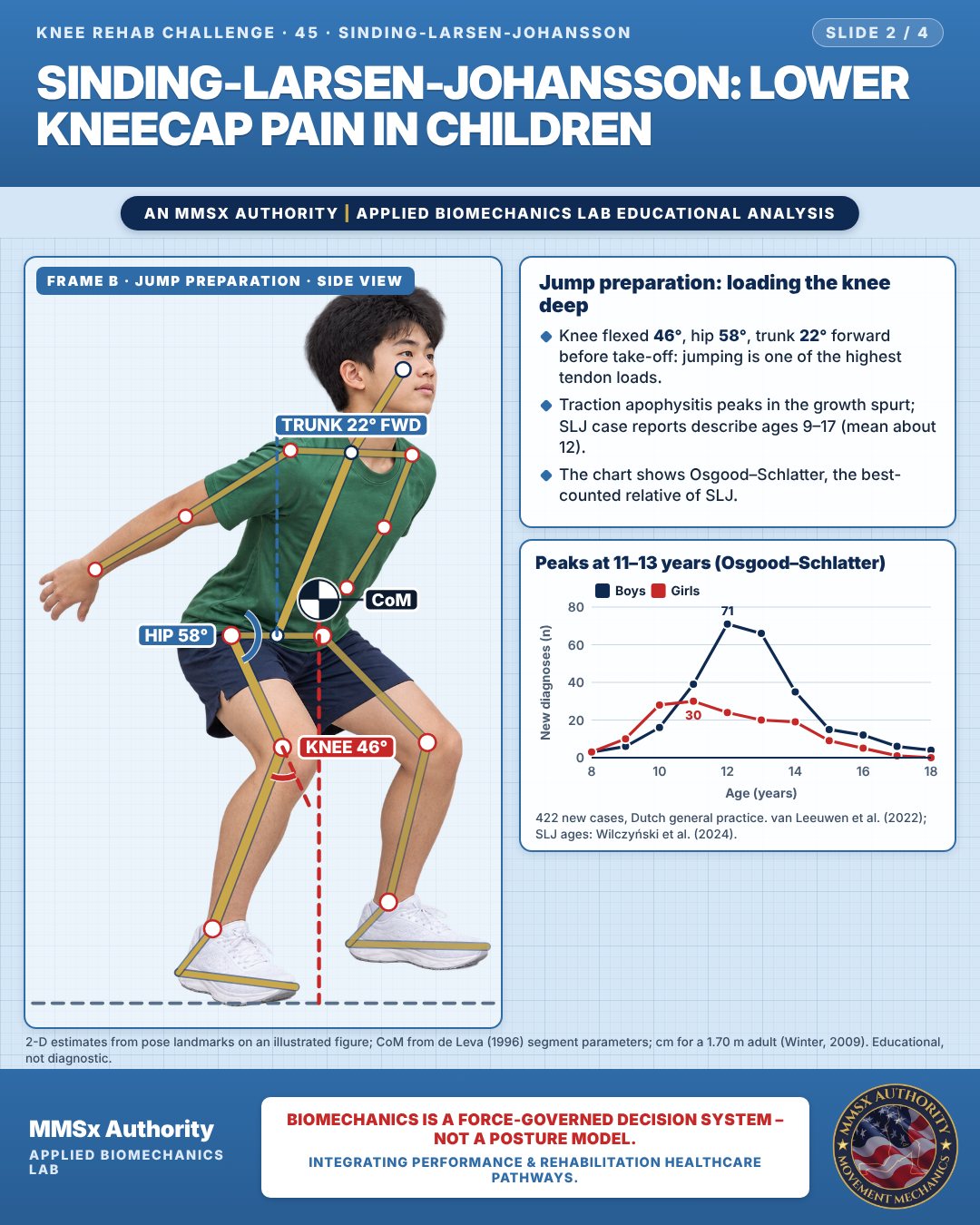
Jump preparation: loading the knee deep
Knee flexed 46°, hip 58°, trunk 22° forward before take-off: jumping is one of the highest tendon loads.
Traction apophysitis peaks in the growth spurt; SLJ case reports describe ages 9–17 (mean about 12).
The chart shows Osgood–Schlatter, the best-counted relative of SLJ.
Peaks at 11–13 years (Osgood–Schlatter)
Movement C: Kneeling (side view)
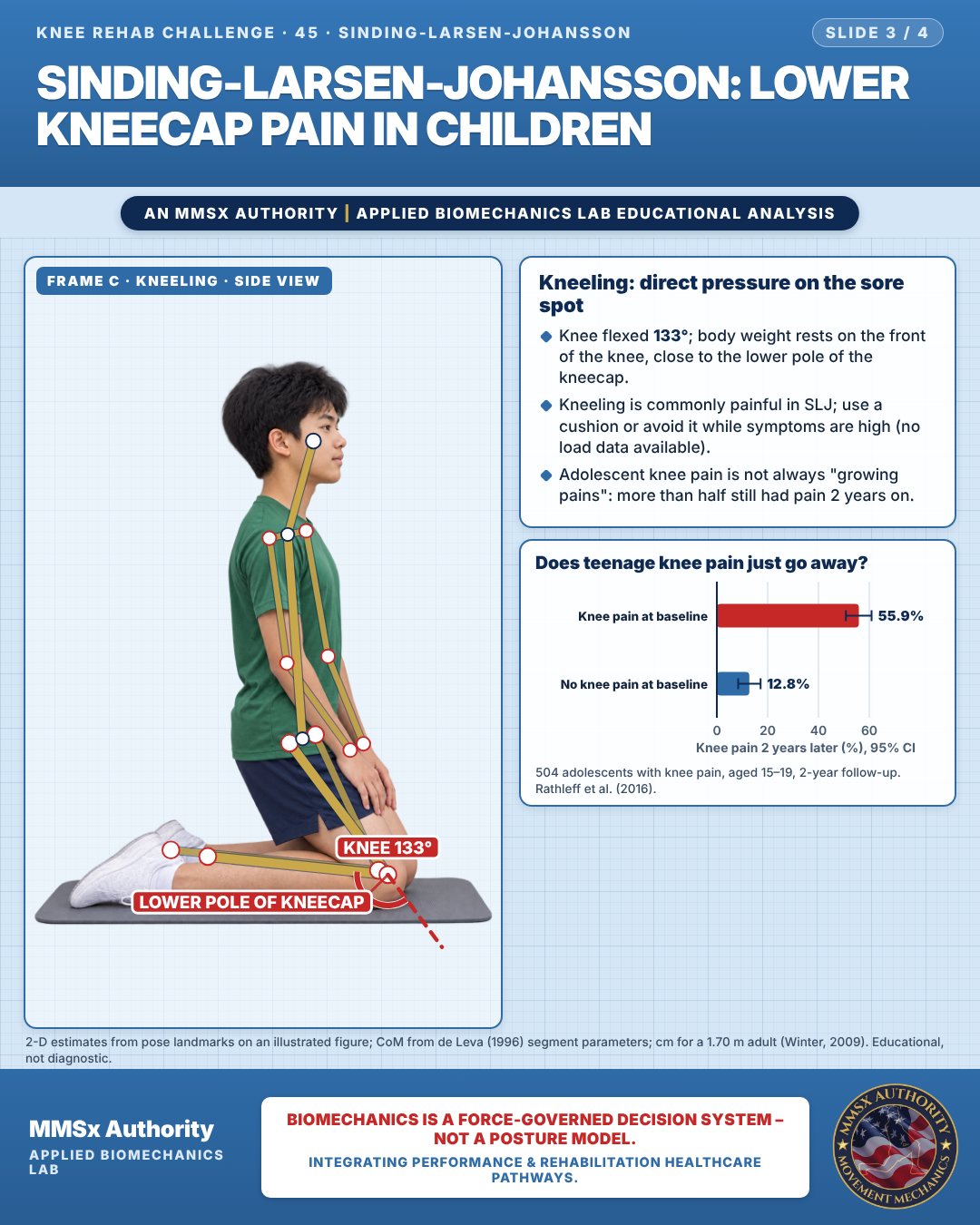
Kneeling: direct pressure on the sore spot
Knee flexed 133°; body weight rests on the front of the knee, close to the lower pole of the kneecap.
Kneeling is commonly painful in SLJ; use a cushion or avoid it while symptoms are high (no load data available).
Adolescent knee pain is not always "growing pains": more than half still had pain 2 years on.
Does teenage knee pain just go away?
Decision pathway
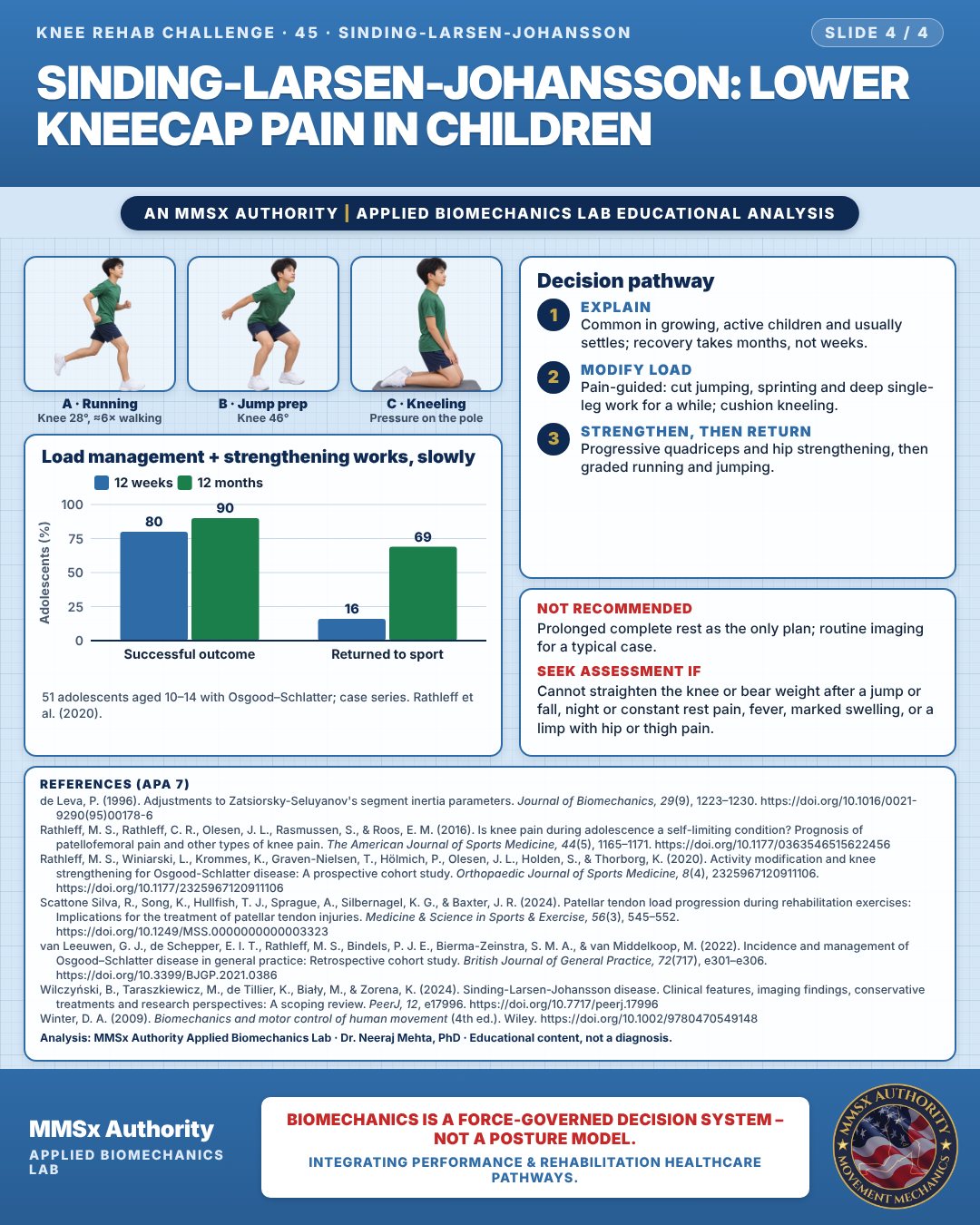
Load management + strengthening works, slowly
Explain
Common in growing, active children and usually settles; recovery takes months, not weeks.
Modify load
Pain-guided: cut jumping, sprinting and deep single-leg work for a while; cushion kneeling.
Strengthen, then return
Progressive quadriceps and hip strengthening, then graded running and jumping.
What the evidence supports
- Recommend: education that the condition is common in growing, active children and usually settles; pain-guided activity modification (reduce high tendon-load tasks such as jumping, sprinting and deep single-leg loading temporarily) with progressive quadriceps and hip strengthening, then graded return to running and jumping (Rathleff 2020; tendon load ranking from Scattone Silva 2024).
- Recommend: expect a time course of months — SLJ case reports describe return to sport in 2–8 months (Wilczyński 2024); in OSD, 69% had returned to sport by 12 months (Rathleff 2020).
Myth and evidence
Myth“It is just growing pains — they always grow out of it.”
Evidence55.9% of adolescents with knee pain still had pain 2 years later (Rathleff 2016); structured load management and strengthening were associated with good outcomes, though return to sport took up to 12 months in many (Rathleff 2020).
Cautions
Not recommended
Prolonged complete rest as the only plan; routine imaging for a typical case.
Seek assessment if
Cannot straighten the knee or bear weight after a jump or fall, night or constant rest pain, fever, marked swelling, or a limp with hip or thigh pain.
Methods note
2-D estimates from pose landmarks on an illustrated figure; CoM from de Leva (1996) segment parameters; cm for a 1.70 m adult (Winter, 2009). These are educational estimates, not a diagnosis.
References
- de Leva, P. (1996). Adjustments to Zatsiorsky-Seluyanov's segment inertia parameters. Journal of Biomechanics, 29(9), 1223–1230. https://doi.org/10.1016/0021-9290(95)00178-6
- Rathleff, M. S., Rathleff, C. R., Olesen, J. L., Rasmussen, S., & Roos, E. M. (2016). Is knee pain during adolescence a self-limiting condition? Prognosis of patellofemoral pain and other types of knee pain. The American Journal of Sports Medicine, 44(5), 1165–1171. https://doi.org/10.1177/0363546515622456
- Rathleff, M. S., Winiarski, L., Krommes, K., Graven-Nielsen, T., Hölmich, P., Olesen, J. L., Holden, S., & Thorborg, K. (2020). Activity modification and knee strengthening for Osgood-Schlatter disease: A prospective cohort study. Orthopaedic Journal of Sports Medicine, 8(4), 2325967120911106. https://doi.org/10.1177/2325967120911106
- Scattone Silva, R., Song, K., Hullfish, T. J., Sprague, A., Silbernagel, K. G., & Baxter, J. R. (2024). Patellar tendon load progression during rehabilitation exercises: Implications for the treatment of patellar tendon injuries. Medicine & Science in Sports & Exercise, 56(3), 545–552. https://doi.org/10.1249/MSS.0000000000003323
- van Leeuwen, G. J., de Schepper, E. I. T., Rathleff, M. S., Bindels, P. J. E., Bierma-Zeinstra, S. M. A., & van Middelkoop, M. (2022). Incidence and management of Osgood–Schlatter disease in general practice: Retrospective cohort study. British Journal of General Practice, 72(717), e301–e306. https://doi.org/10.3399/BJGP.2021.0386
- Wilczyński, B., Taraszkiewicz, M., de Tillier, K., Biały, M., & Zorena, K. (2024). Sinding-Larsen-Johansson disease. Clinical features, imaging findings, conservative treatments and research perspectives: A scoping review. PeerJ, 12, e17996. https://doi.org/10.7717/peerj.17996
- Winter, D. A. (2009). Biomechanics and motor control of human movement (4th ed.). Wiley. https://doi.org/10.1002/9780470549148
Cite this article
Mehta, N. (2026, October 23). Sinding-Larsen-Johansson: lower kneecap pain in children. MMSx Authority Applied Biomechanics Lab. https://mmsxauthority.org/edu/analysis/knee/45-sinding-larsen-johansson-lower-kneecap-pain-in-children/
Part of the collection
Mehta, N. (2026). Knee Rehabilitation: 50 Evidence-Based Biomechanics Analyses [Collection]. MMSx Authority Applied Biomechanics Lab. Zenodo. https://doi.org/10.5281/zenodo.23735752