Knee Rehab Challenge · 43
Body weight and knee load: how every kilogram counts
Knee joint load is the compressive and resultant force transmitted across the tibiofemoral joint during weight-bearing tasks.
Key points
- Lose. Aim for more than 5% of body weight within about 20 weeks: disability improved beyond that point (Christensen et al., 2007).
- Combine. Pair diet with exercise: the combined arm had the least pain and the best function.
- Strengthen. Graded step-ups and stair practice; split heavy shopping into lighter loads.
What it is
Knee joint load is the compressive and resultant force transmitted across the tibiofemoral joint during weight-bearing tasks; it rises with body mass and with task demand (walking < stair ascent < stair descent), and is amplified further when extra load is carried.
How we analysed the movement
Three movements relevant to this topic were analysed from illustrated reference figures. Joint centres were located with two-dimensional pose estimation; joint angles, the whole-body centre of mass and, where relevant, the ground-reaction-force line and its moment arm about the knee were then calculated from standard segment parameters. The figures are educational estimates that show how position changes mechanical demand; they are not measurements of a patient. Every research value quoted below comes from the published source cited beside it.
Movement A: Stair ascent (side view)
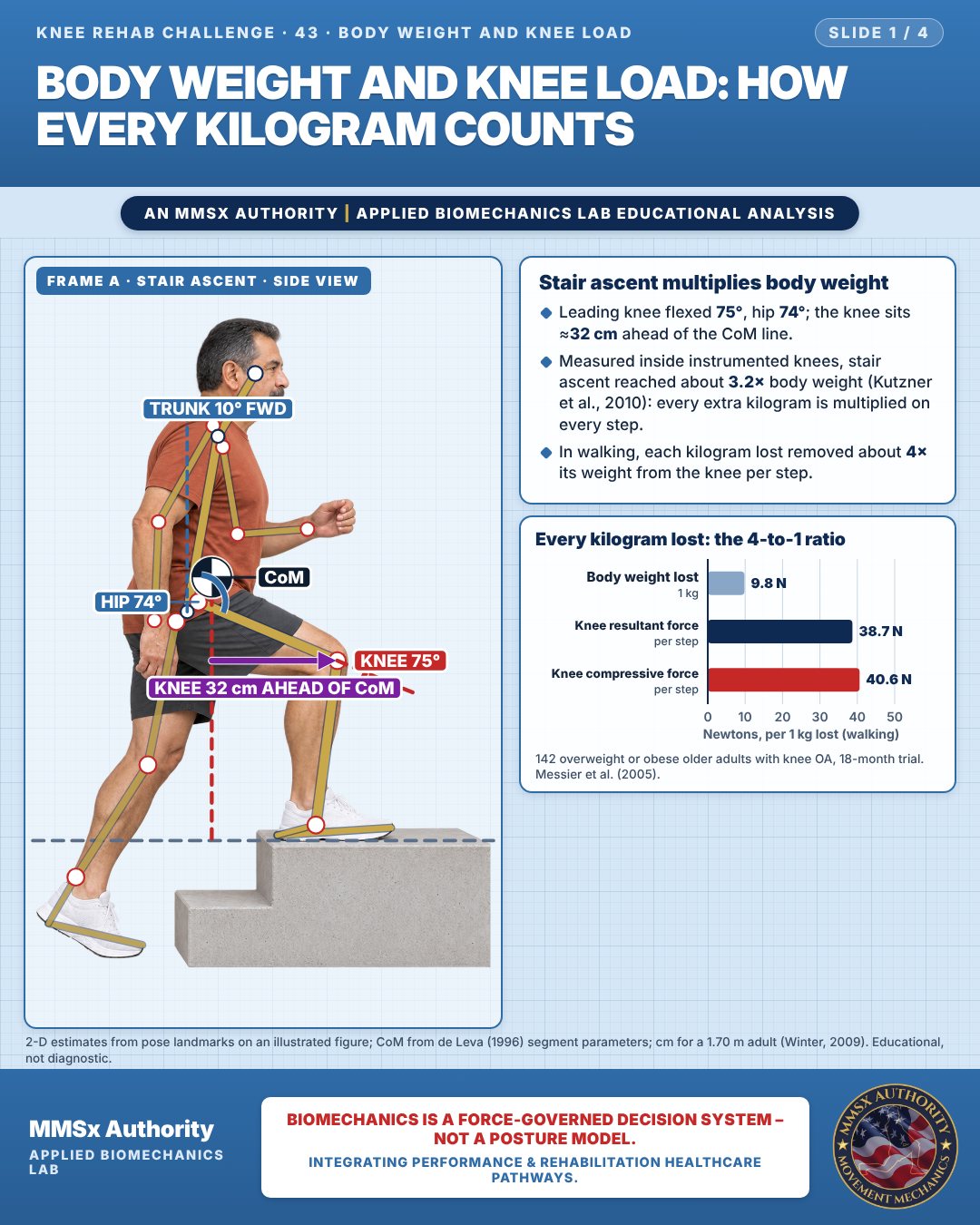
Stair ascent multiplies body weight
Leading knee flexed 75°, hip 74°; the knee sits ≈32 cm ahead of the CoM line.
Measured inside instrumented knees, stair ascent reached about 3.2× body weight (Kutzner et al., 2010): every extra kilogram is multiplied on every step.
In walking, each kilogram lost removed about 4× its weight from the knee per step.
Every kilogram lost: the 4-to-1 ratio
Movement B: Step-up (front view)
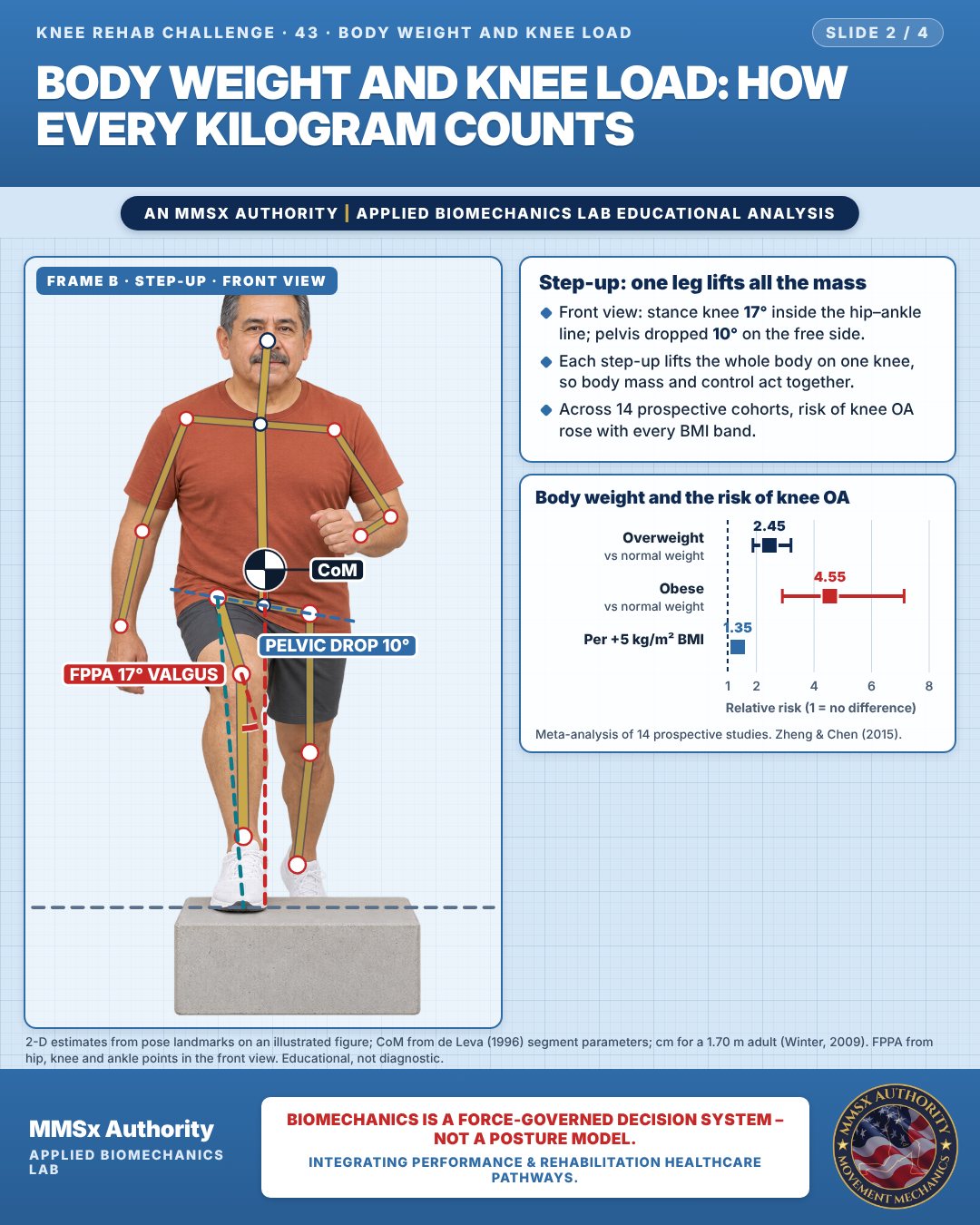
Step-up: one leg lifts all the mass
Front view: stance knee 17° inside the hip–ankle line; pelvis dropped 10° on the free side.
Each step-up lifts the whole body on one knee, so body mass and control act together.
Across 14 prospective cohorts, risk of knee OA rose with every BMI band.
Body weight and the risk of knee OA
Movement C: Ascent carrying a bag, rear-oblique
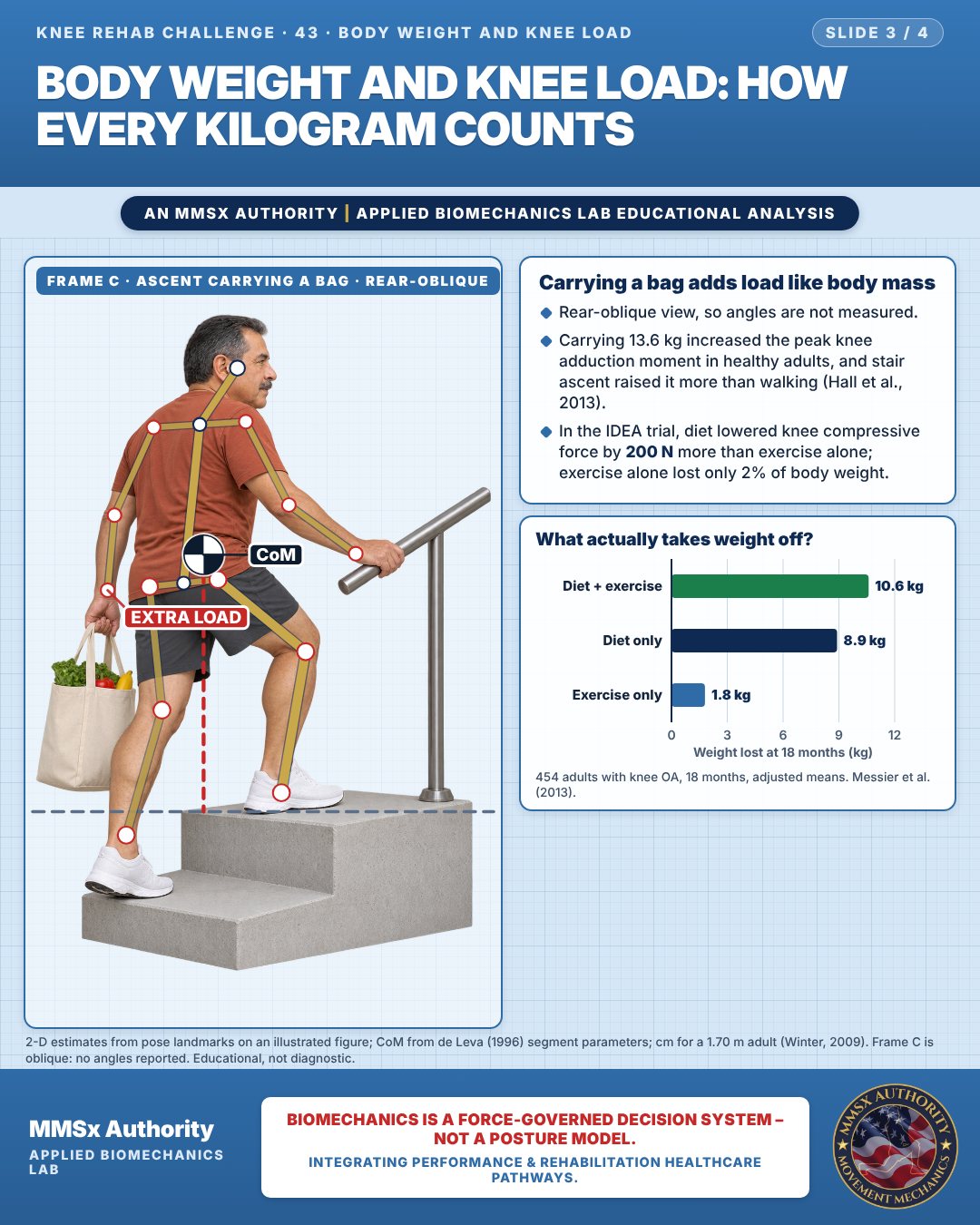
Carrying a bag adds load like body mass
Rear-oblique view, so angles are not measured.
Carrying 13.6 kg increased the peak knee adduction moment in healthy adults, and stair ascent raised it more than walking (Hall et al., 2013).
In the IDEA trial, diet lowered knee compressive force by 200 N more than exercise alone; exercise alone lost only 2% of body weight.
What actually takes weight off?
Decision pathway
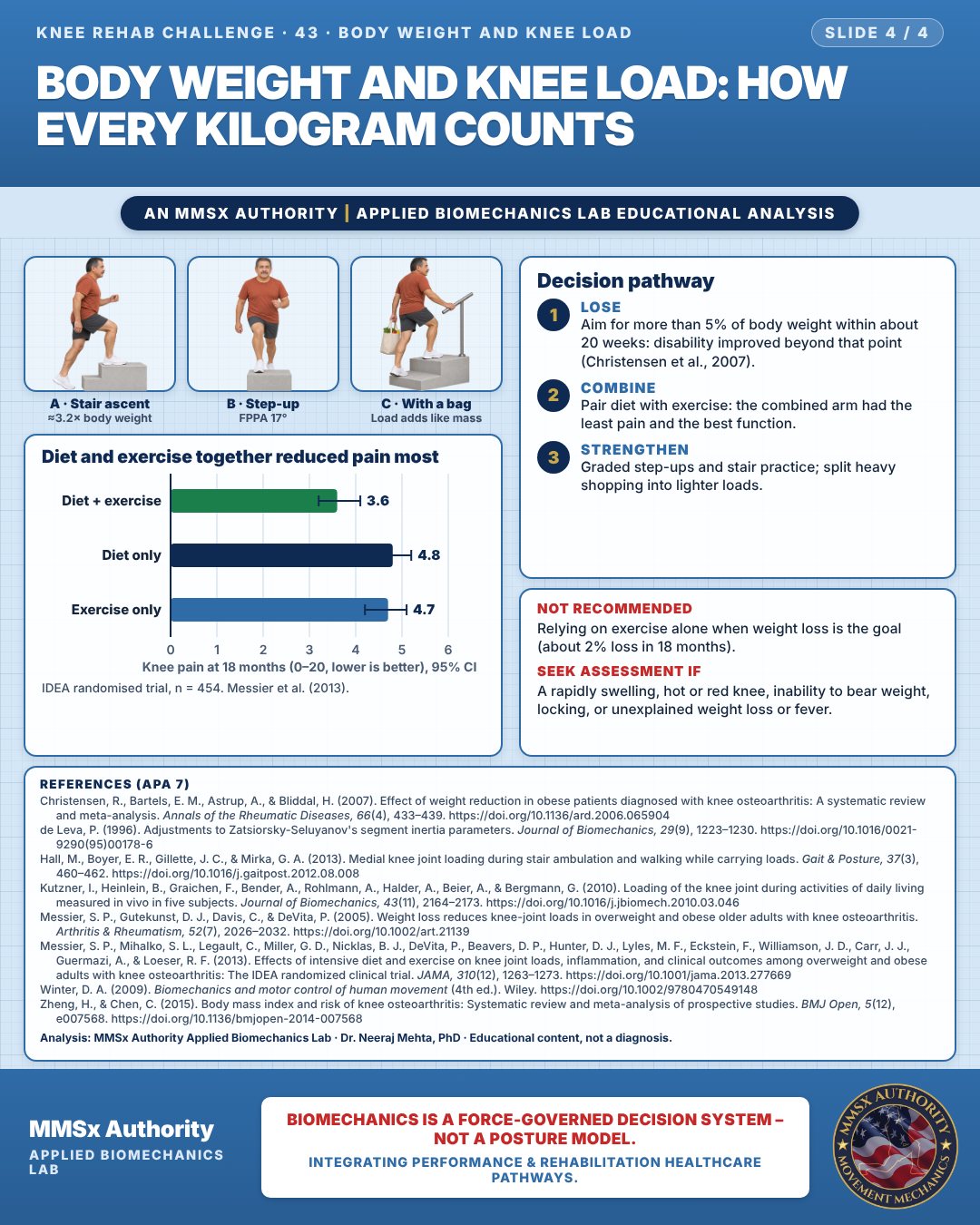
Diet and exercise together reduced pain most
Lose
Aim for more than 5% of body weight within about 20 weeks: disability improved beyond that point (Christensen et al., 2007).
Combine
Pair diet with exercise: the combined arm had the least pain and the best function.
Strengthen
Graded step-ups and stair practice; split heavy shopping into lighter loads.
What the evidence supports
- Recommend: weight loss combined with exercise for people with knee OA who are overweight; the IDEA trial showed the combined arm had the best pain and function outcomes and diet produced lower knee compressive force than exercise alone (Messier 2013). A practical target from meta-regression is >5% body weight within ~20 weeks (Christensen 2007).
- Do not recommend: relying on exercise alone when weight loss is the goal — exercise-only produced ~2% loss (Messier 2013).
Myth and evidence
Myth“A few kilograms make no difference to my knees.”
EvidenceEach 1 kg lost was associated with ~40 N less knee compressive force per walking step (Messier 2005), and disability improved once weight loss exceeded ~5% (Christensen 2007).
Cautions
Not recommended
Relying on exercise alone when weight loss is the goal (about 2% loss in 18 months).
Seek assessment if
A rapidly swelling, hot or red knee, inability to bear weight, locking, or unexplained weight loss or fever.
Methods note
2-D estimates from pose landmarks on an illustrated figure; CoM from de Leva (1996) segment parameters; cm for a 1.70 m adult (Winter, 2009). FPPA from hip, knee and ankle points in the front view. Frame C is oblique: no angles reported. These are educational estimates, not a diagnosis.
References
- Christensen, R., Bartels, E. M., Astrup, A., & Bliddal, H. (2007). Effect of weight reduction in obese patients diagnosed with knee osteoarthritis: A systematic review and meta-analysis. Annals of the Rheumatic Diseases, 66(4), 433–439. https://doi.org/10.1136/ard.2006.065904
- de Leva, P. (1996). Adjustments to Zatsiorsky-Seluyanov's segment inertia parameters. Journal of Biomechanics, 29(9), 1223–1230. https://doi.org/10.1016/0021-9290(95)00178-6
- Hall, M., Boyer, E. R., Gillette, J. C., & Mirka, G. A. (2013). Medial knee joint loading during stair ambulation and walking while carrying loads. Gait & Posture, 37(3), 460–462. https://doi.org/10.1016/j.gaitpost.2012.08.008
- Kutzner, I., Heinlein, B., Graichen, F., Bender, A., Rohlmann, A., Halder, A., Beier, A., & Bergmann, G. (2010). Loading of the knee joint during activities of daily living measured in vivo in five subjects. Journal of Biomechanics, 43(11), 2164–2173. https://doi.org/10.1016/j.jbiomech.2010.03.046
- Messier, S. P., Gutekunst, D. J., Davis, C., & DeVita, P. (2005). Weight loss reduces knee-joint loads in overweight and obese older adults with knee osteoarthritis. Arthritis & Rheumatism, 52(7), 2026–2032. https://doi.org/10.1002/art.21139
- Messier, S. P., Mihalko, S. L., Legault, C., Miller, G. D., Nicklas, B. J., DeVita, P., Beavers, D. P., Hunter, D. J., Lyles, M. F., Eckstein, F., Williamson, J. D., Carr, J. J., Guermazi, A., & Loeser, R. F. (2013). Effects of intensive diet and exercise on knee joint loads, inflammation, and clinical outcomes among overweight and obese adults with knee osteoarthritis: The IDEA randomized clinical trial. JAMA, 310(12), 1263–1273. https://doi.org/10.1001/jama.2013.277669
- Winter, D. A. (2009). Biomechanics and motor control of human movement (4th ed.). Wiley. https://doi.org/10.1002/9780470549148
- Zheng, H., & Chen, C. (2015). Body mass index and risk of knee osteoarthritis: Systematic review and meta-analysis of prospective studies. BMJ Open, 5(12), e007568. https://doi.org/10.1136/bmjopen-2014-007568
Cite this article
Mehta, N. (2026, October 23). Body weight and knee load: how every kilogram counts. MMSx Authority Applied Biomechanics Lab. https://mmsxauthority.org/edu/analysis/knee/43-body-weight-and-knee-load-how-every-kilogram-counts/
Part of the collection
Mehta, N. (2026). Knee Rehabilitation: 50 Evidence-Based Biomechanics Analyses [Collection]. MMSx Authority Applied Biomechanics Lab. Zenodo. https://doi.org/10.5281/zenodo.23735752