Knee Rehab Challenge · 41
Outer-back knee pain: hamstring and popliteus tendons
Posterolateral knee pain describes pain at the outer back of the knee. Movement analysis, verified research data and a decision pathway from the MMSx Authorit
Key points
- Locate. Outer-back knee pain: biceps femoris tendon at the fibular head, or popliteus behind the joint line; rule out joint and nerve causes.
- Load progressively. Hamstring strengthening that includes lengthened positions; settle downhill and sprint volume first.
- Return gradually. Rebuild sprinting, braking and downhill running last.
What it is
Posterolateral knee pain describes pain at the outer back of the knee. Common load-related sources include the biceps femoris (lateral hamstring) tendon near its attachment on the fibular head and the popliteus tendon, which helps unlock the knee from full extension and controls rotation. Pain here can also arise from the posterolateral ligament corner after injury, which needs separate assessment.
How we analysed the movement
Three movements relevant to this topic were analysed from illustrated reference figures. Joint centres were located with two-dimensional pose estimation; joint angles, the whole-body centre of mass and, where relevant, the ground-reaction-force line and its moment arm about the knee were then calculated from standard segment parameters. The figures are educational estimates that show how position changes mechanical demand; they are not measurements of a patient. Every research value quoted below comes from the published source cited beside it.
Movement A: Downhill running (side view)
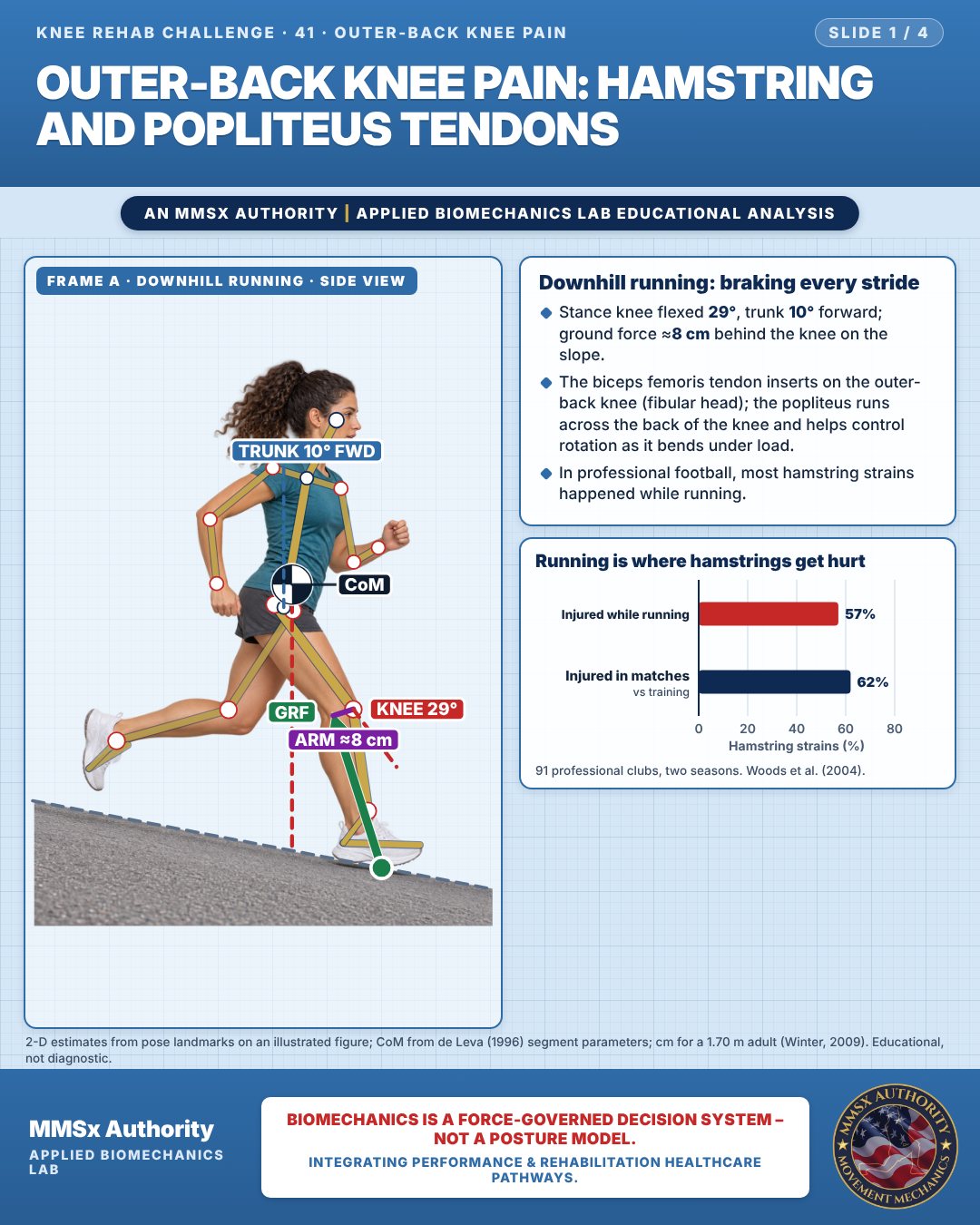
Downhill running: braking every stride
Stance knee flexed 29°, trunk 10° forward; ground force ≈8 cm behind the knee on the slope.
The biceps femoris tendon inserts on the outer-back knee (fibular head); the popliteus runs across the back of the knee and helps control rotation as it bends under load.
In professional football, most hamstring strains happened while running.
Running is where hamstrings get hurt
Movement B: Running stance (rear view)
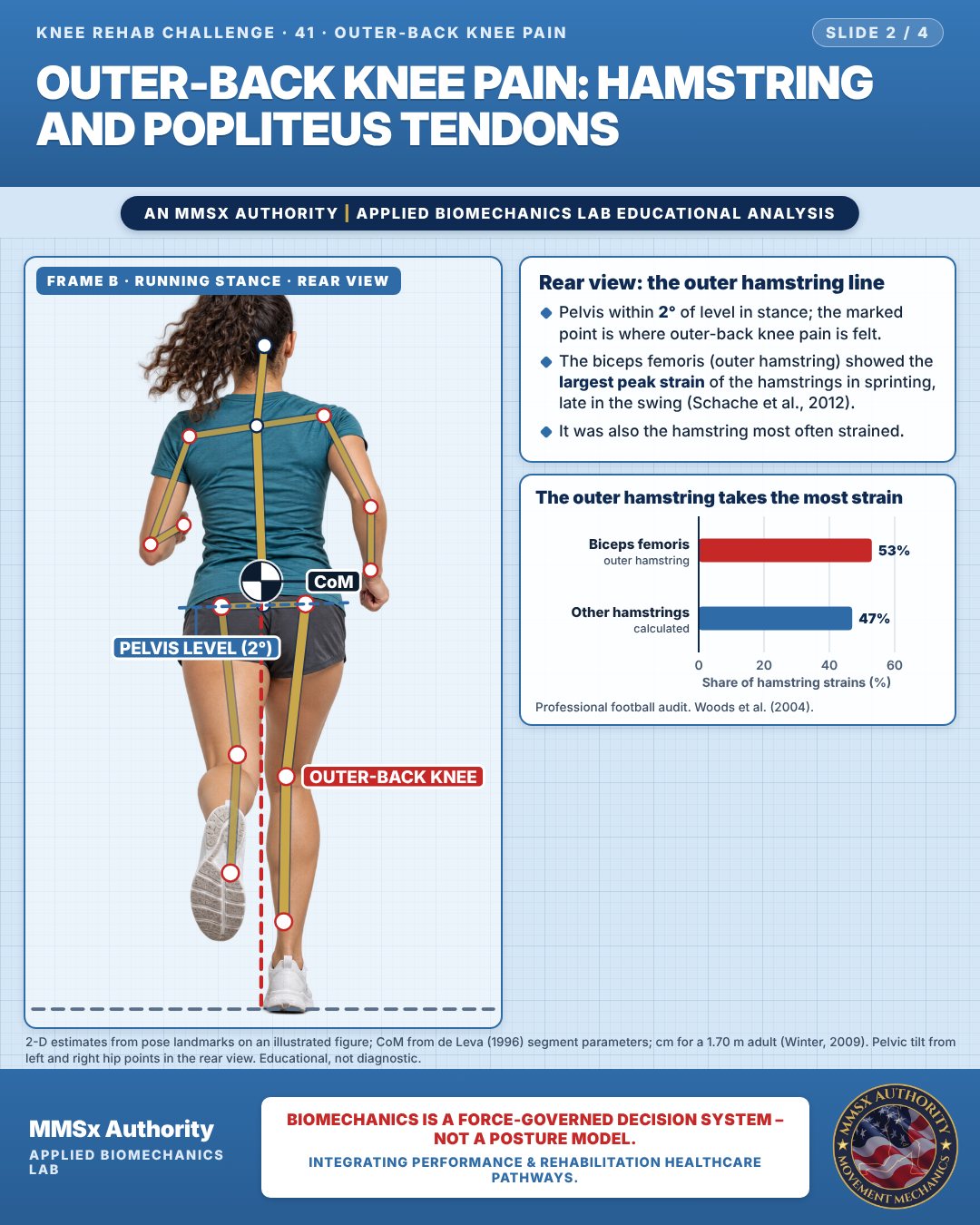
Rear view: the outer hamstring line
Pelvis within 2° of level in stance; the marked point is where outer-back knee pain is felt.
The biceps femoris (outer hamstring) showed the largest peak strain of the hamstrings in sprinting, late in the swing (Schache et al., 2012).
It was also the hamstring most often strained.
The outer hamstring takes the most strain
Movement C: Deceleration step (side view)
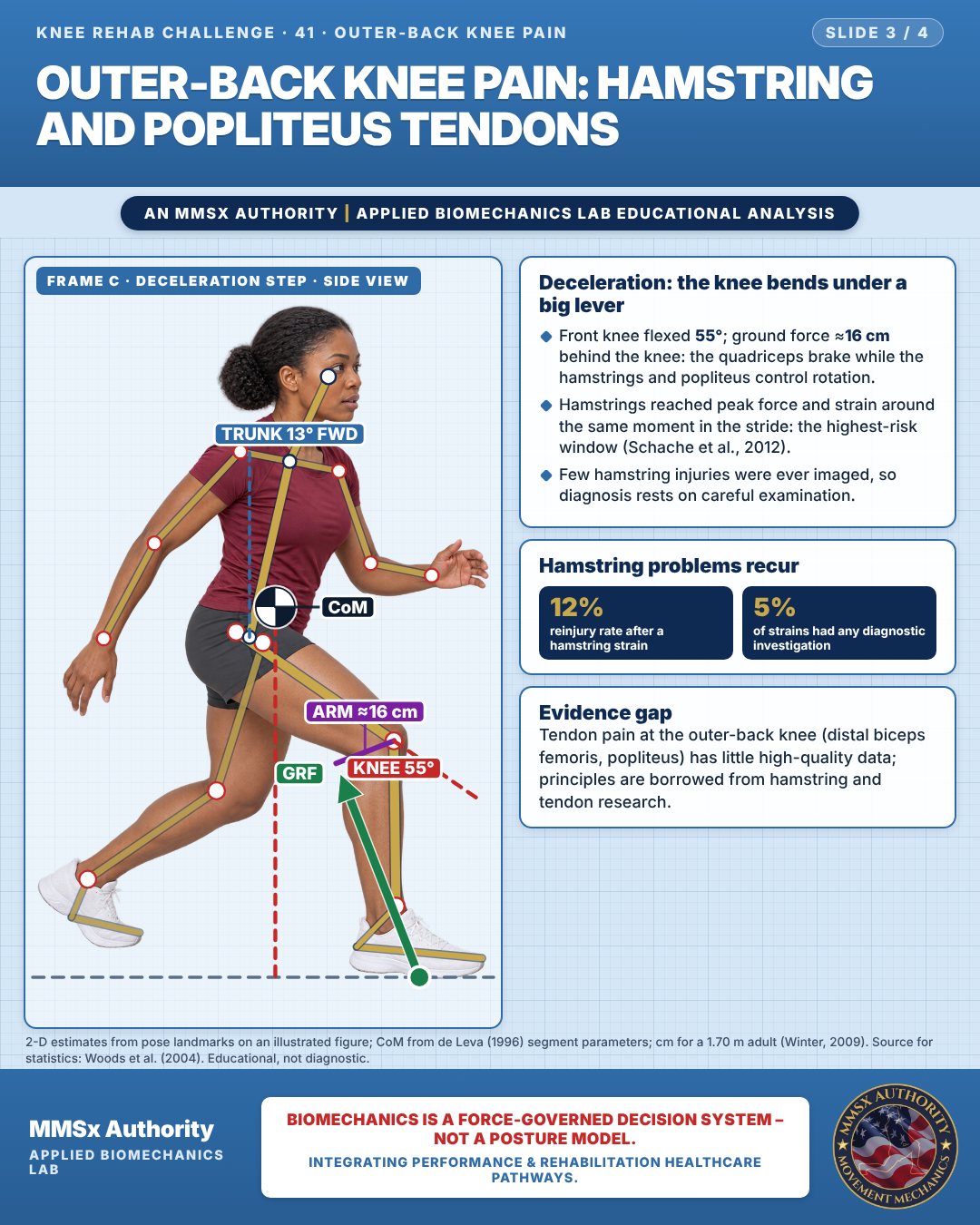
Deceleration: the knee bends under a big lever
Front knee flexed 55°; ground force ≈16 cm behind the knee: the quadriceps brake while the hamstrings and popliteus control rotation.
Hamstrings reached peak force and strain around the same moment in the stride: the highest-risk window (Schache et al., 2012).
Few hamstring injuries were ever imaged, so diagnosis rests on careful examination.
Hamstring problems recur
Evidence gap
Tendon pain at the outer-back knee (distal biceps femoris, popliteus) has little high-quality data; principles are borrowed from hamstring and tendon research.
Decision pathway
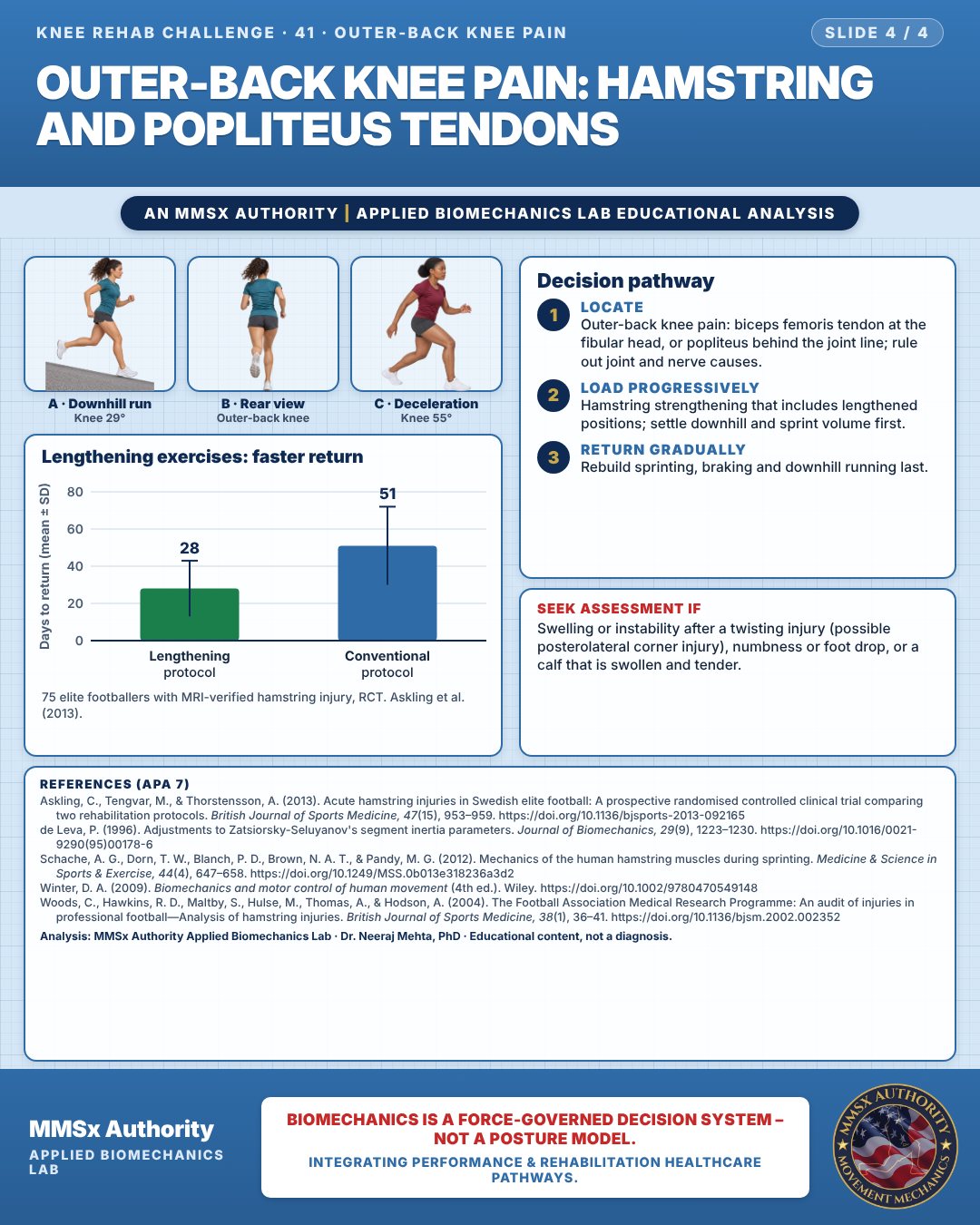
Lengthening exercises: faster return
Locate
Outer-back knee pain: biceps femoris tendon at the fibular head, or popliteus behind the joint line; rule out joint and nerve causes.
Load progressively
Hamstring strengthening that includes lengthened positions; settle downhill and sprint volume first.
Return gradually
Rebuild sprinting, braking and downhill running last.
Cautions
Seek assessment if
Swelling or instability after a twisting injury (possible posterolateral corner injury), numbness or foot drop, or a calf that is swollen and tender.
Methods note
2-D estimates from pose landmarks on an illustrated figure; CoM from de Leva (1996) segment parameters; cm for a 1.70 m adult (Winter, 2009). Pelvic tilt from left and right hip points in the rear view. Source for statistics: Woods et al. (2004). These are educational estimates, not a diagnosis.
References
- Askling, C., Tengvar, M., & Thorstensson, A. (2013). Acute hamstring injuries in Swedish elite football: A prospective randomised controlled clinical trial comparing two rehabilitation protocols. British Journal of Sports Medicine, 47(15), 953–959. https://doi.org/10.1136/bjsports-2013-092165
- de Leva, P. (1996). Adjustments to Zatsiorsky-Seluyanov's segment inertia parameters. Journal of Biomechanics, 29(9), 1223–1230. https://doi.org/10.1016/0021-9290(95)00178-6
- Schache, A. G., Dorn, T. W., Blanch, P. D., Brown, N. A. T., & Pandy, M. G. (2012). Mechanics of the human hamstring muscles during sprinting. Medicine & Science in Sports & Exercise, 44(4), 647–658. https://doi.org/10.1249/MSS.0b013e318236a3d2
- Winter, D. A. (2009). Biomechanics and motor control of human movement (4th ed.). Wiley. https://doi.org/10.1002/9780470549148
- Woods, C., Hawkins, R. D., Maltby, S., Hulse, M., Thomas, A., & Hodson, A. (2004). The Football Association Medical Research Programme: An audit of injuries in professional football—Analysis of hamstring injuries. British Journal of Sports Medicine, 38(1), 36–41. https://doi.org/10.1136/bjsm.2002.002352
Cite this article
Mehta, N. (2026, October 23). Outer-back knee pain: hamstring and popliteus tendons. MMSx Authority Applied Biomechanics Lab. https://mmsxauthority.org/edu/analysis/knee/41-outer-back-knee-pain-hamstring-and-popliteus-tendons/
Part of the collection
Mehta, N. (2026). Knee Rehabilitation: 50 Evidence-Based Biomechanics Analyses [Collection]. MMSx Authority Applied Biomechanics Lab. Zenodo. https://doi.org/10.5281/zenodo.23735752