Knee Rehab Challenge · 38
Quadriceps tendon pain: pain just above the kneecap
Quadriceps tendinopathy is pain arising from the quadriceps tendon where it attaches to the upper border of the kneecap.
Key points
- Confirm the site. Pain and tenderness just above the kneecap, not below it; the two tendons are distinct problems.
- Load, don’t rest. Graded tendon loading: isometric holds, then heavy slow work through range, then energy-storage tasks.
- Progress depth and speed. Deeper flexion and jumping last; keep symptoms settled by the next morning.
What it is
Quadriceps tendinopathy is pain arising from the quadriceps tendon where it attaches to the upper border of the kneecap. It is a load-related tendon condition, most often provoked by repeated knee-extension loading such as jumping, squatting, kneeling or stair use, and it is far less common than patellar tendinopathy below the kneecap.
How we analysed the movement
Three movements relevant to this topic were analysed from illustrated reference figures. Joint centres were located with two-dimensional pose estimation; joint angles, the whole-body centre of mass and, where relevant, the ground-reaction-force line and its moment arm about the knee were then calculated from standard segment parameters. The figures are educational estimates that show how position changes mechanical demand; they are not measurements of a patient. Every research value quoted below comes from the published source cited beside it.
Movement A: Decline squat (side view)
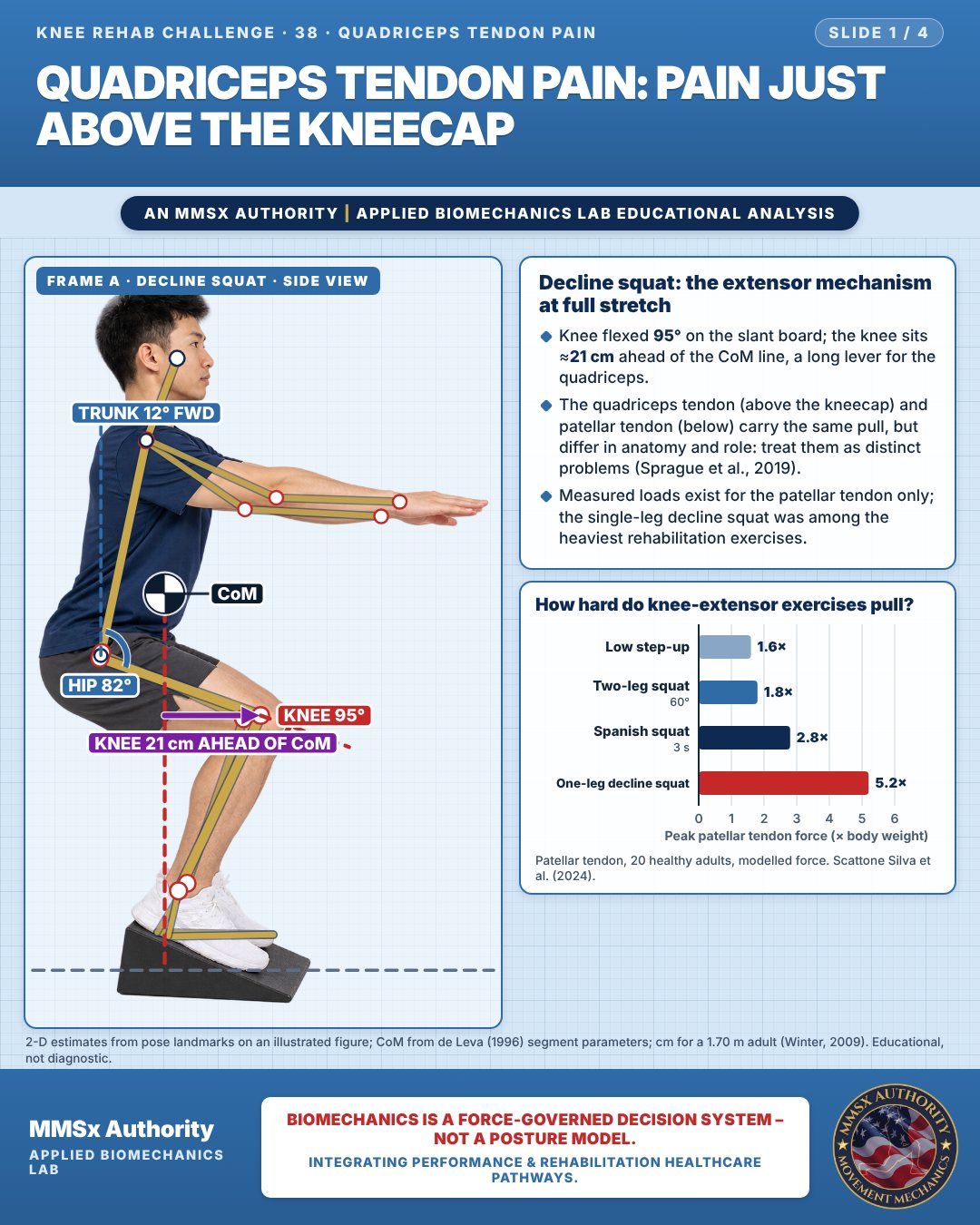
Decline squat: the extensor mechanism at full stretch
Knee flexed 95° on the slant board; the knee sits ≈21 cm ahead of the CoM line, a long lever for the quadriceps.
The quadriceps tendon (above the kneecap) and patellar tendon (below) carry the same pull, but differ in anatomy and role: treat them as distinct problems (Sprague et al., 2019).
Measured loads exist for the patellar tendon only; the single-leg decline squat was among the heaviest rehabilitation exercises.
How hard do knee-extensor exercises pull?
Movement B: Forward lunge (side view)
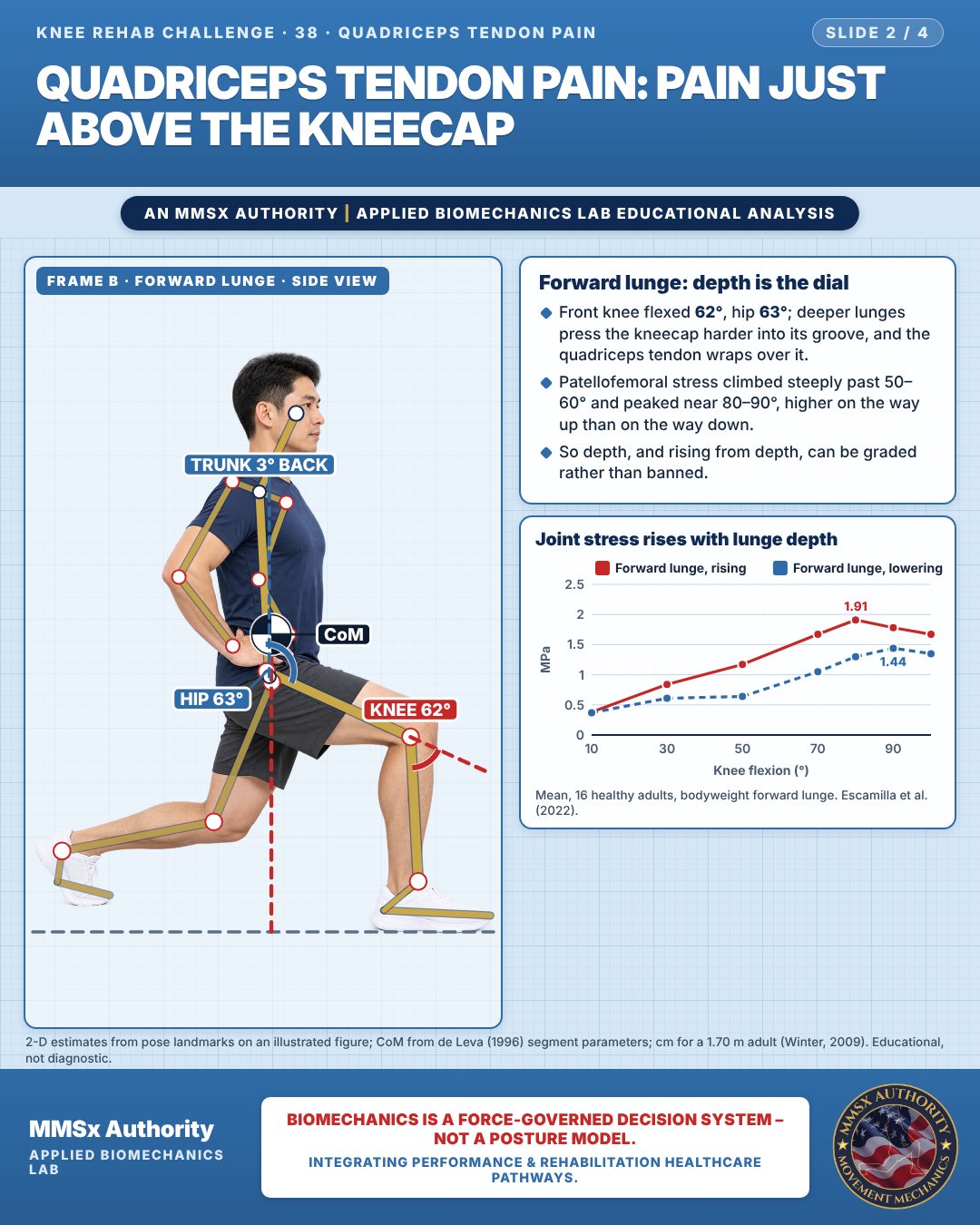
Forward lunge: depth is the dial
Front knee flexed 62°, hip 63°; deeper lunges press the kneecap harder into its groove, and the quadriceps tendon wraps over it.
Patellofemoral stress climbed steeply past 50–60° and peaked near 80–90°, higher on the way up than on the way down.
So depth, and rising from depth, can be graded rather than banned.
Joint stress rises with lunge depth
Movement C: Jump take-off (side view)
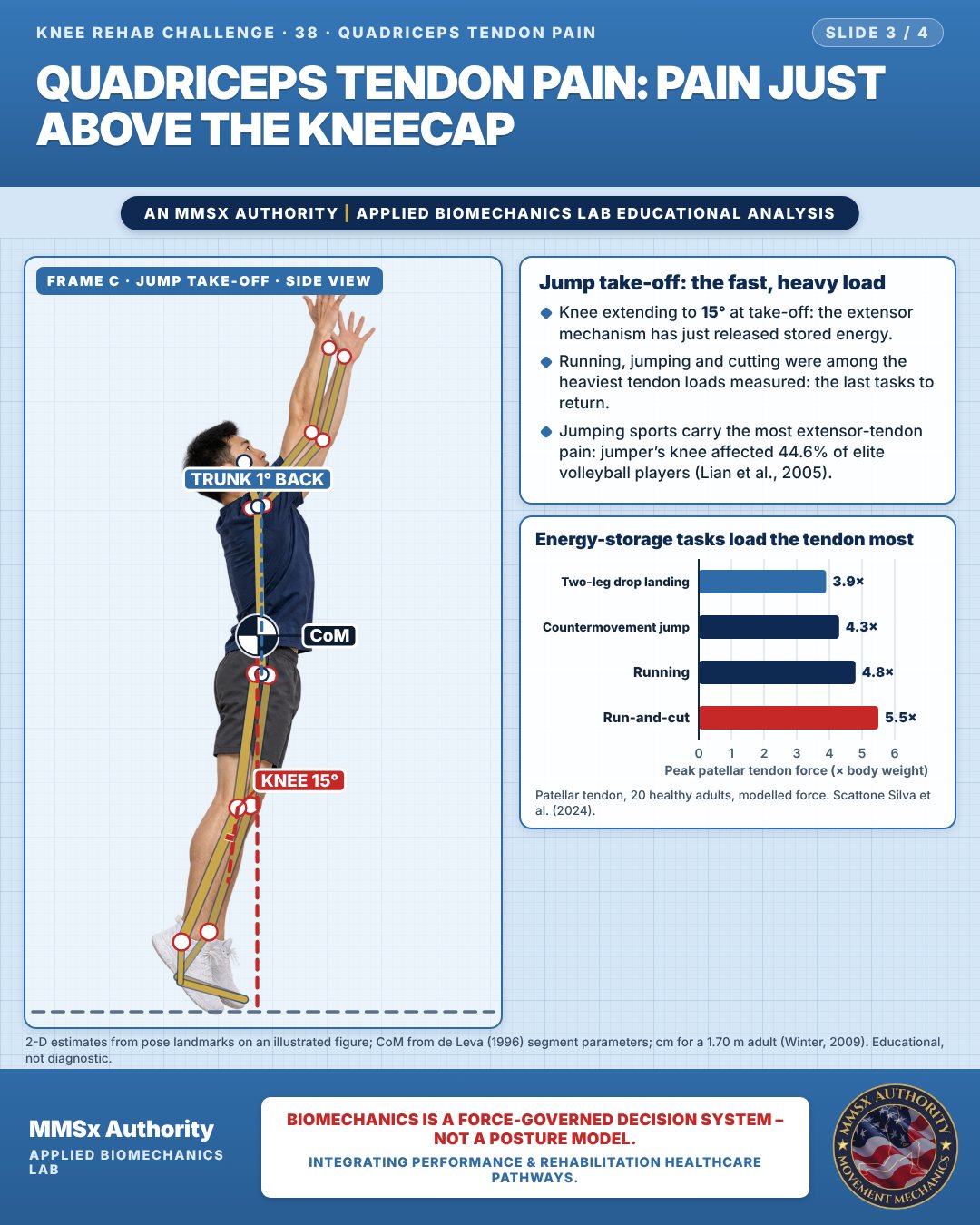
Jump take-off: the fast, heavy load
Knee extending to 15° at take-off: the extensor mechanism has just released stored energy.
Running, jumping and cutting were among the heaviest tendon loads measured: the last tasks to return.
Jumping sports carry the most extensor-tendon pain: jumper’s knee affected 44.6% of elite volleyball players (Lian et al., 2005).
Energy-storage tasks load the tendon most
Decision pathway
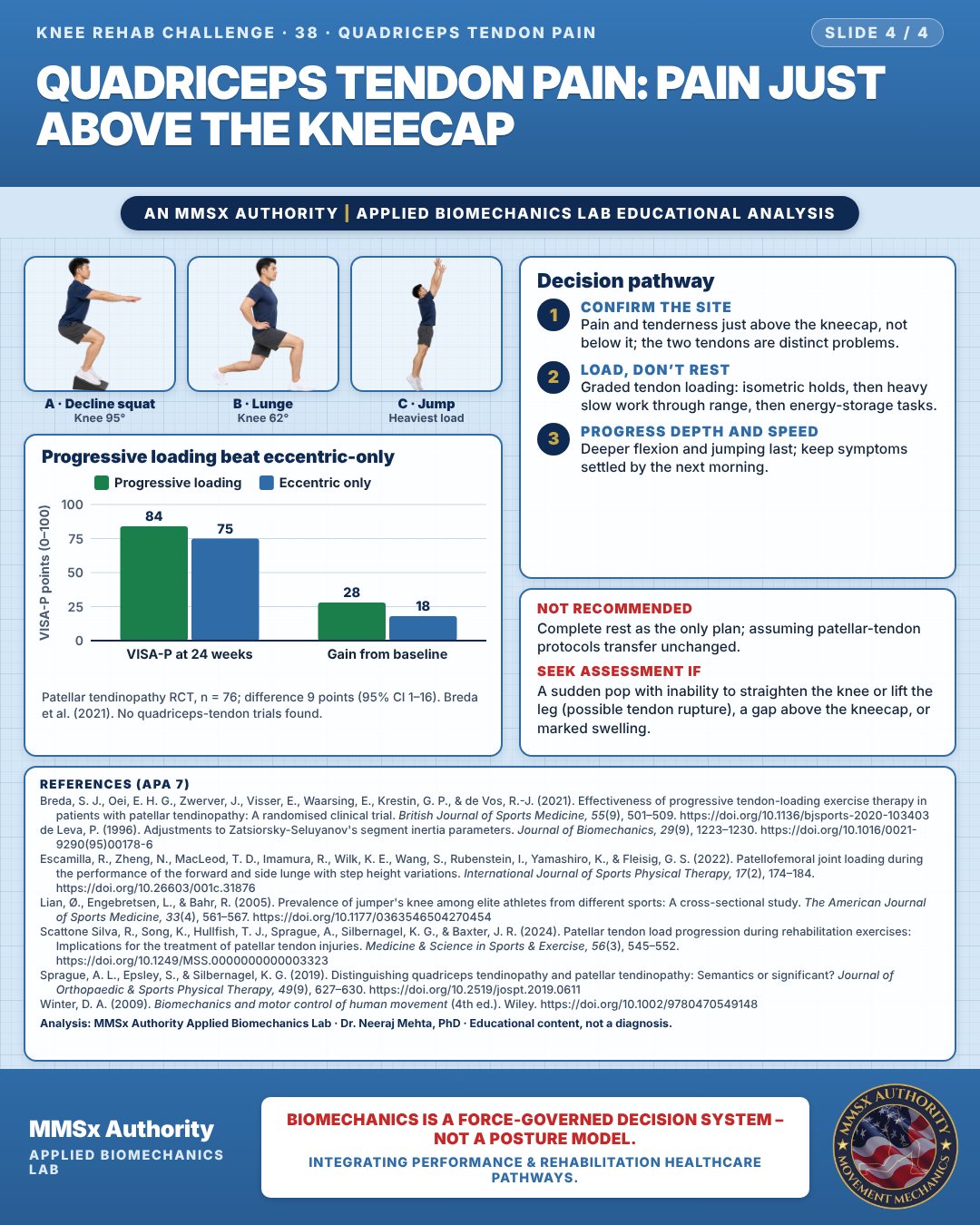
Progressive loading beat eccentric-only
Confirm the site
Pain and tenderness just above the kneecap, not below it; the two tendons are distinct problems.
Load, don’t rest
Graded tendon loading: isometric holds, then heavy slow work through range, then energy-storage tasks.
Progress depth and speed
Deeper flexion and jumping last; keep symptoms settled by the next morning.
Cautions
Not recommended
Complete rest as the only plan; assuming patellar-tendon protocols transfer unchanged.
Seek assessment if
A sudden pop with inability to straighten the knee or lift the leg (possible tendon rupture), a gap above the kneecap, or marked swelling.
Methods note
2-D estimates from pose landmarks on an illustrated figure; CoM from de Leva (1996) segment parameters; cm for a 1.70 m adult (Winter, 2009). These are educational estimates, not a diagnosis.
References
- Breda, S. J., Oei, E. H. G., Zwerver, J., Visser, E., Waarsing, E., Krestin, G. P., & de Vos, R.-J. (2021). Effectiveness of progressive tendon-loading exercise therapy in patients with patellar tendinopathy: A randomised clinical trial. British Journal of Sports Medicine, 55(9), 501–509. https://doi.org/10.1136/bjsports-2020-103403
- de Leva, P. (1996). Adjustments to Zatsiorsky-Seluyanov's segment inertia parameters. Journal of Biomechanics, 29(9), 1223–1230. https://doi.org/10.1016/0021-9290(95)00178-6
- Escamilla, R., Zheng, N., MacLeod, T. D., Imamura, R., Wilk, K. E., Wang, S., Rubenstein, I., Yamashiro, K., & Fleisig, G. S. (2022). Patellofemoral joint loading during the performance of the forward and side lunge with step height variations. International Journal of Sports Physical Therapy, 17(2), 174–184. https://doi.org/10.26603/001c.31876
- Lian, Ø., Engebretsen, L., & Bahr, R. (2005). Prevalence of jumper's knee among elite athletes from different sports: A cross-sectional study. The American Journal of Sports Medicine, 33(4), 561–567. https://doi.org/10.1177/0363546504270454
- Scattone Silva, R., Song, K., Hullfish, T. J., Sprague, A., Silbernagel, K. G., & Baxter, J. R. (2024). Patellar tendon load progression during rehabilitation exercises: Implications for the treatment of patellar tendon injuries. Medicine & Science in Sports & Exercise, 56(3), 545–552. https://doi.org/10.1249/MSS.0000000000003323
- Sprague, A. L., Epsley, S., & Silbernagel, K. G. (2019). Distinguishing quadriceps tendinopathy and patellar tendinopathy: Semantics or significant? Journal of Orthopaedic & Sports Physical Therapy, 49(9), 627–630. https://doi.org/10.2519/jospt.2019.0611
- Winter, D. A. (2009). Biomechanics and motor control of human movement (4th ed.). Wiley. https://doi.org/10.1002/9780470549148
Cite this article
Mehta, N. (2026, October 23). Quadriceps tendon pain: pain just above the kneecap. MMSx Authority Applied Biomechanics Lab. https://mmsxauthority.org/edu/analysis/knee/38-quadriceps-tendon-pain-pain-just-above-the-kneecap/
Part of the collection
Mehta, N. (2026). Knee Rehabilitation: 50 Evidence-Based Biomechanics Analyses [Collection]. MMSx Authority Applied Biomechanics Lab. Zenodo. https://doi.org/10.5281/zenodo.23735752