Knee Rehab Challenge · 37
PCL injury: when the shin is pushed backwards
A posterior cruciate ligament (PCL) injury is a sprain or tear of the ligament that resists the shin bone (tibia) moving backwards on the thigh bone (femur).
Key points
- Check what else. Most PCL injuries come with other ligament damage: combined injuries need specialist assessment.
- Isolated tear. Often managed without surgery; quadriceps strength supports the shin against backward sag.
- Progress depth. Return to deep loaded flexion and pivoting gradually, guided by symptoms and stability.
What it is
A posterior cruciate ligament (PCL) injury is a sprain or tear of the ligament that resists the shin bone (tibia) moving backwards on the thigh bone (femur). It typically follows a direct blow to the front of the shin with the knee bent, such as a dashboard impact or a fall onto a flexed knee, and it may occur alone or with other ligament injuries.
How we analysed the movement
Three movements relevant to this topic were analysed from illustrated reference figures. Joint centres were located with two-dimensional pose estimation; joint angles, the whole-body centre of mass and, where relevant, the ground-reaction-force line and its moment arm about the knee were then calculated from standard segment parameters. The figures are educational estimates that show how position changes mechanical demand; they are not measurements of a patient. Every research value quoted below comes from the published source cited beside it.
Movement A: Kneeling (side view)
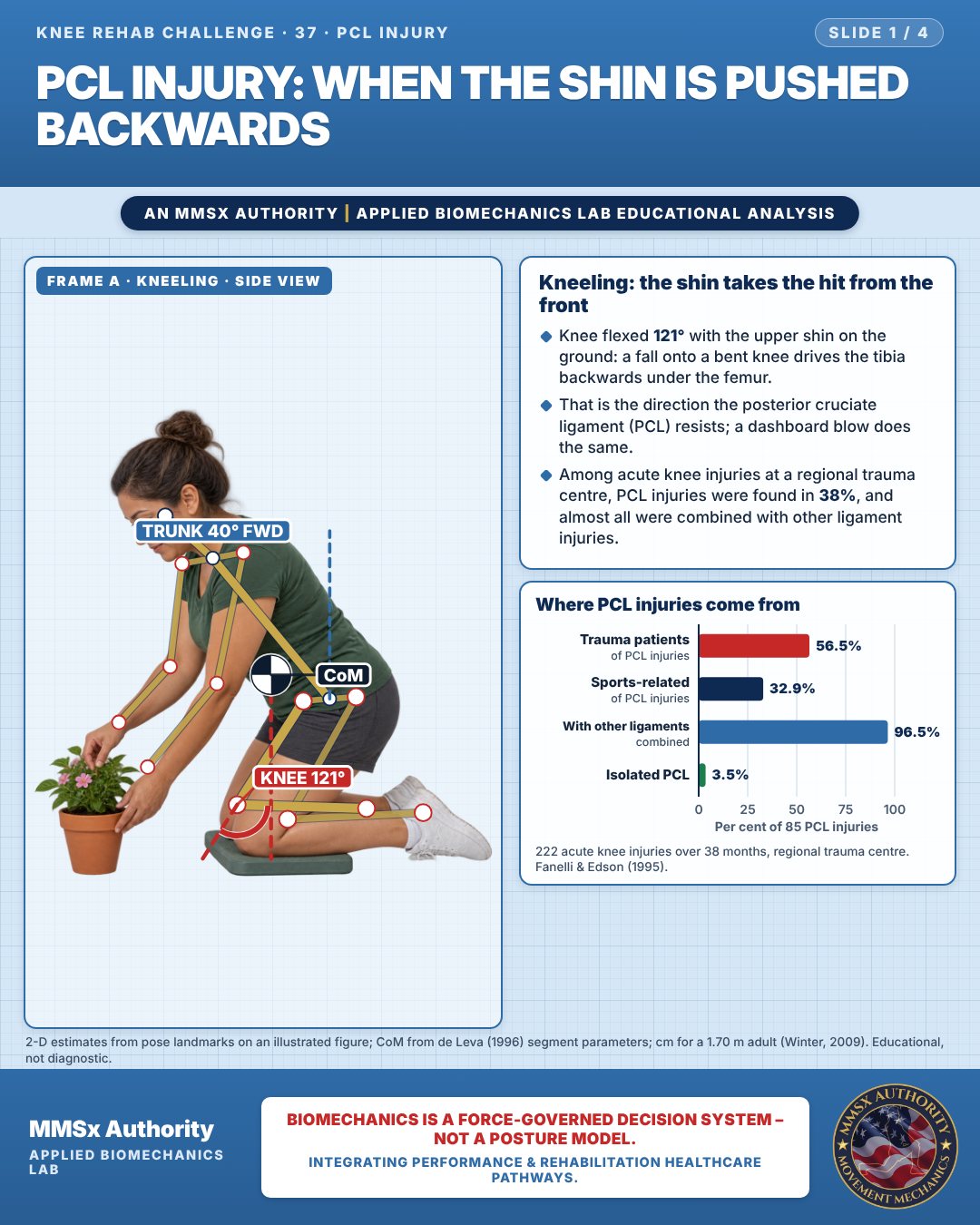
Kneeling: the shin takes the hit from the front
Knee flexed 121° with the upper shin on the ground: a fall onto a bent knee drives the tibia backwards under the femur.
That is the direction the posterior cruciate ligament (PCL) resists; a dashboard blow does the same.
Among acute knee injuries at a regional trauma centre, PCL injuries were found in 38%, and almost all were combined with other ligament injuries.
Where PCL injuries come from
Movement B: Deep squat (side view)
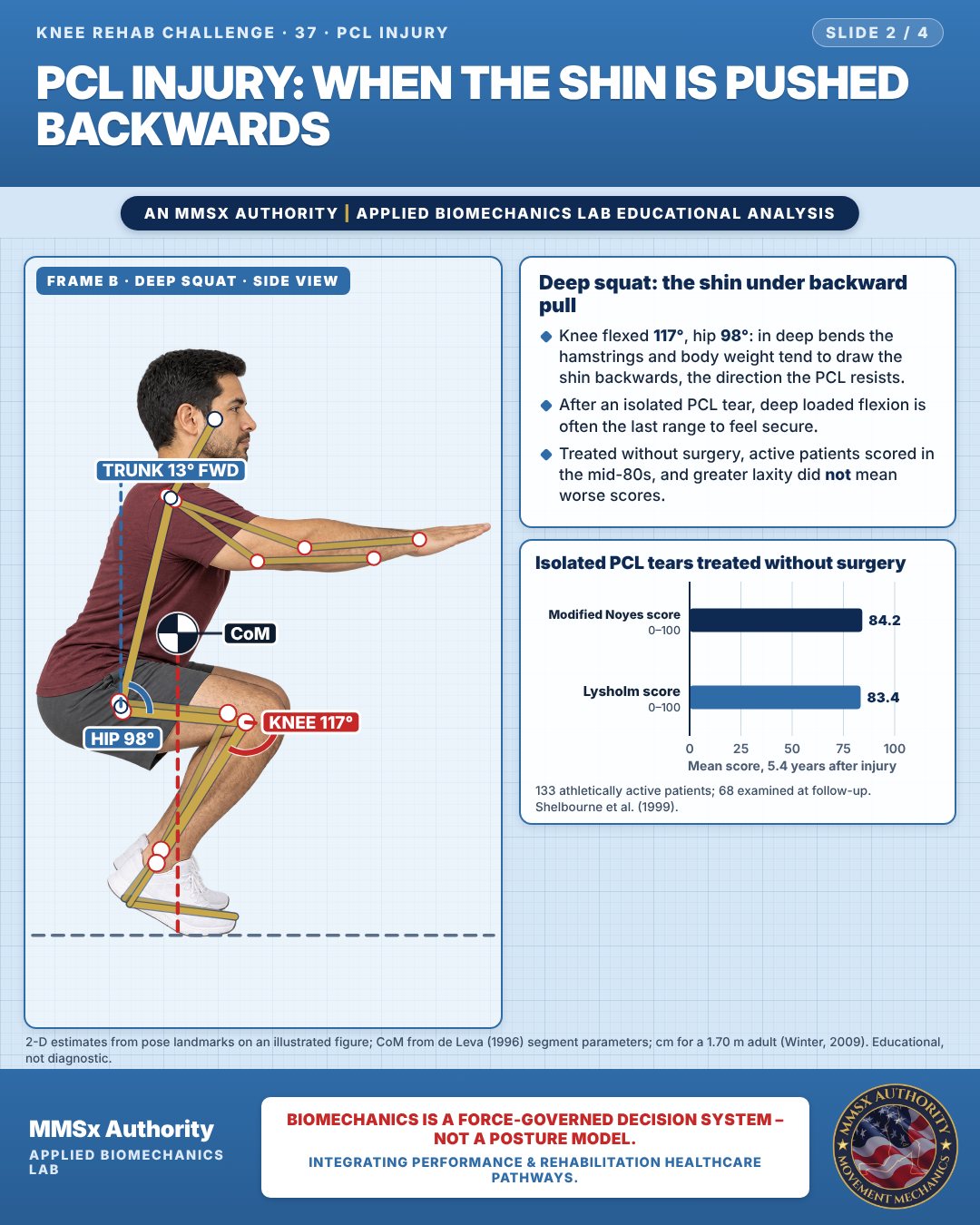
Deep squat: the shin under backward pull
Knee flexed 117°, hip 98°: in deep bends the hamstrings and body weight tend to draw the shin backwards, the direction the PCL resists.
After an isolated PCL tear, deep loaded flexion is often the last range to feel secure.
Treated without surgery, active patients scored in the mid-80s, and greater laxity did not mean worse scores.
Isolated PCL tears treated without surgery
Movement C: Seated, knee bent, oblique
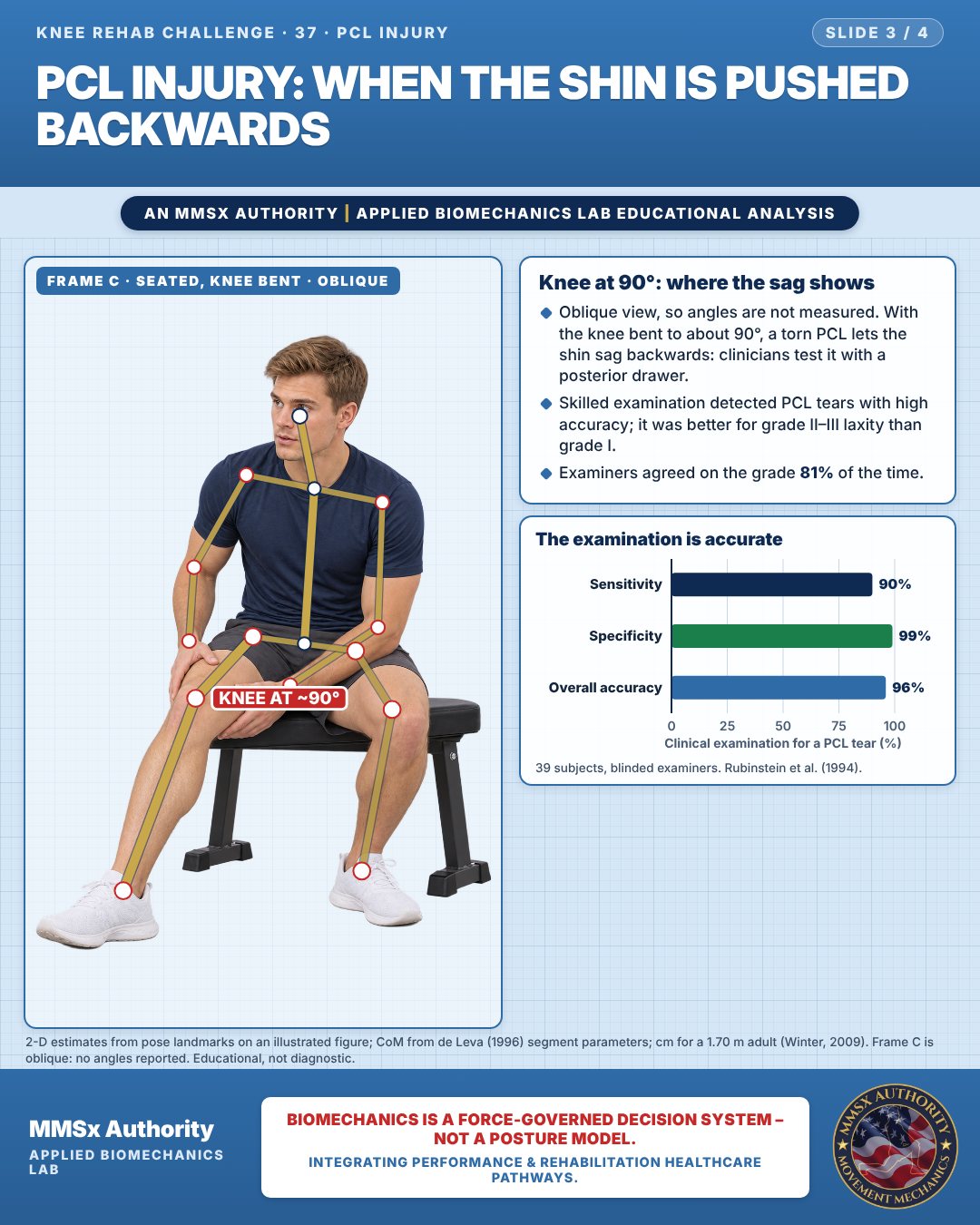
Knee at 90°: where the sag shows
Oblique view, so angles are not measured. With the knee bent to about 90°, a torn PCL lets the shin sag backwards: clinicians test it with a posterior drawer.
Skilled examination detected PCL tears with high accuracy; it was better for grade II–III laxity than grade I.
Examiners agreed on the grade 81% of the time.
The examination is accurate
Decision pathway
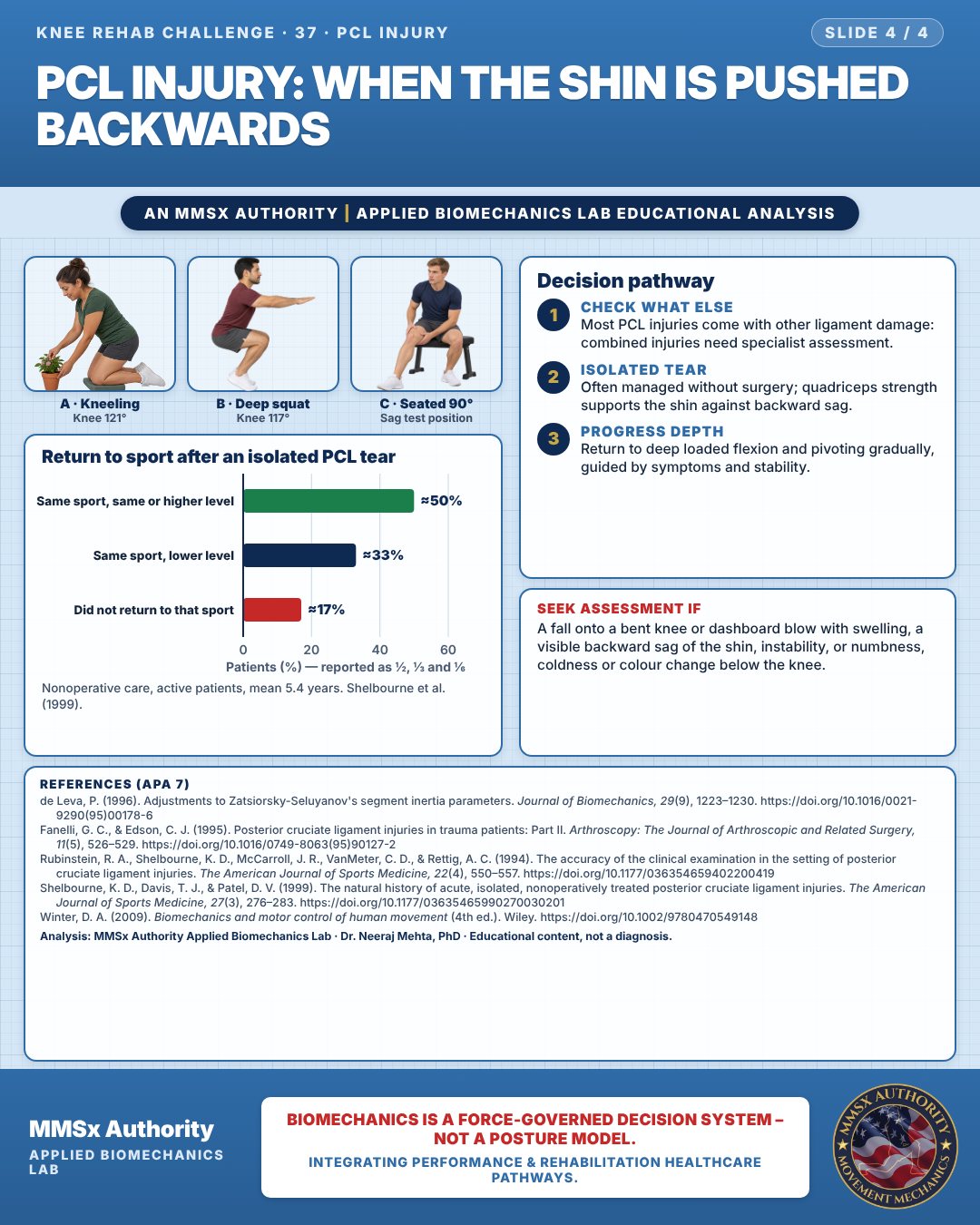
Return to sport after an isolated PCL tear
Check what else
Most PCL injuries come with other ligament damage: combined injuries need specialist assessment.
Isolated tear
Often managed without surgery; quadriceps strength supports the shin against backward sag.
Progress depth
Return to deep loaded flexion and pivoting gradually, guided by symptoms and stability.
Cautions
Seek assessment if
A fall onto a bent knee or dashboard blow with swelling, a visible backward sag of the shin, instability, or numbness, coldness or colour change below the knee.
Methods note
2-D estimates from pose landmarks on an illustrated figure; CoM from de Leva (1996) segment parameters; cm for a 1.70 m adult (Winter, 2009). Frame C is oblique: no angles reported. These are educational estimates, not a diagnosis.
References
- de Leva, P. (1996). Adjustments to Zatsiorsky-Seluyanov's segment inertia parameters. Journal of Biomechanics, 29(9), 1223–1230. https://doi.org/10.1016/0021-9290(95)00178-6
- Fanelli, G. C., & Edson, C. J. (1995). Posterior cruciate ligament injuries in trauma patients: Part II. Arthroscopy: The Journal of Arthroscopic and Related Surgery, 11(5), 526–529. https://doi.org/10.1016/0749-8063(95)90127-2
- Rubinstein, R. A., Shelbourne, K. D., McCarroll, J. R., VanMeter, C. D., & Rettig, A. C. (1994). The accuracy of the clinical examination in the setting of posterior cruciate ligament injuries. The American Journal of Sports Medicine, 22(4), 550–557. https://doi.org/10.1177/036354659402200419
- Shelbourne, K. D., Davis, T. J., & Patel, D. V. (1999). The natural history of acute, isolated, nonoperatively treated posterior cruciate ligament injuries. The American Journal of Sports Medicine, 27(3), 276–283. https://doi.org/10.1177/03635465990270030201
- Winter, D. A. (2009). Biomechanics and motor control of human movement (4th ed.). Wiley. https://doi.org/10.1002/9780470549148
Cite this article
Mehta, N. (2026, October 23). PCL injury: when the shin is pushed backwards. MMSx Authority Applied Biomechanics Lab. https://mmsxauthority.org/edu/analysis/knee/37-pcl-injury-when-the-shin-is-pushed-backwards/
Part of the collection
Mehta, N. (2026). Knee Rehabilitation: 50 Evidence-Based Biomechanics Analyses [Collection]. MMSx Authority Applied Biomechanics Lab. Zenodo. https://doi.org/10.5281/zenodo.23735752