Knee Rehab Challenge · 34
Can't fully straighten your knee? Understanding extension loss
Loss of knee extension is the inability to fully straighten the knee, either actively or passively.
Key points
- Measure. Compare extension with the other knee, including hyperextension; a 2–3° loss is already meaningful.
- Restore early. Heel props, quadriceps setting and frequent gentle extension work; never rest with a pillow under the knee.
- Load through range. Once extension returns, strengthen through it so it stays.
What it is
Loss of knee extension is the inability to fully straighten the knee, either actively or passively. It can follow injury, surgery (such as anterior cruciate ligament reconstruction or knee replacement), joint swelling, a mechanical block (for example a displaced meniscal fragment) or protective muscle guarding. Even a few degrees of lost extension changes how the knee is loaded in standing and walking, so it is assessed and addressed early.
How we analysed the movement
Three movements relevant to this topic were analysed from illustrated reference figures. Joint centres were located with two-dimensional pose estimation; joint angles, the whole-body centre of mass and, where relevant, the ground-reaction-force line and its moment arm about the knee were then calculated from standard segment parameters. The figures are educational estimates that show how position changes mechanical demand; they are not measurements of a patient. Every research value quoted below comes from the published source cited beside it.
Movement A: Walking, end of stance (side view)
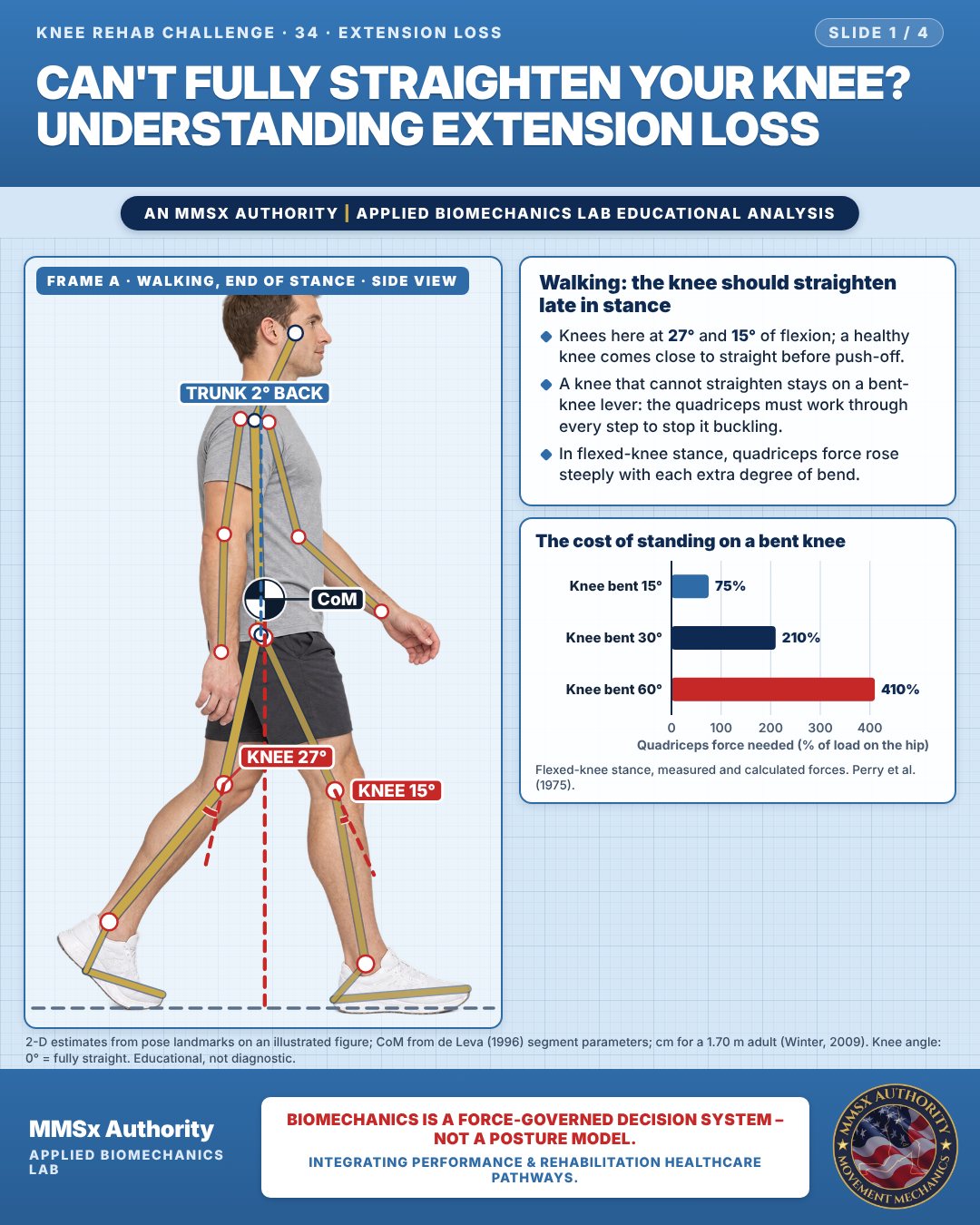
Walking: the knee should straighten late in stance
Knees here at 27° and 15° of flexion; a healthy knee comes close to straight before push-off.
A knee that cannot straighten stays on a bent-knee lever: the quadriceps must work through every step to stop it buckling.
In flexed-knee stance, quadriceps force rose steeply with each extra degree of bend.
The cost of standing on a bent knee
Movement B: Heel propped, oblique
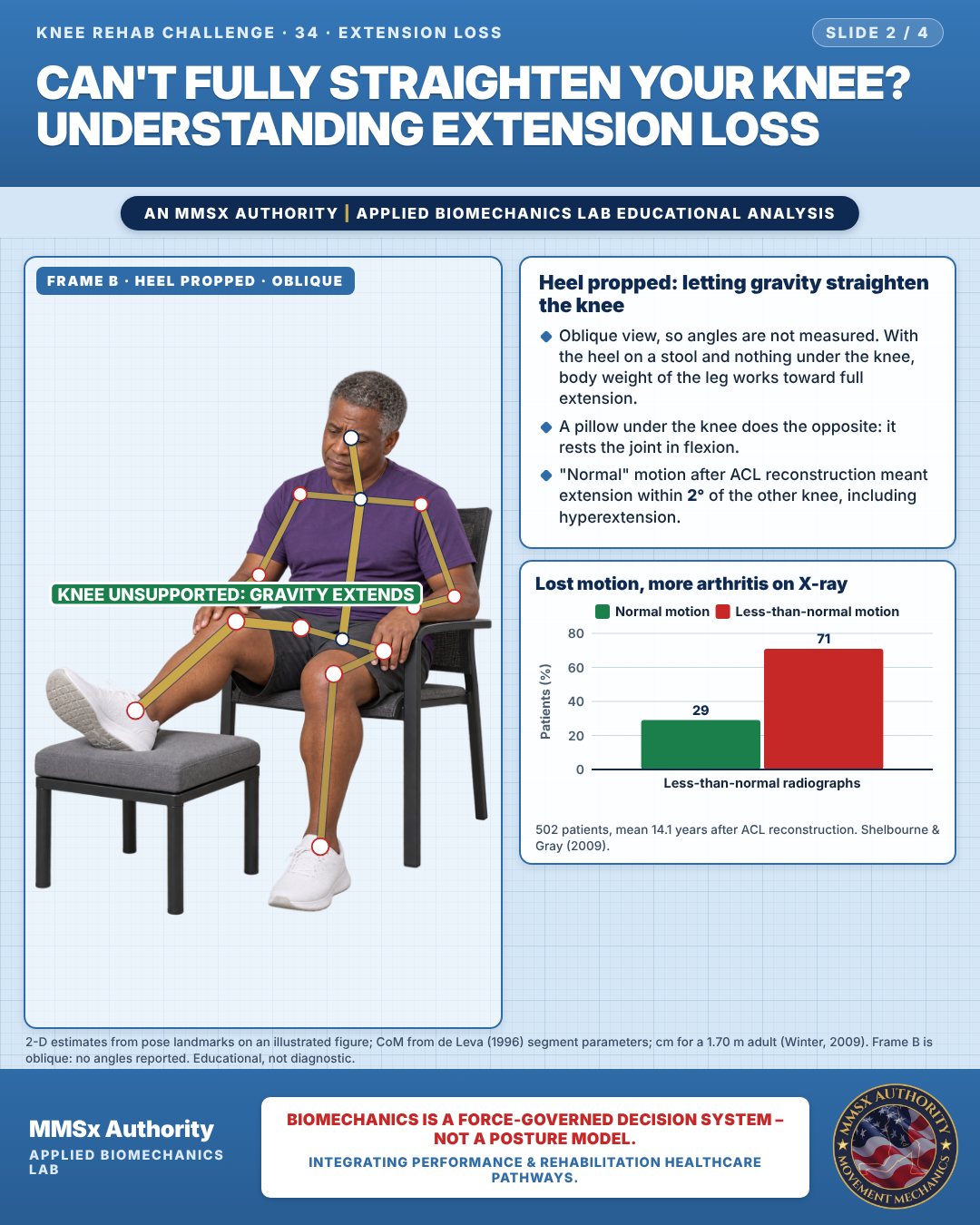
Heel propped: letting gravity straighten the knee
Oblique view, so angles are not measured. With the heel on a stool and nothing under the knee, body weight of the leg works toward full extension.
A pillow under the knee does the opposite: it rests the joint in flexion.
"Normal" motion after ACL reconstruction meant extension within 2° of the other knee, including hyperextension.
Lost motion, more arthritis on X-ray
Movement C: First step after sitting (side view)
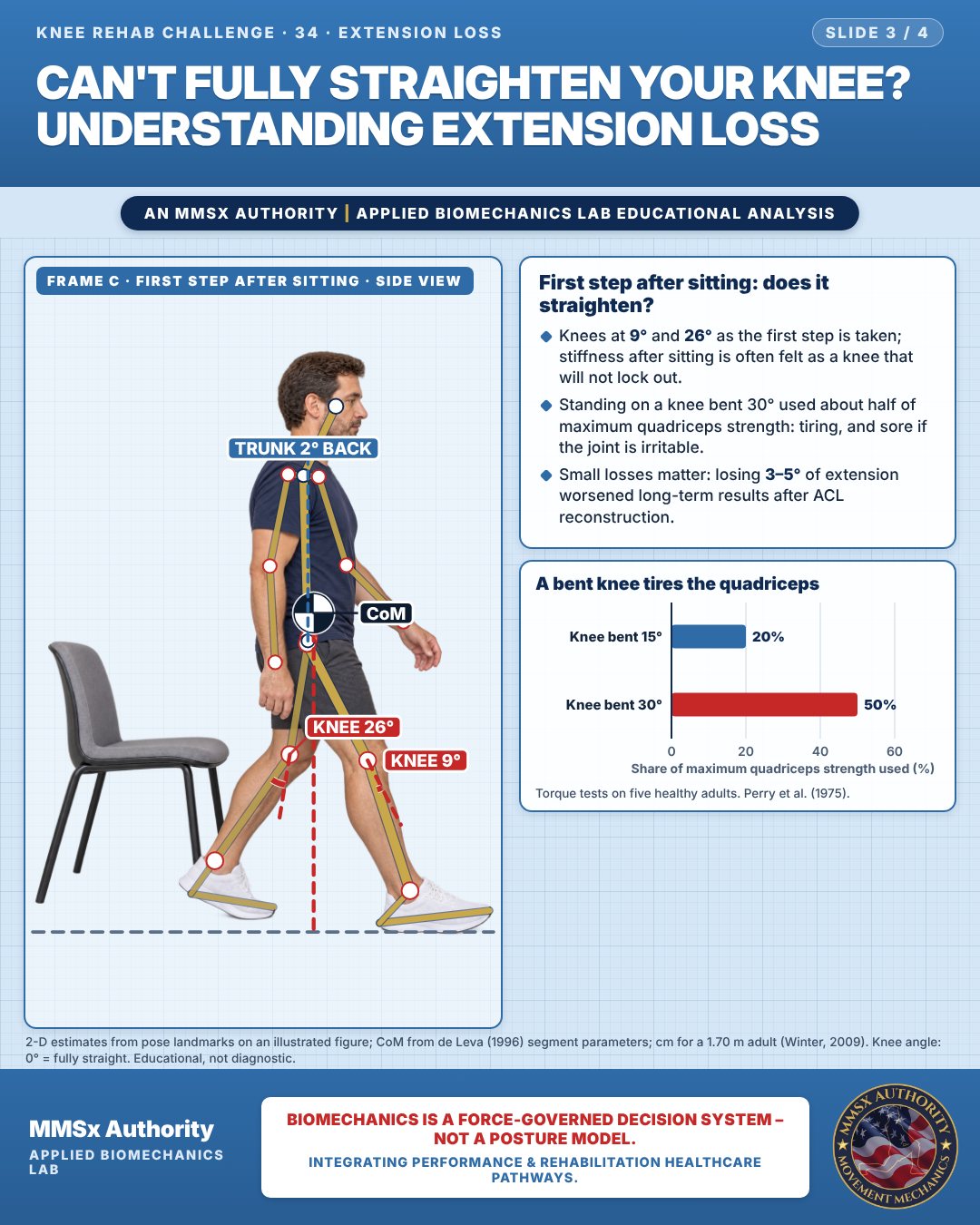
First step after sitting: does it straighten?
Knees at 9° and 26° as the first step is taken; stiffness after sitting is often felt as a knee that will not lock out.
Standing on a knee bent 30° used about half of maximum quadriceps strength: tiring, and sore if the joint is irritable.
Small losses matter: losing 3–5° of extension worsened long-term results after ACL reconstruction.
A bent knee tires the quadriceps
Decision pathway
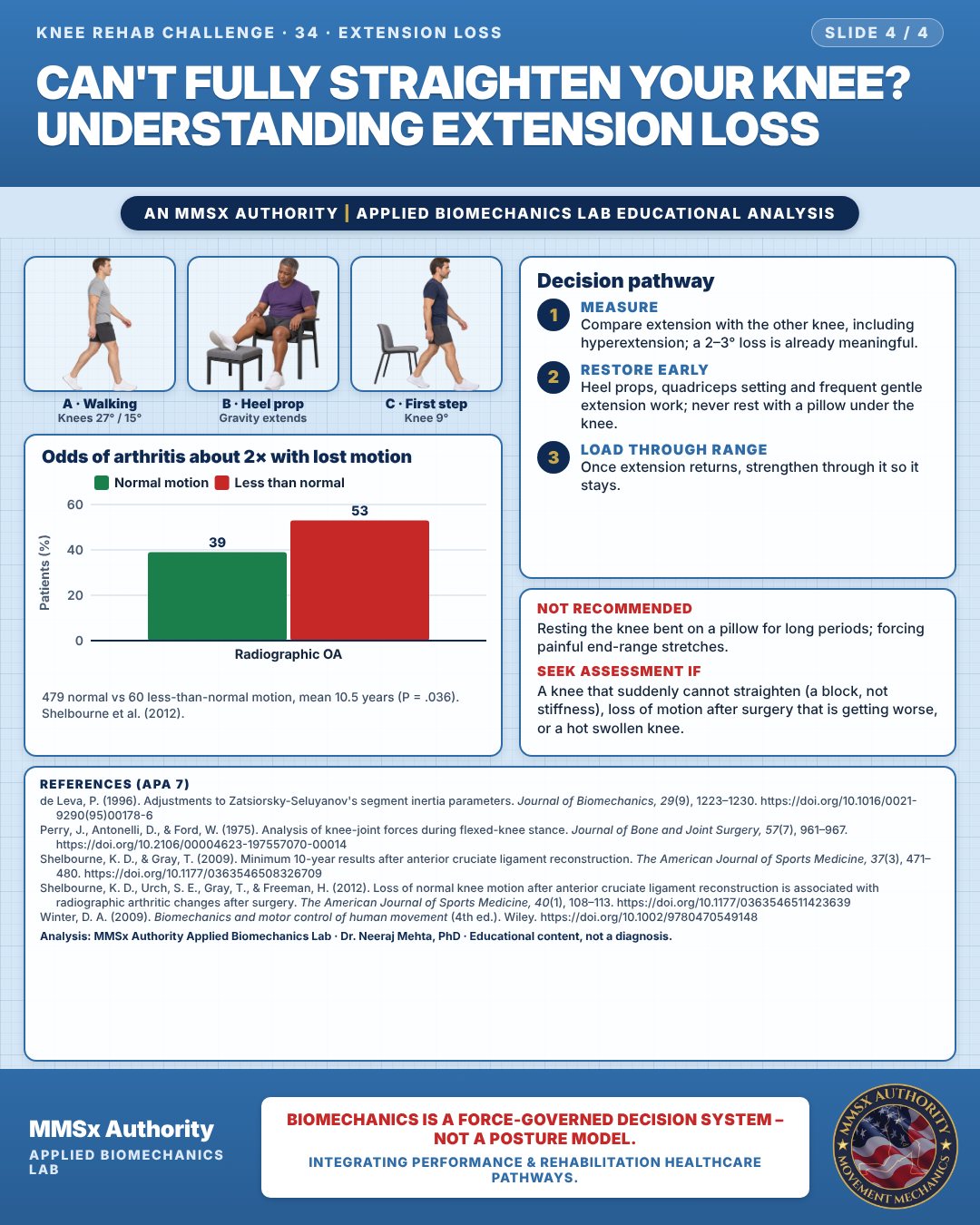
Odds of arthritis about 2× with lost motion
Measure
Compare extension with the other knee, including hyperextension; a 2–3° loss is already meaningful.
Restore early
Heel props, quadriceps setting and frequent gentle extension work; never rest with a pillow under the knee.
Load through range
Once extension returns, strengthen through it so it stays.
Cautions
Not recommended
Resting the knee bent on a pillow for long periods; forcing painful end-range stretches.
Seek assessment if
A knee that suddenly cannot straighten (a block, not stiffness), loss of motion after surgery that is getting worse, or a hot swollen knee.
Methods note
2-D estimates from pose landmarks on an illustrated figure; CoM from de Leva (1996) segment parameters; cm for a 1.70 m adult (Winter, 2009). Knee angle: 0° = fully straight. Frame B is oblique: no angles reported. These are educational estimates, not a diagnosis.
References
- de Leva, P. (1996). Adjustments to Zatsiorsky-Seluyanov's segment inertia parameters. Journal of Biomechanics, 29(9), 1223–1230. https://doi.org/10.1016/0021-9290(95)00178-6
- Perry, J., Antonelli, D., & Ford, W. (1975). Analysis of knee-joint forces during flexed-knee stance. Journal of Bone and Joint Surgery, 57(7), 961–967. https://doi.org/10.2106/00004623-197557070-00014
- Shelbourne, K. D., & Gray, T. (2009). Minimum 10-year results after anterior cruciate ligament reconstruction. The American Journal of Sports Medicine, 37(3), 471–480. https://doi.org/10.1177/0363546508326709
- Shelbourne, K. D., Urch, S. E., Gray, T., & Freeman, H. (2012). Loss of normal knee motion after anterior cruciate ligament reconstruction is associated with radiographic arthritic changes after surgery. The American Journal of Sports Medicine, 40(1), 108–113. https://doi.org/10.1177/0363546511423639
- Winter, D. A. (2009). Biomechanics and motor control of human movement (4th ed.). Wiley. https://doi.org/10.1002/9780470549148
Cite this article
Mehta, N. (2026, October 23). Can't fully straighten your knee? Understanding extension loss. MMSx Authority Applied Biomechanics Lab. https://mmsxauthority.org/edu/analysis/knee/34-cant-fully-straighten-your-knee-understanding-extension-loss/
Part of the collection
Mehta, N. (2026). Knee Rehabilitation: 50 Evidence-Based Biomechanics Analyses [Collection]. MMSx Authority Applied Biomechanics Lab. Zenodo. https://doi.org/10.5281/zenodo.23735752