Knee Rehab Challenge · 32
After knee replacement: getting bend, straightening and strength back
Rehabilitation after total knee arthroplasty (TKA) aims to restore knee range of motion (full extension and enough flexion for daily tasks),…
Key points
- Move early. Start within 24 hours; daily range-of-motion work toward full straightening and about 110° of bend.
- Strengthen hard. Progressive, high-intensity quadriceps strengthening from the first week; add NMES if activation is poor.
- Keep going. Walking, balance and symmetry training beyond the early months: the strength gap persists at 1 year.
What it is
Rehabilitation after total knee arthroplasty (TKA) aims to restore knee range of motion (full extension and enough flexion for daily tasks), quadriceps strength and symmetrical movement (walking, sit-to-stand, stairs); early postoperative weakness is driven largely by reduced voluntary quadriceps activation as well as muscle atrophy.
How we analysed the movement
Three movements relevant to this topic were analysed from illustrated reference figures. Joint centres were located with two-dimensional pose estimation; joint angles, the whole-body centre of mass and, where relevant, the ground-reaction-force line and its moment arm about the knee were then calculated from standard segment parameters. The figures are educational estimates that show how position changes mechanical demand; they are not measurements of a patient. Every research value quoted below comes from the published source cited beside it.
Movement A: Sit-to-stand (side view)
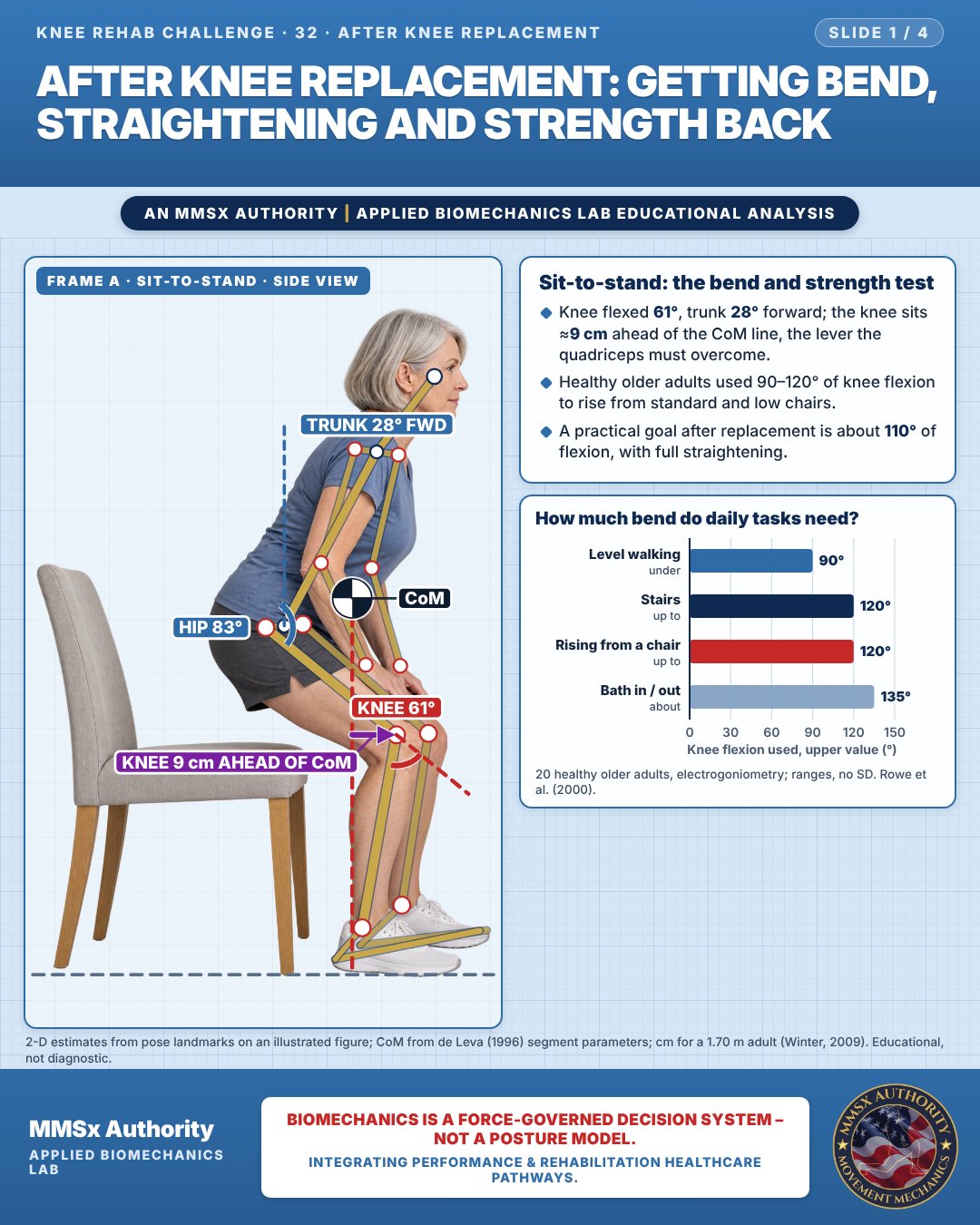
Sit-to-stand: the bend and strength test
Knee flexed 61°, trunk 28° forward; the knee sits ≈9 cm ahead of the CoM line, the lever the quadriceps must overcome.
Healthy older adults used 90–120° of knee flexion to rise from standard and low chairs.
A practical goal after replacement is about 110° of flexion, with full straightening.
How much bend do daily tasks need?
Movement B: Chair rise (front view)
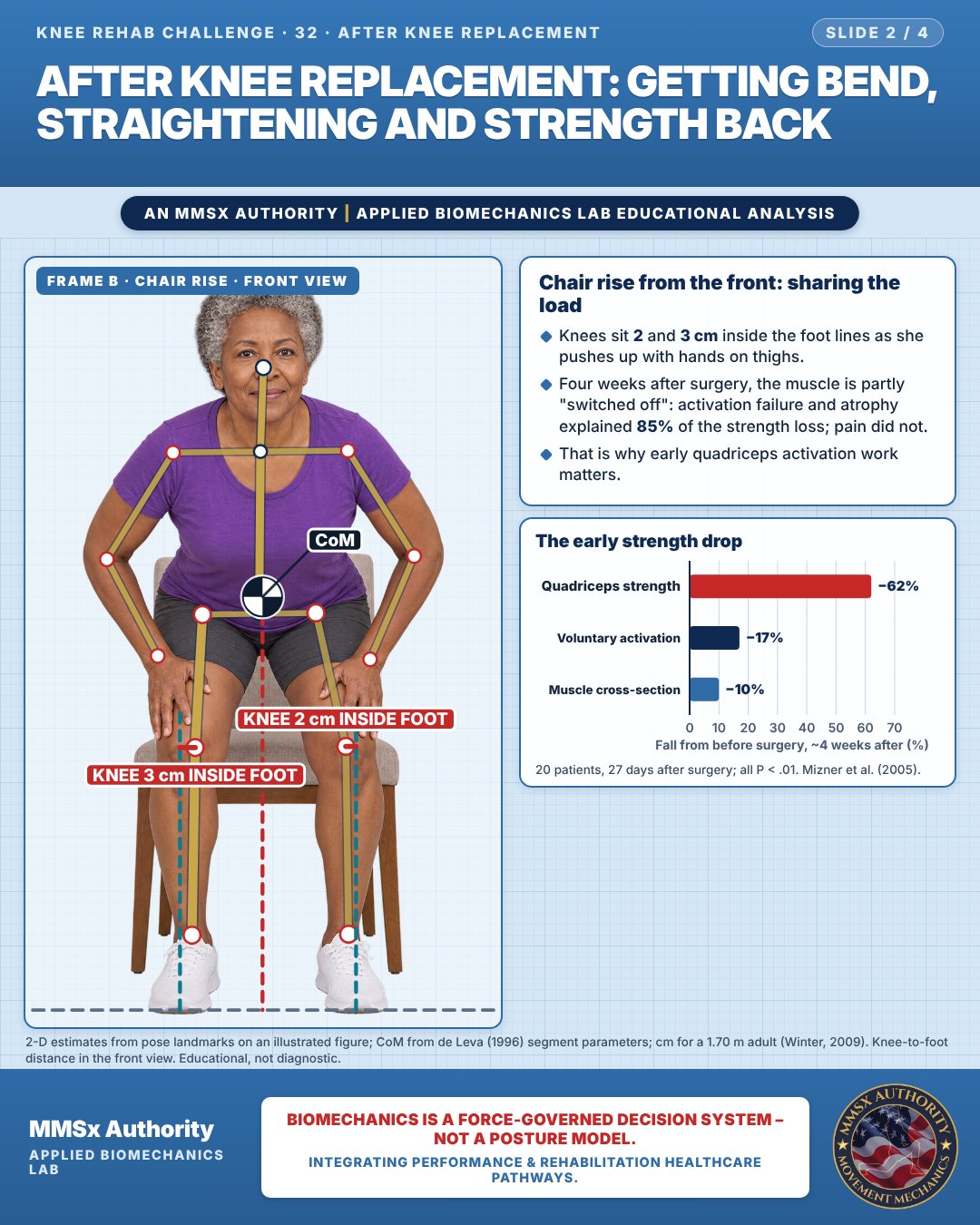
Chair rise from the front: sharing the load
Knees sit 2 and 3 cm inside the foot lines as she pushes up with hands on thighs.
Four weeks after surgery, the muscle is partly "switched off": activation failure and atrophy explained 85% of the strength loss; pain did not.
That is why early quadriceps activation work matters.
The early strength drop
Movement C: Walking (oblique view)
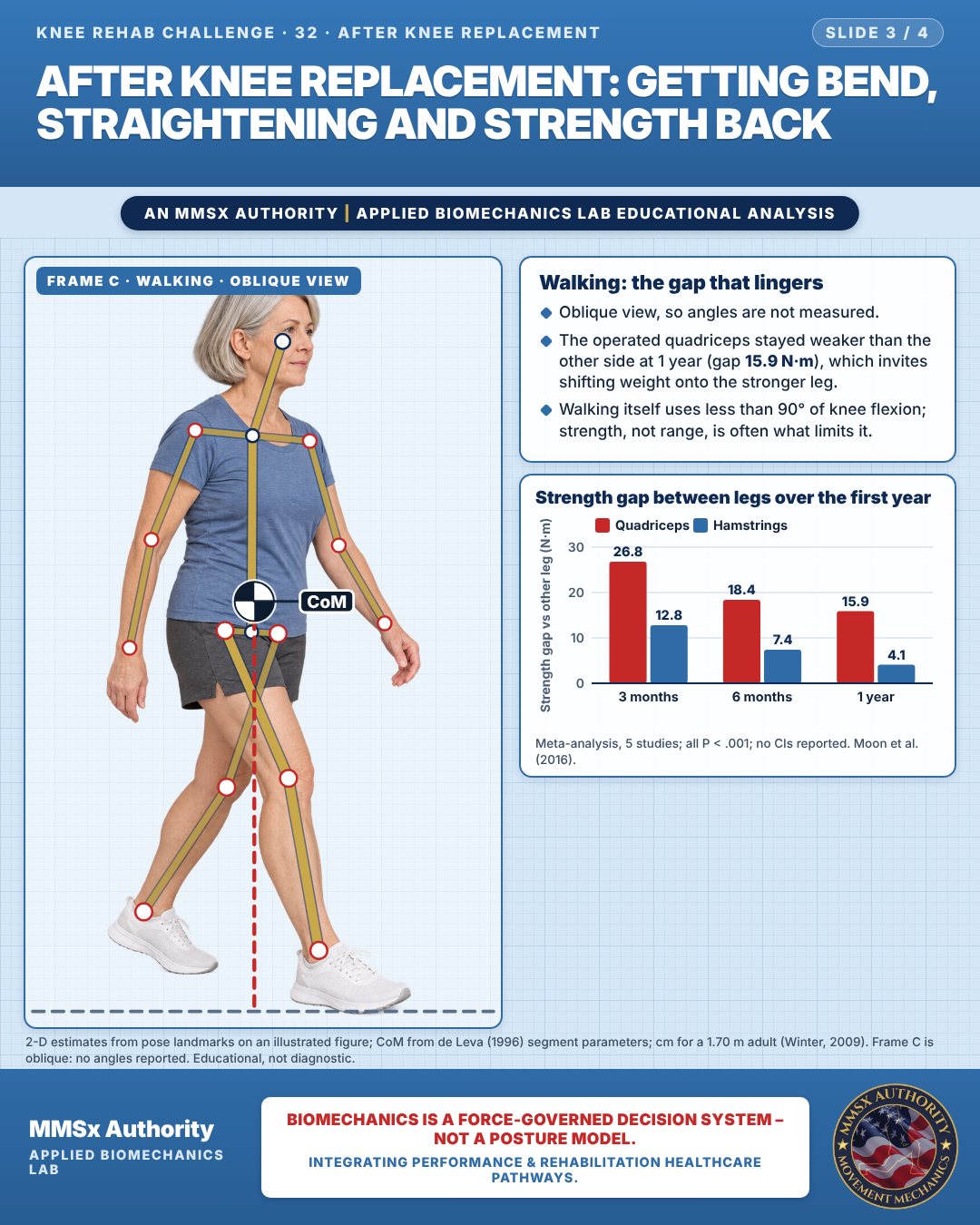
Walking: the gap that lingers
Oblique view, so angles are not measured.
The operated quadriceps stayed weaker than the other side at 1 year (gap 15.9 N·m), which invites shifting weight onto the stronger leg.
Walking itself uses less than 90° of knee flexion; strength, not range, is often what limits it.
Strength gap between legs over the first year
Decision pathway
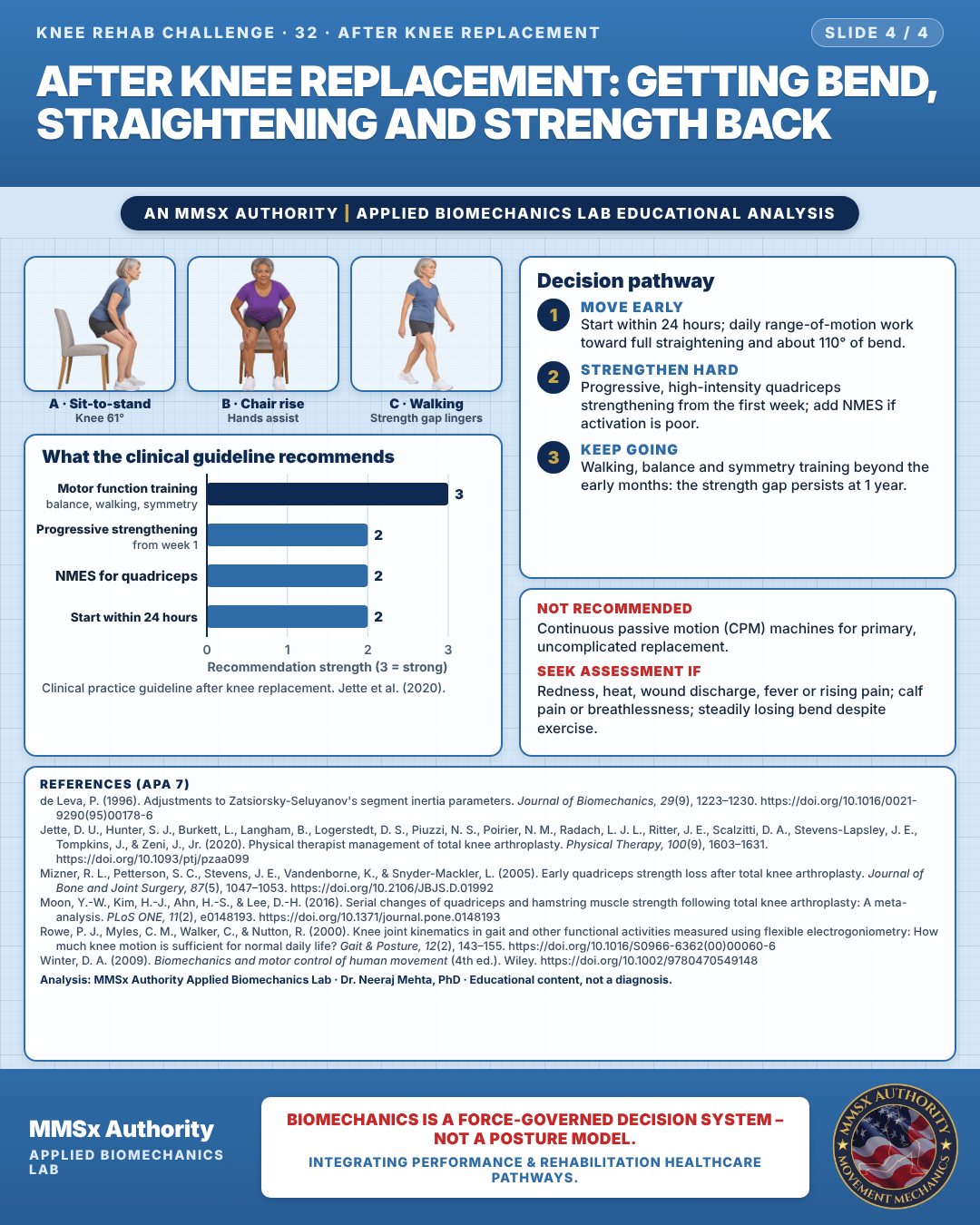
What the clinical guideline recommends
Move early
Start within 24 hours; daily range-of-motion work toward full straightening and about 110° of bend.
Strengthen hard
Progressive, high-intensity quadriceps strengthening from the first week; add NMES if activation is poor.
Keep going
Walking, balance and symmetry training beyond the early months: the strength gap persists at 1 year.
What the evidence supports
- Recommended (Jette et al., 2020): start within 24 h; early mobility; ROM exercise; high-intensity, progressive strengthening from the first week; NMES for quadriceps; balance, walking and movement-symmetry training; cryotherapy for early pain; supervised therapy.
- Not recommended: CPM for primary, uncomplicated TKA (Jette et al., 2020).
- Target: functional flexion of about 110° supports stairs and chair rise; baths need more (~135°) (Rowe et al., 2000).
- Expect strength to lag: plan quadriceps work beyond the early phase, because a side-to-side gap persists at 1 year (Moon et al., 2016).
Myth and evidence
Myth“The new knee will be strong once the pain goes.”
EvidenceEarly weakness is largely an activation failure plus atrophy (85% explained), not pain (Mizner et al., 2005), and deficits persist at 1 year (Moon et al., 2016).
Myth“A CPM machine is essential to get the bend back.”
EvidenceThe APTA clinical practice guideline recommends against CPM in primary, uncomplicated TKA (Jette et al., 2020).
Cautions
Not recommended
Continuous passive motion (CPM) machines for primary, uncomplicated replacement.
Seek assessment if
Redness, heat, wound discharge, fever or rising pain; calf pain or breathlessness; steadily losing bend despite exercise.
Methods note
2-D estimates from pose landmarks on an illustrated figure; CoM from de Leva (1996) segment parameters; cm for a 1.70 m adult (Winter, 2009). Knee-to-foot distance in the front view. Frame C is oblique: no angles reported. These are educational estimates, not a diagnosis.
References
- de Leva, P. (1996). Adjustments to Zatsiorsky-Seluyanov's segment inertia parameters. Journal of Biomechanics, 29(9), 1223–1230. https://doi.org/10.1016/0021-9290(95)00178-6
- Jette, D. U., Hunter, S. J., Burkett, L., Langham, B., Logerstedt, D. S., Piuzzi, N. S., Poirier, N. M., Radach, L. J. L., Ritter, J. E., Scalzitti, D. A., Stevens-Lapsley, J. E., Tompkins, J., & Zeni, J., Jr. (2020). Physical therapist management of total knee arthroplasty. Physical Therapy, 100(9), 1603–1631. https://doi.org/10.1093/ptj/pzaa099
- Mizner, R. L., Petterson, S. C., Stevens, J. E., Vandenborne, K., & Snyder-Mackler, L. (2005). Early quadriceps strength loss after total knee arthroplasty. Journal of Bone and Joint Surgery, 87(5), 1047–1053. https://doi.org/10.2106/JBJS.D.01992
- Moon, Y.-W., Kim, H.-J., Ahn, H.-S., & Lee, D.-H. (2016). Serial changes of quadriceps and hamstring muscle strength following total knee arthroplasty: A meta-analysis. PLoS ONE, 11(2), e0148193. https://doi.org/10.1371/journal.pone.0148193
- Rowe, P. J., Myles, C. M., Walker, C., & Nutton, R. (2000). Knee joint kinematics in gait and other functional activities measured using flexible electrogoniometry: How much knee motion is sufficient for normal daily life? Gait & Posture, 12(2), 143–155. https://doi.org/10.1016/S0966-6362(00)00060-6
- Winter, D. A. (2009). Biomechanics and motor control of human movement (4th ed.). Wiley. https://doi.org/10.1002/9780470549148
Cite this article
Mehta, N. (2026, October 23). After knee replacement: getting bend, straightening and strength back. MMSx Authority Applied Biomechanics Lab. https://mmsxauthority.org/edu/analysis/knee/32-after-knee-replacement-getting-bend-straightening-and-strength-back/
Part of the collection
Mehta, N. (2026). Knee Rehabilitation: 50 Evidence-Based Biomechanics Analyses [Collection]. MMSx Authority Applied Biomechanics Lab. Zenodo. https://doi.org/10.5281/zenodo.23735752