Knee Rehab Challenge · 31
After ACL reconstruction: when is the knee ready to return to sport?
Return to sport (RTS) after anterior cruciate ligament reconstruction (ACLR) is a staged decision, not a date: it combines time since surgery…
Key points
- Test, not date. Quadriceps strength and four hop tests above 90% symmetry, plus self-reported function, before pivoting sport.
- Respect time. Return to level I pivoting sport no earlier than about 9 months after surgery.
- Benchmark high. Both legs lose capacity after injury: compare with pre-injury capacity where known, and address fear of re-injury.
What it is
Return to sport (RTS) after anterior cruciate ligament reconstruction (ACLR) is a staged decision, not a date: it combines time since surgery (biological graft and muscle recovery) with objective criteria — quadriceps strength symmetry, hop-test performance and self-reported function — before an athlete resumes pivoting, cutting and jumping sport.
How we analysed the movement
Three movements relevant to this topic were analysed from illustrated reference figures. Joint centres were located with two-dimensional pose estimation; joint angles, the whole-body centre of mass and, where relevant, the ground-reaction-force line and its moment arm about the knee were then calculated from standard segment parameters. The figures are educational estimates that show how position changes mechanical demand; they are not measurements of a patient. Every research value quoted below comes from the published source cited beside it.
Movement A: Single-leg landing (side view)
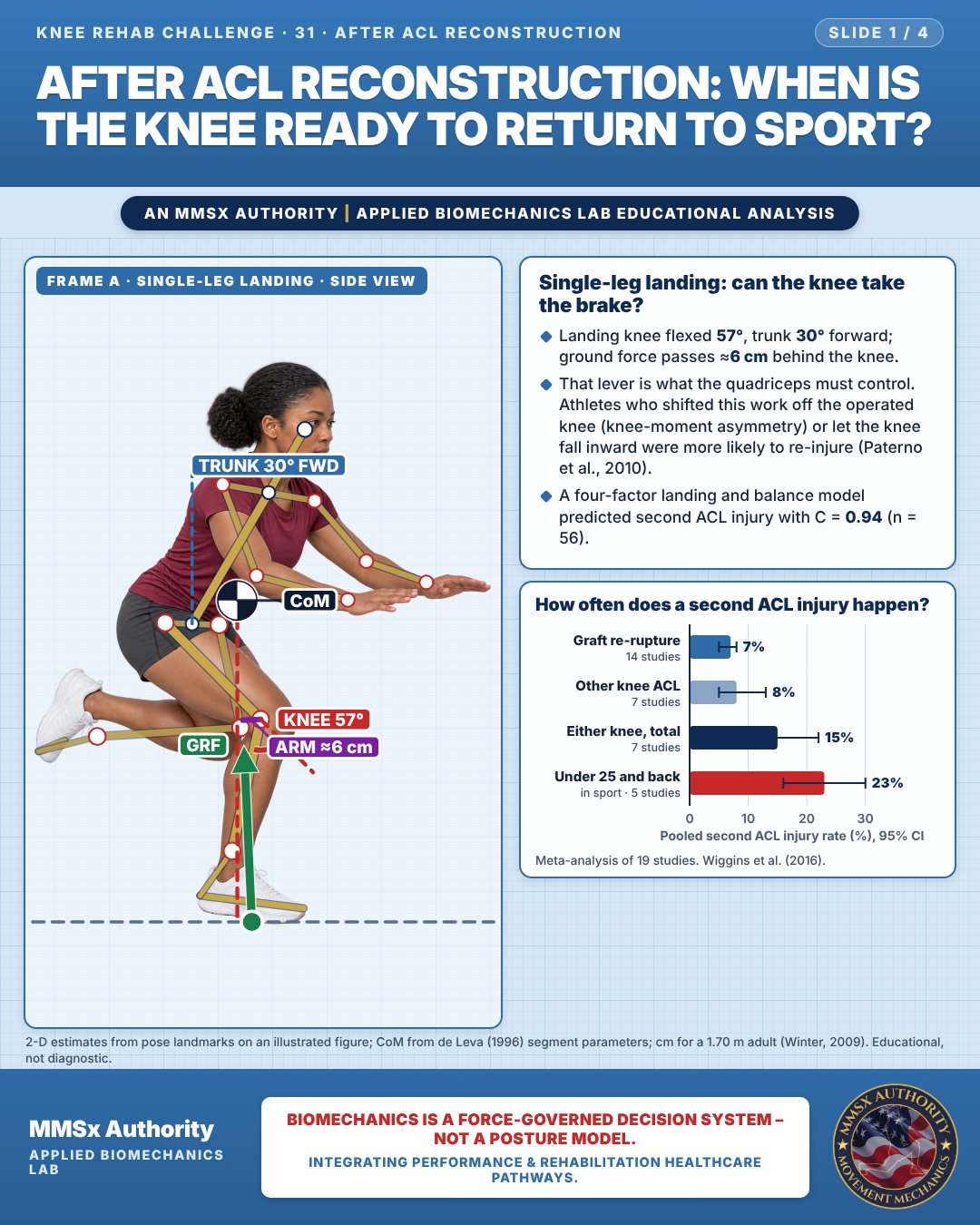
Single-leg landing: can the knee take the brake?
Landing knee flexed 57°, trunk 30° forward; ground force passes ≈6 cm behind the knee.
That lever is what the quadriceps must control. Athletes who shifted this work off the operated knee (knee-moment asymmetry) or let the knee fall inward were more likely to re-injure (Paterno et al., 2010).
A four-factor landing and balance model predicted second ACL injury with C = 0.94 (n = 56).
How often does a second ACL injury happen?
Movement B: Single-leg squat (front view)
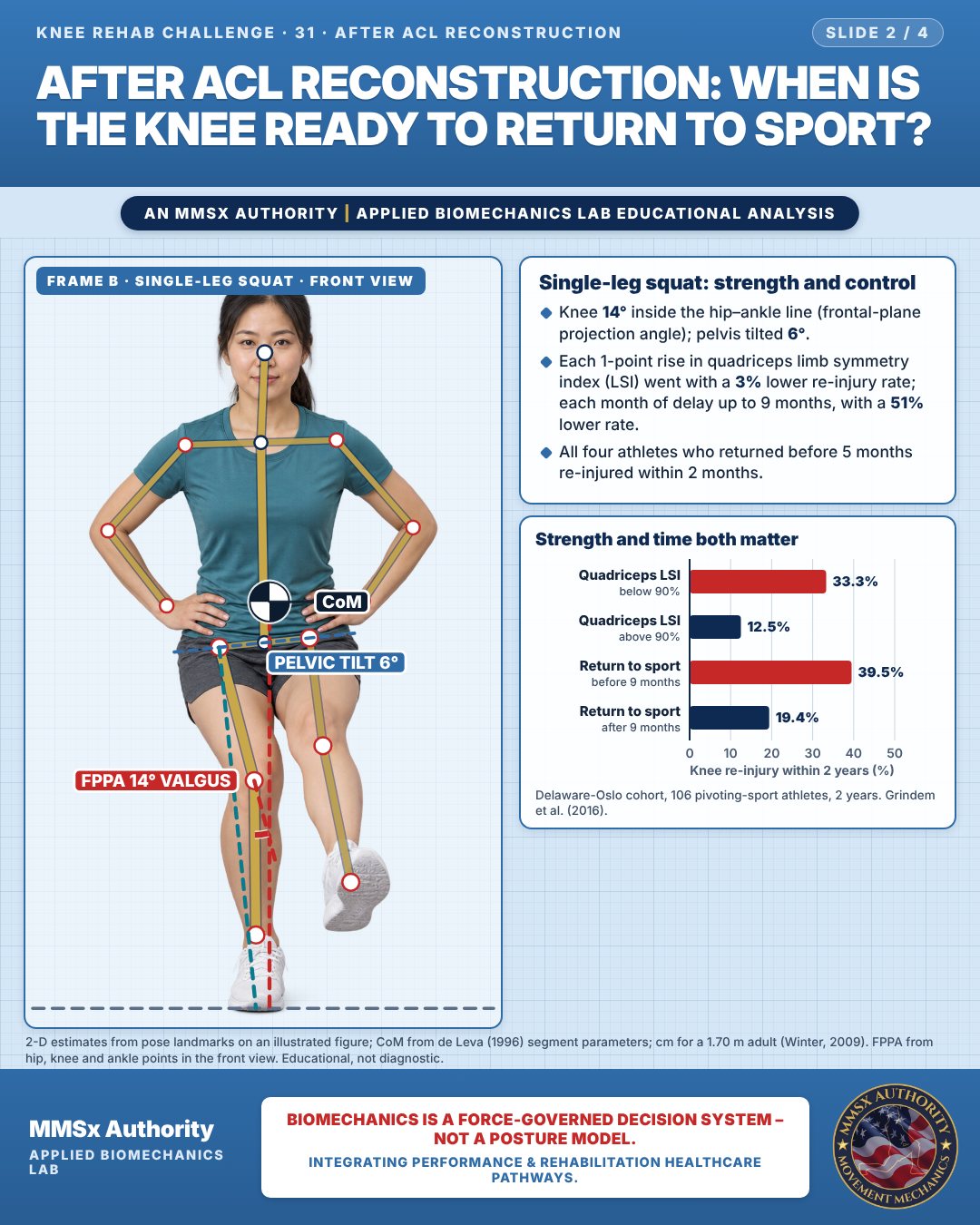
Single-leg squat: strength and control
Knee 14° inside the hip–ankle line (frontal-plane projection angle); pelvis tilted 6°.
Each 1-point rise in quadriceps limb symmetry index (LSI) went with a 3% lower re-injury rate; each month of delay up to 9 months, with a 51% lower rate.
All four athletes who returned before 5 months re-injured within 2 months.
Strength and time both matter
Movement C: Change of direction, oblique
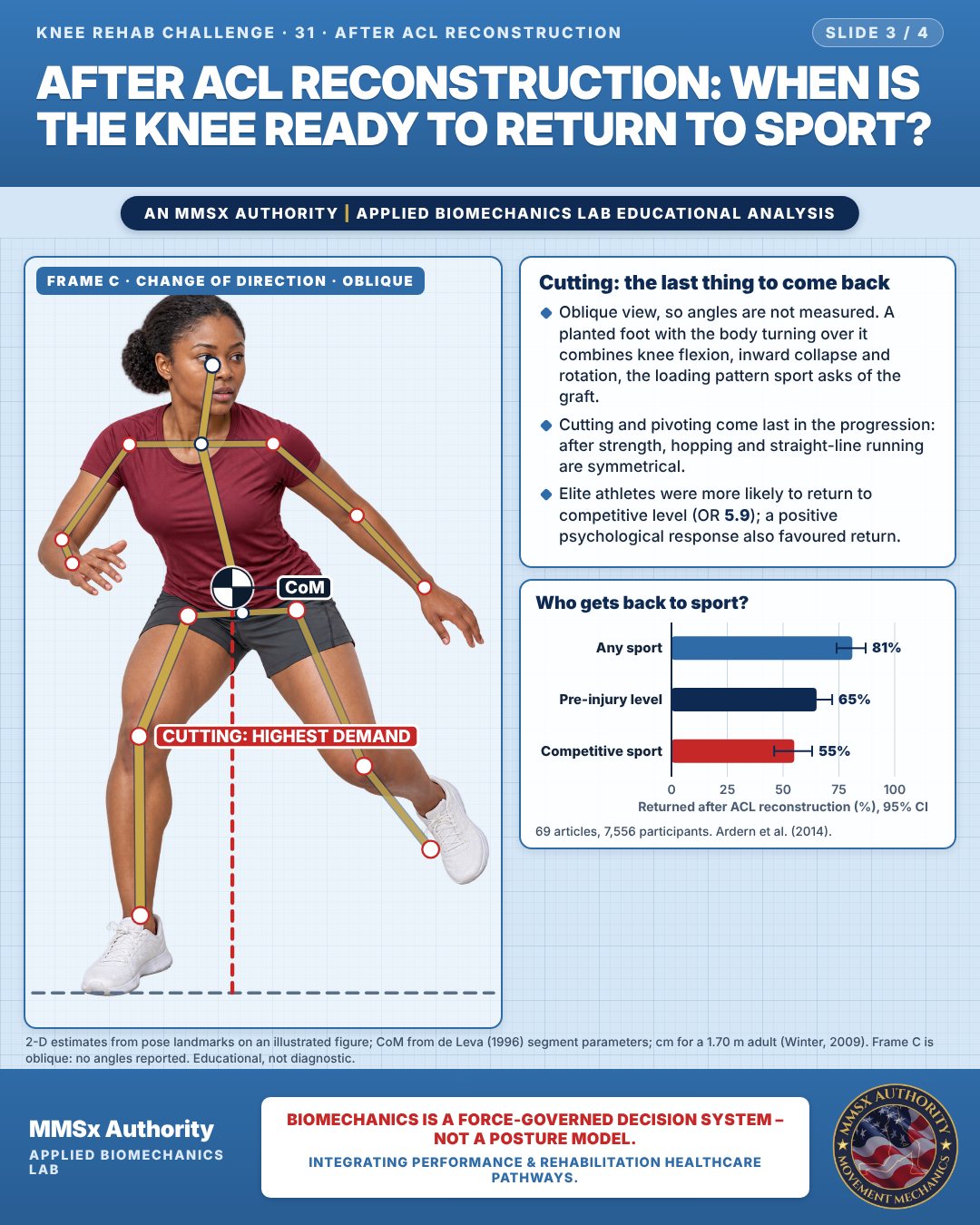
Cutting: the last thing to come back
Oblique view, so angles are not measured. A planted foot with the body turning over it combines knee flexion, inward collapse and rotation, the loading pattern sport asks of the graft.
Cutting and pivoting come last in the progression: after strength, hopping and straight-line running are symmetrical.
Elite athletes were more likely to return to competitive level (OR 5.9); a positive psychological response also favoured return.
Who gets back to sport?
Decision pathway
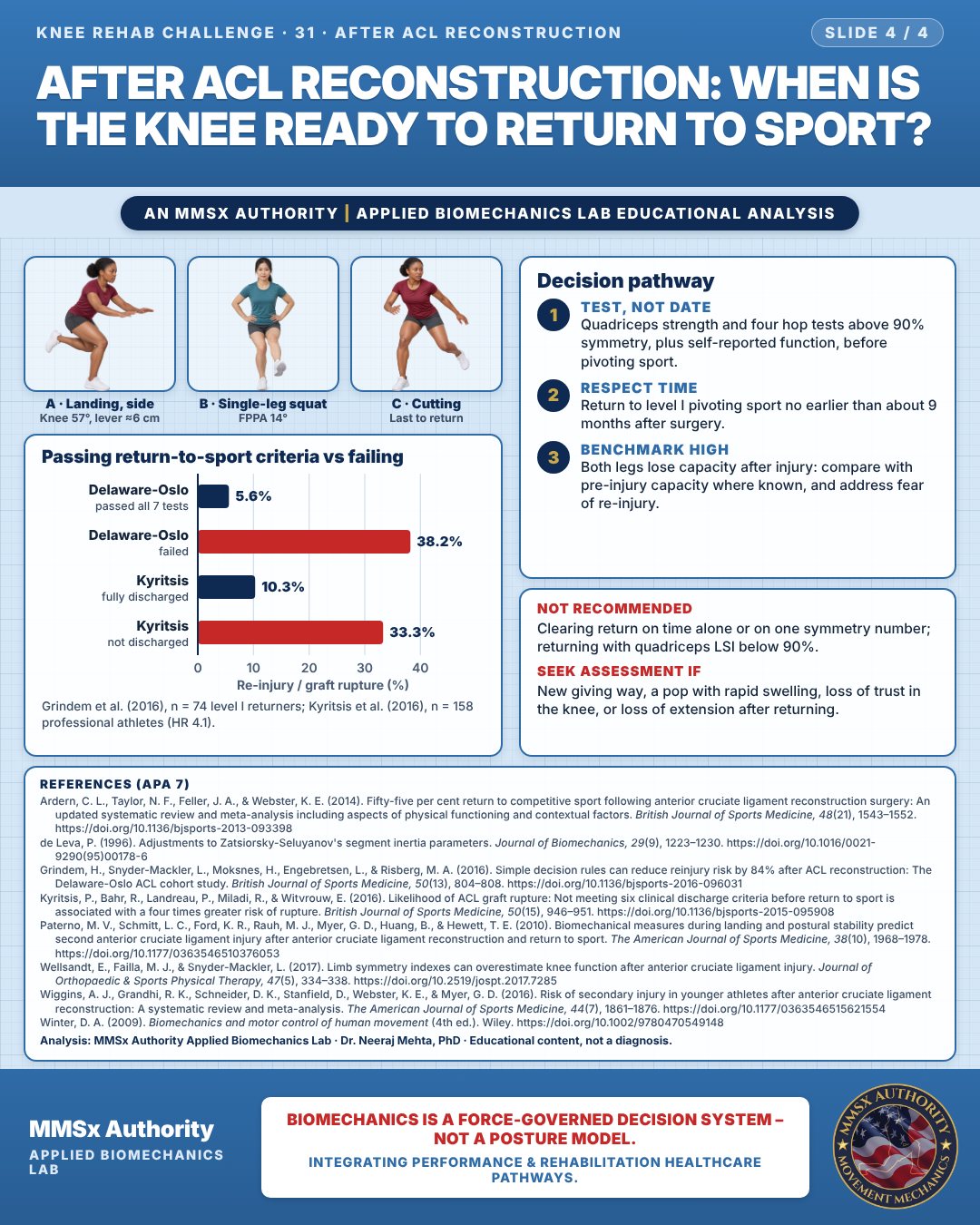
Passing return-to-sport criteria vs failing
Test, not date
Quadriceps strength and four hop tests above 90% symmetry, plus self-reported function, before pivoting sport.
Respect time
Return to level I pivoting sport no earlier than about 9 months after surgery.
Benchmark high
Both legs lose capacity after injury: compare with pre-injury capacity where known, and address fear of re-injury.
What the evidence supports
- Recommended: criterion-based progression with objective testing before RTS — quadriceps strength and hop-test symmetry >90% plus self-reported function (Grindem et al., 2016); meeting discharge criteria before RTS (Kyritsis et al., 2016).
- Time matters: delaying return to level I sport until at least 9 months after surgery was associated with lower re-injury (Grindem et al., 2016).
- Benchmark the operated limb against pre-injury capacity where possible, not only the current uninvolved limb, because both limbs lose capacity after injury (Wellsandt et al., 2017).
- Address psychological readiness/fear of re-injury as part of RTS (Ardern et al., 2014).
Myth and evidence
Myth“Nine months and I'm cleared.”
EvidenceTime is necessary but not sufficient: only 24.3% of level I returners in Delaware-Oslo passed all criteria, and failing them was associated with a 38.2% re-injury rate (Grindem et al., 2016).
Myth“90% symmetry means the knee is back to normal.”
EvidenceLSI can overestimate function because the uninvolved limb also deconditions; LSI identified only about a quarter of later second injuries vs about four-fifths for pre-injury benchmarks (Wellsandt et al., 2017).
Cautions
Not recommended
Clearing return on time alone or on one symmetry number; returning with quadriceps LSI below 90%.
Seek assessment if
New giving way, a pop with rapid swelling, loss of trust in the knee, or loss of extension after returning.
Methods note
2-D estimates from pose landmarks on an illustrated figure; CoM from de Leva (1996) segment parameters; cm for a 1.70 m adult (Winter, 2009). FPPA from hip, knee and ankle points in the front view. Frame C is oblique: no angles reported. These are educational estimates, not a diagnosis.
References
- Ardern, C. L., Taylor, N. F., Feller, J. A., & Webster, K. E. (2014). Fifty-five per cent return to competitive sport following anterior cruciate ligament reconstruction surgery: An updated systematic review and meta-analysis including aspects of physical functioning and contextual factors. British Journal of Sports Medicine, 48(21), 1543–1552. https://doi.org/10.1136/bjsports-2013-093398
- de Leva, P. (1996). Adjustments to Zatsiorsky-Seluyanov's segment inertia parameters. Journal of Biomechanics, 29(9), 1223–1230. https://doi.org/10.1016/0021-9290(95)00178-6
- Grindem, H., Snyder-Mackler, L., Moksnes, H., Engebretsen, L., & Risberg, M. A. (2016). Simple decision rules can reduce reinjury risk by 84% after ACL reconstruction: The Delaware-Oslo ACL cohort study. British Journal of Sports Medicine, 50(13), 804–808. https://doi.org/10.1136/bjsports-2016-096031
- Kyritsis, P., Bahr, R., Landreau, P., Miladi, R., & Witvrouw, E. (2016). Likelihood of ACL graft rupture: Not meeting six clinical discharge criteria before return to sport is associated with a four times greater risk of rupture. British Journal of Sports Medicine, 50(15), 946–951. https://doi.org/10.1136/bjsports-2015-095908
- Paterno, M. V., Schmitt, L. C., Ford, K. R., Rauh, M. J., Myer, G. D., Huang, B., & Hewett, T. E. (2010). Biomechanical measures during landing and postural stability predict second anterior cruciate ligament injury after anterior cruciate ligament reconstruction and return to sport. The American Journal of Sports Medicine, 38(10), 1968–1978. https://doi.org/10.1177/0363546510376053
- Wellsandt, E., Failla, M. J., & Snyder-Mackler, L. (2017). Limb symmetry indexes can overestimate knee function after anterior cruciate ligament injury. Journal of Orthopaedic & Sports Physical Therapy, 47(5), 334–338. https://doi.org/10.2519/jospt.2017.7285
- Wiggins, A. J., Grandhi, R. K., Schneider, D. K., Stanfield, D., Webster, K. E., & Myer, G. D. (2016). Risk of secondary injury in younger athletes after anterior cruciate ligament reconstruction: A systematic review and meta-analysis. The American Journal of Sports Medicine, 44(7), 1861–1876. https://doi.org/10.1177/0363546515621554
- Winter, D. A. (2009). Biomechanics and motor control of human movement (4th ed.). Wiley. https://doi.org/10.1002/9780470549148
Cite this article
Mehta, N. (2026, October 23). After ACL reconstruction: when is the knee ready to return to sport? MMSx Authority Applied Biomechanics Lab. https://mmsxauthority.org/edu/analysis/knee/31-after-acl-reconstruction-when-is-the-knee-ready-to-return-to-sport/
Part of the collection
Mehta, N. (2026). Knee Rehabilitation: 50 Evidence-Based Biomechanics Analyses [Collection]. MMSx Authority Applied Biomechanics Lab. Zenodo. https://doi.org/10.5281/zenodo.23735752