Knee Rehab Challenge · 30
A swollen knee after activity: when it needs assessment
A knee effusion is an abnormal increase of fluid inside the knee joint capsule (synovial fluid, blood — haemarthrosis — or, rarely, pus).
Key points
- Triage. Hot, red, painful swollen knee — with or without fever — needs same-day assessment and aspiration.
- After injury. Swelling within hours of a twist or landing: assess for ACL, meniscal and bone injury; use the Ottawa rule for X-ray.
- Rehab. Monitor swelling and restore quadriceps activation before adding impact load.
What it is
A knee effusion is an abnormal increase of fluid inside the knee joint capsule (synovial fluid, blood — haemarthrosis — or, rarely, pus). Swelling that appears quickly after a twisting or impact injury suggests bleeding into the joint; swelling without injury, with heat, redness, fever or inability to move the joint suggests inflammation or infection and needs urgent assessment.
How we analysed the movement
Three movements relevant to this topic were analysed from illustrated reference figures. Joint centres were located with two-dimensional pose estimation; joint angles, the whole-body centre of mass and, where relevant, the ground-reaction-force line and its moment arm about the knee were then calculated from standard segment parameters. The figures are educational estimates that show how position changes mechanical demand; they are not measurements of a patient. Every research value quoted below comes from the published source cited beside it.
Movement A: Seated after activity (front view)
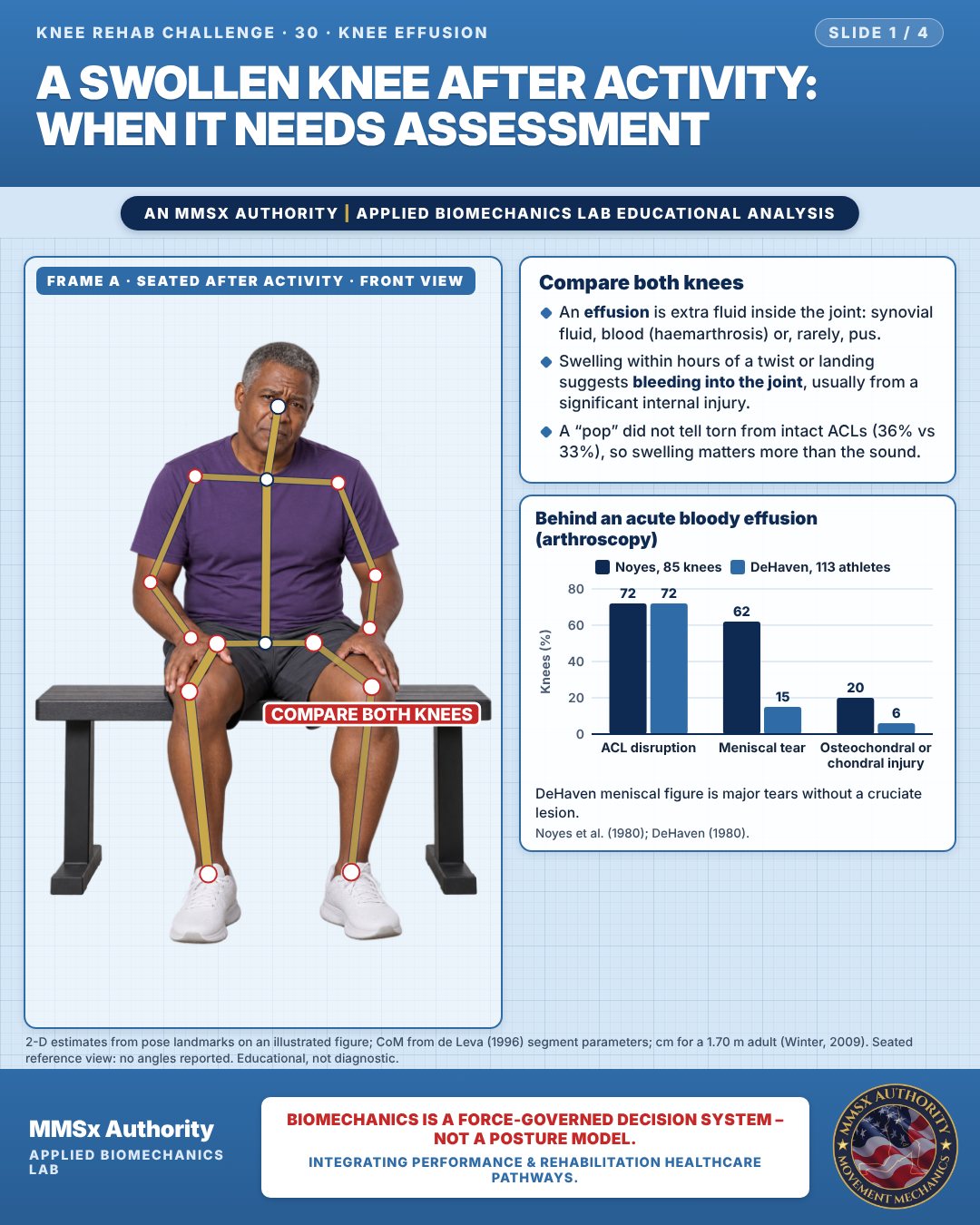
Compare both knees
An effusion is extra fluid inside the joint: synovial fluid, blood (haemarthrosis) or, rarely, pus.
Swelling within hours of a twist or landing suggests bleeding into the joint, usually from a significant internal injury.
A “pop” did not tell torn from intact ACLs (36% vs 33%), so swelling matters more than the sound.
Behind an acute bloody effusion (arthroscopy)
DeHaven meniscal figure is major tears without a cruciate lesion.
Movement B: Leg supported, oblique
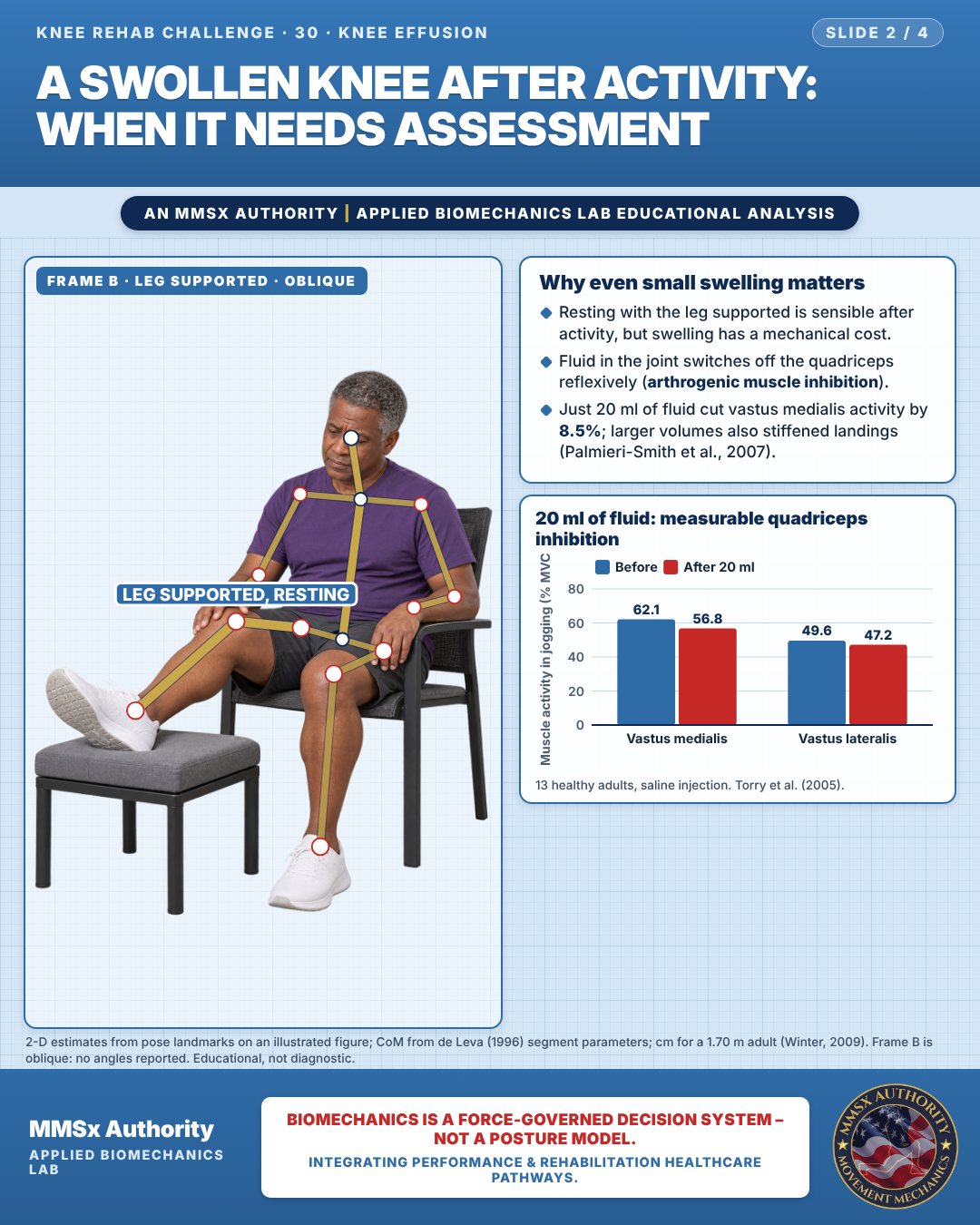
Why even small swelling matters
Resting with the leg supported is sensible after activity, but swelling has a mechanical cost.
Fluid in the joint switches off the quadriceps reflexively (arthrogenic muscle inhibition).
Just 20 ml of fluid cut vastus medialis activity by 8.5%; larger volumes also stiffened landings (Palmieri-Smith et al., 2007).
20 ml of fluid: measurable quadriceps inhibition
Movement C: Clinical examination, oblique
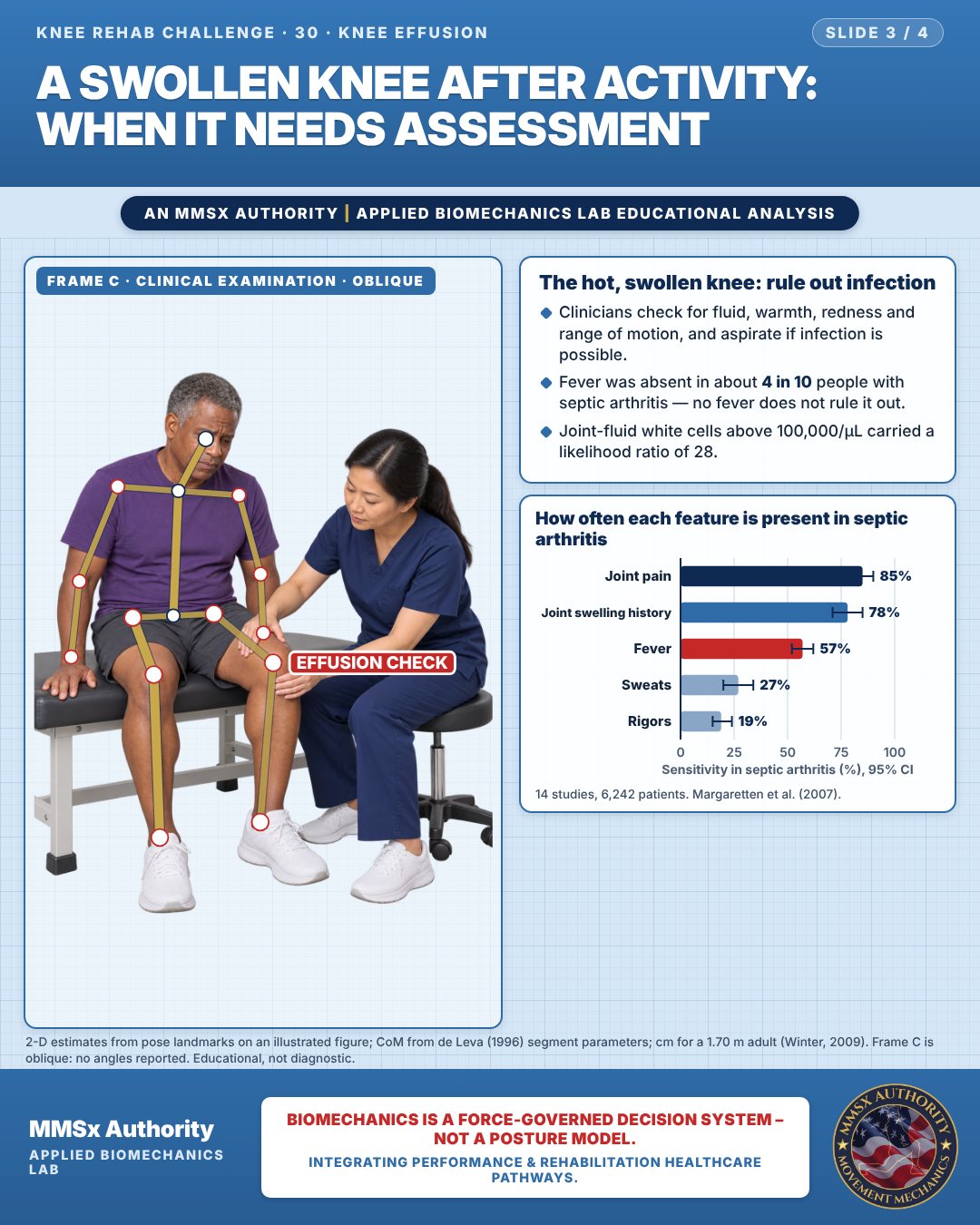
The hot, swollen knee: rule out infection
Clinicians check for fluid, warmth, redness and range of motion, and aspirate if infection is possible.
Fever was absent in about 4 in 10 people with septic arthritis — no fever does not rule it out.
Joint-fluid white cells above 100,000/µL carried a likelihood ratio of 28.
How often each feature is present in septic arthritis
Decision pathway
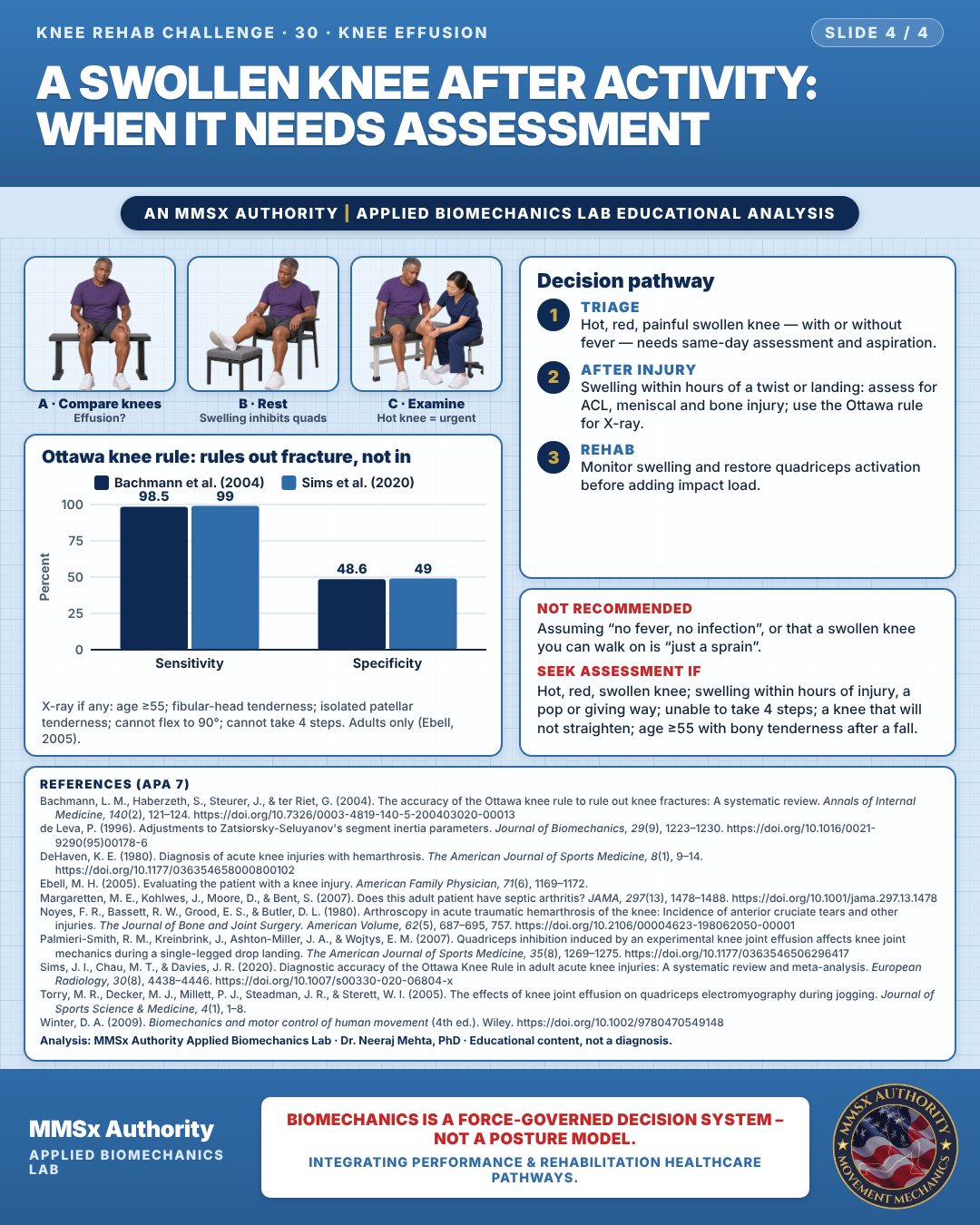
Ottawa knee rule: rules out fracture, not in
Triage
Hot, red, painful swollen knee — with or without fever — needs same-day assessment and aspiration.
After injury
Swelling within hours of a twist or landing: assess for ACL, meniscal and bone injury; use the Ottawa rule for X-ray.
Rehab
Monitor swelling and restore quadriceps activation before adding impact load.
What the evidence supports
- Acute traumatic effusion: apply the Ottawa knee rule to decide on radiography (high sensitivity, ~49% specificity) (Bachmann et al., 2004; Sims et al., 2020); a rapid bloody effusion after a pivot/landing warrants assessment for ACL and meniscal injury given the arthroscopic yields above (Noyes et al., 1980; DeHaven, 1980).
Myth and evidence
Myth“No fever means it can't be an infection.”
EvidenceFever was present in only 57% (52–62%) of septic arthritis cases (Margaretten et al., 2007).
Myth“If you heard a pop and it swelled, but you can walk, it's just a sprain.”
Evidence72% of acute traumatic haemarthroses had ACL disruption at arthroscopy, and only 24% of ACL-torn knees had a positive anterior drawer without anaesthesia (Noyes et al., 1980).
Cautions
Not recommended
Assuming “no fever, no infection”, or that a swollen knee you can walk on is “just a sprain”.
Seek assessment if
Hot, red, swollen knee; swelling within hours of injury, a pop or giving way; unable to take 4 steps; a knee that will not straighten; age ≥55 with bony tenderness after a fall.
Methods note
2-D estimates from pose landmarks on an illustrated figure; CoM from de Leva (1996) segment parameters; cm for a 1.70 m adult (Winter, 2009). Seated reference view: no angles reported. Frame B is oblique: no angles reported. Frame C is oblique: no angles reported. These are educational estimates, not a diagnosis.
References
- Bachmann, L. M., Haberzeth, S., Steurer, J., & ter Riet, G. (2004). The accuracy of the Ottawa knee rule to rule out knee fractures: A systematic review. Annals of Internal Medicine, 140(2), 121–124. https://doi.org/10.7326/0003-4819-140-5-200403020-00013
- de Leva, P. (1996). Adjustments to Zatsiorsky-Seluyanov's segment inertia parameters. Journal of Biomechanics, 29(9), 1223–1230. https://doi.org/10.1016/0021-9290(95)00178-6
- DeHaven, K. E. (1980). Diagnosis of acute knee injuries with hemarthrosis. The American Journal of Sports Medicine, 8(1), 9–14. https://doi.org/10.1177/036354658000800102
- Ebell, M. H. (2005). Evaluating the patient with a knee injury. American Family Physician, 71(6), 1169–1172.
- Margaretten, M. E., Kohlwes, J., Moore, D., & Bent, S. (2007). Does this adult patient have septic arthritis? JAMA, 297(13), 1478–1488. https://doi.org/10.1001/jama.297.13.1478
- Noyes, F. R., Bassett, R. W., Grood, E. S., & Butler, D. L. (1980). Arthroscopy in acute traumatic hemarthrosis of the knee: Incidence of anterior cruciate tears and other injuries. The Journal of Bone and Joint Surgery. American Volume, 62(5), 687–695, 757. https://doi.org/10.2106/00004623-198062050-00001
- Palmieri-Smith, R. M., Kreinbrink, J., Ashton-Miller, J. A., & Wojtys, E. M. (2007). Quadriceps inhibition induced by an experimental knee joint effusion affects knee joint mechanics during a single-legged drop landing. The American Journal of Sports Medicine, 35(8), 1269–1275. https://doi.org/10.1177/0363546506296417
- Sims, J. I., Chau, M. T., & Davies, J. R. (2020). Diagnostic accuracy of the Ottawa Knee Rule in adult acute knee injuries: A systematic review and meta-analysis. European Radiology, 30(8), 4438–4446. https://doi.org/10.1007/s00330-020-06804-x
- Torry, M. R., Decker, M. J., Millett, P. J., Steadman, J. R., & Sterett, W. I. (2005). The effects of knee joint effusion on quadriceps electromyography during jogging. Journal of Sports Science & Medicine, 4(1), 1–8.
- Winter, D. A. (2009). Biomechanics and motor control of human movement (4th ed.). Wiley. https://doi.org/10.1002/9780470549148
Cite this article
Mehta, N. (2026, October 23). A swollen knee after activity: when it needs assessment. MMSx Authority Applied Biomechanics Lab. https://mmsxauthority.org/edu/analysis/knee/30-a-swollen-knee-after-activity-when-it-needs-assessment/
Part of the collection
Mehta, N. (2026). Knee Rehabilitation: 50 Evidence-Based Biomechanics Analyses [Collection]. MMSx Authority Applied Biomechanics Lab. Zenodo. https://doi.org/10.5281/zenodo.23735752