Knee Rehab Challenge · 29
Knee clicking, catching, and locking: what is the difference?
- Clicking / crepitus: audible or palpable noise (cracking, grinding, popping) during knee movement.
Key points
- Click. Painless clicking: reassurance and education; keep active. If painful at the front of the knee, follow patellofemoral care (hip + knee exercise).
- Catch. Occasional catching with a degenerative tear: exercise-based care; mechanical symptoms alone are not a reason for meniscectomy.
- Lock. A knee that cannot fully straighten, especially after a twist, needs prompt orthopaedic assessment.
What it is
- Clicking / crepitus: audible or palpable noise (cracking, grinding, popping) during knee movement; often painless. - Catching: a brief, momentary hitch or "sticking" sensation during movement that frees itself. - True locking: a mechanical block in which the knee cannot be fully straightened (fixed loss of extension) until it is manipulated or "unlocks" — classically linked with a displaced meniscal fragment or loose body. Pseudolocking: a pain-related or guarding stiffness without a fixed mechanical block. (Definitions are clinical convention; the self-reported terms "catching or occasional locking" in trials do not distinguish true from pseudo-locking.)
How we analysed the movement
Three movements relevant to this topic were analysed from illustrated reference figures. Joint centres were located with two-dimensional pose estimation; joint angles, the whole-body centre of mass and, where relevant, the ground-reaction-force line and its moment arm about the knee were then calculated from standard segment parameters. The figures are educational estimates that show how position changes mechanical demand; they are not measurements of a patient. Every research value quoted below comes from the published source cited beside it.
Movement A: Rising from a chair (side view)
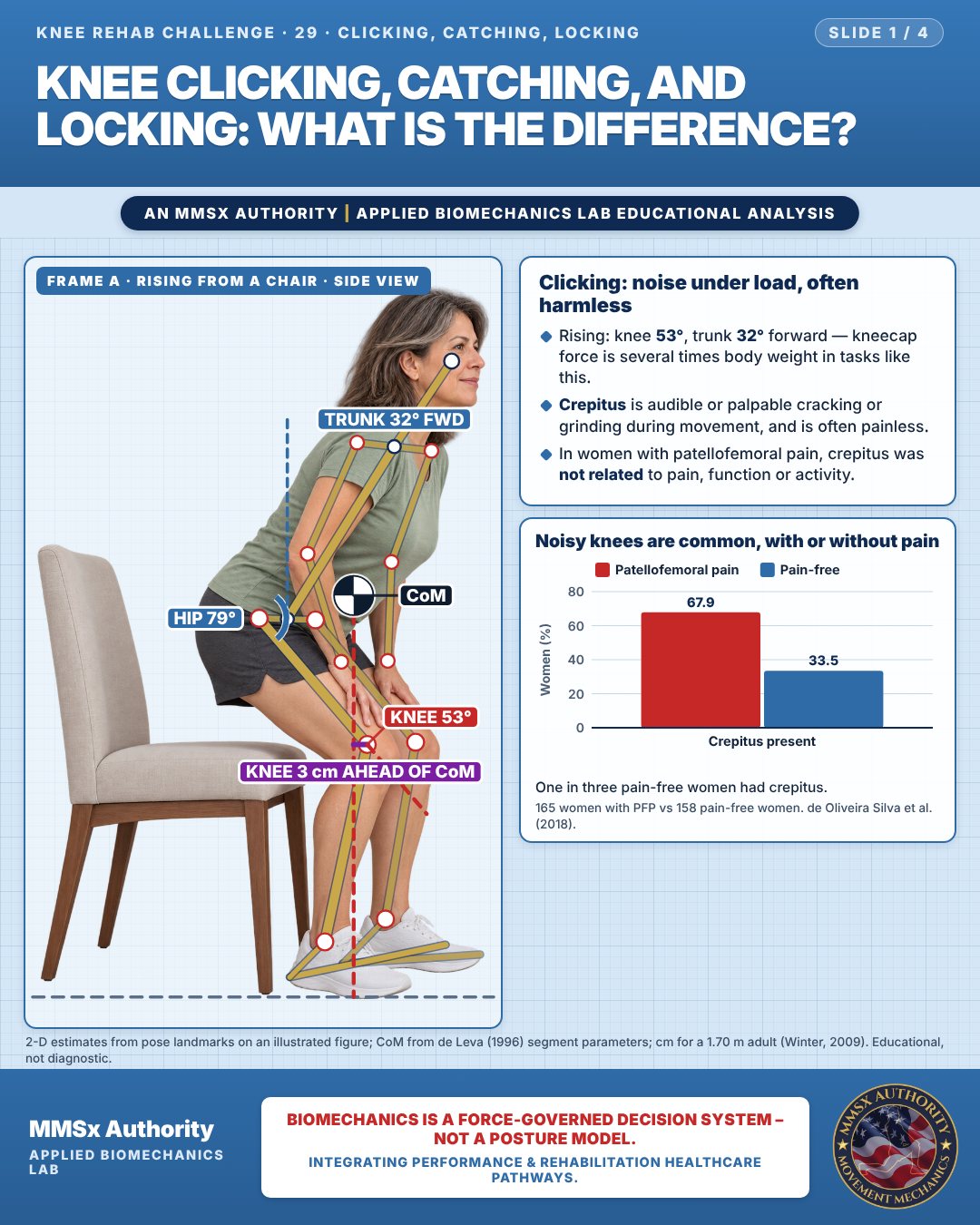
Clicking: noise under load, often harmless
Rising: knee 53°, trunk 32° forward — kneecap force is several times body weight in tasks like this.
Crepitus is audible or palpable cracking or grinding during movement, and is often painless.
In women with patellofemoral pain, crepitus was not related to pain, function or activity.
Noisy knees are common, with or without pain
One in three pain-free women had crepitus.
Movement B: Pausing mid-turn, oblique
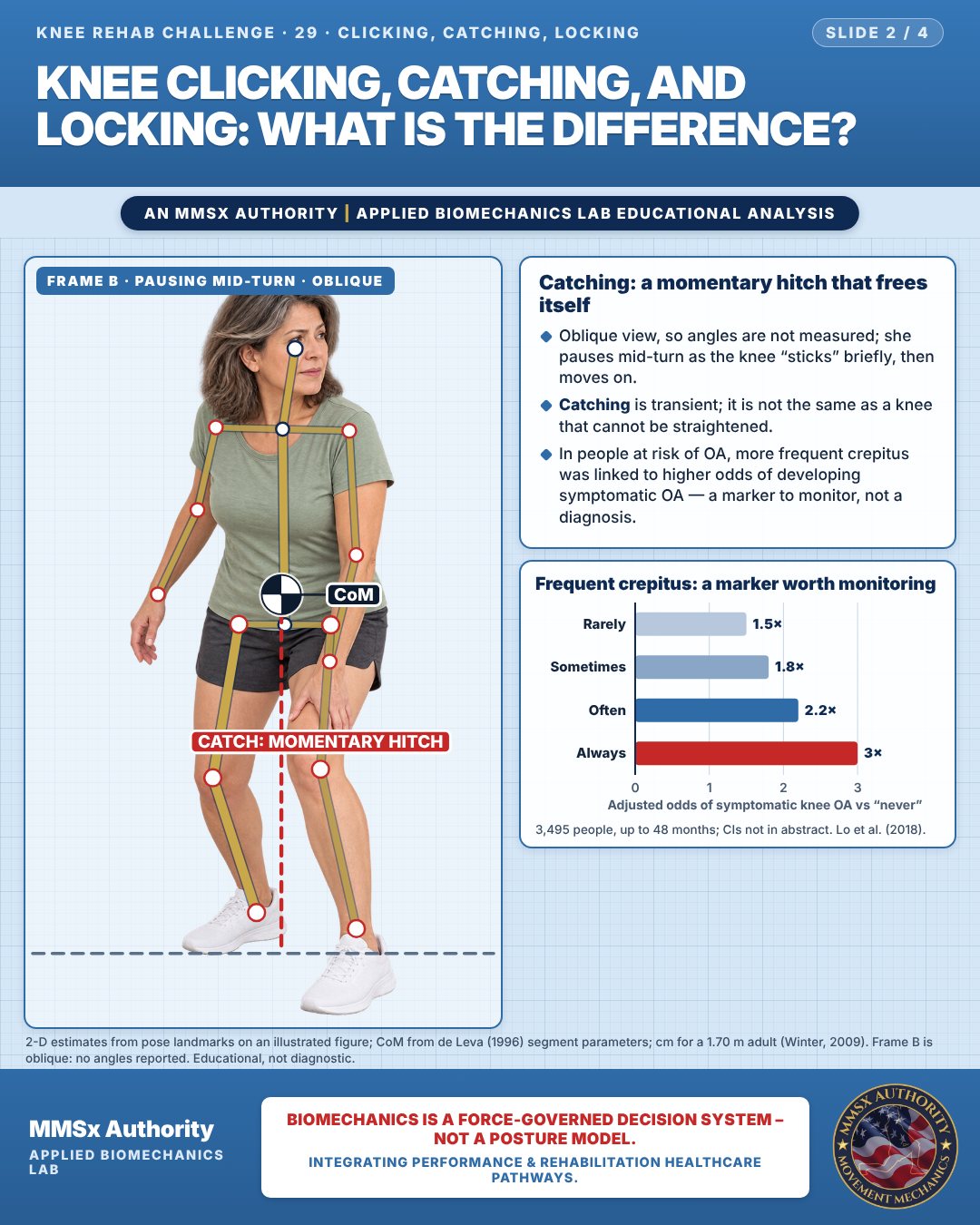
Catching: a momentary hitch that frees itself
Oblique view, so angles are not measured; she pauses mid-turn as the knee “sticks” briefly, then moves on.
Catching is transient; it is not the same as a knee that cannot be straightened.
In people at risk of OA, more frequent crepitus was linked to higher odds of developing symptomatic OA — a marker to monitor, not a diagnosis.
Frequent crepitus: a marker worth monitoring
Movement C: Seated, knee bent (side view)
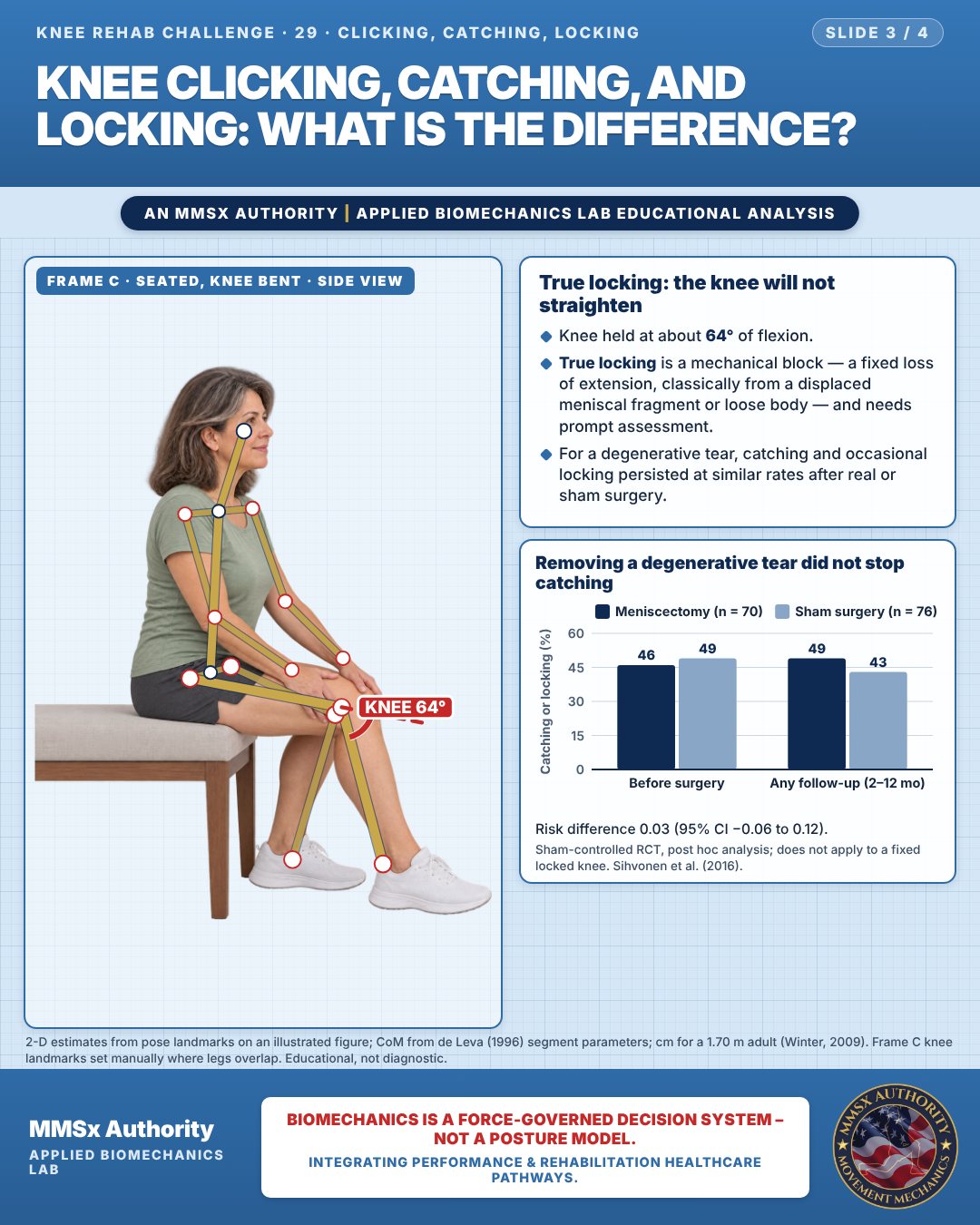
True locking: the knee will not straighten
Knee held at about 64° of flexion.
True locking is a mechanical block — a fixed loss of extension, classically from a displaced meniscal fragment or loose body — and needs prompt assessment.
For a degenerative tear, catching and occasional locking persisted at similar rates after real or sham surgery.
Removing a degenerative tear did not stop catching
Risk difference 0.03 (95% CI −0.06 to 0.12).
Decision pathway
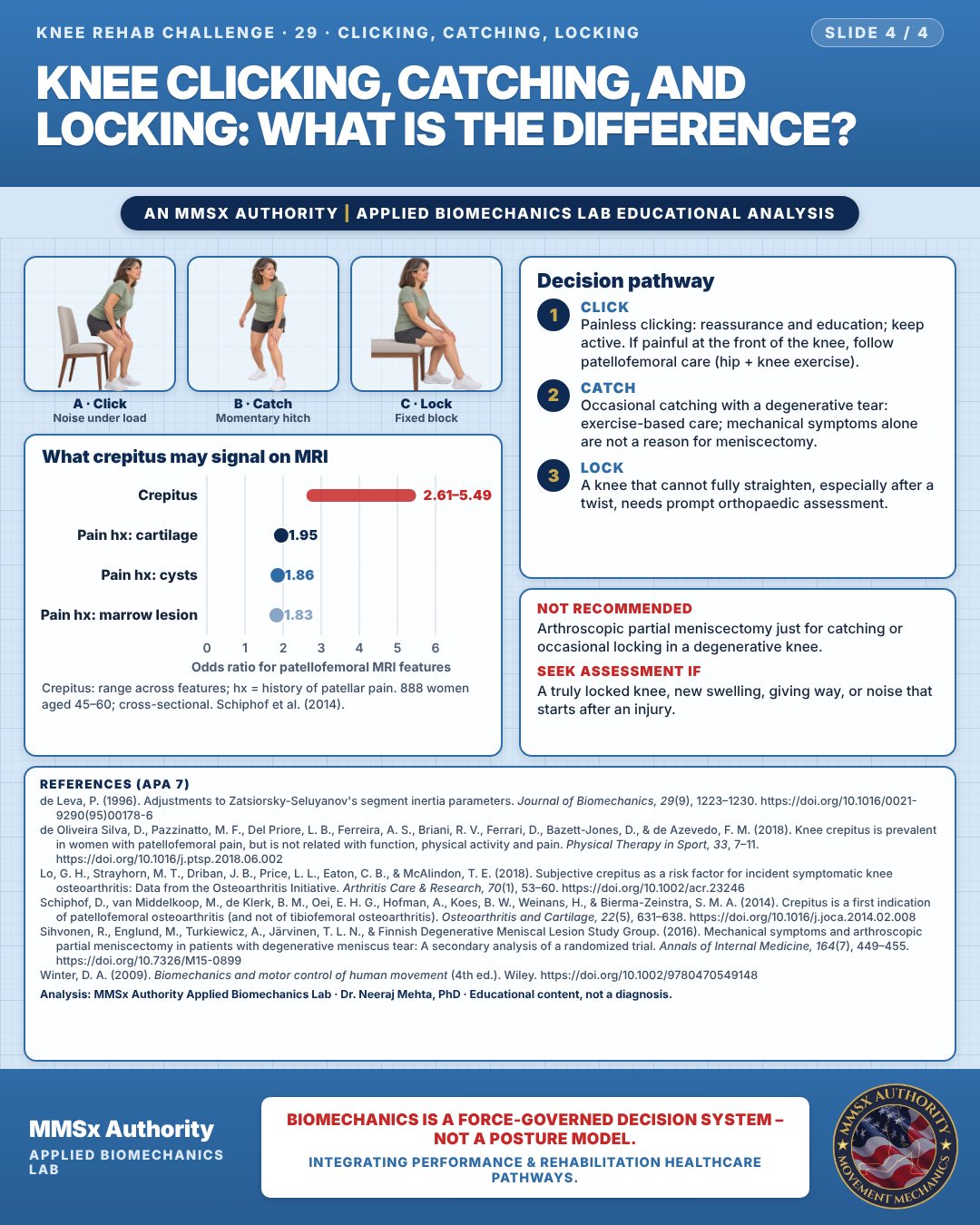
What crepitus may signal on MRI
Click
Painless clicking: reassurance and education; keep active. If painful at the front of the knee, follow patellofemoral care (hip + knee exercise).
Catch
Occasional catching with a degenerative tear: exercise-based care; mechanical symptoms alone are not a reason for meniscectomy.
Lock
A knee that cannot fully straighten, especially after a twist, needs prompt orthopaedic assessment.
What the evidence supports
- Catching/occasional locking with a degenerative meniscal tear: self-reported mechanical symptoms alone should not be the reason for arthroscopic partial meniscectomy — surgery gave no added relief over sham (Sihvonen et al., 2016).
Myth and evidence
Myth“Catching means the meniscus must be removed.”
EvidenceCatching/locking persisted at similar rates after meniscectomy and sham surgery (RD 0.03, 95% CI −0.06 to 0.12) (Sihvonen et al., 2016).
Cautions
Not recommended
Arthroscopic partial meniscectomy just for catching or occasional locking in a degenerative knee.
Seek assessment if
A truly locked knee, new swelling, giving way, or noise that starts after an injury.
Methods note
2-D estimates from pose landmarks on an illustrated figure; CoM from de Leva (1996) segment parameters; cm for a 1.70 m adult (Winter, 2009). Frame B is oblique: no angles reported. Frame C knee landmarks set manually where legs overlap. These are educational estimates, not a diagnosis.
References
- de Leva, P. (1996). Adjustments to Zatsiorsky-Seluyanov's segment inertia parameters. Journal of Biomechanics, 29(9), 1223–1230. https://doi.org/10.1016/0021-9290(95)00178-6
- de Oliveira Silva, D., Pazzinatto, M. F., Del Priore, L. B., Ferreira, A. S., Briani, R. V., Ferrari, D., Bazett-Jones, D., & de Azevedo, F. M. (2018). Knee crepitus is prevalent in women with patellofemoral pain, but is not related with function, physical activity and pain. Physical Therapy in Sport, 33, 7–11. https://doi.org/10.1016/j.ptsp.2018.06.002
- Lo, G. H., Strayhorn, M. T., Driban, J. B., Price, L. L., Eaton, C. B., & McAlindon, T. E. (2018). Subjective crepitus as a risk factor for incident symptomatic knee osteoarthritis: Data from the Osteoarthritis Initiative. Arthritis Care & Research, 70(1), 53–60. https://doi.org/10.1002/acr.23246
- Schiphof, D., van Middelkoop, M., de Klerk, B. M., Oei, E. H. G., Hofman, A., Koes, B. W., Weinans, H., & Bierma-Zeinstra, S. M. A. (2014). Crepitus is a first indication of patellofemoral osteoarthritis (and not of tibiofemoral osteoarthritis). Osteoarthritis and Cartilage, 22(5), 631–638. https://doi.org/10.1016/j.joca.2014.02.008
- Sihvonen, R., Englund, M., Turkiewicz, A., Järvinen, T. L. N., & Finnish Degenerative Meniscal Lesion Study Group. (2016). Mechanical symptoms and arthroscopic partial meniscectomy in patients with degenerative meniscus tear: A secondary analysis of a randomized trial. Annals of Internal Medicine, 164(7), 449–455. https://doi.org/10.7326/M15-0899
- Winter, D. A. (2009). Biomechanics and motor control of human movement (4th ed.). Wiley. https://doi.org/10.1002/9780470549148
Cite this article
Mehta, N. (2026, October 23). Knee clicking, catching, and locking: what is the difference? MMSx Authority Applied Biomechanics Lab. https://mmsxauthority.org/edu/analysis/knee/29-knee-clicking-catching-and-locking-what-is-the-difference/
Part of the collection
Mehta, N. (2026). Knee Rehabilitation: 50 Evidence-Based Biomechanics Analyses [Collection]. MMSx Authority Applied Biomechanics Lab. Zenodo. https://doi.org/10.5281/zenodo.23735752