Knee Rehab Challenge · 28
Knee hyperextension: what happens when the knee moves beyond straight?
Knee hyperextension (genu recurvatum) is extension of the tibiofemoral joint beyond 0° (straight).
Key points
- Educate. Some hyperextension is common; hypermobility alone was not linked to more injuries in students.
- Train bending. Practise landings and braking that keep the knee bending after contact.
- Strengthen. Progressive strength and control work for hypermobile knees rather than restriction.
What it is
Knee hyperextension (genu recurvatum) is extension of the tibiofemoral joint beyond 0° (straight). Knee hyperextension is one of the items of the 9-point Beighton score for generalised joint hypermobility (one point per knee); small amounts are common and can be normal. Thresholds for "recurvatum" vary between studies — state the threshold per source. Note: the widely quoted Beighton knee threshold (">10°") and the brief's ">5°" recurvatum definition were NOT confirmed from a primary source in this pack — do not print a degree threshold unless confirmed.
How we analysed the movement
Three movements relevant to this topic were analysed from illustrated reference figures. Joint centres were located with two-dimensional pose estimation; joint angles, the whole-body centre of mass and, where relevant, the ground-reaction-force line and its moment arm about the knee were then calculated from standard segment parameters. The figures are educational estimates that show how position changes mechanical demand; they are not measurements of a patient. Every research value quoted below comes from the published source cited beside it.
Movement A: Standing, true side view
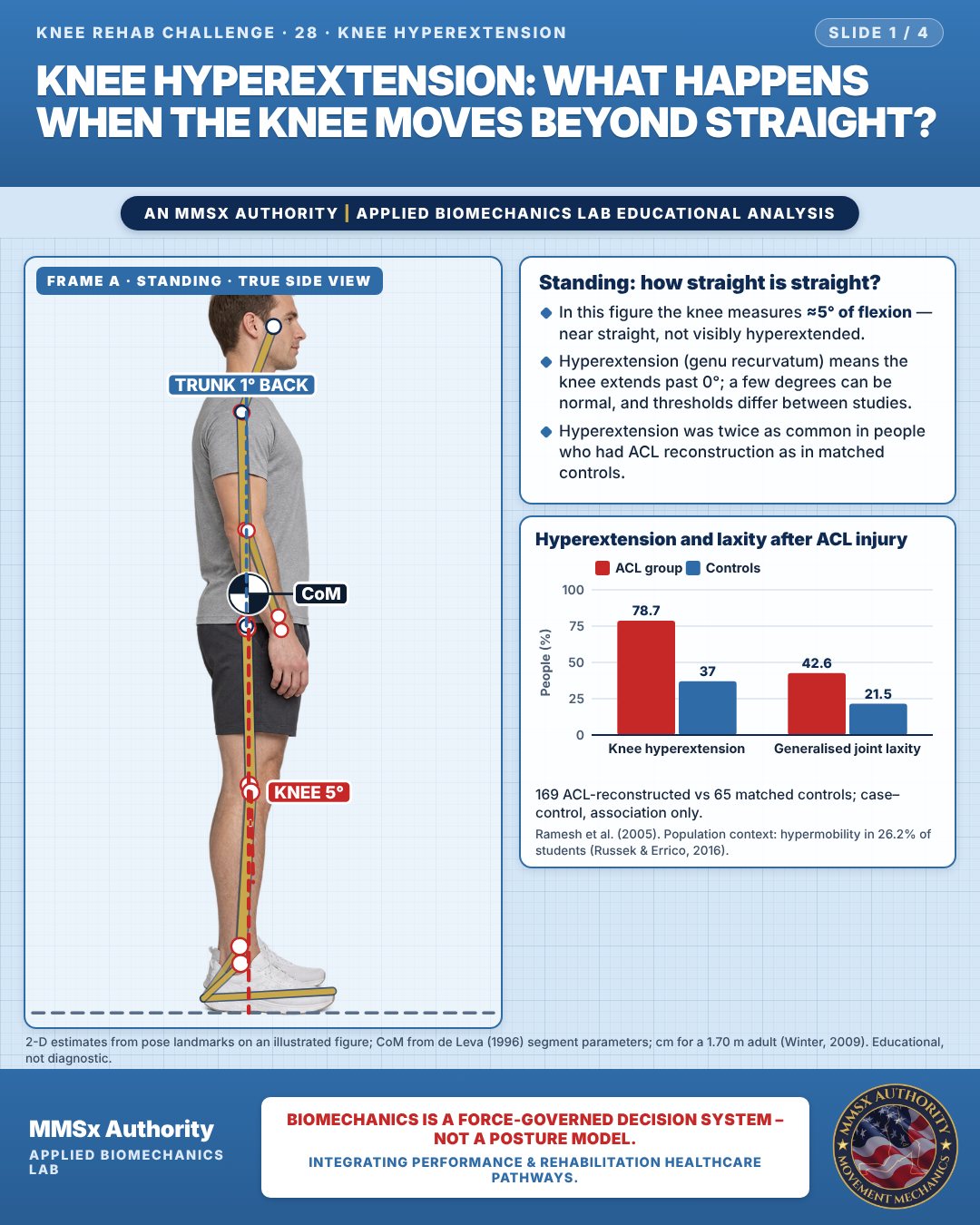
Standing: how straight is straight?
In this figure the knee measures ≈5° of flexion — near straight, not visibly hyperextended.
Hyperextension (genu recurvatum) means the knee extends past 0°; a few degrees can be normal, and thresholds differ between studies.
Hyperextension was twice as common in people who had ACL reconstruction as in matched controls.
Hyperextension and laxity after ACL injury
169 ACL-reconstructed vs 65 matched controls; case–control, association only.
Movement B: Walking, end of stance (side view)
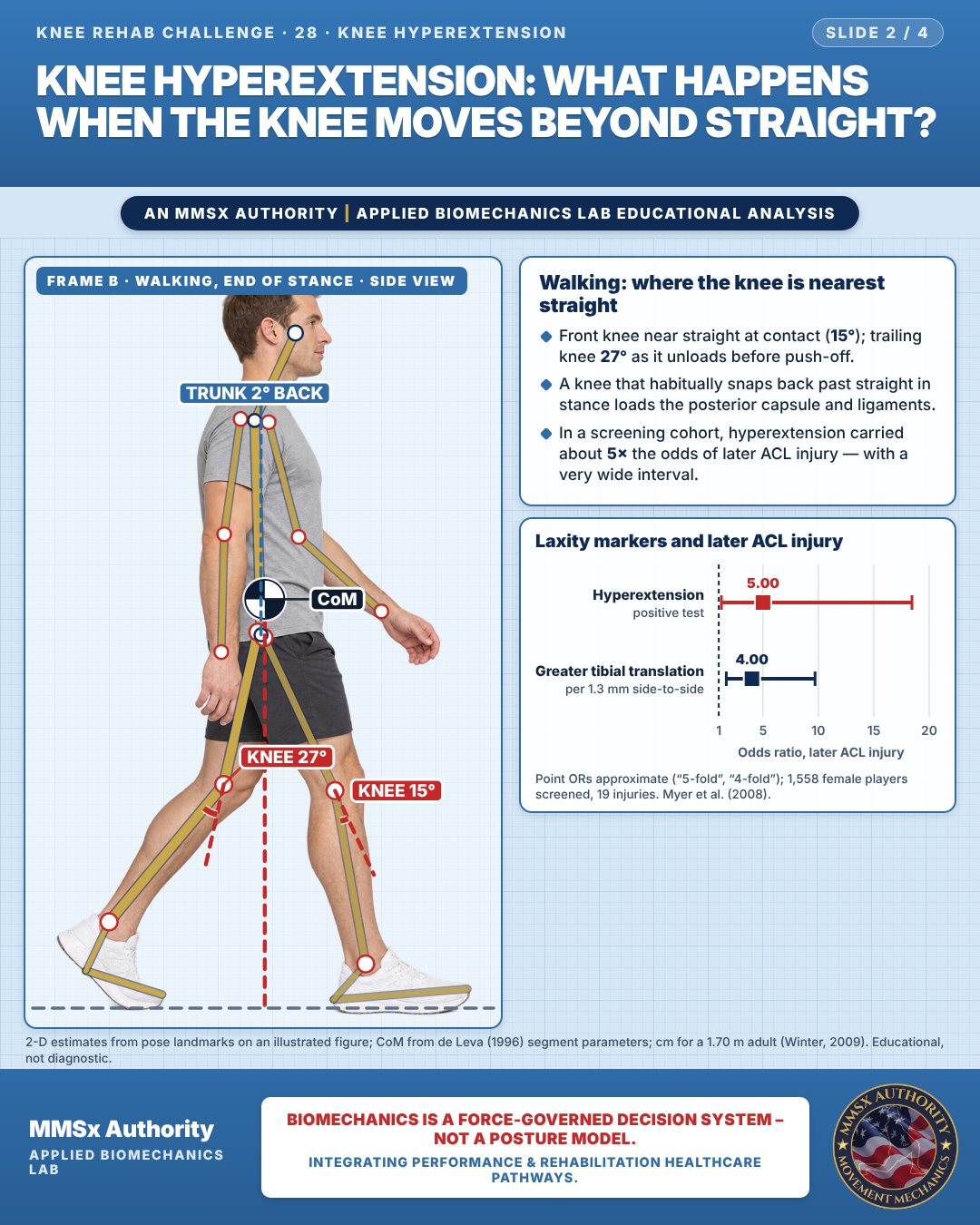
Walking: where the knee is nearest straight
Front knee near straight at contact (15°); trailing knee 27° as it unloads before push-off.
A knee that habitually snaps back past straight in stance loads the posterior capsule and ligaments.
In a screening cohort, hyperextension carried about 5× the odds of later ACL injury — with a very wide interval.
Laxity markers and later ACL injury
Movement C: Braking step (side view)
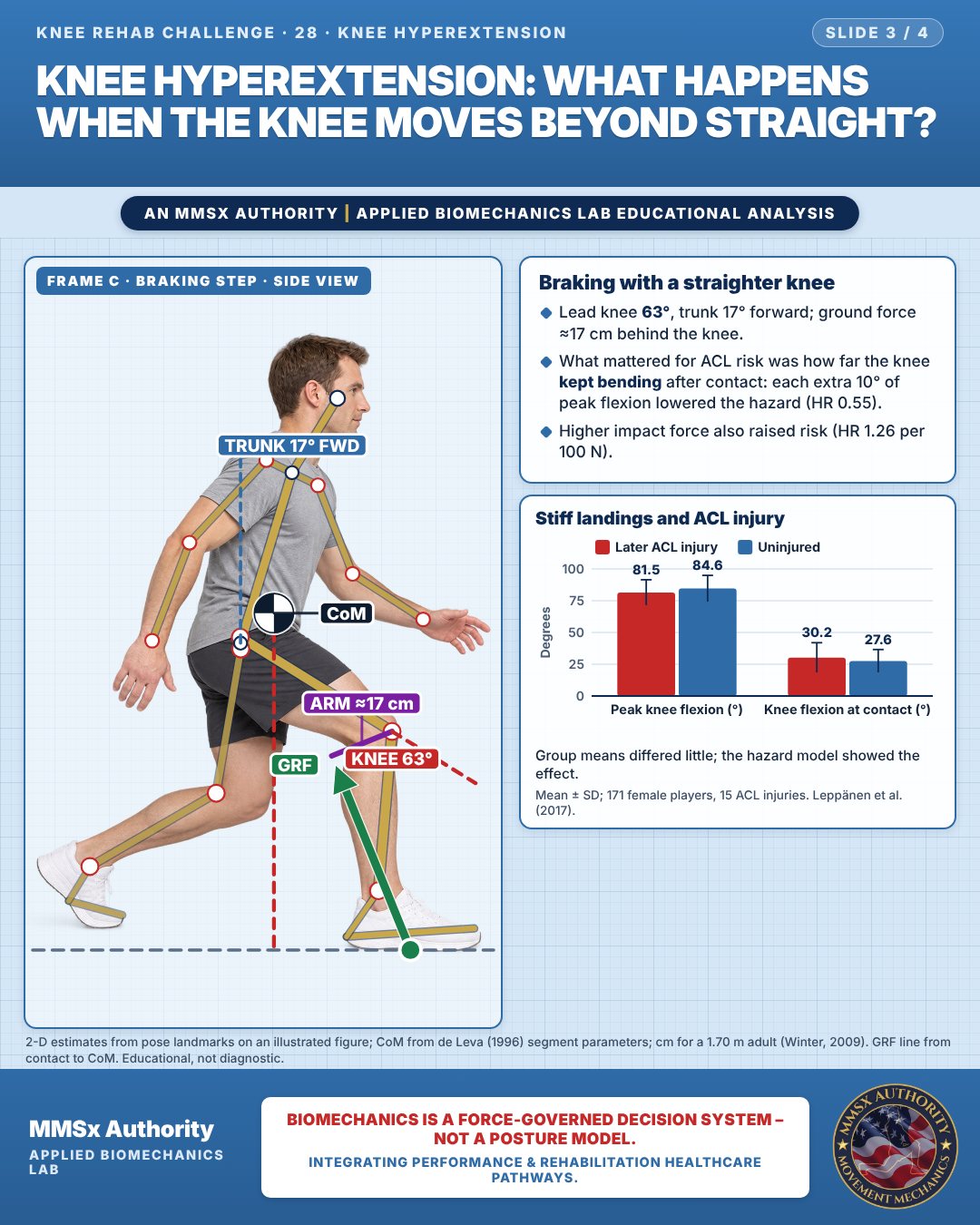
Braking with a straighter knee
Lead knee 63°, trunk 17° forward; ground force ≈17 cm behind the knee.
What mattered for ACL risk was how far the knee kept bending after contact: each extra 10° of peak flexion lowered the hazard (HR 0.55).
Higher impact force also raised risk (HR 1.26 per 100 N).
Stiff landings and ACL injury
Group means differed little; the hazard model showed the effect.
Decision pathway
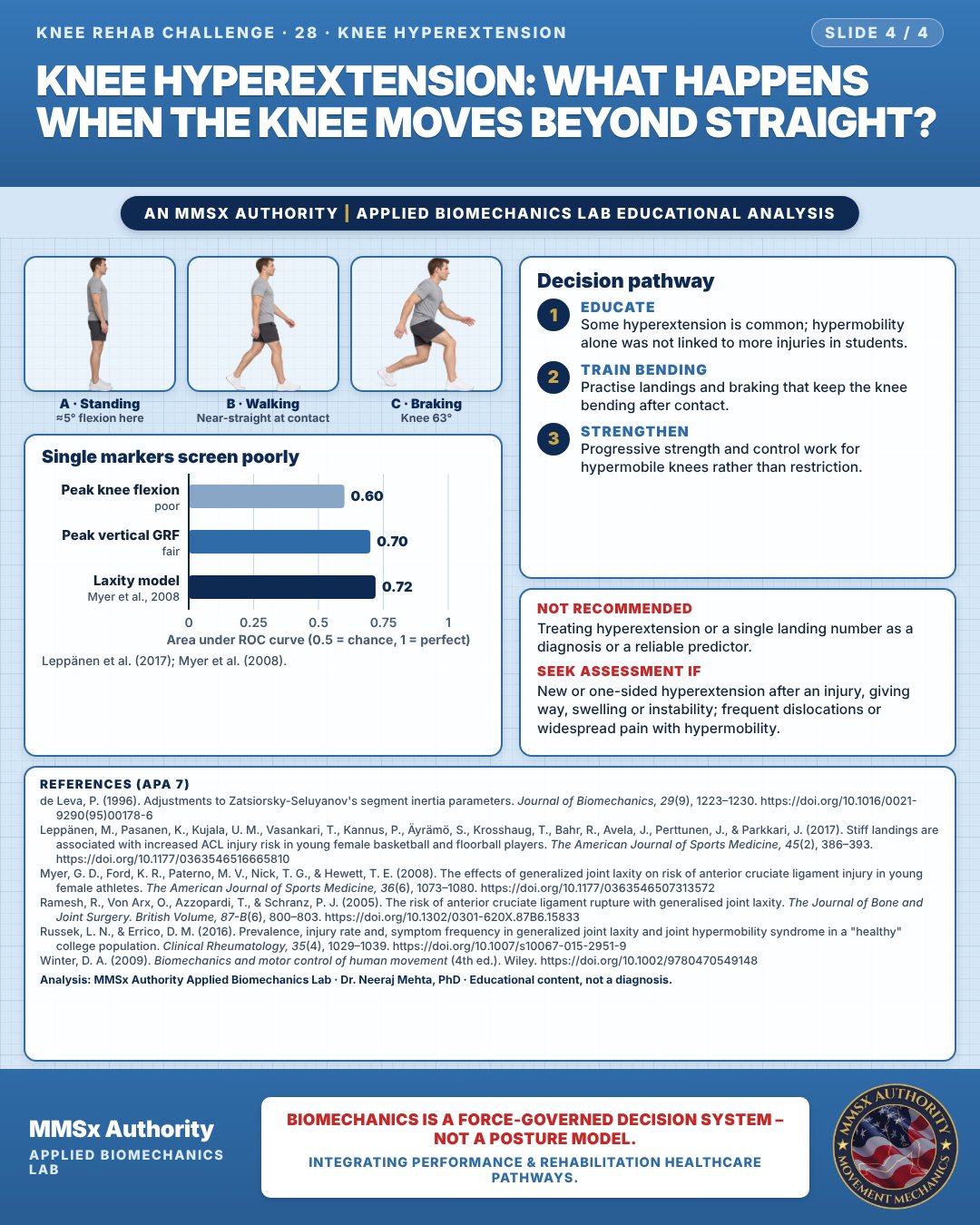
Single markers screen poorly
Educate
Some hyperextension is common; hypermobility alone was not linked to more injuries in students.
Train bending
Practise landings and braking that keep the knee bending after contact.
Strengthen
Progressive strength and control work for hypermobile knees rather than restriction.
What the evidence supports
- Generalised hypermobility alone was not associated with a higher injury rate in students; the symptomatic syndrome (JHS) was associated with more sprains, back pain and stress fractures. (Russek & Errico, 2016)
Myth and evidence
Myth“If your knees bend backwards you will inevitably tear your ACL.”
EvidenceHyperextension is associated with higher odds (OR ≈5, wide CI 1.24–18.44) (Myer et al., 2008), but single biomechanical markers screen poorly (AUC 0.6–0.7) (Leppänen et al., 2017), and GJH alone was not linked to more injuries in students (Russek & Errico, 2016).
Myth“Landing with straight knees is 'stronger'.”
EvidenceEach extra 10° of peak knee flexion was associated with 45% lower hazard of ACL injury (HR 0.55) (Leppänen et al., 2017).
Cautions
Not recommended
Treating hyperextension or a single landing number as a diagnosis or a reliable predictor.
Seek assessment if
New or one-sided hyperextension after an injury, giving way, swelling or instability; frequent dislocations or widespread pain with hypermobility.
Methods note
2-D estimates from pose landmarks on an illustrated figure; CoM from de Leva (1996) segment parameters; cm for a 1.70 m adult (Winter, 2009). GRF line from contact to CoM. These are educational estimates, not a diagnosis.
References
- de Leva, P. (1996). Adjustments to Zatsiorsky-Seluyanov's segment inertia parameters. Journal of Biomechanics, 29(9), 1223–1230. https://doi.org/10.1016/0021-9290(95)00178-6
- Leppänen, M., Pasanen, K., Kujala, U. M., Vasankari, T., Kannus, P., Äyrämö, S., Krosshaug, T., Bahr, R., Avela, J., Perttunen, J., & Parkkari, J. (2017). Stiff landings are associated with increased ACL injury risk in young female basketball and floorball players. The American Journal of Sports Medicine, 45(2), 386–393. https://doi.org/10.1177/0363546516665810
- Myer, G. D., Ford, K. R., Paterno, M. V., Nick, T. G., & Hewett, T. E. (2008). The effects of generalized joint laxity on risk of anterior cruciate ligament injury in young female athletes. The American Journal of Sports Medicine, 36(6), 1073–1080. https://doi.org/10.1177/0363546507313572
- Ramesh, R., Von Arx, O., Azzopardi, T., & Schranz, P. J. (2005). The risk of anterior cruciate ligament rupture with generalised joint laxity. The Journal of Bone and Joint Surgery. British Volume, 87-B(6), 800–803. https://doi.org/10.1302/0301-620X.87B6.15833
- Russek, L. N., & Errico, D. M. (2016). Prevalence, injury rate and, symptom frequency in generalized joint laxity and joint hypermobility syndrome in a "healthy" college population. Clinical Rheumatology, 35(4), 1029–1039. https://doi.org/10.1007/s10067-015-2951-9
- Winter, D. A. (2009). Biomechanics and motor control of human movement (4th ed.). Wiley. https://doi.org/10.1002/9780470549148
Cite this article
Mehta, N. (2026, October 23). Knee hyperextension: what happens when the knee moves beyond straight? MMSx Authority Applied Biomechanics Lab. https://mmsxauthority.org/edu/analysis/knee/28-knee-hyperextension-what-happens-when-the-knee-moves-beyond-straight/
Part of the collection
Mehta, N. (2026). Knee Rehabilitation: 50 Evidence-Based Biomechanics Analyses [Collection]. MMSx Authority Applied Biomechanics Lab. Zenodo. https://doi.org/10.5281/zenodo.23735752