Knee Rehab Challenge · 26
Can limited ankle mobility change how you load your knees?
Limited ankle dorsiflexion is a reduced ability of the shin to move forward over the planted foot (talocrural/tibial forward rotation), usually…
Key points
- Test weight-bearing. Use the knee-to-wall lunge, not only a lying measure; re-test against ~2 cm or ~5° before calling it a change.
- Train the range. Where dorsiflexion is limited, work on calf length and ankle mobility alongside strength.
- Load smart. Use heel lifts for comfort or depth, knowing they shift a little more load to the knee.
What it is
Limited ankle dorsiflexion is a reduced ability of the shin to move forward over the planted foot (talocrural/tibial forward rotation), usually measured clinically with the weight-bearing lunge (knee-to-wall) test as either the toe–wall distance (cm) or the tibial angle to vertical (degrees).
How we analysed the movement
Three movements relevant to this topic were analysed from illustrated reference figures. Joint centres were located with two-dimensional pose estimation; joint angles, the whole-body centre of mass and, where relevant, the ground-reaction-force line and its moment arm about the knee were then calculated from standard segment parameters. The figures are educational estimates that show how position changes mechanical demand; they are not measurements of a patient. Every research value quoted below comes from the published source cited beside it.
Movement A: Knee-to-wall test (side view)
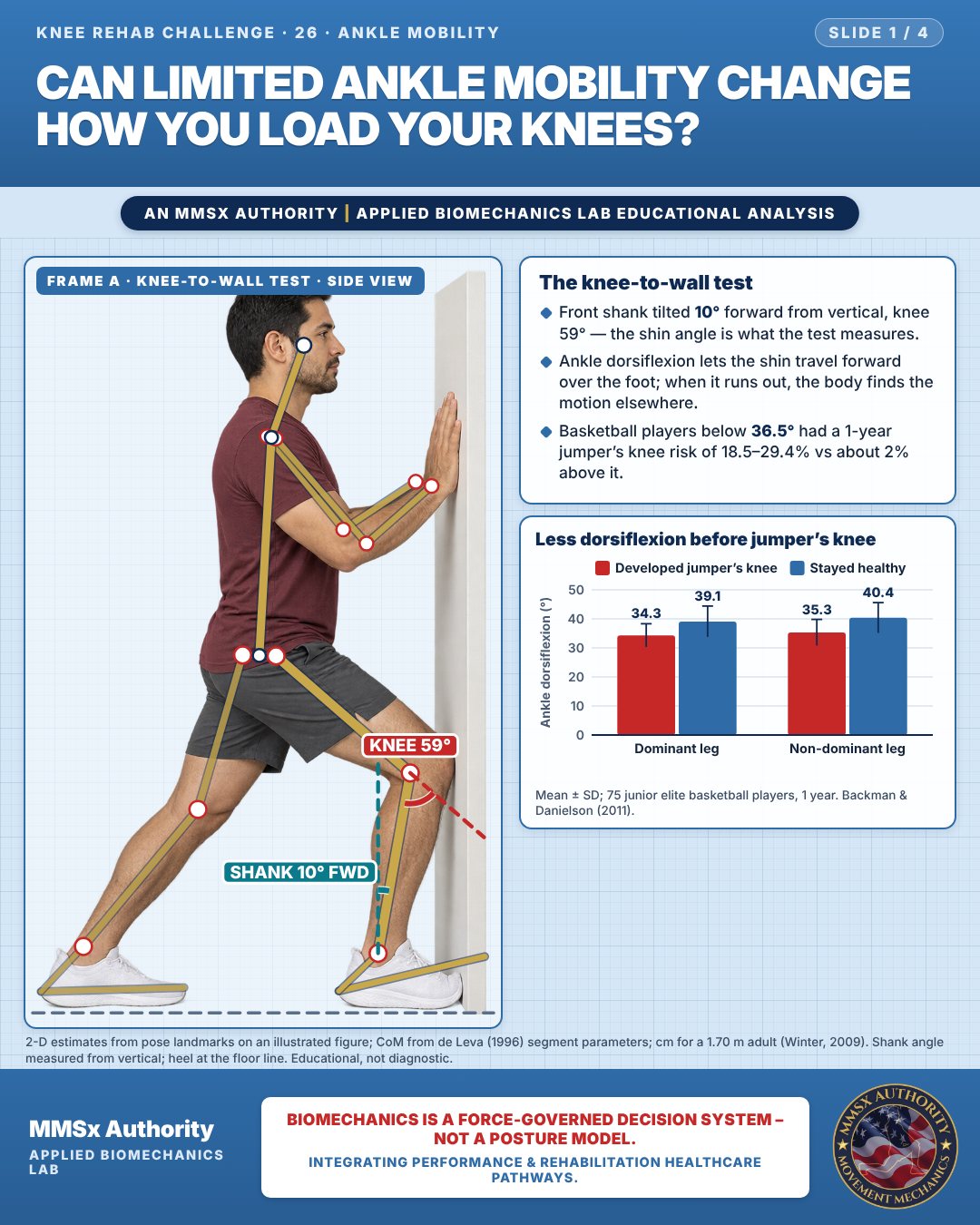
The knee-to-wall test
Front shank tilted 10° forward from vertical, knee 59° — the shin angle is what the test measures.
Ankle dorsiflexion lets the shin travel forward over the foot; when it runs out, the body finds the motion elsewhere.
Basketball players below 36.5° had a 1-year jumper’s knee risk of 18.5–29.4% vs about 2% above it.
Less dorsiflexion before jumper’s knee
Movement B: Squat with heels rising (side view)
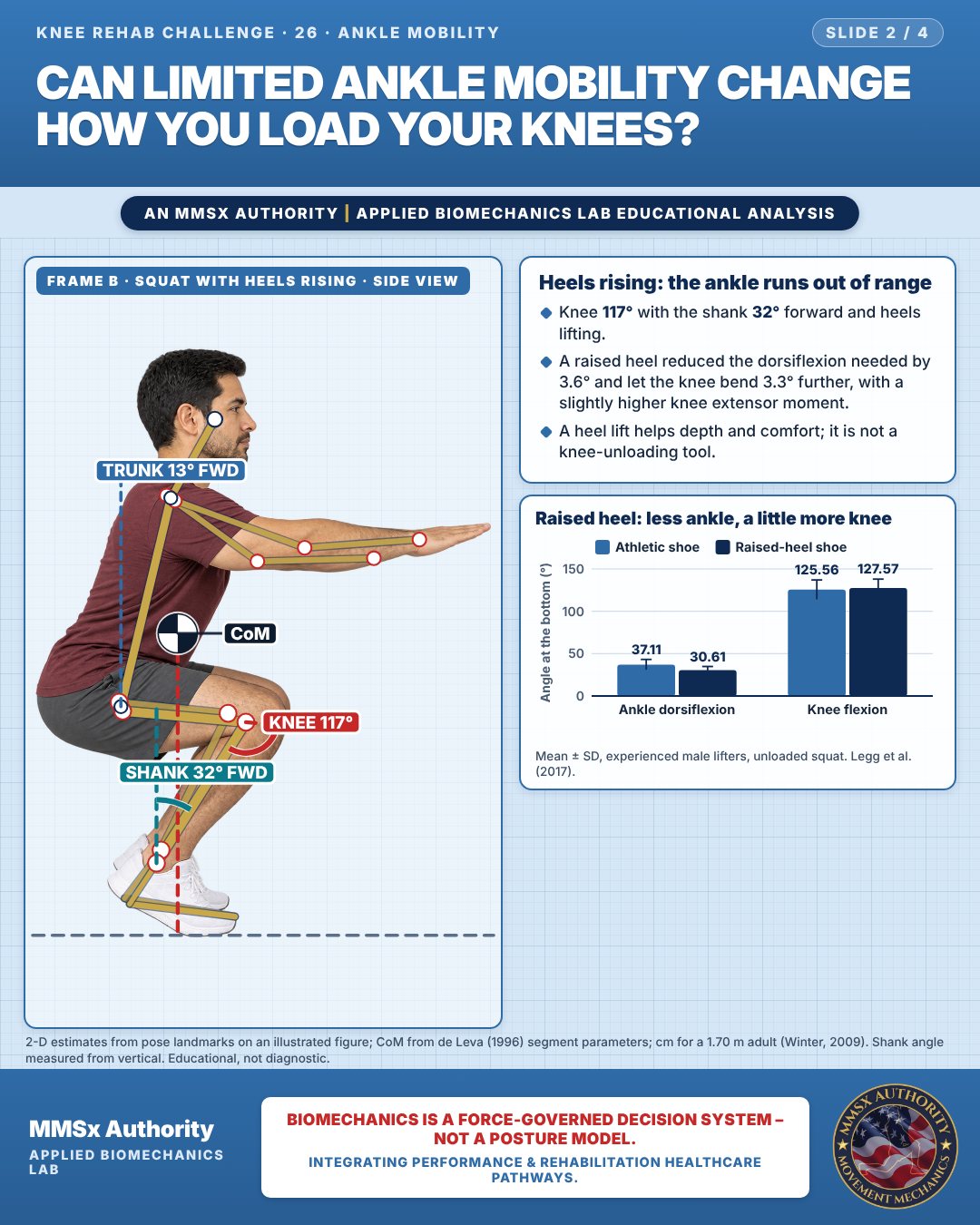
Heels rising: the ankle runs out of range
Knee 117° with the shank 32° forward and heels lifting.
A raised heel reduced the dorsiflexion needed by 3.6° and let the knee bend 3.3° further, with a slightly higher knee extensor moment.
A heel lift helps depth and comfort; it is not a knee-unloading tool.
Raised heel: less ankle, a little more knee
Movement C: Step-down, oblique
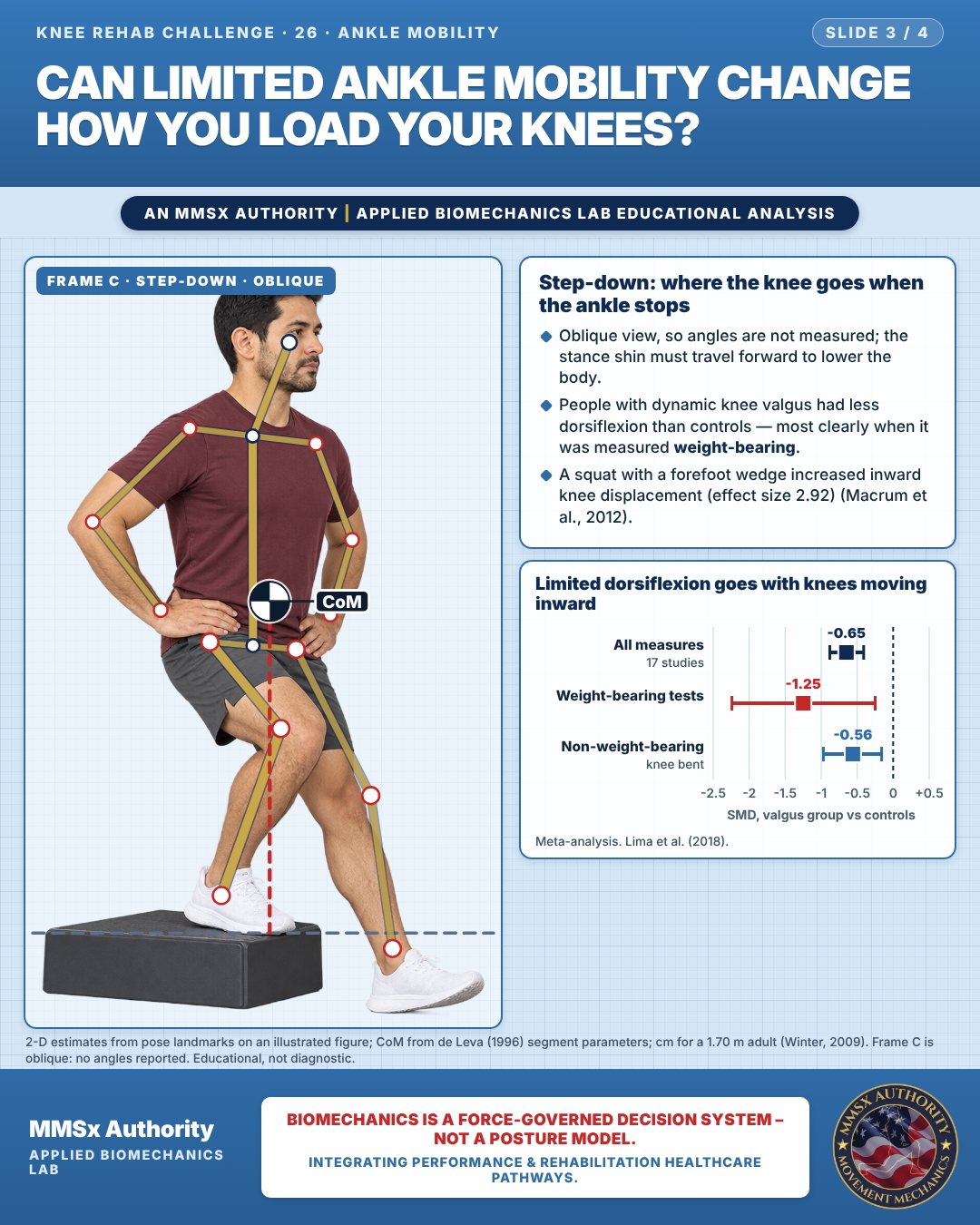
Step-down: where the knee goes when the ankle stops
Oblique view, so angles are not measured; the stance shin must travel forward to lower the body.
People with dynamic knee valgus had less dorsiflexion than controls — most clearly when it was measured weight-bearing.
A squat with a forefoot wedge increased inward knee displacement (effect size 2.92) (Macrum et al., 2012).
Limited dorsiflexion goes with knees moving inward
Decision pathway
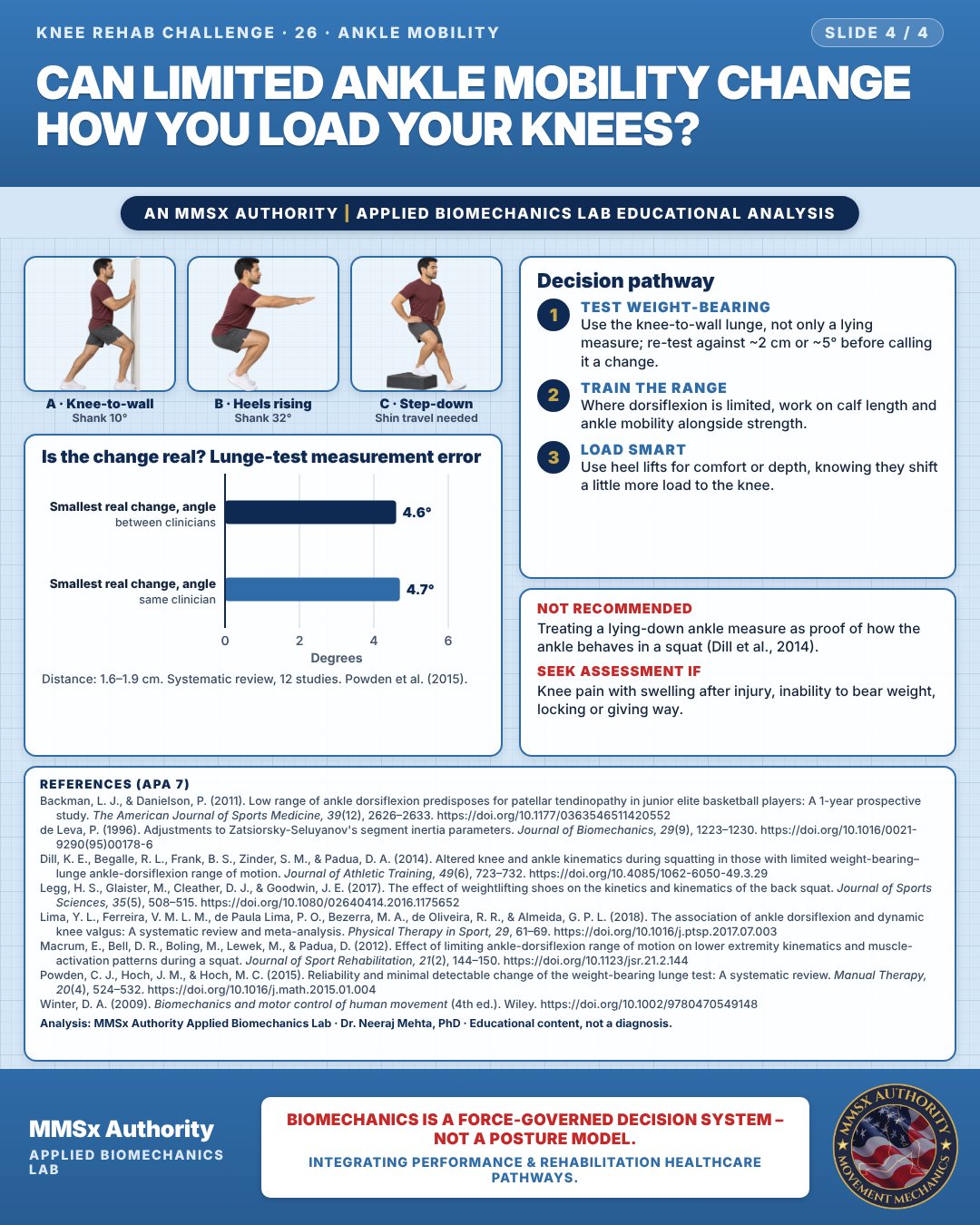
Is the change real? Lunge-test measurement error
Test weight-bearing
Use the knee-to-wall lunge, not only a lying measure; re-test against ~2 cm or ~5° before calling it a change.
Train the range
Where dorsiflexion is limited, work on calf length and ankle mobility alongside strength.
Load smart
Use heel lifts for comfort or depth, knowing they shift a little more load to the knee.
Myth and evidence
Myth“A heel lift unloads the knee.”
EvidenceRaised heels reduced dorsiflexion demand by 3.61° but increased knee flexion (+3.32°) and knee extensor moment (+0.05 N·m/kg) (Legg et al., 2017) — useful for comfort and depth, not a knee-unloading tool.
Cautions
Not recommended
Treating a lying-down ankle measure as proof of how the ankle behaves in a squat (Dill et al., 2014).
Seek assessment if
Knee pain with swelling after injury, inability to bear weight, locking or giving way.
Methods note
2-D estimates from pose landmarks on an illustrated figure; CoM from de Leva (1996) segment parameters; cm for a 1.70 m adult (Winter, 2009). Shank angle measured from vertical; heel at the floor line. Shank angle measured from vertical. Frame C is oblique: no angles reported. These are educational estimates, not a diagnosis.
References
- Backman, L. J., & Danielson, P. (2011). Low range of ankle dorsiflexion predisposes for patellar tendinopathy in junior elite basketball players: A 1-year prospective study. The American Journal of Sports Medicine, 39(12), 2626–2633. https://doi.org/10.1177/0363546511420552
- de Leva, P. (1996). Adjustments to Zatsiorsky-Seluyanov's segment inertia parameters. Journal of Biomechanics, 29(9), 1223–1230. https://doi.org/10.1016/0021-9290(95)00178-6
- Dill, K. E., Begalle, R. L., Frank, B. S., Zinder, S. M., & Padua, D. A. (2014). Altered knee and ankle kinematics during squatting in those with limited weight-bearing–lunge ankle-dorsiflexion range of motion. Journal of Athletic Training, 49(6), 723–732. https://doi.org/10.4085/1062-6050-49.3.29
- Legg, H. S., Glaister, M., Cleather, D. J., & Goodwin, J. E. (2017). The effect of weightlifting shoes on the kinetics and kinematics of the back squat. Journal of Sports Sciences, 35(5), 508–515. https://doi.org/10.1080/02640414.2016.1175652
- Lima, Y. L., Ferreira, V. M. L. M., de Paula Lima, P. O., Bezerra, M. A., de Oliveira, R. R., & Almeida, G. P. L. (2018). The association of ankle dorsiflexion and dynamic knee valgus: A systematic review and meta-analysis. Physical Therapy in Sport, 29, 61–69. https://doi.org/10.1016/j.ptsp.2017.07.003
- Macrum, E., Bell, D. R., Boling, M., Lewek, M., & Padua, D. (2012). Effect of limiting ankle-dorsiflexion range of motion on lower extremity kinematics and muscle-activation patterns during a squat. Journal of Sport Rehabilitation, 21(2), 144–150. https://doi.org/10.1123/jsr.21.2.144
- Powden, C. J., Hoch, J. M., & Hoch, M. C. (2015). Reliability and minimal detectable change of the weight-bearing lunge test: A systematic review. Manual Therapy, 20(4), 524–532. https://doi.org/10.1016/j.math.2015.01.004
- Winter, D. A. (2009). Biomechanics and motor control of human movement (4th ed.). Wiley. https://doi.org/10.1002/9780470549148
Cite this article
Mehta, N. (2026, October 23). Can limited ankle mobility change how you load your knees? MMSx Authority Applied Biomechanics Lab. https://mmsxauthority.org/edu/analysis/knee/26-can-limited-ankle-mobility-change-how-you-load-your-knees/
Part of the collection
Mehta, N. (2026). Knee Rehabilitation: 50 Evidence-Based Biomechanics Analyses [Collection]. MMSx Authority Applied Biomechanics Lab. Zenodo. https://doi.org/10.5281/zenodo.23735752