Knee Rehab Challenge · 24
Knee pain during pivoting: tennis, football, and pickleball
Pivot-related knee pain arises when the planted knee must decelerate and redirect the body: the joint is loaded not only in flexion but also by…
Key points
- Warm up. Use a structured programme such as FIFA 11+: about 39% fewer injuries overall.
- Cut smarter. Narrower foot placement and less knee valgus during cuts were linked to lower knee abduction moment (laboratory data).
- Older players. In pickleball, balance and deceleration training matter: falls and fractures dominate the injuries.
What it is
Pivot-related knee pain arises when the planted knee must decelerate and redirect the body: the joint is loaded not only in flexion but also by valgus/varus (side-to-side) and rotational moments. Pain may reflect overload of the patellofemoral joint or tendons, a meniscal or ligament (e.g. ACL, MCL) injury after a single pivot event, or flare of existing osteoarthritis; acute pivot injuries need different handling from gradual overload pain.
How we analysed the movement
Three movements relevant to this topic were analysed from illustrated reference figures. Joint centres were located with two-dimensional pose estimation; joint angles, the whole-body centre of mass and, where relevant, the ground-reaction-force line and its moment arm about the knee were then calculated from standard segment parameters. The figures are educational estimates that show how position changes mechanical demand; they are not measurements of a patient. Every research value quoted below comes from the published source cited beside it.
Movement A: Tennis direction change, oblique
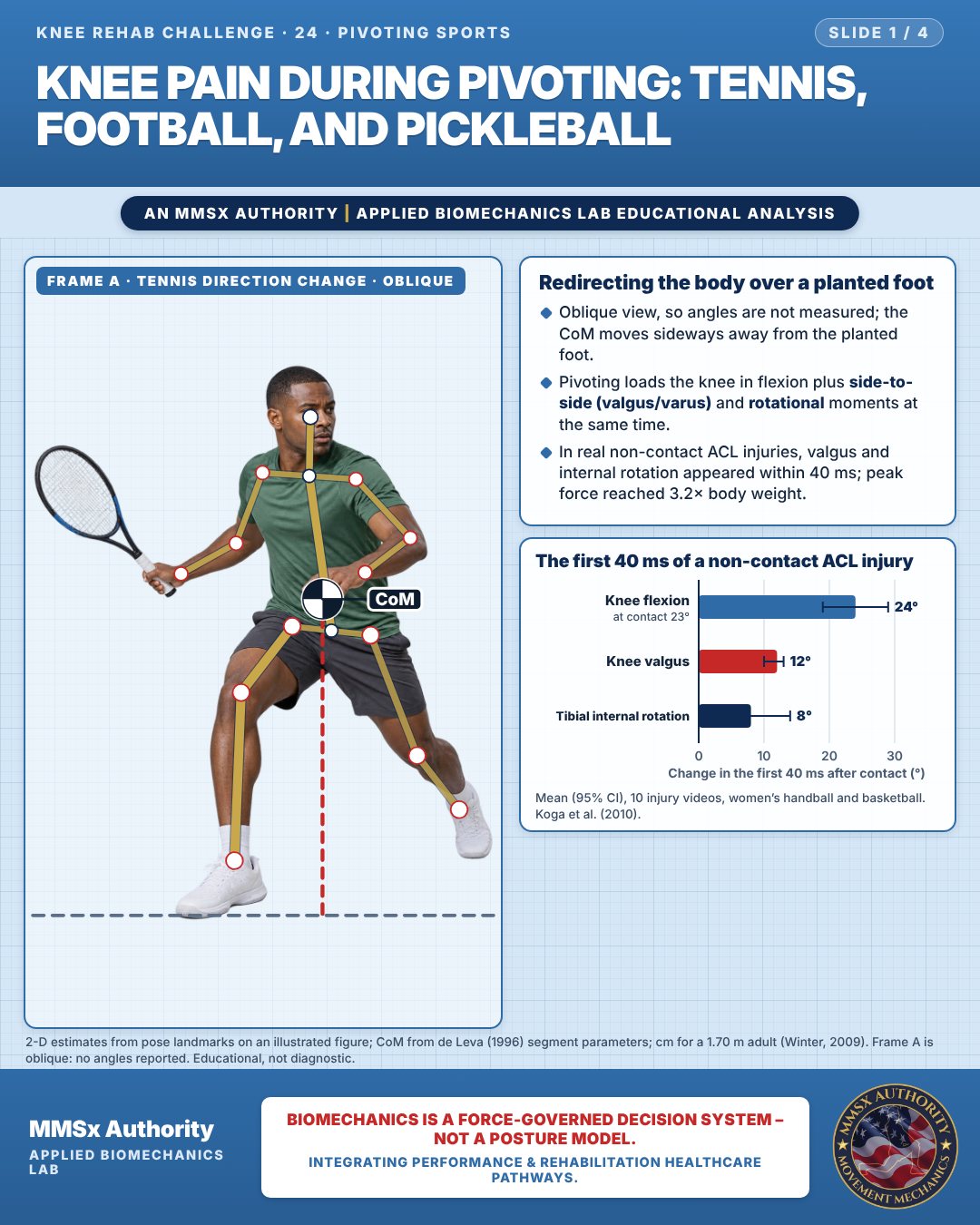
Redirecting the body over a planted foot
Oblique view, so angles are not measured; the CoM moves sideways away from the planted foot.
Pivoting loads the knee in flexion plus side-to-side (valgus/varus) and rotational moments at the same time.
In real non-contact ACL injuries, valgus and internal rotation appeared within 40 ms; peak force reached 3.2× body weight.
The first 40 ms of a non-contact ACL injury
Movement B: Football cut (side view)
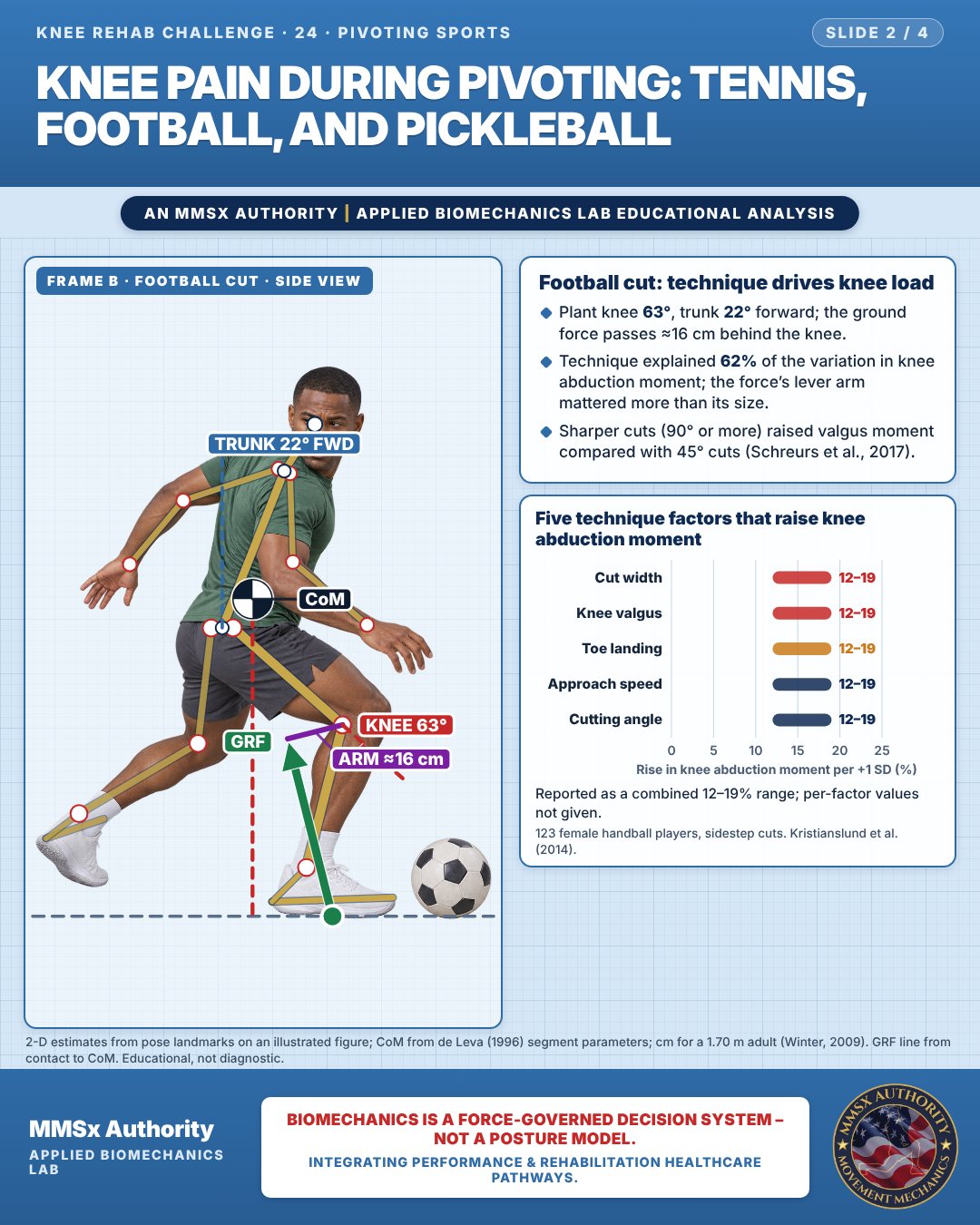
Football cut: technique drives knee load
Plant knee 63°, trunk 22° forward; the ground force passes ≈16 cm behind the knee.
Technique explained 62% of the variation in knee abduction moment; the force’s lever arm mattered more than its size.
Sharper cuts (90° or more) raised valgus moment compared with 45° cuts (Schreurs et al., 2017).
Five technique factors that raise knee abduction moment
Reported as a combined 12–19% range; per-factor values not given.
Movement C: Pickleball braking reach (side view)
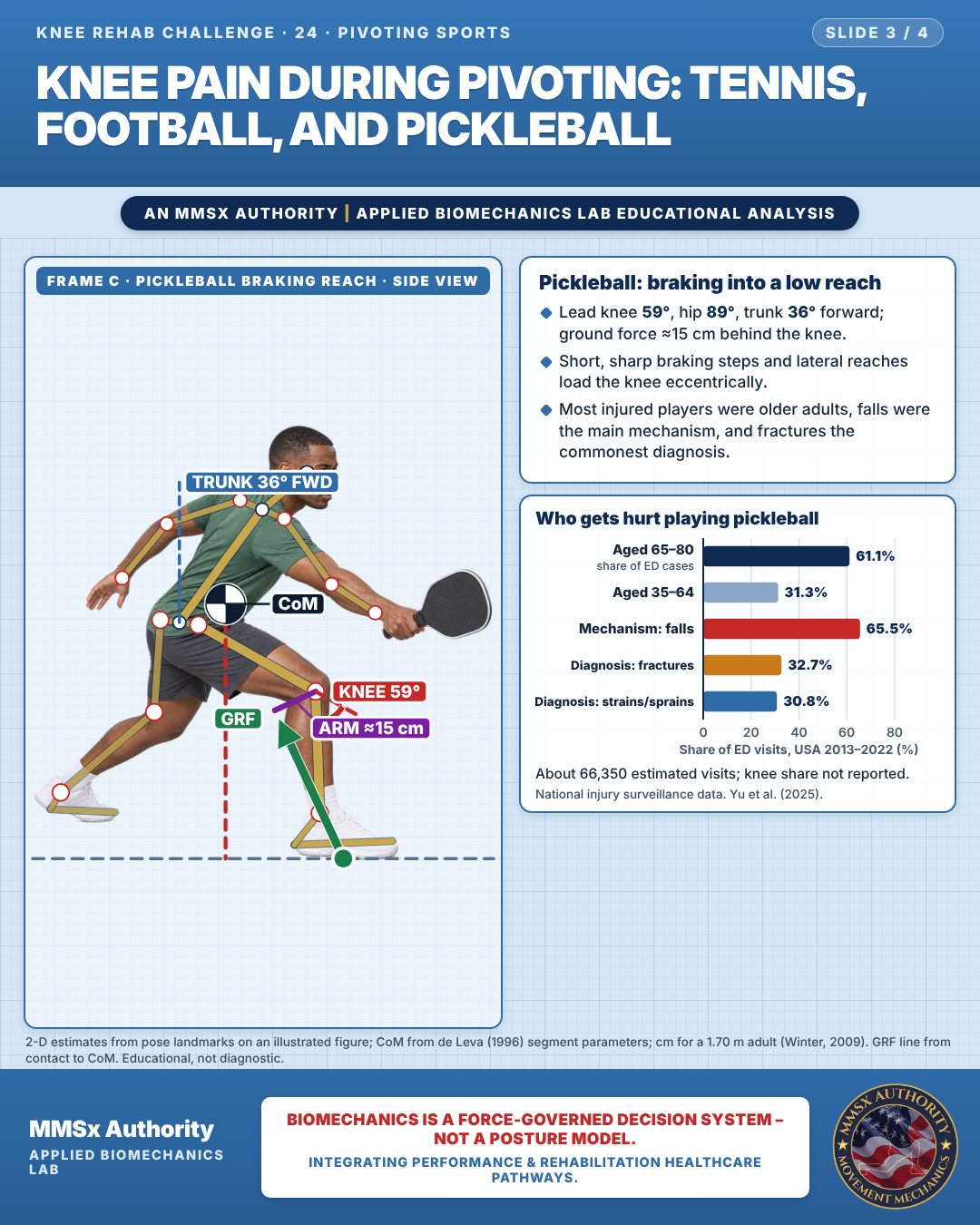
Pickleball: braking into a low reach
Lead knee 59°, hip 89°, trunk 36° forward; ground force ≈15 cm behind the knee.
Short, sharp braking steps and lateral reaches load the knee eccentrically.
Most injured players were older adults, falls were the main mechanism, and fractures the commonest diagnosis.
Who gets hurt playing pickleball
About 66,350 estimated visits; knee share not reported.
Decision pathway
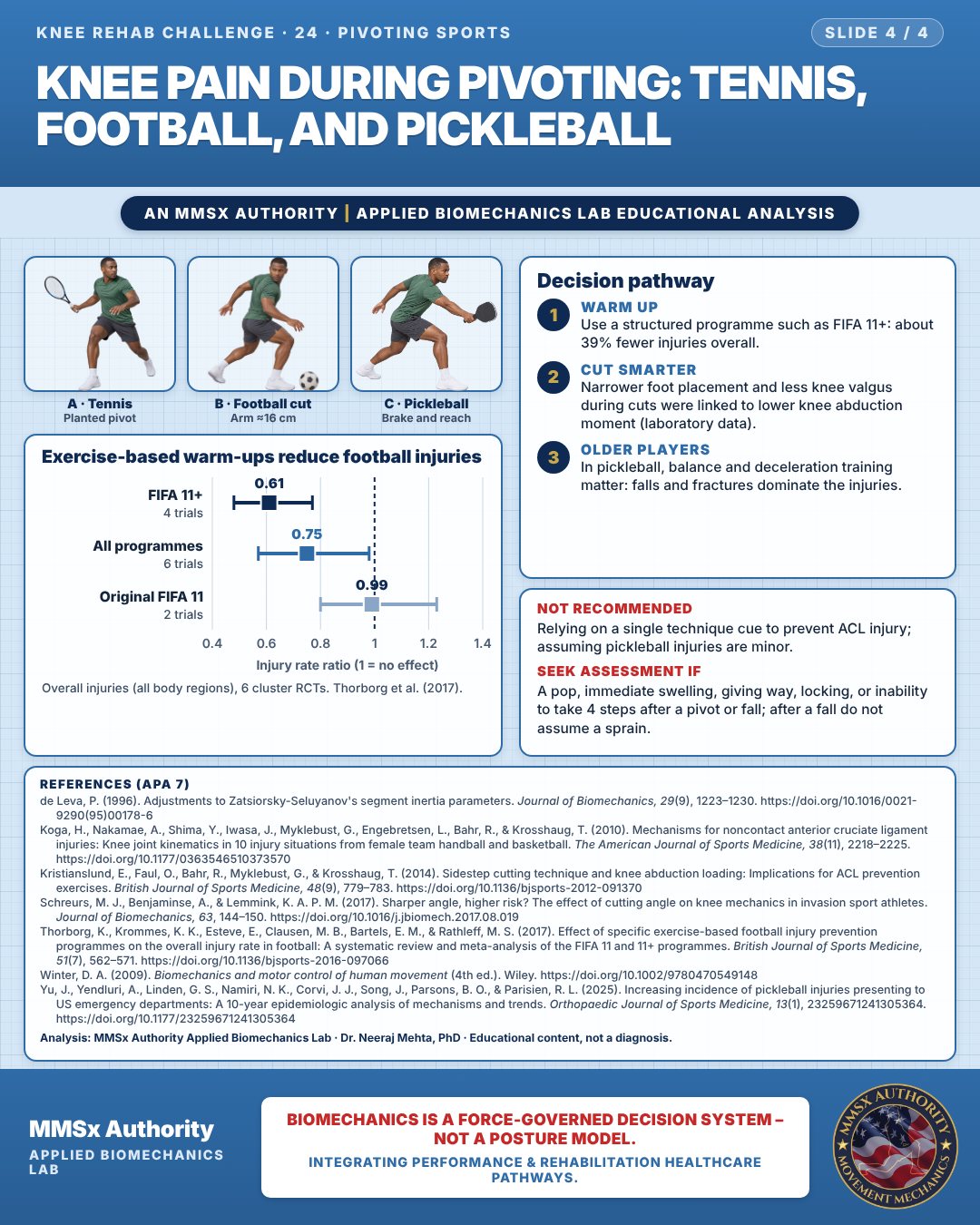
Exercise-based warm-ups reduce football injuries
Warm up
Use a structured programme such as FIFA 11+: about 39% fewer injuries overall.
Cut smarter
Narrower foot placement and less knee valgus during cuts were linked to lower knee abduction moment (laboratory data).
Older players
In pickleball, balance and deceleration training matter: falls and fractures dominate the injuries.
What the evidence supports
- Prevention: structured exercise-based warm-up programmes (FIFA 11+) reduce overall football injury rates (RR 0.61; Thorborg et al., 2017).
- Technique levers associated with lower knee abduction moment: narrower foot placement and less knee valgus during cuts (Kristianslund et al., 2014); sharper cut angles raise valgus moment vs 45° cuts (Schreurs et al., 2017). These are associations from laboratory data.
Myth and evidence
Myth“Knee injuries in pivoting sports are bad luck — they can't be trained against.”
EvidenceStructured exercise-based programmes reduce injury rates (11+: RR 0.61; Thorborg et al., 2017), and technique factors explained 62% of variance in knee abduction moment during cutting (Kristianslund et al., 2014). Myth 2: "Pickleball is a gentle sport, so injuries are minor." ED data show fractures as the most common diagnosis (32.7%) and a rising trend (Yu et al., 2025).
Cautions
Not recommended
Relying on a single technique cue to prevent ACL injury; assuming pickleball injuries are minor.
Seek assessment if
A pop, immediate swelling, giving way, locking, or inability to take 4 steps after a pivot or fall; after a fall do not assume a sprain.
Methods note
2-D estimates from pose landmarks on an illustrated figure; CoM from de Leva (1996) segment parameters; cm for a 1.70 m adult (Winter, 2009). Frame A is oblique: no angles reported. GRF line from contact to CoM. These are educational estimates, not a diagnosis.
References
- de Leva, P. (1996). Adjustments to Zatsiorsky-Seluyanov's segment inertia parameters. Journal of Biomechanics, 29(9), 1223–1230. https://doi.org/10.1016/0021-9290(95)00178-6
- Koga, H., Nakamae, A., Shima, Y., Iwasa, J., Myklebust, G., Engebretsen, L., Bahr, R., & Krosshaug, T. (2010). Mechanisms for noncontact anterior cruciate ligament injuries: Knee joint kinematics in 10 injury situations from female team handball and basketball. The American Journal of Sports Medicine, 38(11), 2218–2225. https://doi.org/10.1177/0363546510373570
- Kristianslund, E., Faul, O., Bahr, R., Myklebust, G., & Krosshaug, T. (2014). Sidestep cutting technique and knee abduction loading: Implications for ACL prevention exercises. British Journal of Sports Medicine, 48(9), 779–783. https://doi.org/10.1136/bjsports-2012-091370
- Schreurs, M. J., Benjaminse, A., & Lemmink, K. A. P. M. (2017). Sharper angle, higher risk? The effect of cutting angle on knee mechanics in invasion sport athletes. Journal of Biomechanics, 63, 144–150. https://doi.org/10.1016/j.jbiomech.2017.08.019
- Thorborg, K., Krommes, K. K., Esteve, E., Clausen, M. B., Bartels, E. M., & Rathleff, M. S. (2017). Effect of specific exercise-based football injury prevention programmes on the overall injury rate in football: A systematic review and meta-analysis of the FIFA 11 and 11+ programmes. British Journal of Sports Medicine, 51(7), 562–571. https://doi.org/10.1136/bjsports-2016-097066
- Winter, D. A. (2009). Biomechanics and motor control of human movement (4th ed.). Wiley. https://doi.org/10.1002/9780470549148
- Yu, J., Yendluri, A., Linden, G. S., Namiri, N. K., Corvi, J. J., Song, J., Parsons, B. O., & Parisien, R. L. (2025). Increasing incidence of pickleball injuries presenting to US emergency departments: A 10-year epidemiologic analysis of mechanisms and trends. Orthopaedic Journal of Sports Medicine, 13(1), 23259671241305364. https://doi.org/10.1177/23259671241305364
Cite this article
Mehta, N. (2026, October 23). Knee pain during pivoting: tennis, football, and pickleball. MMSx Authority Applied Biomechanics Lab. https://mmsxauthority.org/edu/analysis/knee/24-knee-pain-during-pivoting-tennis-football-and-pickleball/
Part of the collection
Mehta, N. (2026). Knee Rehabilitation: 50 Evidence-Based Biomechanics Analyses [Collection]. MMSx Authority Applied Biomechanics Lab. Zenodo. https://doi.org/10.5281/zenodo.23735752