Knee Rehab Challenge · 23
Knee pain when jumping or landing
Jump/landing-related knee pain is most often anterior pain at the lower pole of the patella (patellar tendinopathy, "jumper's knee") or around the…
Key points
- Land soft. Practise deeper hip-and-knee landings; start with two-foot landings before single-leg.
- Grade height. Progress drop and jump heights gradually: force rises faster than the knee’s bend as height increases.
- Load the tendon. For jumper’s knee, a staged programme from isometric to energy-storage work beat eccentric-only exercise.
What it is
Jump/landing-related knee pain is most often anterior pain at the lower pole of the patella (patellar tendinopathy, "jumper's knee") or around the patella (patellofemoral pain), provoked by the high, rapid extensor loads of take-off and especially landing; how the knee and hip flex on landing ("soft" vs "stiff") and whether one or two legs absorb the load change how much force the knee must handle.
How we analysed the movement
Three movements relevant to this topic were analysed from illustrated reference figures. Joint centres were located with two-dimensional pose estimation; joint angles, the whole-body centre of mass and, where relevant, the ground-reaction-force line and its moment arm about the knee were then calculated from standard segment parameters. The figures are educational estimates that show how position changes mechanical demand; they are not measurements of a patient. Every research value quoted below comes from the published source cited beside it.
Movement A: Countermovement (side view)
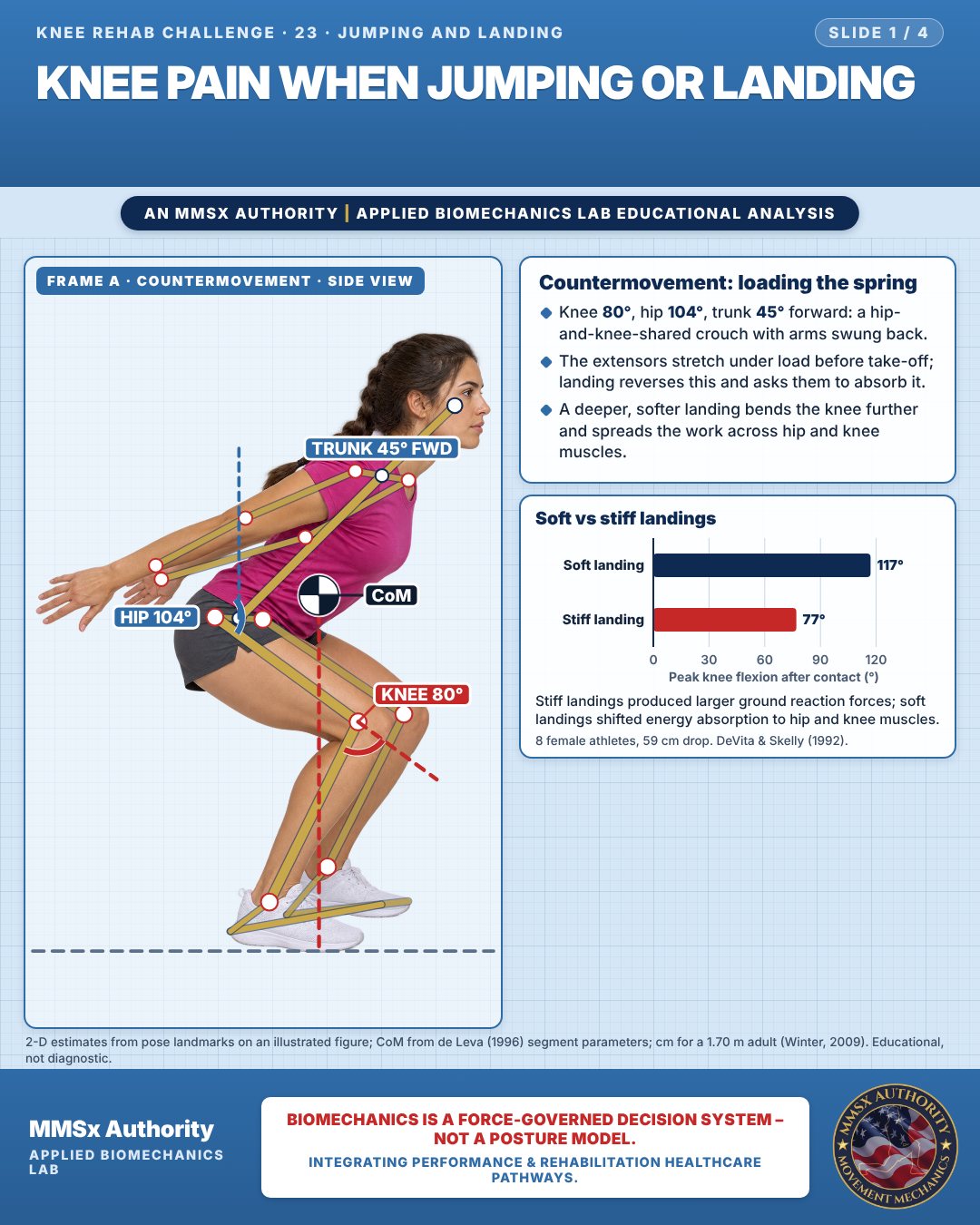
Countermovement: loading the spring
Knee 80°, hip 104°, trunk 45° forward: a hip-and-knee-shared crouch with arms swung back.
The extensors stretch under load before take-off; landing reverses this and asks them to absorb it.
A deeper, softer landing bends the knee further and spreads the work across hip and knee muscles.
Soft vs stiff landings
Stiff landings produced larger ground reaction forces; soft landings shifted energy absorption to hip and knee muscles.
Movement B: Two-foot landing (front view)
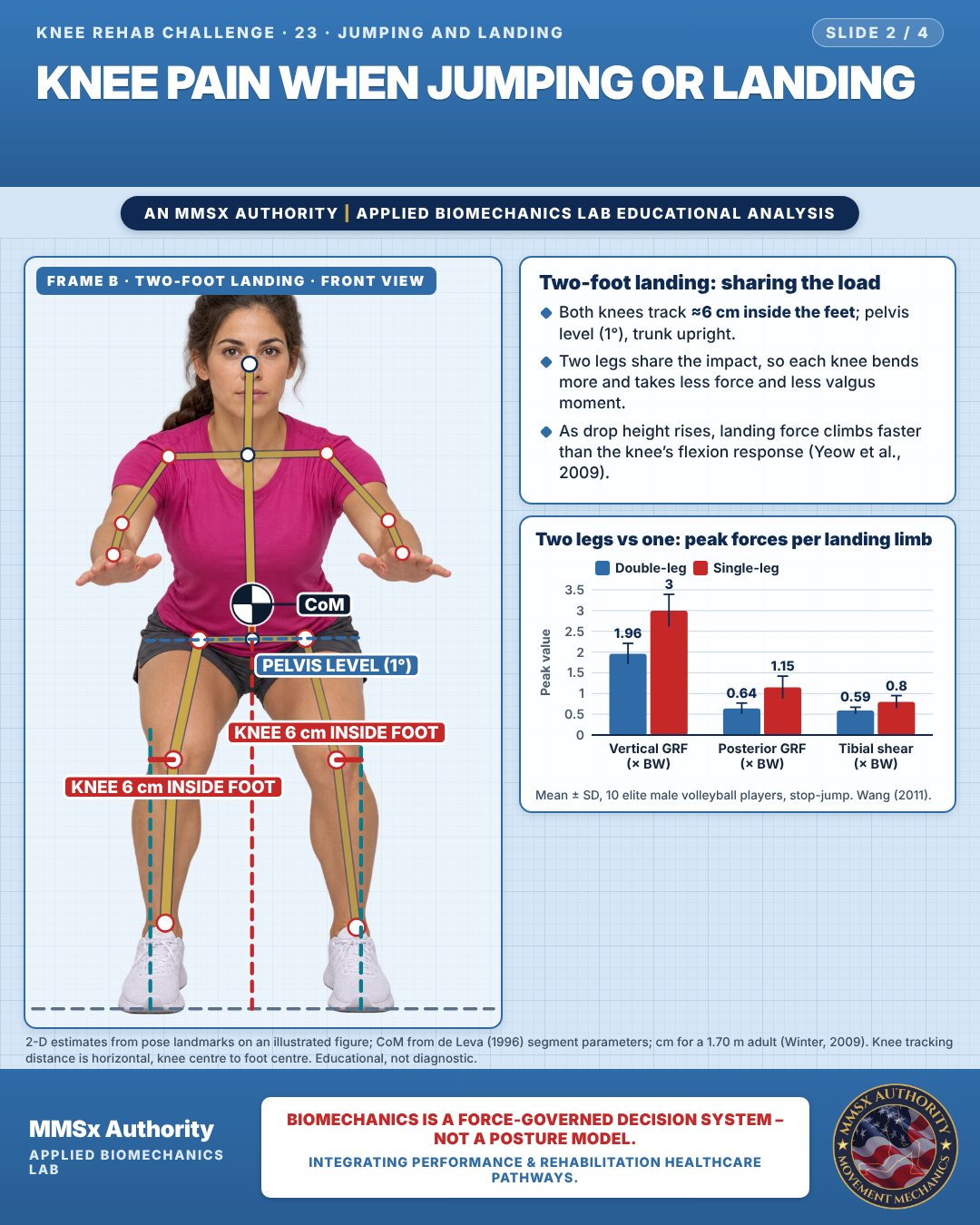
Two-foot landing: sharing the load
Both knees track ≈6 cm inside the feet; pelvis level (1°), trunk upright.
Two legs share the impact, so each knee bends more and takes less force and less valgus moment.
As drop height rises, landing force climbs faster than the knee’s flexion response (Yeow et al., 2009).
Two legs vs one: peak forces per landing limb
Movement C: Single-leg landing (side view)
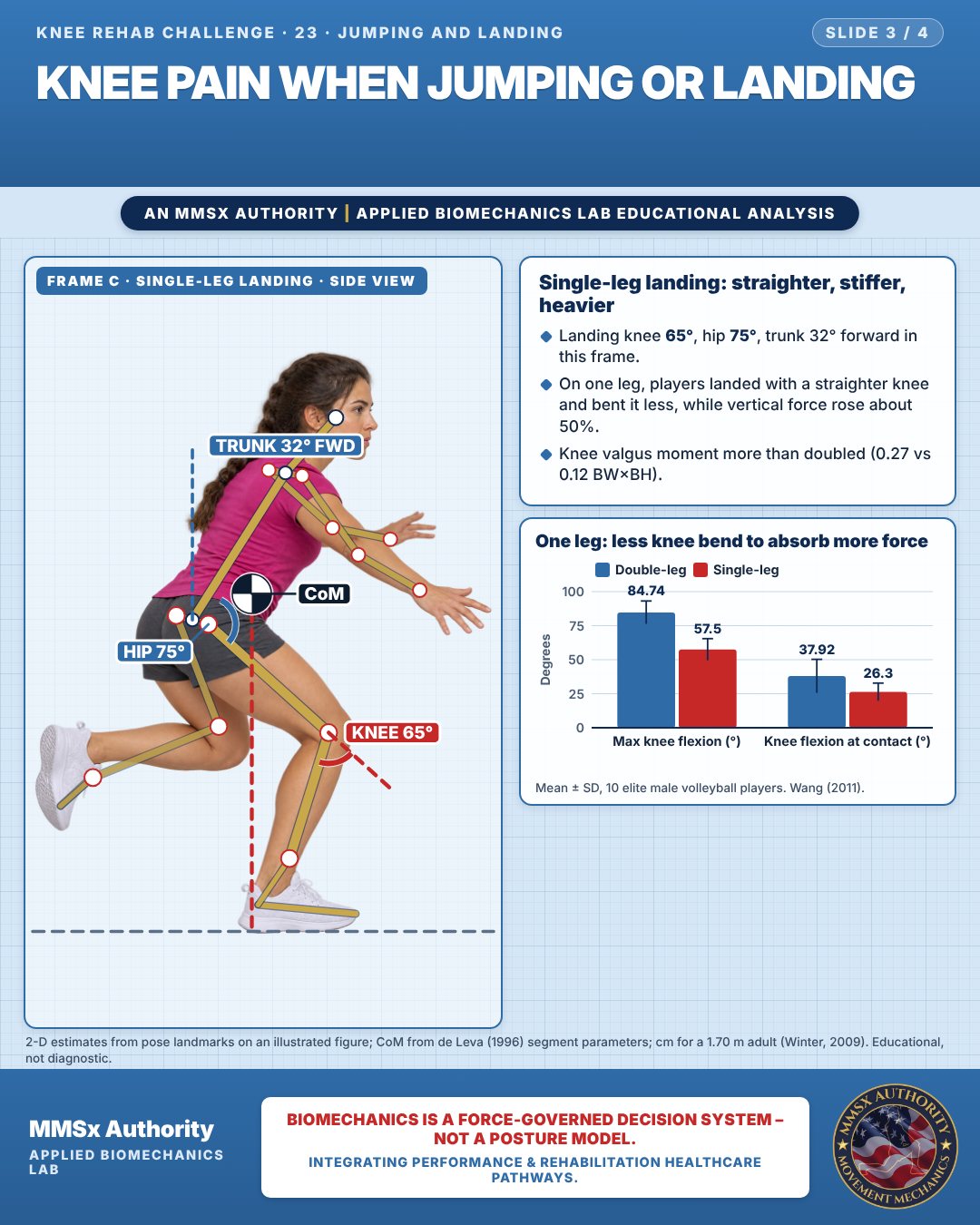
Single-leg landing: straighter, stiffer, heavier
Landing knee 65°, hip 75°, trunk 32° forward in this frame.
On one leg, players landed with a straighter knee and bent it less, while vertical force rose about 50%.
Knee valgus moment more than doubled (0.27 vs 0.12 BW×BH).
One leg: less knee bend to absorb more force
Decision pathway
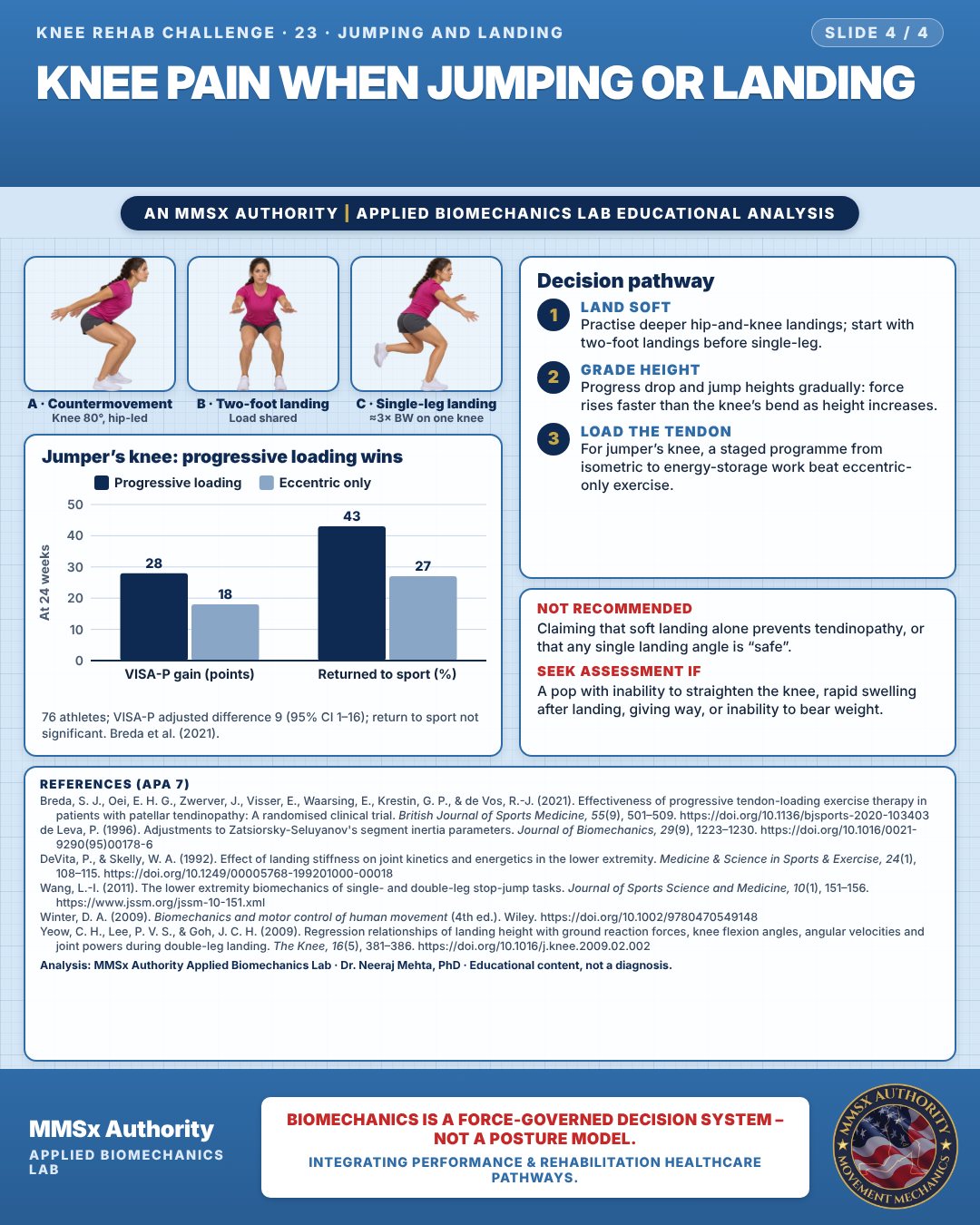
Jumper’s knee: progressive loading wins
Land soft
Practise deeper hip-and-knee landings; start with two-foot landings before single-leg.
Grade height
Progress drop and jump heights gradually: force rises faster than the knee’s bend as height increases.
Load the tendon
For jumper’s knee, a staged programme from isometric to energy-storage work beat eccentric-only exercise.
What the evidence supports
- Patellar tendinopathy: progressive tendon-loading exercise superior to eccentric-only on VISA-P at 24 weeks (Breda et al., 2021).
- Technique dose levers supported by data: deeper (softer) knee/hip flexion on landing shifts energy absorption to hip/knee muscles and lowers GRF (DeVita & Skelly, 1992); double-leg landings before single-leg (Wang, 2011); lower drop/jump heights first (Yeow et al., 2009).
Myth and evidence
Myth“Landing softly means landing with less knee bend so the knee isn't 'stressed'.”
EvidenceSoft landings used MORE knee flexion (117° vs 77°), produced smaller GRFs, and shifted energy absorption to hip and knee muscles (DeVita & Skelly, 1992). Myth 2: "One-leg landings are just half of a two-leg landing." Single-leg landings had 3.00 vs 1.96 BW peak vertical GRF and more than double the knee valgus moment (Wang, 2011).
Cautions
Not recommended
Claiming that soft landing alone prevents tendinopathy, or that any single landing angle is “safe”.
Seek assessment if
A pop with inability to straighten the knee, rapid swelling after landing, giving way, or inability to bear weight.
Methods note
2-D estimates from pose landmarks on an illustrated figure; CoM from de Leva (1996) segment parameters; cm for a 1.70 m adult (Winter, 2009). Knee tracking distance is horizontal, knee centre to foot centre. These are educational estimates, not a diagnosis.
References
- Breda, S. J., Oei, E. H. G., Zwerver, J., Visser, E., Waarsing, E., Krestin, G. P., & de Vos, R.-J. (2021). Effectiveness of progressive tendon-loading exercise therapy in patients with patellar tendinopathy: A randomised clinical trial. British Journal of Sports Medicine, 55(9), 501–509. https://doi.org/10.1136/bjsports-2020-103403
- de Leva, P. (1996). Adjustments to Zatsiorsky-Seluyanov's segment inertia parameters. Journal of Biomechanics, 29(9), 1223–1230. https://doi.org/10.1016/0021-9290(95)00178-6
- DeVita, P., & Skelly, W. A. (1992). Effect of landing stiffness on joint kinetics and energetics in the lower extremity. Medicine & Science in Sports & Exercise, 24(1), 108–115. https://doi.org/10.1249/00005768-199201000-00018
- Wang, L.-I. (2011). The lower extremity biomechanics of single- and double-leg stop-jump tasks. Journal of Sports Science and Medicine, 10(1), 151–156. https://www.jssm.org/jssm-10-151.xml
- Winter, D. A. (2009). Biomechanics and motor control of human movement (4th ed.). Wiley. https://doi.org/10.1002/9780470549148
- Yeow, C. H., Lee, P. V. S., & Goh, J. C. H. (2009). Regression relationships of landing height with ground reaction forces, knee flexion angles, angular velocities and joint powers during double-leg landing. The Knee, 16(5), 381–386. https://doi.org/10.1016/j.knee.2009.02.002
Cite this article
Mehta, N. (2026, October 23). Knee pain when jumping or landing. MMSx Authority Applied Biomechanics Lab. https://mmsxauthority.org/edu/analysis/knee/23-knee-pain-when-jumping-or-landing/
Part of the collection
Mehta, N. (2026). Knee Rehabilitation: 50 Evidence-Based Biomechanics Analyses [Collection]. MMSx Authority Applied Biomechanics Lab. Zenodo. https://doi.org/10.5281/zenodo.23735752