Knee Rehab Challenge · 20
Why downhill walking can aggravate knee pain
Downhill-provoked knee pain is anterior or diffuse knee pain that appears or worsens when walking down slopes, steps or stairs.
Key points
- Use poles. Poles reduced knee moment and joint forces by 12–25% on a downhill ramp.
- Change the dose. Options: shorter steps, a slower descent, zig-zag routes, a lighter pack, and shorter downhill sections while symptoms settle.
- Build capacity. Exercise therapy, preferably hip plus knee, is recommended for patellofemoral pain (Crossley et al., 2016); train slow step-downs.
What it is
Downhill-provoked knee pain is anterior or diffuse knee pain that appears or worsens when walking down slopes, steps or stairs; it is a typical feature of patellofemoral pain (pain around or behind the patella aggravated by loaded knee-flexion tasks such as stairs and squatting) and is also reported in knee osteoarthritis. Downhill walking demands eccentric (lengthening) quadriceps control to brake the body, with the knee flexed under load.
How we analysed the movement
Three movements relevant to this topic were analysed from illustrated reference figures. Joint centres were located with two-dimensional pose estimation; joint angles, the whole-body centre of mass and, where relevant, the ground-reaction-force line and its moment arm about the knee were then calculated from standard segment parameters. The figures are educational estimates that show how position changes mechanical demand; they are not measurements of a patient. Every research value quoted below comes from the published source cited beside it.
Movement A: Downhill walking (side view)
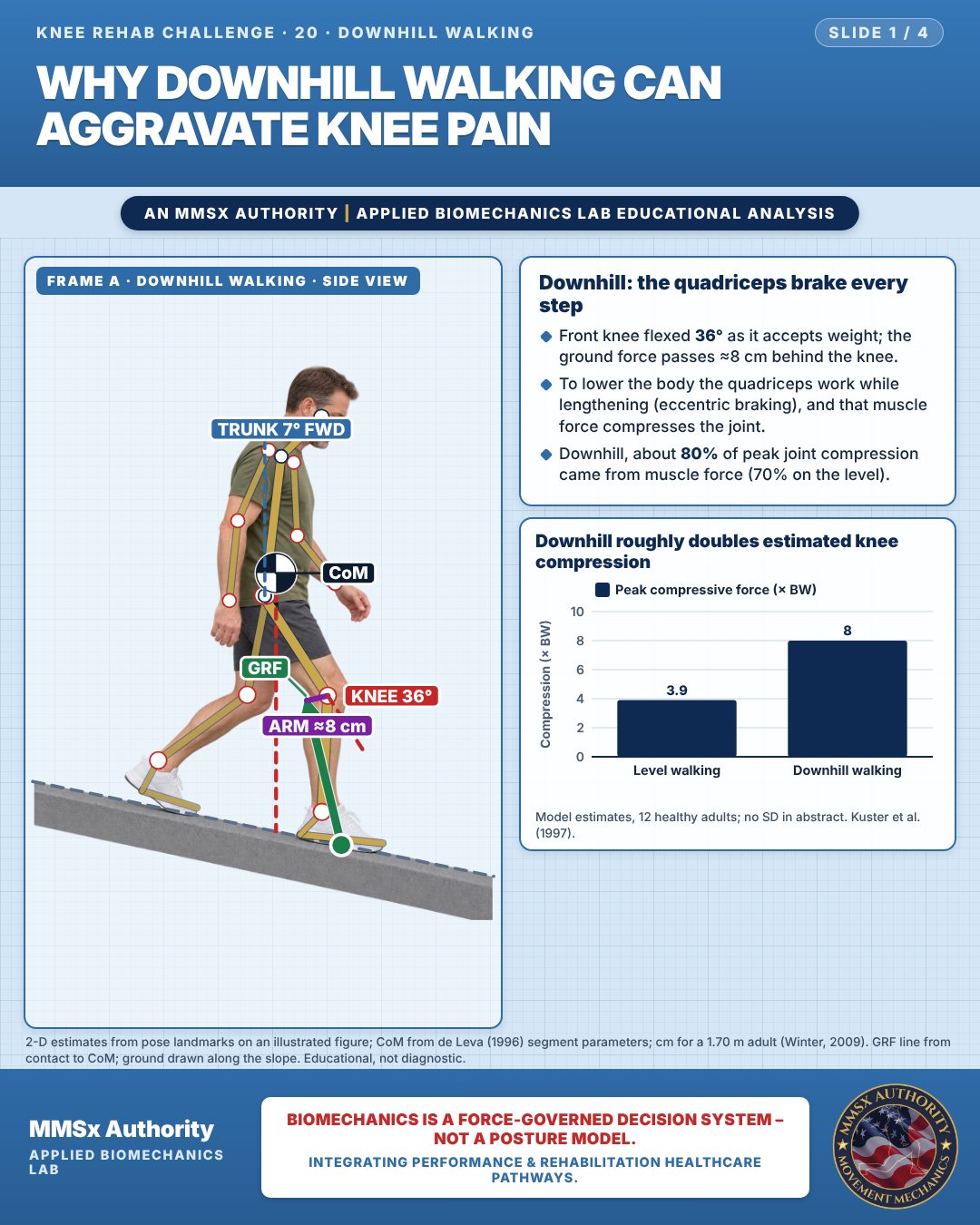
Downhill: the quadriceps brake every step
Front knee flexed 36° as it accepts weight; the ground force passes ≈8 cm behind the knee.
To lower the body the quadriceps work while lengthening (eccentric braking), and that muscle force compresses the joint.
Downhill, about 80% of peak joint compression came from muscle force (70% on the level).
Downhill roughly doubles estimated knee compression
Movement B: Uneven step descent, oblique
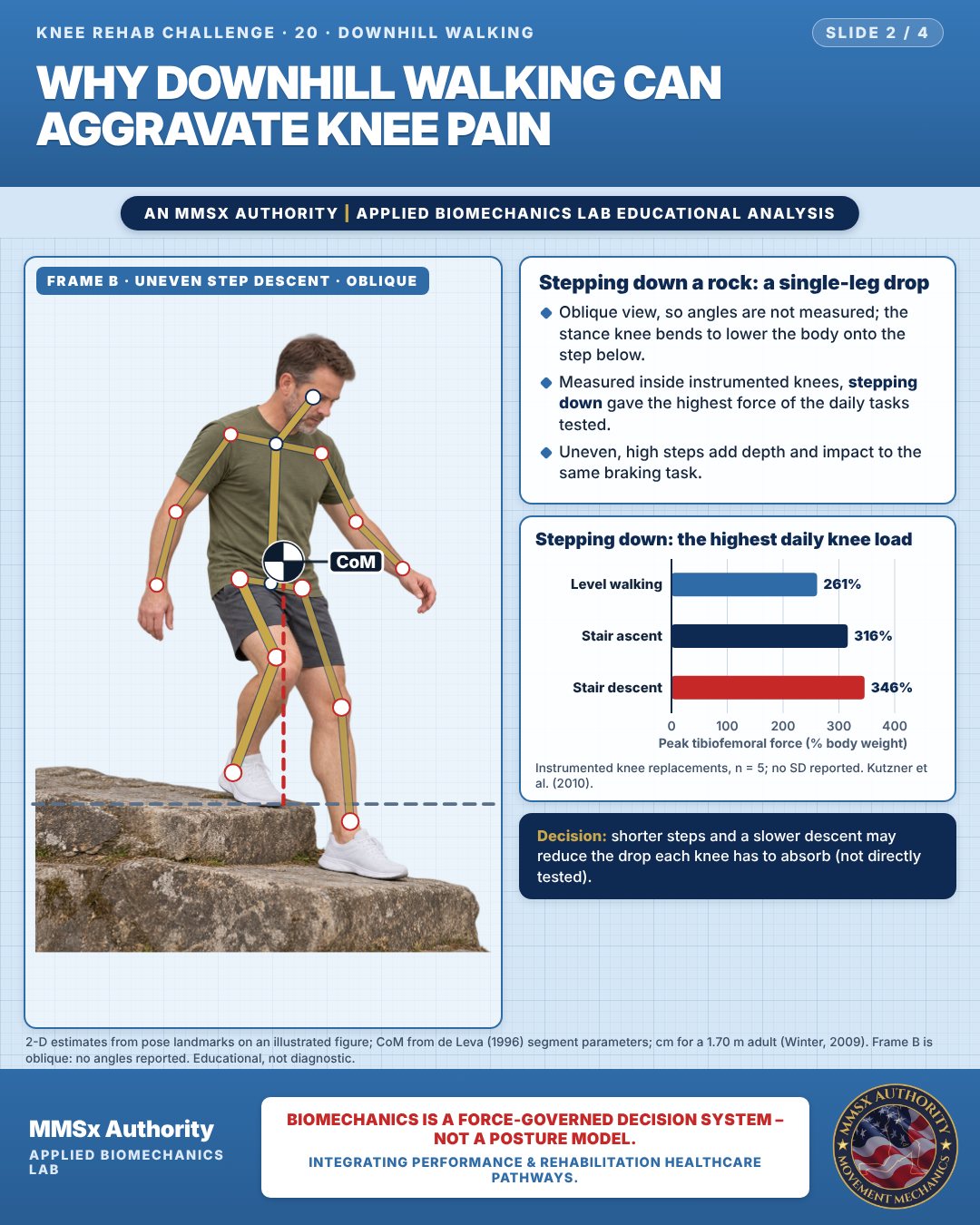
Stepping down a rock: a single-leg drop
Oblique view, so angles are not measured; the stance knee bends to lower the body onto the step below.
Measured inside instrumented knees, stepping down gave the highest force of the daily tasks tested.
Uneven, high steps add depth and impact to the same braking task.
Stepping down: the highest daily knee load
Movement C: Backpack downhill, oblique
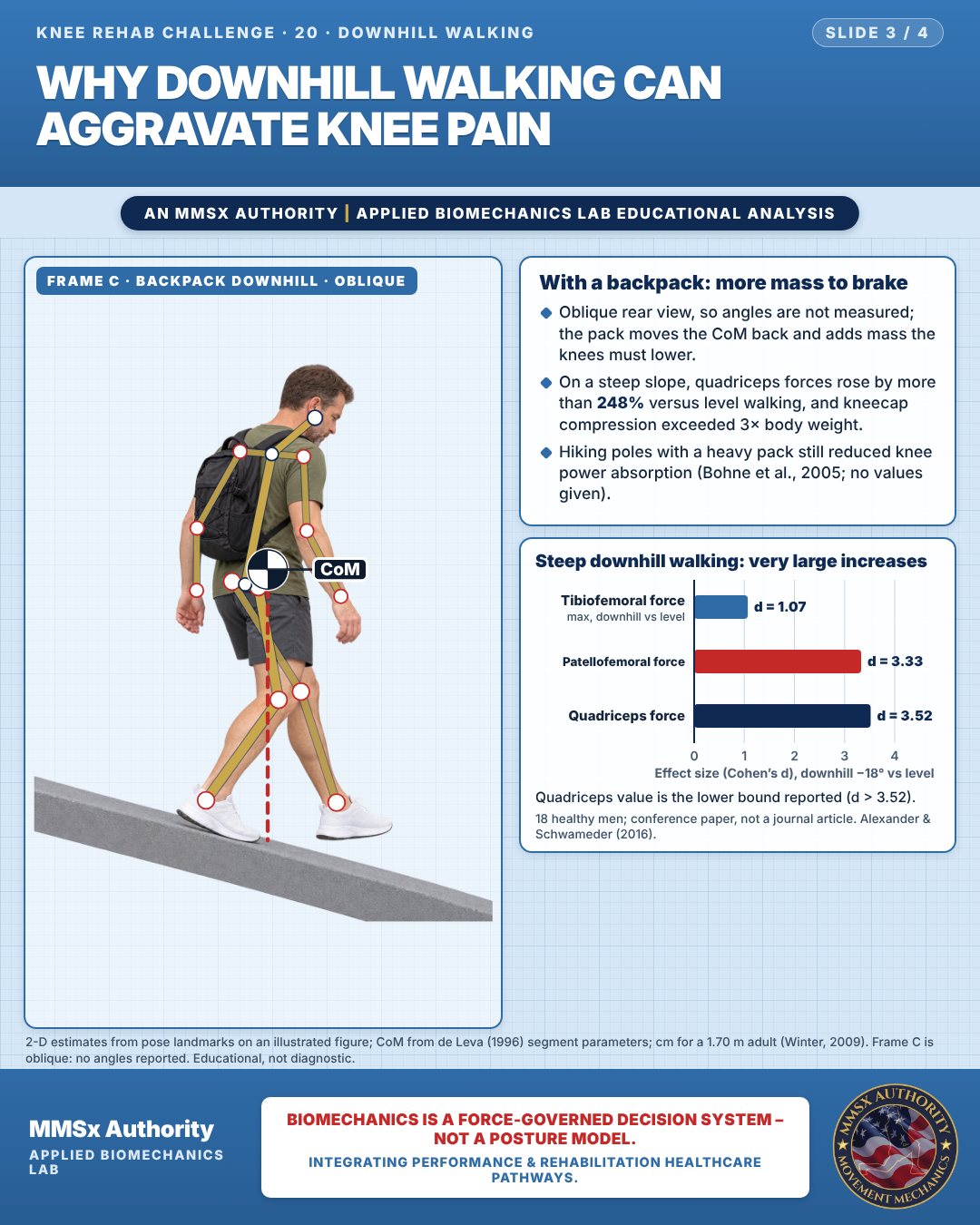
With a backpack: more mass to brake
Oblique rear view, so angles are not measured; the pack moves the CoM back and adds mass the knees must lower.
On a steep slope, quadriceps forces rose by more than 248% versus level walking, and kneecap compression exceeded 3× body weight.
Hiking poles with a heavy pack still reduced knee power absorption (Bohne et al., 2005; no values given).
Steep downhill walking: very large increases
Quadriceps value is the lower bound reported (d > 3.52).
Decision pathway
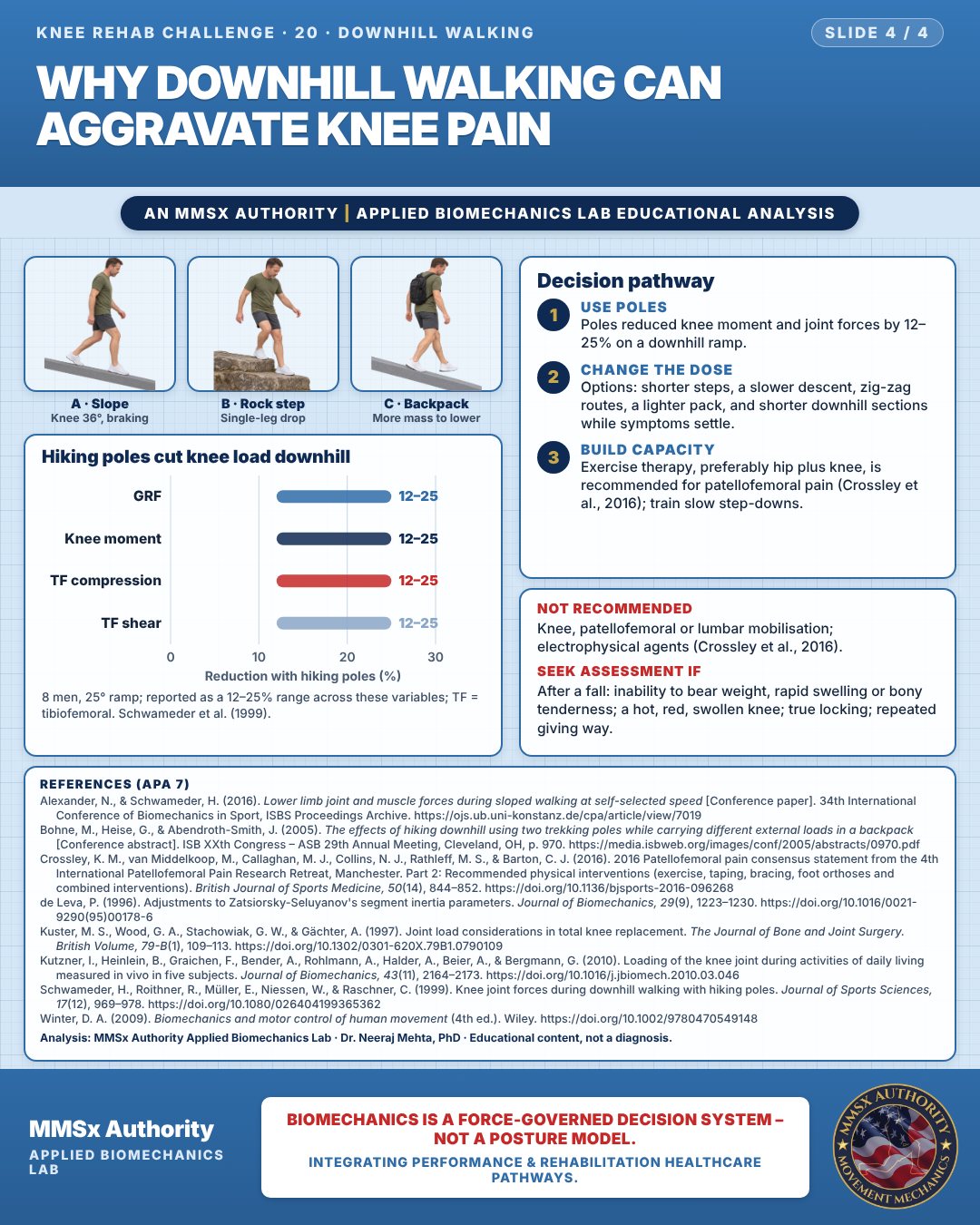
Hiking poles cut knee load downhill
Use poles
Poles reduced knee moment and joint forces by 12–25% on a downhill ramp.
Change the dose
Options: shorter steps, a slower descent, zig-zag routes, a lighter pack, and shorter downhill sections while symptoms settle.
Build capacity
Exercise therapy, preferably hip plus knee, is recommended for patellofemoral pain (Crossley et al., 2016); train slow step-downs.
Cautions
Not recommended
Knee, patellofemoral or lumbar mobilisation; electrophysical agents (Crossley et al., 2016).
Seek assessment if
After a fall: inability to bear weight, rapid swelling or bony tenderness; a hot, red, swollen knee; true locking; repeated giving way.
Methods note
2-D estimates from pose landmarks on an illustrated figure; CoM from de Leva (1996) segment parameters; cm for a 1.70 m adult (Winter, 2009). GRF line from contact to CoM; ground drawn along the slope. Frame B is oblique: no angles reported. Frame C is oblique: no angles reported. These are educational estimates, not a diagnosis.
References
- Alexander, N., & Schwameder, H. (2016). Lower limb joint and muscle forces during sloped walking at self-selected speed [Conference paper]. 34th International Conference of Biomechanics in Sport, ISBS Proceedings Archive. https://ojs.ub.uni-konstanz.de/cpa/article/view/7019
- Bohne, M., Heise, G., & Abendroth-Smith, J. (2005). The effects of hiking downhill using two trekking poles while carrying different external loads in a backpack [Conference abstract]. ISB XXth Congress – ASB 29th Annual Meeting, Cleveland, OH, p. 970. https://media.isbweb.org/images/conf/2005/abstracts/0970.pdf
- Crossley, K. M., van Middelkoop, M., Callaghan, M. J., Collins, N. J., Rathleff, M. S., & Barton, C. J. (2016). 2016 Patellofemoral pain consensus statement from the 4th International Patellofemoral Pain Research Retreat, Manchester. Part 2: Recommended physical interventions (exercise, taping, bracing, foot orthoses and combined interventions). British Journal of Sports Medicine, 50(14), 844–852. https://doi.org/10.1136/bjsports-2016-096268
- de Leva, P. (1996). Adjustments to Zatsiorsky-Seluyanov's segment inertia parameters. Journal of Biomechanics, 29(9), 1223–1230. https://doi.org/10.1016/0021-9290(95)00178-6
- Kuster, M. S., Wood, G. A., Stachowiak, G. W., & Gächter, A. (1997). Joint load considerations in total knee replacement. The Journal of Bone and Joint Surgery. British Volume, 79-B(1), 109–113. https://doi.org/10.1302/0301-620X.79B1.0790109
- Kutzner, I., Heinlein, B., Graichen, F., Bender, A., Rohlmann, A., Halder, A., Beier, A., & Bergmann, G. (2010). Loading of the knee joint during activities of daily living measured in vivo in five subjects. Journal of Biomechanics, 43(11), 2164–2173. https://doi.org/10.1016/j.jbiomech.2010.03.046
- Schwameder, H., Roithner, R., Müller, E., Niessen, W., & Raschner, C. (1999). Knee joint forces during downhill walking with hiking poles. Journal of Sports Sciences, 17(12), 969–978. https://doi.org/10.1080/026404199365362
- Winter, D. A. (2009). Biomechanics and motor control of human movement (4th ed.). Wiley. https://doi.org/10.1002/9780470549148
Cite this article
Mehta, N. (2026, October 23). Why downhill walking can aggravate knee pain. MMSx Authority Applied Biomechanics Lab. https://mmsxauthority.org/edu/analysis/knee/20-why-downhill-walking-can-aggravate-knee-pain/
Part of the collection
Mehta, N. (2026). Knee Rehabilitation: 50 Evidence-Based Biomechanics Analyses [Collection]. MMSx Authority Applied Biomechanics Lab. Zenodo. https://doi.org/10.5281/zenodo.23735752