Knee Rehab Challenge · 19
Knee pain after running: is your current training load too much?
Running-related knee pain is pain around or behind the kneecap or at the lateral knee that appears during or after running and limits training.
Key points
- Adjust the dose. Reduce distance, pace or hills while symptoms settle; avoid large jumps in weekly distance, especially as a novice.
- Strengthen. Exercise therapy, preferably hip plus knee, is recommended for patellofemoral pain (Crossley et al., 2016).
- Retrain. Consider a small step-rate increase; rebuild volume before adding hills or speed.
What it is
Running-related knee pain is pain around or behind the kneecap or at the lateral knee that appears during or after running and limits training; patellofemoral pain (PFP) is the most common presentation and is aggravated by loaded knee-flexion tasks such as running, squatting, stairs and prolonged sitting.
How we analysed the movement
Three movements relevant to this topic were analysed from illustrated reference figures. Joint centres were located with two-dimensional pose estimation; joint angles, the whole-body centre of mass and, where relevant, the ground-reaction-force line and its moment arm about the knee were then calculated from standard segment parameters. The figures are educational estimates that show how position changes mechanical demand; they are not measurements of a patient. Every research value quoted below comes from the published source cited beside it.
Movement A: Easy running (side view)
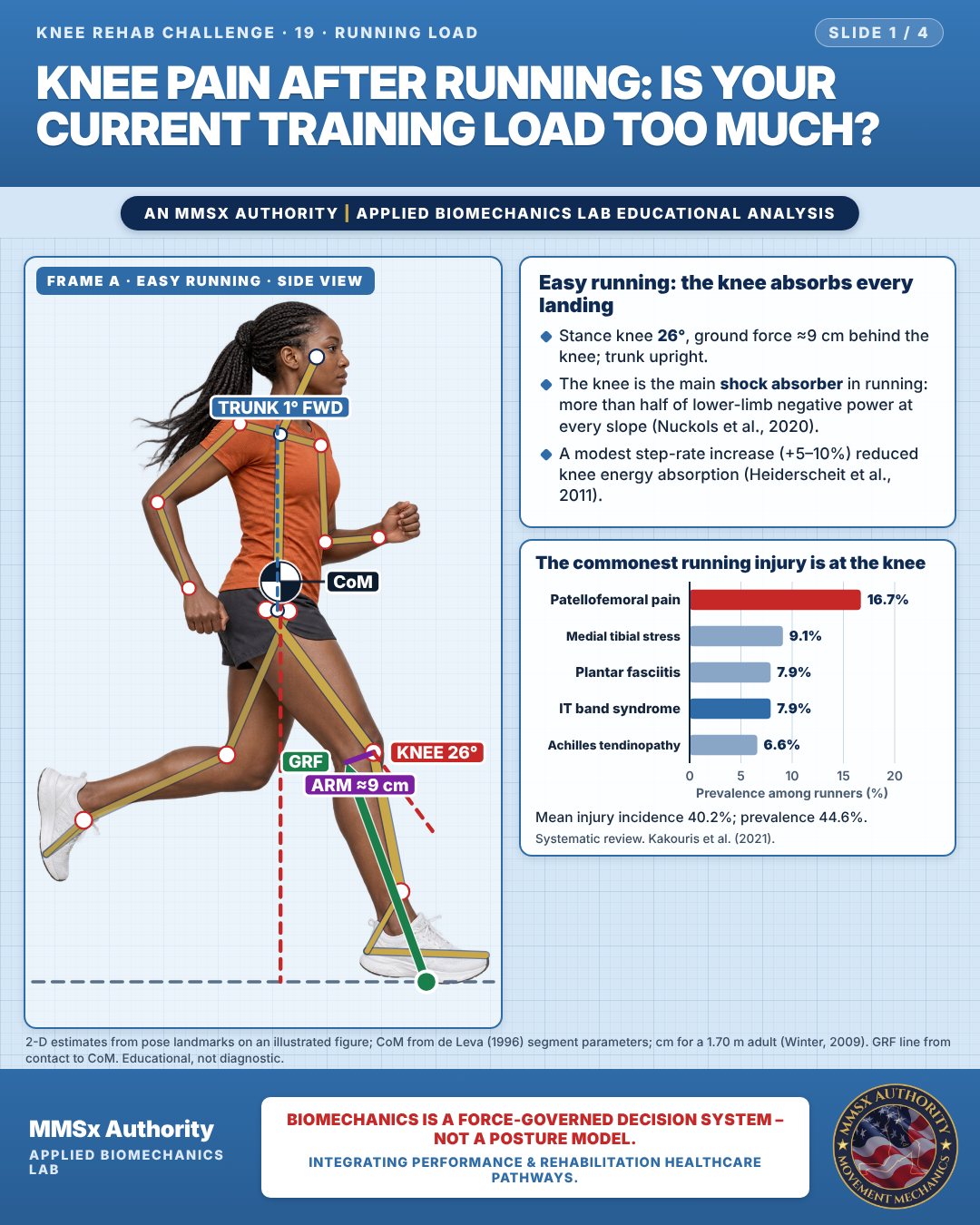
Easy running: the knee absorbs every landing
Stance knee 26°, ground force ≈9 cm behind the knee; trunk upright.
The knee is the main shock absorber in running: more than half of lower-limb negative power at every slope (Nuckols et al., 2020).
A modest step-rate increase (+5–10%) reduced knee energy absorption (Heiderscheit et al., 2011).
The commonest running injury is at the knee
Mean injury incidence 40.2%; prevalence 44.6%.
Movement B: Uphill running (side view)
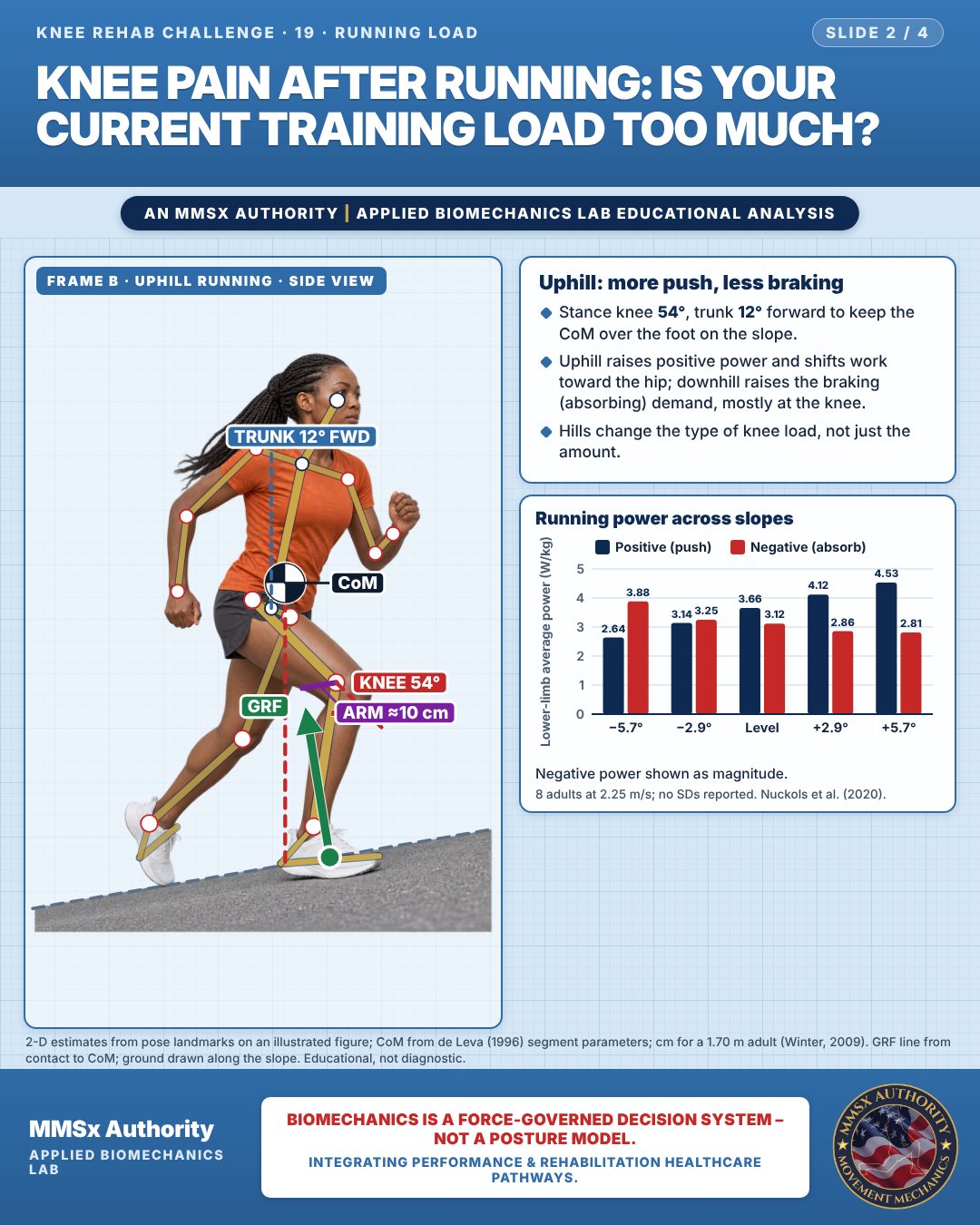
Uphill: more push, less braking
Stance knee 54°, trunk 12° forward to keep the CoM over the foot on the slope.
Uphill raises positive power and shifts work toward the hip; downhill raises the braking (absorbing) demand, mostly at the knee.
Hills change the type of knee load, not just the amount.
Running power across slopes
Negative power shown as magnitude.
Movement C: After the session (front view)
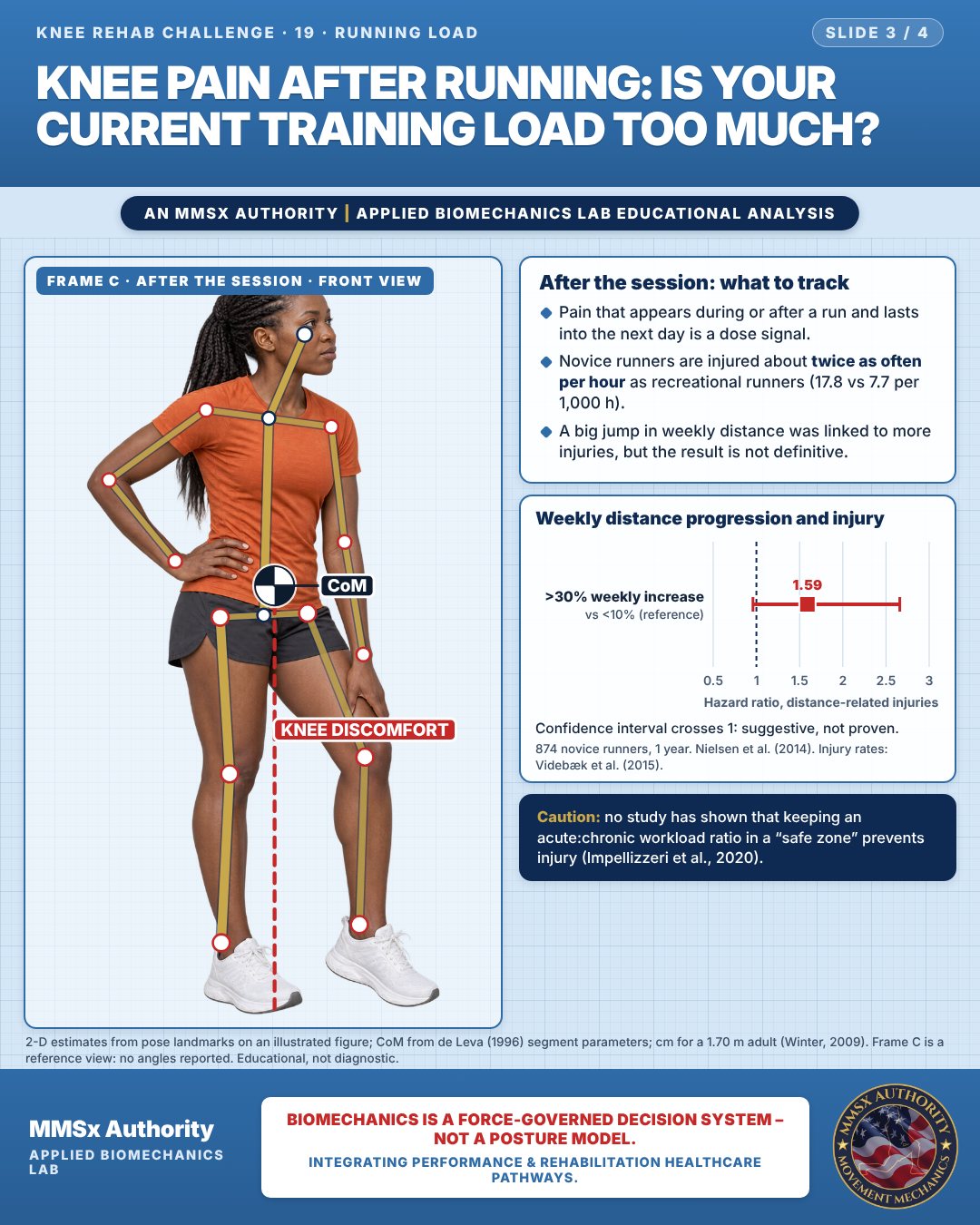
After the session: what to track
Pain that appears during or after a run and lasts into the next day is a dose signal.
Novice runners are injured about twice as often per hour as recreational runners (17.8 vs 7.7 per 1,000 h).
A big jump in weekly distance was linked to more injuries, but the result is not definitive.
Weekly distance progression and injury
Confidence interval crosses 1: suggestive, not proven.
Decision pathway
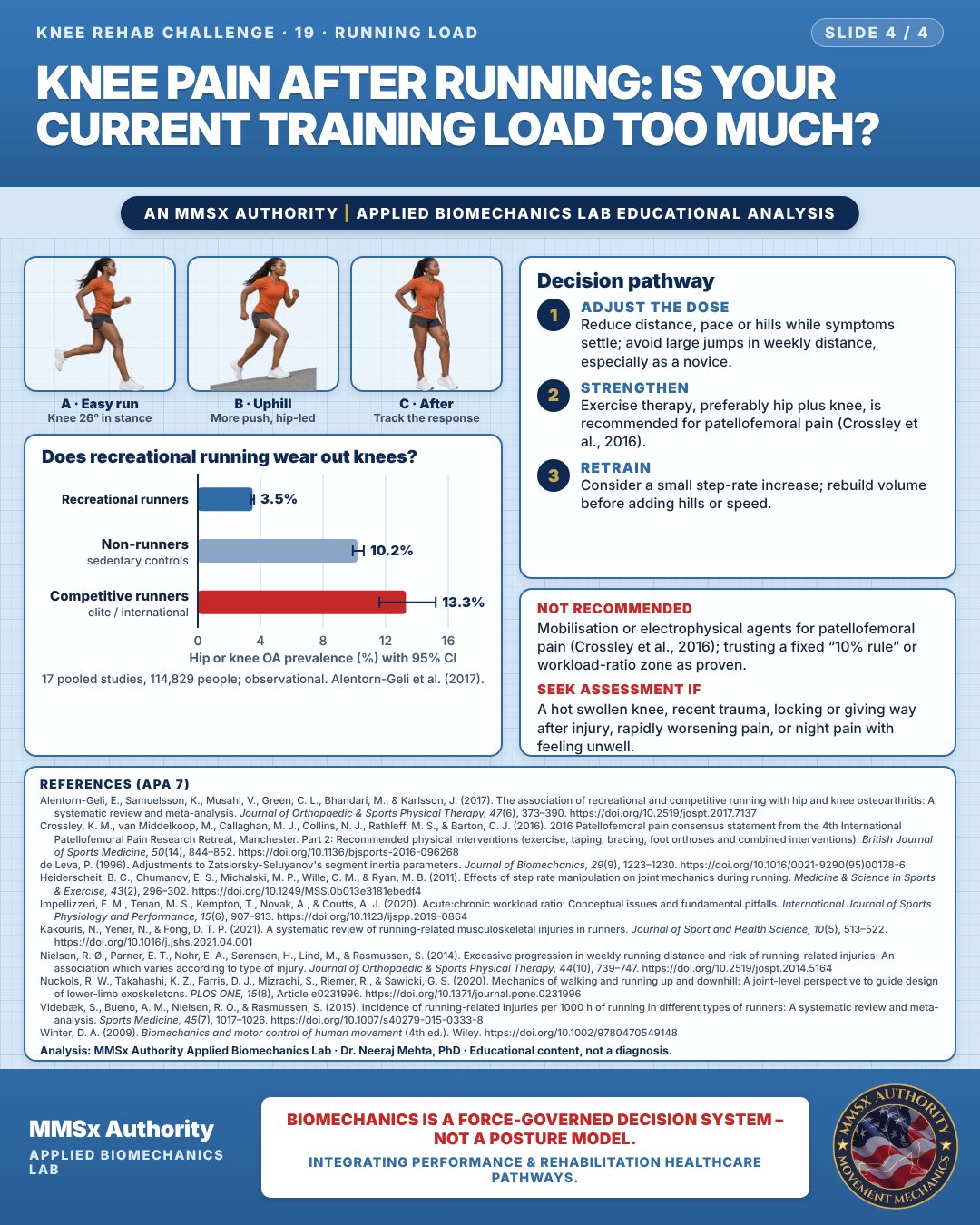
Does recreational running wear out knees?
Adjust the dose
Reduce distance, pace or hills while symptoms settle; avoid large jumps in weekly distance, especially as a novice.
Strengthen
Exercise therapy, preferably hip plus knee, is recommended for patellofemoral pain (Crossley et al., 2016).
Retrain
Consider a small step-rate increase; rebuild volume before adding hills or speed.
What the evidence supports
- PFP (most common running knee pain): exercise therapy recommended for pain (short, medium, long term) and function (medium, long term); hip + knee exercise preferred over knee-only; combined interventions recommended short/medium term in adults; foot orthoses for short-term pain. NOT recommended: patellofemoral, knee or lumbar mobilisation; electrophysical agents. Taping/bracing: no recommendation in isolation (Crossley et al., 2016, consensus full text).
- Load: evidence supports reviewing sudden jumps in weekly distance, especially in novices, but it is an association with a wide CI (Nielsen et al., 2014); avoid presenting the "10% rule" or an ACWR band as proven thresholds (Impellizzeri et al., 2020).
- Cadence: small step-rate increases (+5–10%) reduce knee energy absorption in healthy runners (Heiderscheit et al., 2011) — a mechanical rationale, not proof of injury prevention.
Cautions
Not recommended
Mobilisation or electrophysical agents for patellofemoral pain (Crossley et al., 2016); trusting a fixed “10% rule” or workload-ratio zone as proven.
Seek assessment if
A hot swollen knee, recent trauma, locking or giving way after injury, rapidly worsening pain, or night pain with feeling unwell.
Methods note
2-D estimates from pose landmarks on an illustrated figure; CoM from de Leva (1996) segment parameters; cm for a 1.70 m adult (Winter, 2009). GRF line from contact to CoM. GRF line from contact to CoM; ground drawn along the slope. Frame C is a reference view: no angles reported. These are educational estimates, not a diagnosis.
References
- Alentorn-Geli, E., Samuelsson, K., Musahl, V., Green, C. L., Bhandari, M., & Karlsson, J. (2017). The association of recreational and competitive running with hip and knee osteoarthritis: A systematic review and meta-analysis. Journal of Orthopaedic & Sports Physical Therapy, 47(6), 373–390. https://doi.org/10.2519/jospt.2017.7137
- Crossley, K. M., van Middelkoop, M., Callaghan, M. J., Collins, N. J., Rathleff, M. S., & Barton, C. J. (2016). 2016 Patellofemoral pain consensus statement from the 4th International Patellofemoral Pain Research Retreat, Manchester. Part 2: Recommended physical interventions (exercise, taping, bracing, foot orthoses and combined interventions). British Journal of Sports Medicine, 50(14), 844–852. https://doi.org/10.1136/bjsports-2016-096268
- de Leva, P. (1996). Adjustments to Zatsiorsky-Seluyanov's segment inertia parameters. Journal of Biomechanics, 29(9), 1223–1230. https://doi.org/10.1016/0021-9290(95)00178-6
- Heiderscheit, B. C., Chumanov, E. S., Michalski, M. P., Wille, C. M., & Ryan, M. B. (2011). Effects of step rate manipulation on joint mechanics during running. Medicine & Science in Sports & Exercise, 43(2), 296–302. https://doi.org/10.1249/MSS.0b013e3181ebedf4
- Impellizzeri, F. M., Tenan, M. S., Kempton, T., Novak, A., & Coutts, A. J. (2020). Acute:chronic workload ratio: Conceptual issues and fundamental pitfalls. International Journal of Sports Physiology and Performance, 15(6), 907–913. https://doi.org/10.1123/ijspp.2019-0864
- Kakouris, N., Yener, N., & Fong, D. T. P. (2021). A systematic review of running-related musculoskeletal injuries in runners. Journal of Sport and Health Science, 10(5), 513–522. https://doi.org/10.1016/j.jshs.2021.04.001
- Nielsen, R. Ø., Parner, E. T., Nohr, E. A., Sørensen, H., Lind, M., & Rasmussen, S. (2014). Excessive progression in weekly running distance and risk of running-related injuries: An association which varies according to type of injury. Journal of Orthopaedic & Sports Physical Therapy, 44(10), 739–747. https://doi.org/10.2519/jospt.2014.5164
- Nuckols, R. W., Takahashi, K. Z., Farris, D. J., Mizrachi, S., Riemer, R., & Sawicki, G. S. (2020). Mechanics of walking and running up and downhill: A joint-level perspective to guide design of lower-limb exoskeletons. PLOS ONE, 15(8), Article e0231996. https://doi.org/10.1371/journal.pone.0231996
- Videbæk, S., Bueno, A. M., Nielsen, R. O., & Rasmussen, S. (2015). Incidence of running-related injuries per 1000 h of running in different types of runners: A systematic review and meta-analysis. Sports Medicine, 45(7), 1017–1026. https://doi.org/10.1007/s40279-015-0333-8
- Winter, D. A. (2009). Biomechanics and motor control of human movement (4th ed.). Wiley. https://doi.org/10.1002/9780470549148
Cite this article
Mehta, N. (2026, October 23). Knee pain after running: is your current training load too much? MMSx Authority Applied Biomechanics Lab. https://mmsxauthority.org/edu/analysis/knee/19-knee-pain-after-running-is-your-current-training-load-too-much/
Part of the collection
Mehta, N. (2026). Knee Rehabilitation: 50 Evidence-Based Biomechanics Analyses [Collection]. MMSx Authority Applied Biomechanics Lab. Zenodo. https://doi.org/10.5281/zenodo.23735752