Knee Rehab Challenge · 17
Knee pain after sitting: why the first few steps hurt
Pain or stiffness felt on the first steps after a period of sitting ("start-up" pain/stiffness, inactivity stiffness) that eases within minutes of moving.
Key points
- Move often. Break up long sitting with short walks; straighten and bend the knees while seated.
- Build. Exercise is core treatment: strengthening plus aerobic activity (NICE, 2022); hip and knee exercise for patellofemoral pain (Crossley et al., 2016).
- Accumulate. Work toward about 6,000 steps a day, spread across the day.
What it is
Pain or stiffness felt on the first steps after a period of sitting ("start-up" pain/stiffness, inactivity stiffness) that eases within minutes of moving. Prolonged sitting is a recognised aggravating position in patellofemoral pain, and in knee osteoarthritis stiffness is typically short-lived — the NICE clinical diagnosis requires either no morning stiffness or morning stiffness lasting no more than 30 minutes. Prolonged morning stiffness is an atypical feature that should prompt consideration of another diagnosis (NG226 1.1.2).
How we analysed the movement
Three movements relevant to this topic were analysed from illustrated reference figures. Joint centres were located with two-dimensional pose estimation; joint angles, the whole-body centre of mass and, where relevant, the ground-reaction-force line and its moment arm about the knee were then calculated from standard segment parameters. The figures are educational estimates that show how position changes mechanical demand; they are not measurements of a patient. Every research value quoted below comes from the published source cited beside it.
Movement A: Seated at a desk (side view)
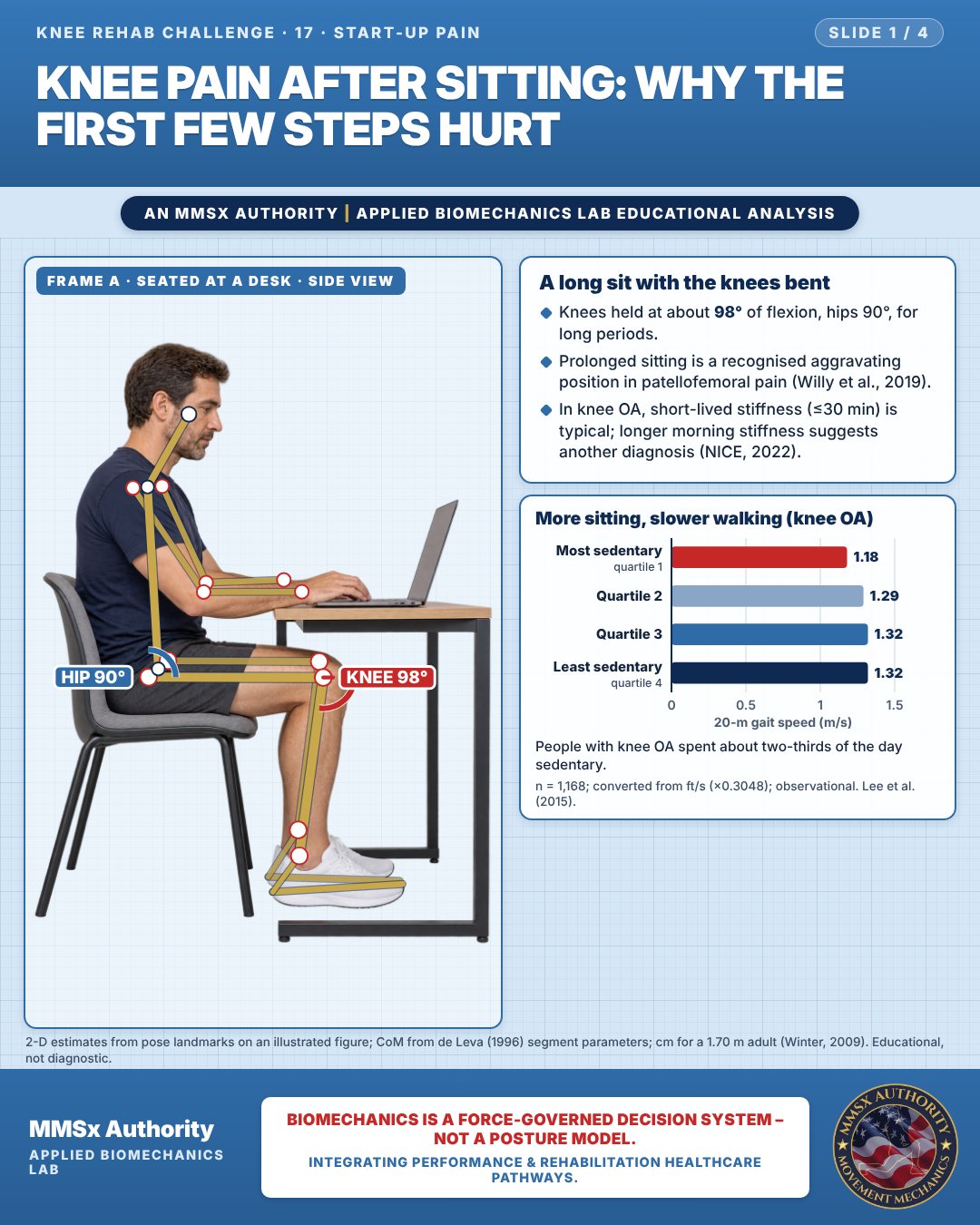
A long sit with the knees bent
Knees held at about 98° of flexion, hips 90°, for long periods.
Prolonged sitting is a recognised aggravating position in patellofemoral pain (Willy et al., 2019).
In knee OA, short-lived stiffness (≤30 min) is typical; longer morning stiffness suggests another diagnosis (NICE, 2022).
More sitting, slower walking (knee OA)
People with knee OA spent about two-thirds of the day sedentary.
Movement B: Starting to stand (side view)
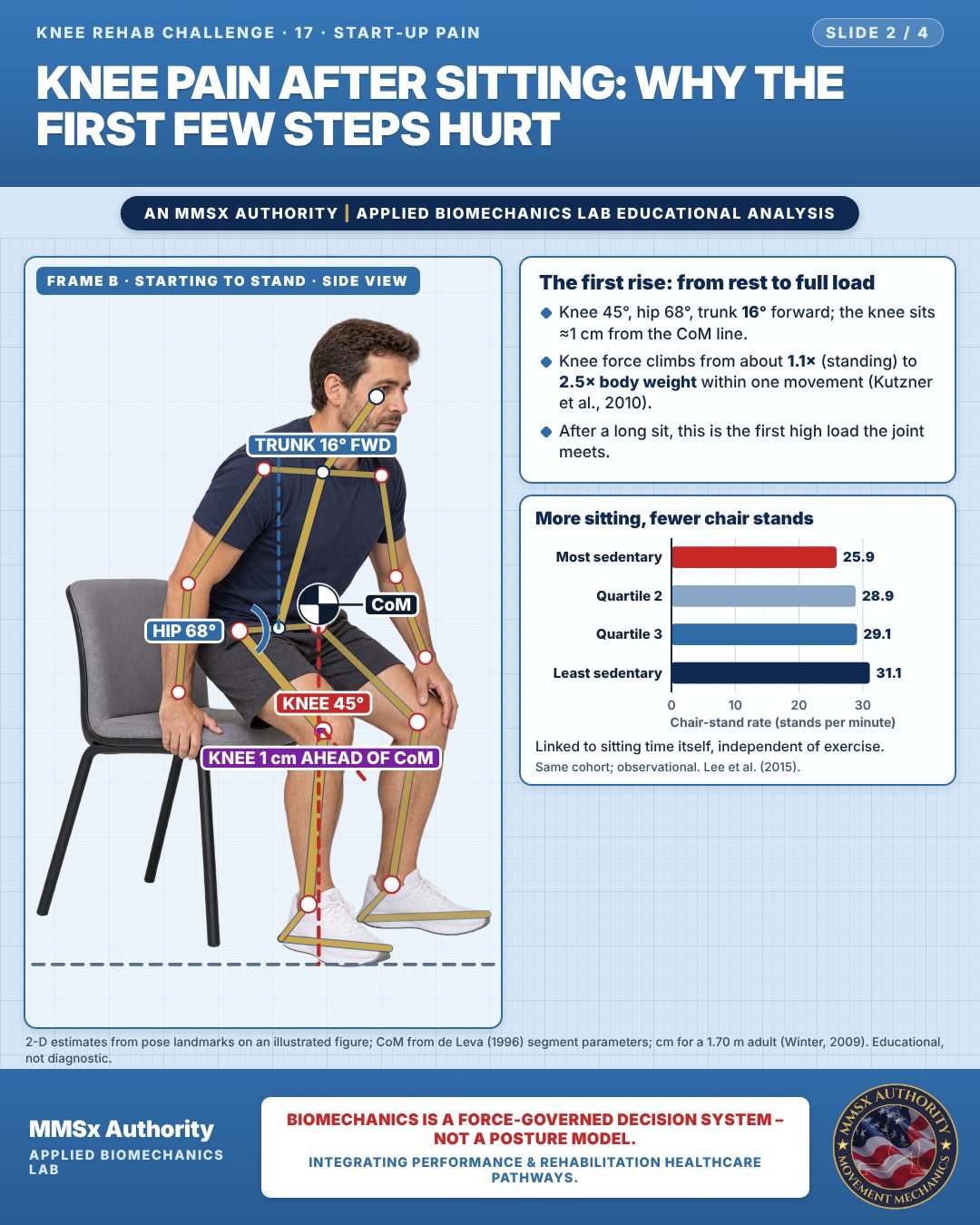
The first rise: from rest to full load
Knee 45°, hip 68°, trunk 16° forward; the knee sits ≈1 cm from the CoM line.
Knee force climbs from about 1.1× (standing) to 2.5× body weight within one movement (Kutzner et al., 2010).
After a long sit, this is the first high load the joint meets.
More sitting, fewer chair stands
Linked to sitting time itself, independent of exercise.
Movement C: First step (side view)
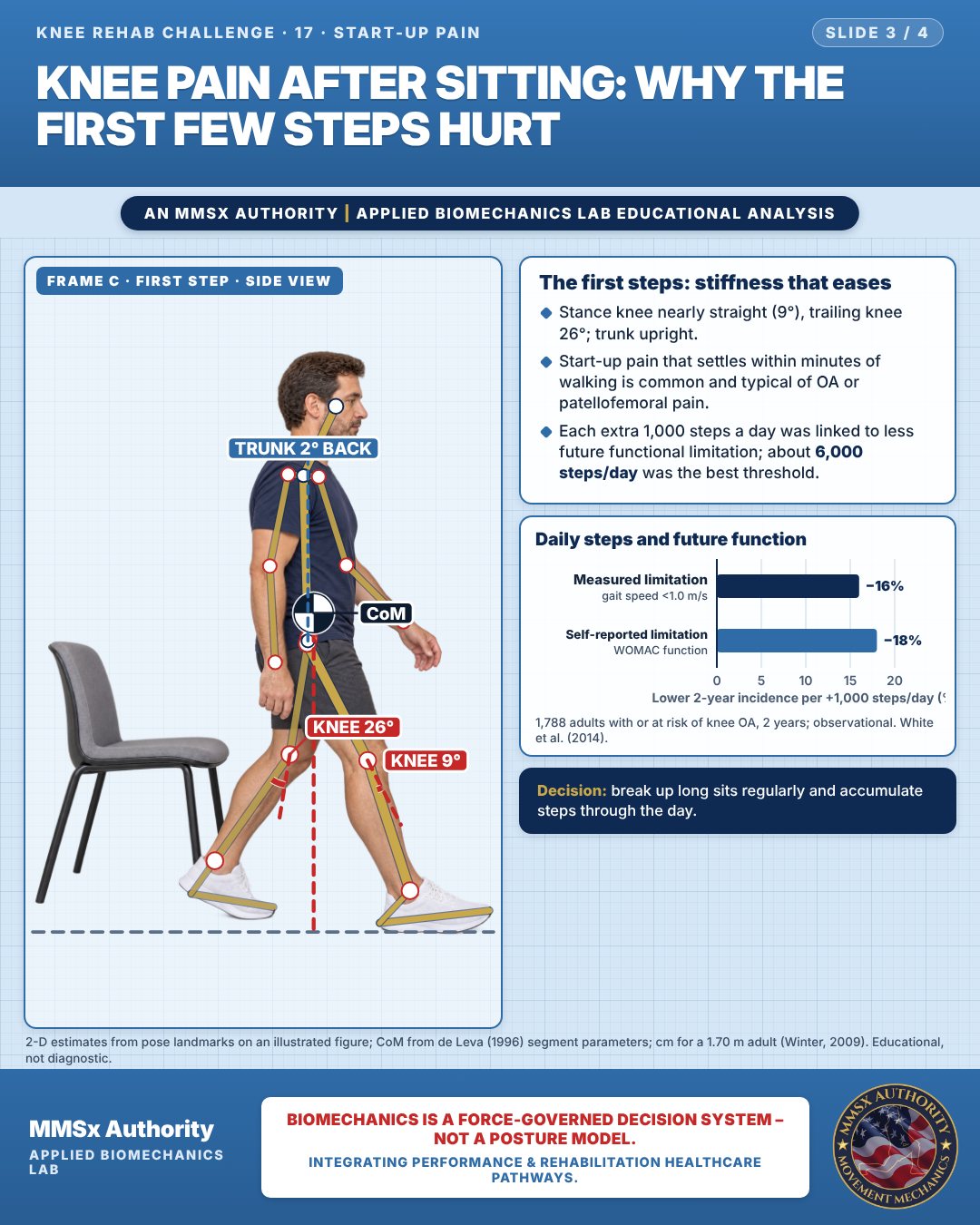
The first steps: stiffness that eases
Stance knee nearly straight (9°), trailing knee 26°; trunk upright.
Start-up pain that settles within minutes of walking is common and typical of OA or patellofemoral pain.
Each extra 1,000 steps a day was linked to less future functional limitation; about 6,000 steps/day was the best threshold.
Daily steps and future function
Decision pathway
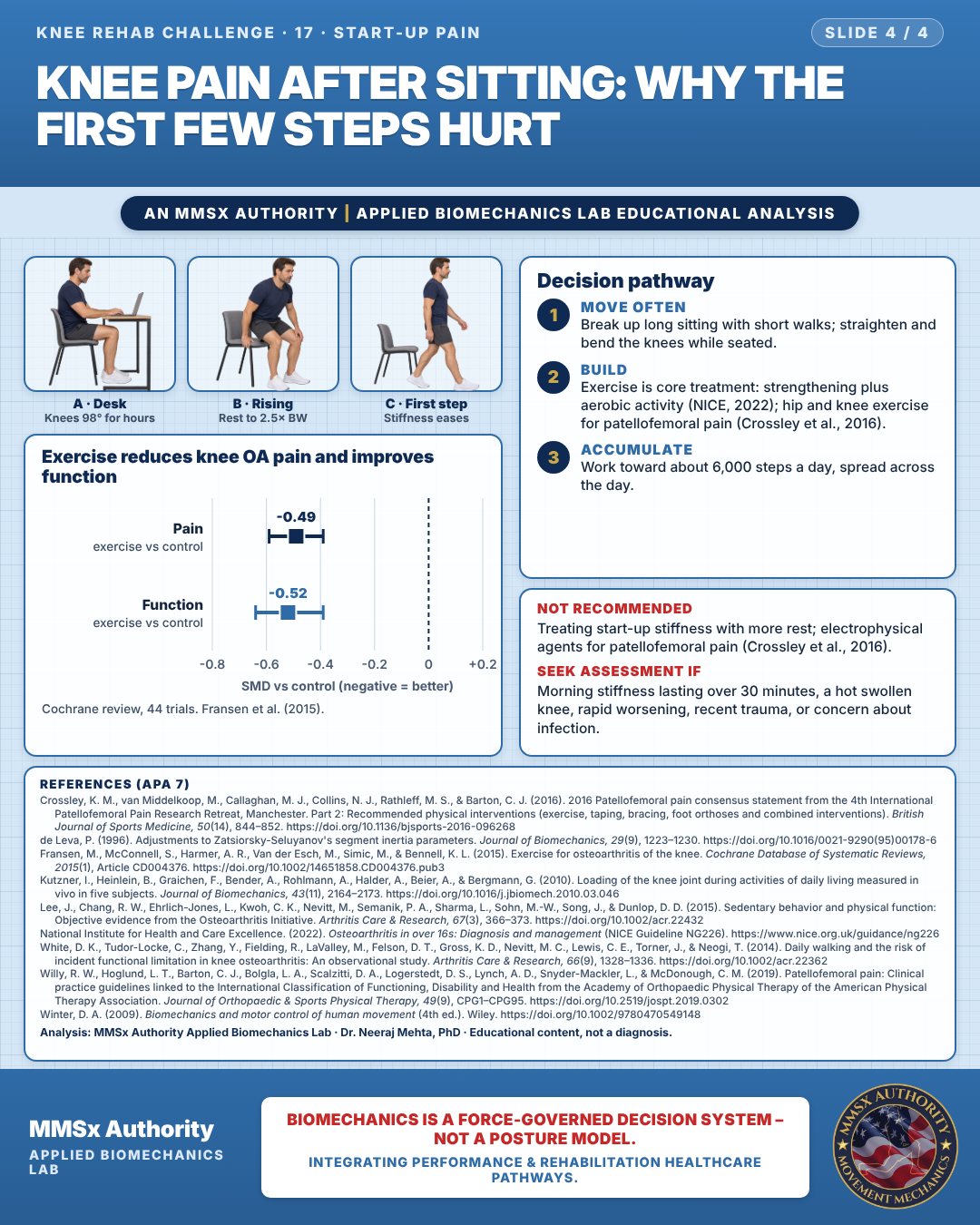
Exercise reduces knee OA pain and improves function
Move often
Break up long sitting with short walks; straighten and bend the knees while seated.
Build
Exercise is core treatment: strengthening plus aerobic activity (NICE, 2022); hip and knee exercise for patellofemoral pain (Crossley et al., 2016).
Accumulate
Work toward about 6,000 steps a day, spread across the day.
What the evidence supports
- Information and reassurance plus therapeutic exercise and weight management are core for knee OA (NICE NG226 1.2.2); exercise reduces pain (SMD −0.49) and improves function (SMD −0.52) (Fransen et al., 2015).
- Patellofemoral pain: exercise (hip + knee) recommended; mobilisation and electrophysical agents not recommended (Crossley et al., 2016).
- Practical: break up long sitting and accumulate daily steps (association data — Lee et al., 2015; White et al., 2014); present as sensible, low-risk advice supported by observational evidence, not as proven treatment.
Cautions
Not recommended
Treating start-up stiffness with more rest; electrophysical agents for patellofemoral pain (Crossley et al., 2016).
Seek assessment if
Morning stiffness lasting over 30 minutes, a hot swollen knee, rapid worsening, recent trauma, or concern about infection.
Methods note
2-D estimates from pose landmarks on an illustrated figure; CoM from de Leva (1996) segment parameters; cm for a 1.70 m adult (Winter, 2009). These are educational estimates, not a diagnosis.
References
- Crossley, K. M., van Middelkoop, M., Callaghan, M. J., Collins, N. J., Rathleff, M. S., & Barton, C. J. (2016). 2016 Patellofemoral pain consensus statement from the 4th International Patellofemoral Pain Research Retreat, Manchester. Part 2: Recommended physical interventions (exercise, taping, bracing, foot orthoses and combined interventions). British Journal of Sports Medicine, 50(14), 844–852. https://doi.org/10.1136/bjsports-2016-096268
- de Leva, P. (1996). Adjustments to Zatsiorsky-Seluyanov's segment inertia parameters. Journal of Biomechanics, 29(9), 1223–1230. https://doi.org/10.1016/0021-9290(95)00178-6
- Fransen, M., McConnell, S., Harmer, A. R., Van der Esch, M., Simic, M., & Bennell, K. L. (2015). Exercise for osteoarthritis of the knee. Cochrane Database of Systematic Reviews, 2015(1), Article CD004376. https://doi.org/10.1002/14651858.CD004376.pub3
- Kutzner, I., Heinlein, B., Graichen, F., Bender, A., Rohlmann, A., Halder, A., Beier, A., & Bergmann, G. (2010). Loading of the knee joint during activities of daily living measured in vivo in five subjects. Journal of Biomechanics, 43(11), 2164–2173. https://doi.org/10.1016/j.jbiomech.2010.03.046
- Lee, J., Chang, R. W., Ehrlich-Jones, L., Kwoh, C. K., Nevitt, M., Semanik, P. A., Sharma, L., Sohn, M.-W., Song, J., & Dunlop, D. D. (2015). Sedentary behavior and physical function: Objective evidence from the Osteoarthritis Initiative. Arthritis Care & Research, 67(3), 366–373. https://doi.org/10.1002/acr.22432
- National Institute for Health and Care Excellence. (2022). Osteoarthritis in over 16s: Diagnosis and management (NICE Guideline NG226). https://www.nice.org.uk/guidance/ng226
- White, D. K., Tudor-Locke, C., Zhang, Y., Fielding, R., LaValley, M., Felson, D. T., Gross, K. D., Nevitt, M. C., Lewis, C. E., Torner, J., & Neogi, T. (2014). Daily walking and the risk of incident functional limitation in knee osteoarthritis: An observational study. Arthritis Care & Research, 66(9), 1328–1336. https://doi.org/10.1002/acr.22362
- Willy, R. W., Hoglund, L. T., Barton, C. J., Bolgla, L. A., Scalzitti, D. A., Logerstedt, D. S., Lynch, A. D., Snyder-Mackler, L., & McDonough, C. M. (2019). Patellofemoral pain: Clinical practice guidelines linked to the International Classification of Functioning, Disability and Health from the Academy of Orthopaedic Physical Therapy of the American Physical Therapy Association. Journal of Orthopaedic & Sports Physical Therapy, 49(9), CPG1–CPG95. https://doi.org/10.2519/jospt.2019.0302
- Winter, D. A. (2009). Biomechanics and motor control of human movement (4th ed.). Wiley. https://doi.org/10.1002/9780470549148
Cite this article
Mehta, N. (2026, October 23). Knee pain after sitting: why the first few steps hurt. MMSx Authority Applied Biomechanics Lab. https://mmsxauthority.org/edu/analysis/knee/17-knee-pain-after-sitting-why-the-first-few-steps-hurt/
Part of the collection
Mehta, N. (2026). Knee Rehabilitation: 50 Evidence-Based Biomechanics Analyses [Collection]. MMSx Authority Applied Biomechanics Lab. Zenodo. https://doi.org/10.5281/zenodo.23735752