Knee Rehab Challenge · 16
Knee pain when standing up from a chair
Knee pain on rising from sitting is pain provoked as the knees extend from deep flexion under body-weight load.
Key points
- Technique. Feet slightly back, lean the trunk forward ("nose over toes"), then stand; use the arms if needed.
- Set-up. Choose a firmer, higher seat while symptoms settle; very low sofas raise knee demand.
- Strengthen. Sit-to-stand practice from progressively lower seats plus quadriceps and hip strengthening, about 3 times a week.
What it is
Knee pain on rising from sitting is pain provoked as the knees extend from deep flexion under body-weight load; it is a typical aggravating task in patellofemoral pain (squatting/prolonged sitting; Willy et al., 2019) and an activity-related symptom of knee osteoarthritis.
How we analysed the movement
Three movements relevant to this topic were analysed from illustrated reference figures. Joint centres were located with two-dimensional pose estimation; joint angles, the whole-body centre of mass and, where relevant, the ground-reaction-force line and its moment arm about the knee were then calculated from standard segment parameters. The figures are educational estimates that show how position changes mechanical demand; they are not measurements of a patient. Every research value quoted below comes from the published source cited beside it.
Movement A: Rising from a chair (side view)
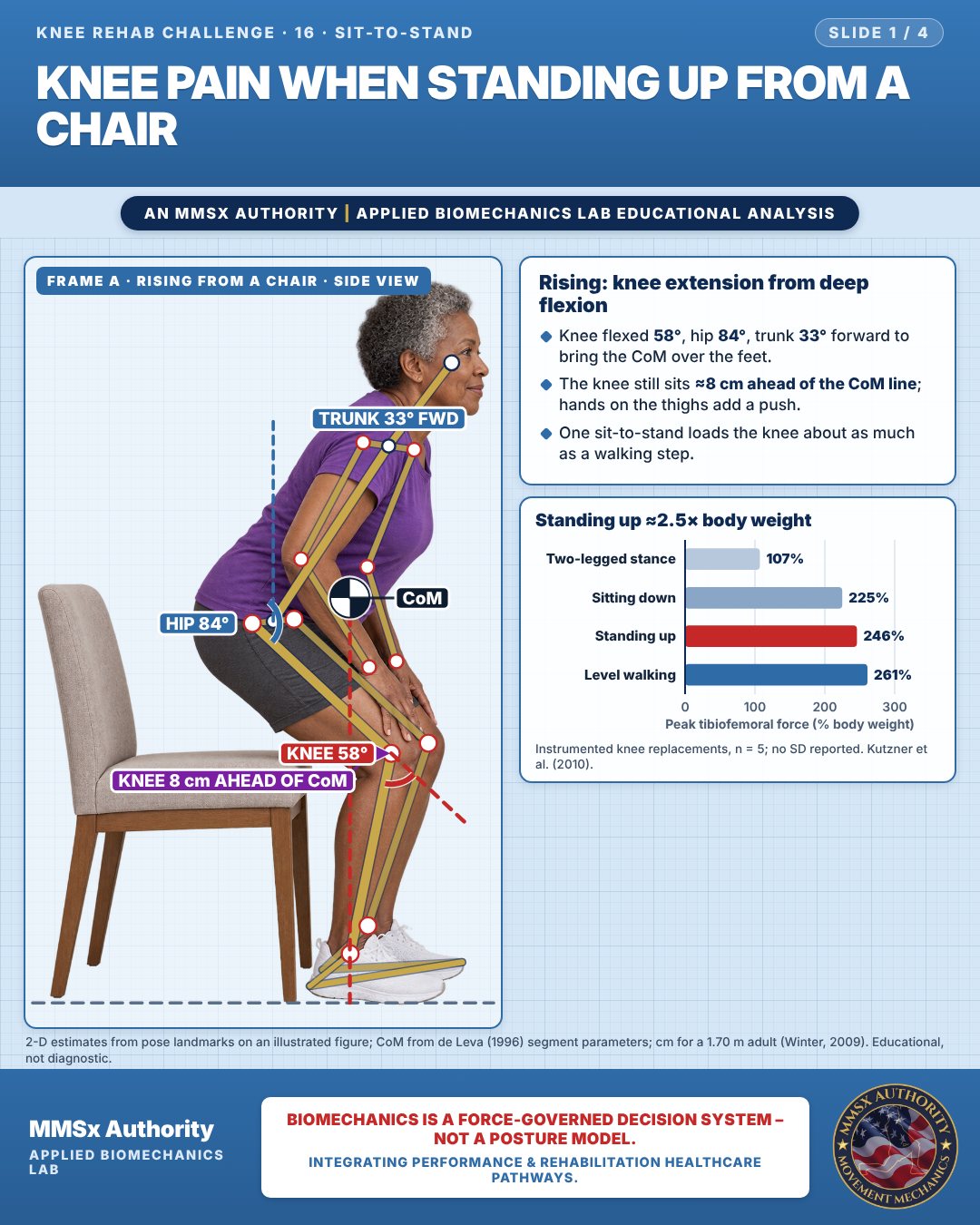
Rising: knee extension from deep flexion
Knee flexed 58°, hip 84°, trunk 33° forward to bring the CoM over the feet.
The knee still sits ≈8 cm ahead of the CoM line; hands on the thighs add a push.
One sit-to-stand loads the knee about as much as a walking step.
Standing up ≈2.5× body weight
Movement B: Mid-rise (front view)
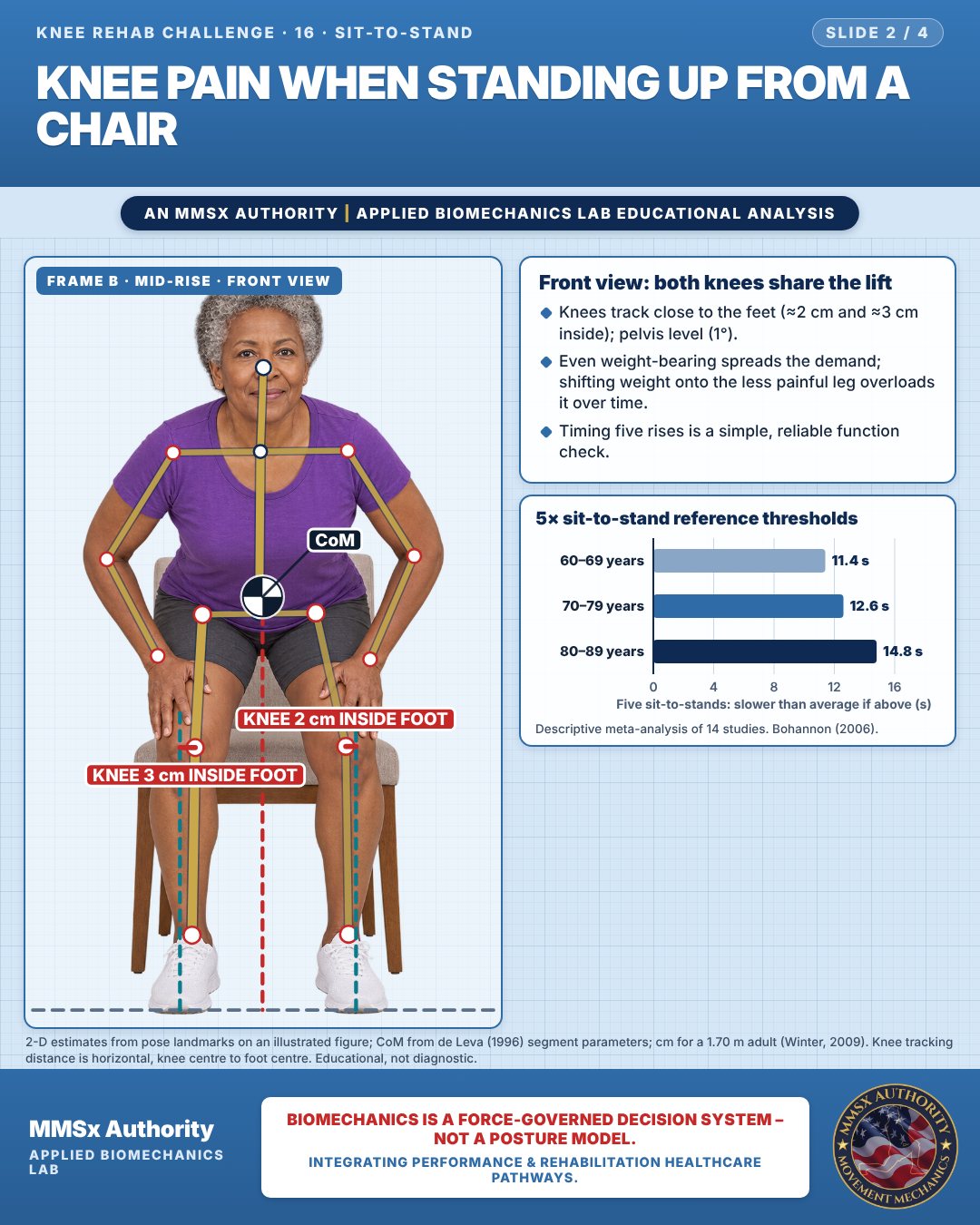
Front view: both knees share the lift
Knees track close to the feet (≈2 cm and ≈3 cm inside); pelvis level (1°).
Even weight-bearing spreads the demand; shifting weight onto the less painful leg overloads it over time.
Timing five rises is a simple, reliable function check.
5× sit-to-stand reference thresholds
Movement C: Rising from a sofa, oblique
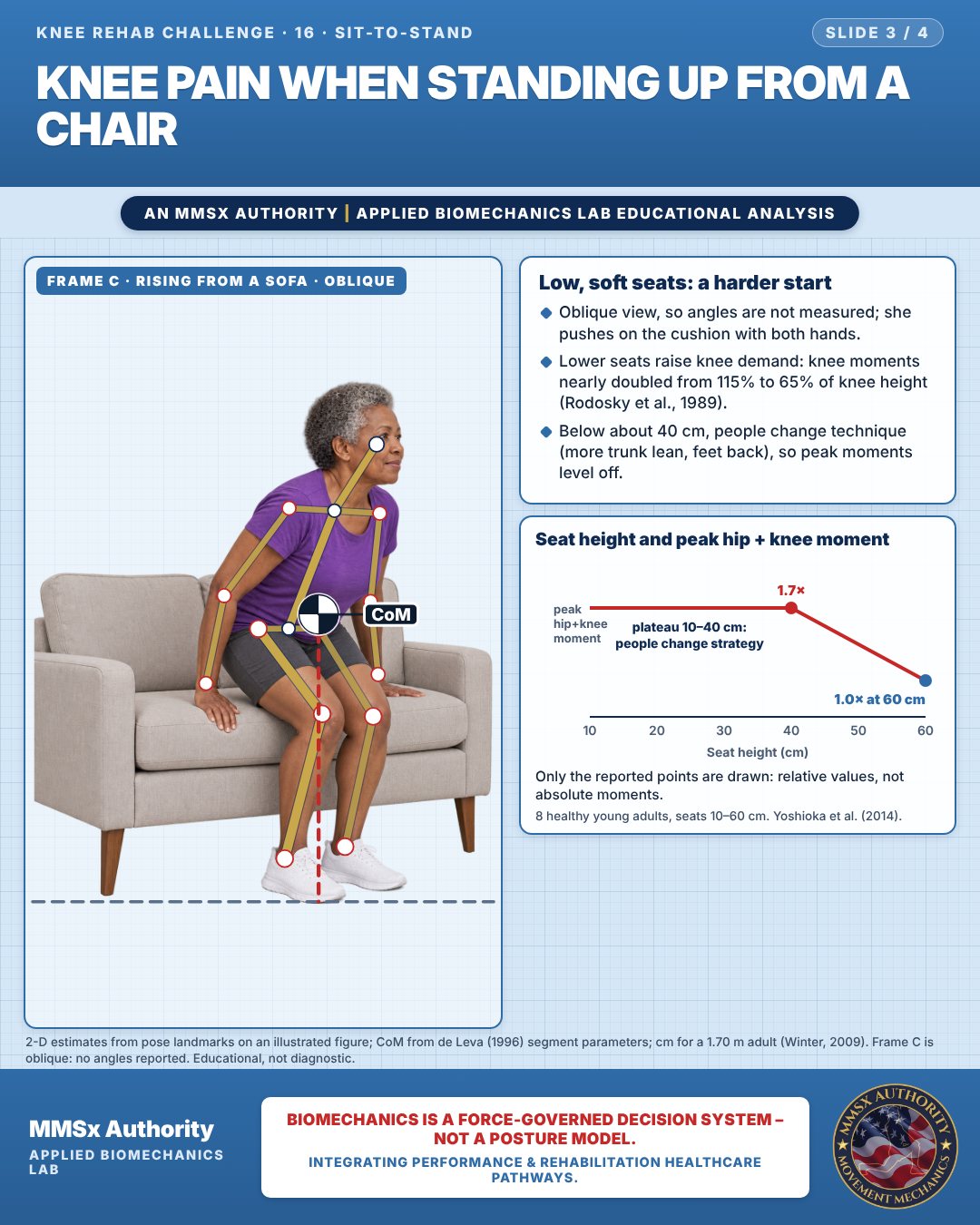
Low, soft seats: a harder start
Oblique view, so angles are not measured; she pushes on the cushion with both hands.
Lower seats raise knee demand: knee moments nearly doubled from 115% to 65% of knee height (Rodosky et al., 1989).
Below about 40 cm, people change technique (more trunk lean, feet back), so peak moments level off.
Seat height and peak hip + knee moment
Only the reported points are drawn: relative values, not absolute moments.
Decision pathway
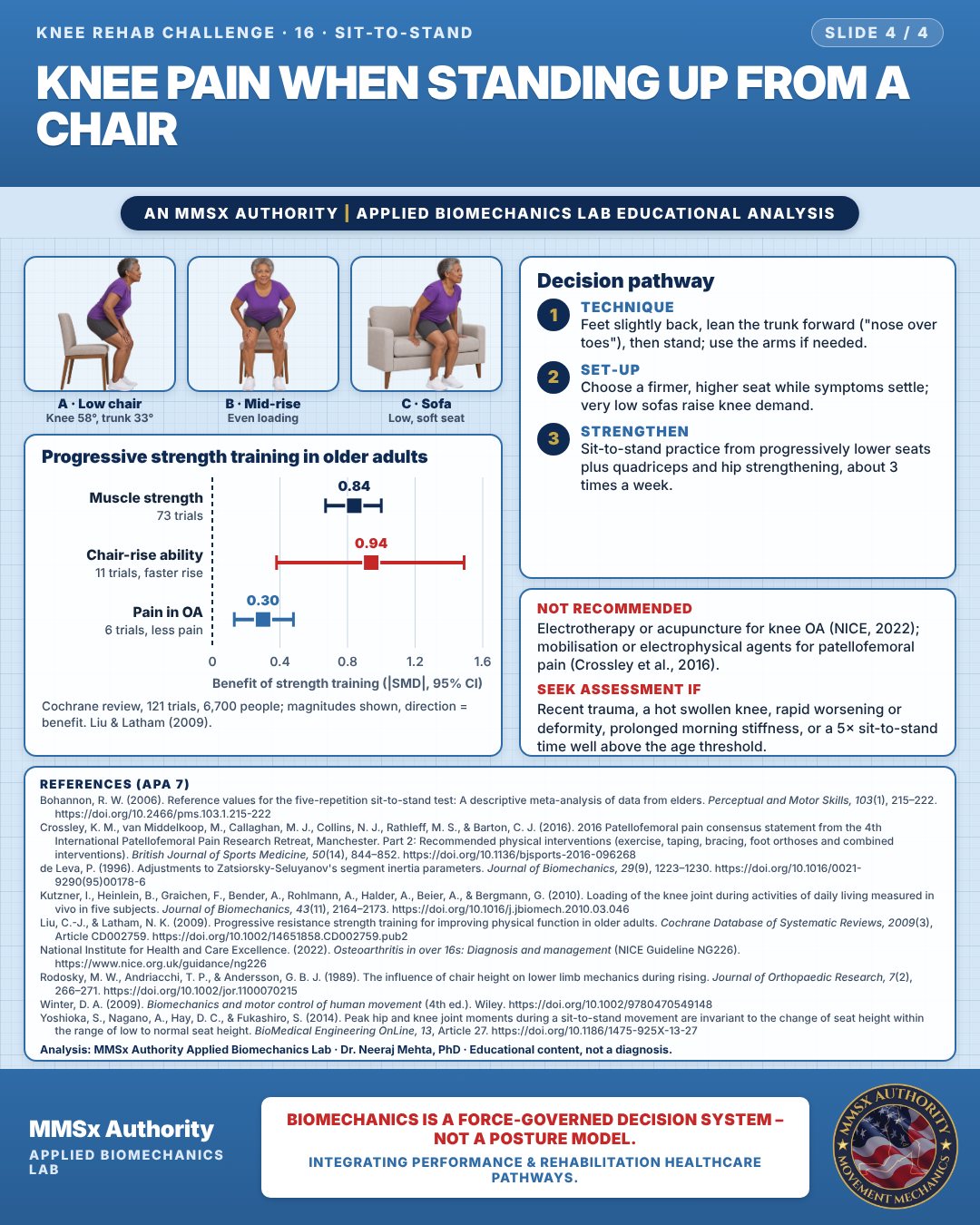
Progressive strength training in older adults
Technique
Feet slightly back, lean the trunk forward ("nose over toes"), then stand; use the arms if needed.
Set-up
Choose a firmer, higher seat while symptoms settle; very low sofas raise knee demand.
Strengthen
Sit-to-stand practice from progressively lower seats plus quadriceps and hip strengthening, about 3 times a week.
What the evidence supports
- Patellofemoral pain: exercise, preferably hip + knee, recommended; mobilisation and electrophysical agents not recommended (Crossley et al., 2016).
Cautions
Not recommended
Electrotherapy or acupuncture for knee OA (NICE, 2022); mobilisation or electrophysical agents for patellofemoral pain (Crossley et al., 2016).
Seek assessment if
Recent trauma, a hot swollen knee, rapid worsening or deformity, prolonged morning stiffness, or a 5× sit-to-stand time well above the age threshold.
Methods note
2-D estimates from pose landmarks on an illustrated figure; CoM from de Leva (1996) segment parameters; cm for a 1.70 m adult (Winter, 2009). Knee tracking distance is horizontal, knee centre to foot centre. Frame C is oblique: no angles reported. These are educational estimates, not a diagnosis.
References
- Bohannon, R. W. (2006). Reference values for the five-repetition sit-to-stand test: A descriptive meta-analysis of data from elders. Perceptual and Motor Skills, 103(1), 215–222. https://doi.org/10.2466/pms.103.1.215-222
- Crossley, K. M., van Middelkoop, M., Callaghan, M. J., Collins, N. J., Rathleff, M. S., & Barton, C. J. (2016). 2016 Patellofemoral pain consensus statement from the 4th International Patellofemoral Pain Research Retreat, Manchester. Part 2: Recommended physical interventions (exercise, taping, bracing, foot orthoses and combined interventions). British Journal of Sports Medicine, 50(14), 844–852. https://doi.org/10.1136/bjsports-2016-096268
- de Leva, P. (1996). Adjustments to Zatsiorsky-Seluyanov's segment inertia parameters. Journal of Biomechanics, 29(9), 1223–1230. https://doi.org/10.1016/0021-9290(95)00178-6
- Kutzner, I., Heinlein, B., Graichen, F., Bender, A., Rohlmann, A., Halder, A., Beier, A., & Bergmann, G. (2010). Loading of the knee joint during activities of daily living measured in vivo in five subjects. Journal of Biomechanics, 43(11), 2164–2173. https://doi.org/10.1016/j.jbiomech.2010.03.046
- Liu, C.-J., & Latham, N. K. (2009). Progressive resistance strength training for improving physical function in older adults. Cochrane Database of Systematic Reviews, 2009(3), Article CD002759. https://doi.org/10.1002/14651858.CD002759.pub2
- National Institute for Health and Care Excellence. (2022). Osteoarthritis in over 16s: Diagnosis and management (NICE Guideline NG226). https://www.nice.org.uk/guidance/ng226
- Rodosky, M. W., Andriacchi, T. P., & Andersson, G. B. J. (1989). The influence of chair height on lower limb mechanics during rising. Journal of Orthopaedic Research, 7(2), 266–271. https://doi.org/10.1002/jor.1100070215
- Winter, D. A. (2009). Biomechanics and motor control of human movement (4th ed.). Wiley. https://doi.org/10.1002/9780470549148
- Yoshioka, S., Nagano, A., Hay, D. C., & Fukashiro, S. (2014). Peak hip and knee joint moments during a sit-to-stand movement are invariant to the change of seat height within the range of low to normal seat height. BioMedical Engineering OnLine, 13, Article 27. https://doi.org/10.1186/1475-925X-13-27
Cite this article
Mehta, N. (2026, October 23). Knee pain when standing up from a chair. MMSx Authority Applied Biomechanics Lab. https://mmsxauthority.org/edu/analysis/knee/16-knee-pain-when-standing-up-from-a-chair/
Part of the collection
Mehta, N. (2026). Knee Rehabilitation: 50 Evidence-Based Biomechanics Analyses [Collection]. MMSx Authority Applied Biomechanics Lab. Zenodo. https://doi.org/10.5281/zenodo.23735752