Knee Rehab Challenge · 15
Why does going upstairs hurt my knees?
Stair-ascent knee pain is pain felt as the leading knee extends to lift body mass onto the step.
Key points
- Modify. Lead up with the stronger leg, lean the trunk slightly forward, use the rail for balance; split heavy shopping into lighter loads.
- Strengthen. Quadriceps-focused exercise, at least 3 sessions a week, gave the largest pain effects in knee OA.
- Progress. Step-ups from a low step, then higher; add load and repetitions. Pain may rise briefly at first (NICE, 2022).
What it is
Stair-ascent knee pain is pain felt as the leading knee extends to lift body mass onto the step; it is a common activity limitation in knee osteoarthritis and patellofemoral pain (activity-related pain: NICE NG226, 2022; Willy et al., 2019).
How we analysed the movement
Three movements relevant to this topic were analysed from illustrated reference figures. Joint centres were located with two-dimensional pose estimation; joint angles, the whole-body centre of mass and, where relevant, the ground-reaction-force line and its moment arm about the knee were then calculated from standard segment parameters. The figures are educational estimates that show how position changes mechanical demand; they are not measurements of a patient. Every research value quoted below comes from the published source cited beside it.
Movement A: Stair ascent (side view)
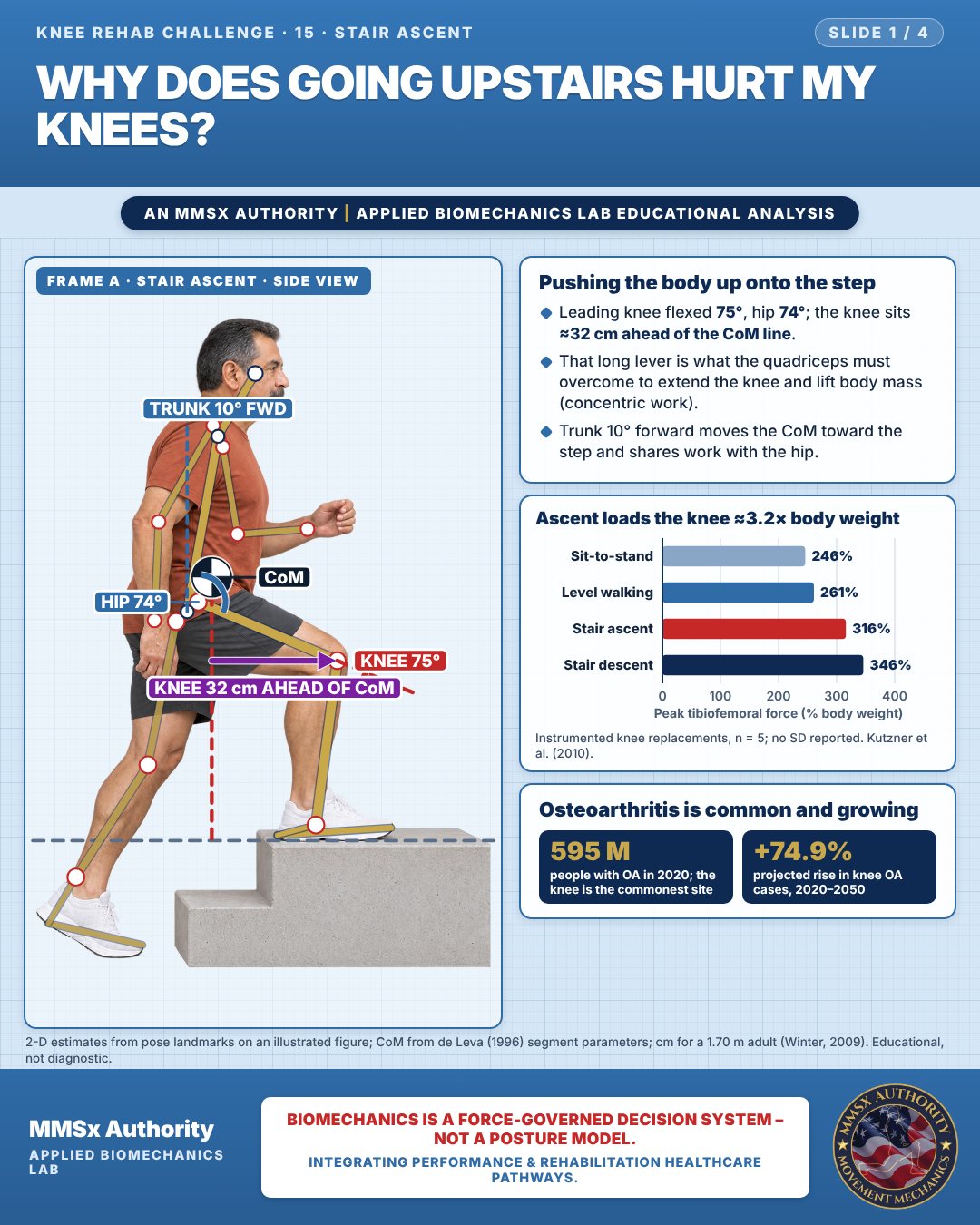
Pushing the body up onto the step
Leading knee flexed 75°, hip 74°; the knee sits ≈32 cm ahead of the CoM line.
That long lever is what the quadriceps must overcome to extend the knee and lift body mass (concentric work).
Trunk 10° forward moves the CoM toward the step and shares work with the hip.
Ascent loads the knee ≈3.2× body weight
Osteoarthritis is common and growing
Movement B: Step-up (front view)
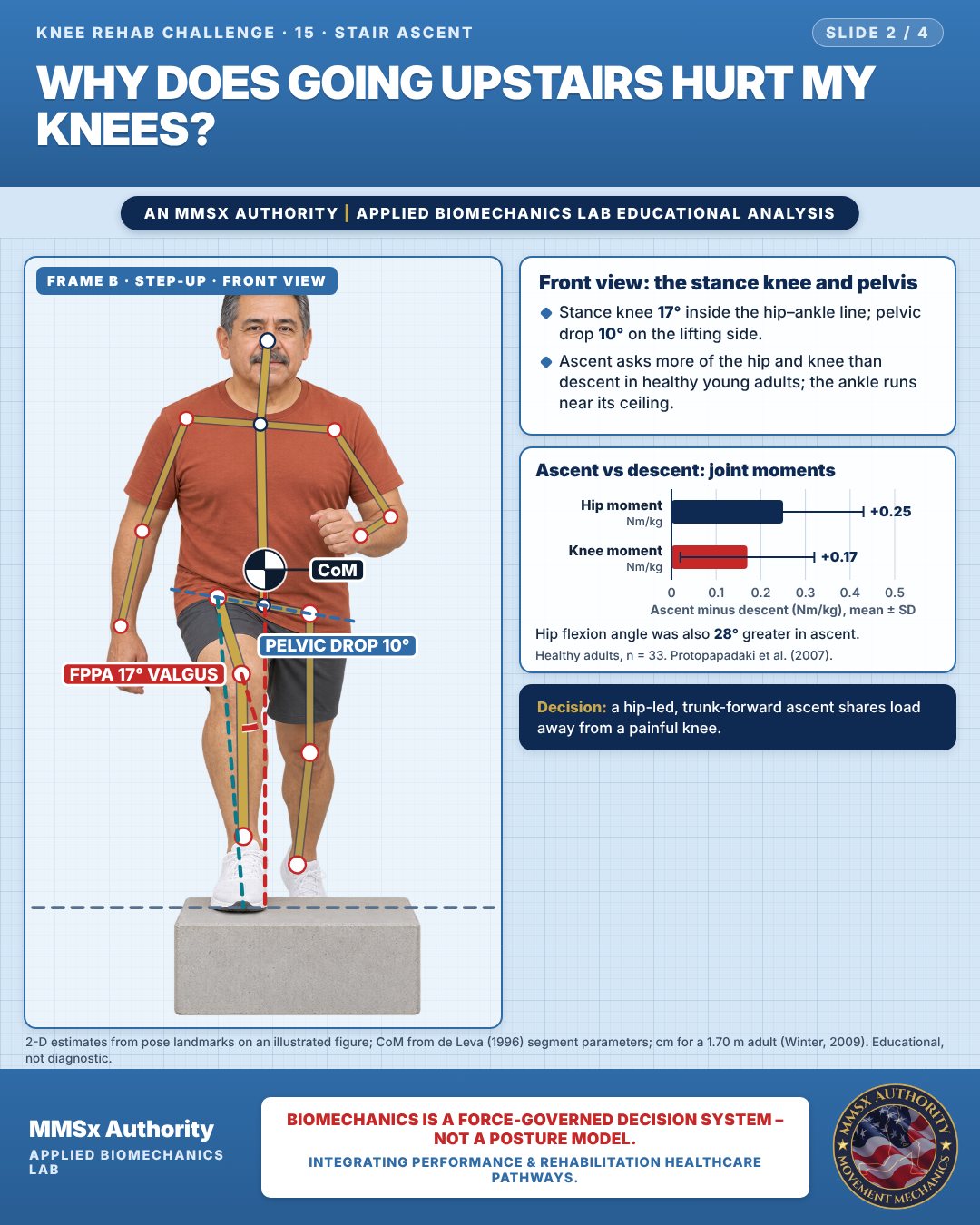
Front view: the stance knee and pelvis
Stance knee 17° inside the hip–ankle line; pelvic drop 10° on the lifting side.
Ascent asks more of the hip and knee than descent in healthy young adults; the ankle runs near its ceiling.
Ascent vs descent: joint moments
Hip flexion angle was also 28° greater in ascent.
Movement C: Ascent with a bag, rear-oblique
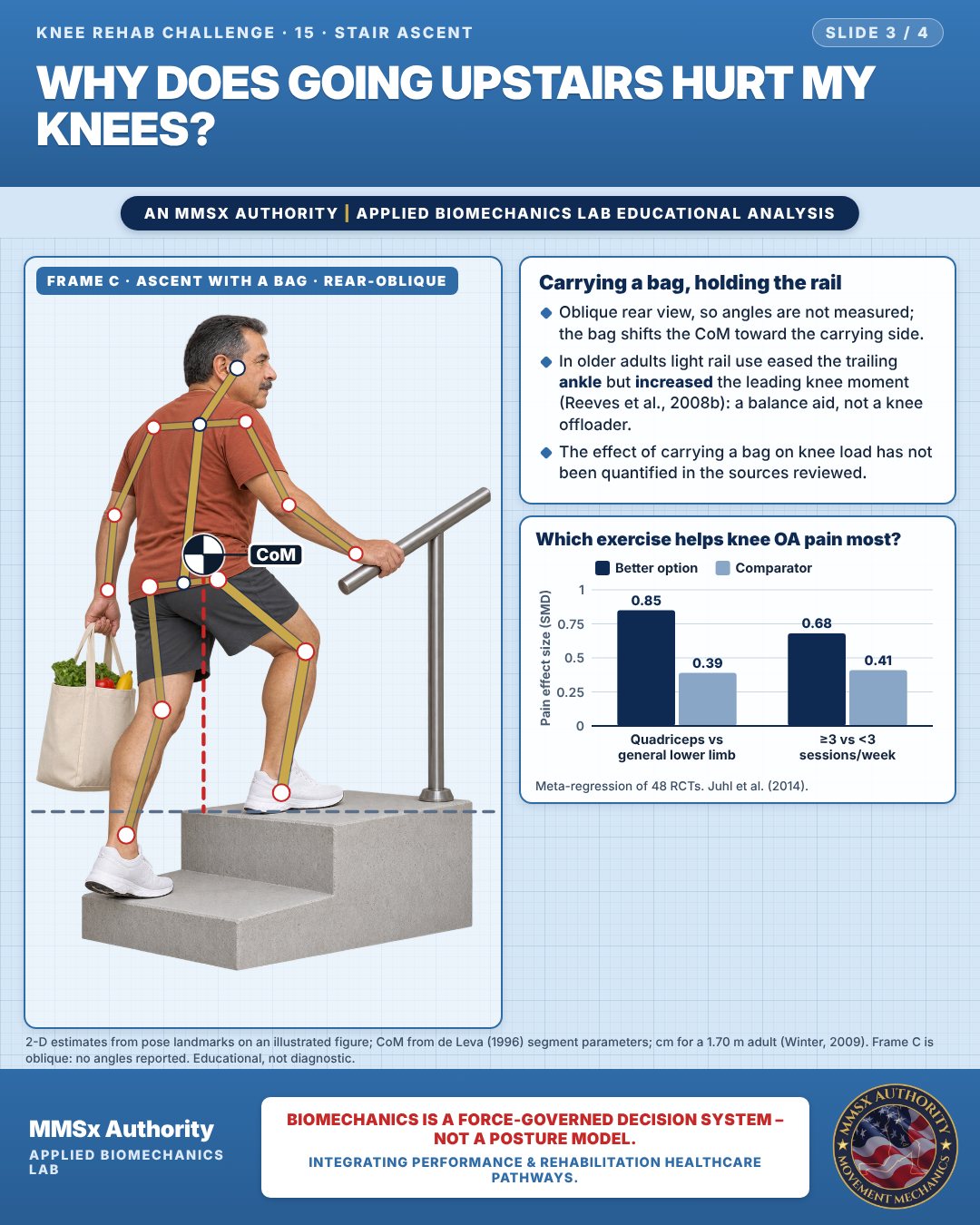
Carrying a bag, holding the rail
Oblique rear view, so angles are not measured; the bag shifts the CoM toward the carrying side.
In older adults light rail use eased the trailing ankle but increased the leading knee moment (Reeves et al., 2008b): a balance aid, not a knee offloader.
The effect of carrying a bag on knee load has not been quantified in the sources reviewed.
Which exercise helps knee OA pain most?
Decision pathway
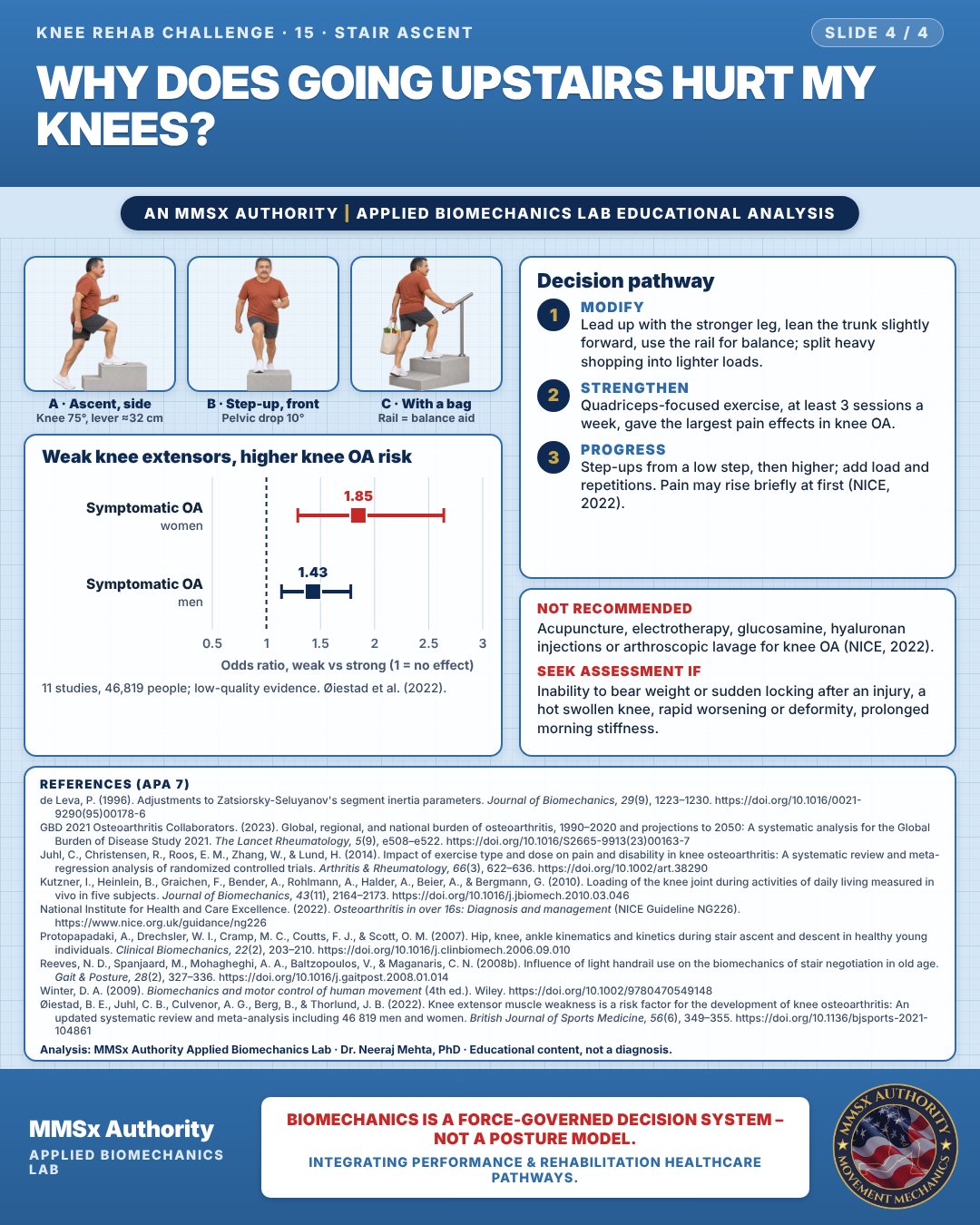
Weak knee extensors, higher knee OA risk
Modify
Lead up with the stronger leg, lean the trunk slightly forward, use the rail for balance; split heavy shopping into lighter loads.
Strengthen
Quadriceps-focused exercise, at least 3 sessions a week, gave the largest pain effects in knee OA.
Progress
Step-ups from a low step, then higher; add load and repetitions. Pain may rise briefly at first (NICE, 2022).
Cautions
Not recommended
Acupuncture, electrotherapy, glucosamine, hyaluronan injections or arthroscopic lavage for knee OA (NICE, 2022).
Seek assessment if
Inability to bear weight or sudden locking after an injury, a hot swollen knee, rapid worsening or deformity, prolonged morning stiffness.
Methods note
2-D estimates from pose landmarks on an illustrated figure; CoM from de Leva (1996) segment parameters; cm for a 1.70 m adult (Winter, 2009). Frame C is oblique: no angles reported. These are educational estimates, not a diagnosis.
References
- de Leva, P. (1996). Adjustments to Zatsiorsky-Seluyanov's segment inertia parameters. Journal of Biomechanics, 29(9), 1223–1230. https://doi.org/10.1016/0021-9290(95)00178-6
- GBD 2021 Osteoarthritis Collaborators. (2023). Global, regional, and national burden of osteoarthritis, 1990–2020 and projections to 2050: A systematic analysis for the Global Burden of Disease Study 2021. The Lancet Rheumatology, 5(9), e508–e522. https://doi.org/10.1016/S2665-9913(23)00163-7
- Juhl, C., Christensen, R., Roos, E. M., Zhang, W., & Lund, H. (2014). Impact of exercise type and dose on pain and disability in knee osteoarthritis: A systematic review and meta-regression analysis of randomized controlled trials. Arthritis & Rheumatology, 66(3), 622–636. https://doi.org/10.1002/art.38290
- Kutzner, I., Heinlein, B., Graichen, F., Bender, A., Rohlmann, A., Halder, A., Beier, A., & Bergmann, G. (2010). Loading of the knee joint during activities of daily living measured in vivo in five subjects. Journal of Biomechanics, 43(11), 2164–2173. https://doi.org/10.1016/j.jbiomech.2010.03.046
- National Institute for Health and Care Excellence. (2022). Osteoarthritis in over 16s: Diagnosis and management (NICE Guideline NG226). https://www.nice.org.uk/guidance/ng226
- Protopapadaki, A., Drechsler, W. I., Cramp, M. C., Coutts, F. J., & Scott, O. M. (2007). Hip, knee, ankle kinematics and kinetics during stair ascent and descent in healthy young individuals. Clinical Biomechanics, 22(2), 203–210. https://doi.org/10.1016/j.clinbiomech.2006.09.010
- Reeves, N. D., Spanjaard, M., Mohagheghi, A. A., Baltzopoulos, V., & Maganaris, C. N. (2008b). Influence of light handrail use on the biomechanics of stair negotiation in old age. Gait & Posture, 28(2), 327–336. https://doi.org/10.1016/j.gaitpost.2008.01.014
- Winter, D. A. (2009). Biomechanics and motor control of human movement (4th ed.). Wiley. https://doi.org/10.1002/9780470549148
- Øiestad, B. E., Juhl, C. B., Culvenor, A. G., Berg, B., & Thorlund, J. B. (2022). Knee extensor muscle weakness is a risk factor for the development of knee osteoarthritis: An updated systematic review and meta-analysis including 46 819 men and women. British Journal of Sports Medicine, 56(6), 349–355. https://doi.org/10.1136/bjsports-2021-104861
Cite this article
Mehta, N. (2026, October 23). Why does going upstairs hurt my knees? MMSx Authority Applied Biomechanics Lab. https://mmsxauthority.org/edu/analysis/knee/15-why-does-going-upstairs-hurt-my-knees/
Part of the collection
Mehta, N. (2026). Knee Rehabilitation: 50 Evidence-Based Biomechanics Analyses [Collection]. MMSx Authority Applied Biomechanics Lab. Zenodo. https://doi.org/10.5281/zenodo.23735752