Knee Rehab Challenge · 12
Osgood–Schlatter disease: knee pain in growing athletes
Osgood–Schlatter disease (OSD) is a traction apophysitis of the tibial tubercle in growing adolescents: repeated pull of the patellar tendon on the…
Key points
- Educate. Explain the tendon–growth-plate link; use pain to guide how much running and jumping to keep.
- Strengthen. Progressive knee and hip strengthening: knee extension strength rose 32% in the programme.
- Return. Climb the load ladder: isometrics and squats, then running, jumping and cutting.
What it is
Osgood–Schlatter disease (OSD) is a traction apophysitis of the tibial tubercle in growing adolescents: repeated pull of the patellar tendon on the immature tubercle causes local pain, tenderness and often a bony prominence just below the kneecap, aggravated by running, jumping and kneeling (Rathleff et al., 2020a; de Lucena et al., 2011).
How we analysed the movement
Three movements relevant to this topic were analysed from illustrated reference figures. Joint centres were located with two-dimensional pose estimation; joint angles, the whole-body centre of mass and, where relevant, the ground-reaction-force line and its moment arm about the knee were then calculated from standard segment parameters. The figures are educational estimates that show how position changes mechanical demand; they are not measurements of a patient. Every research value quoted below comes from the published source cited beside it.
Movement A: Adolescent running (side view)
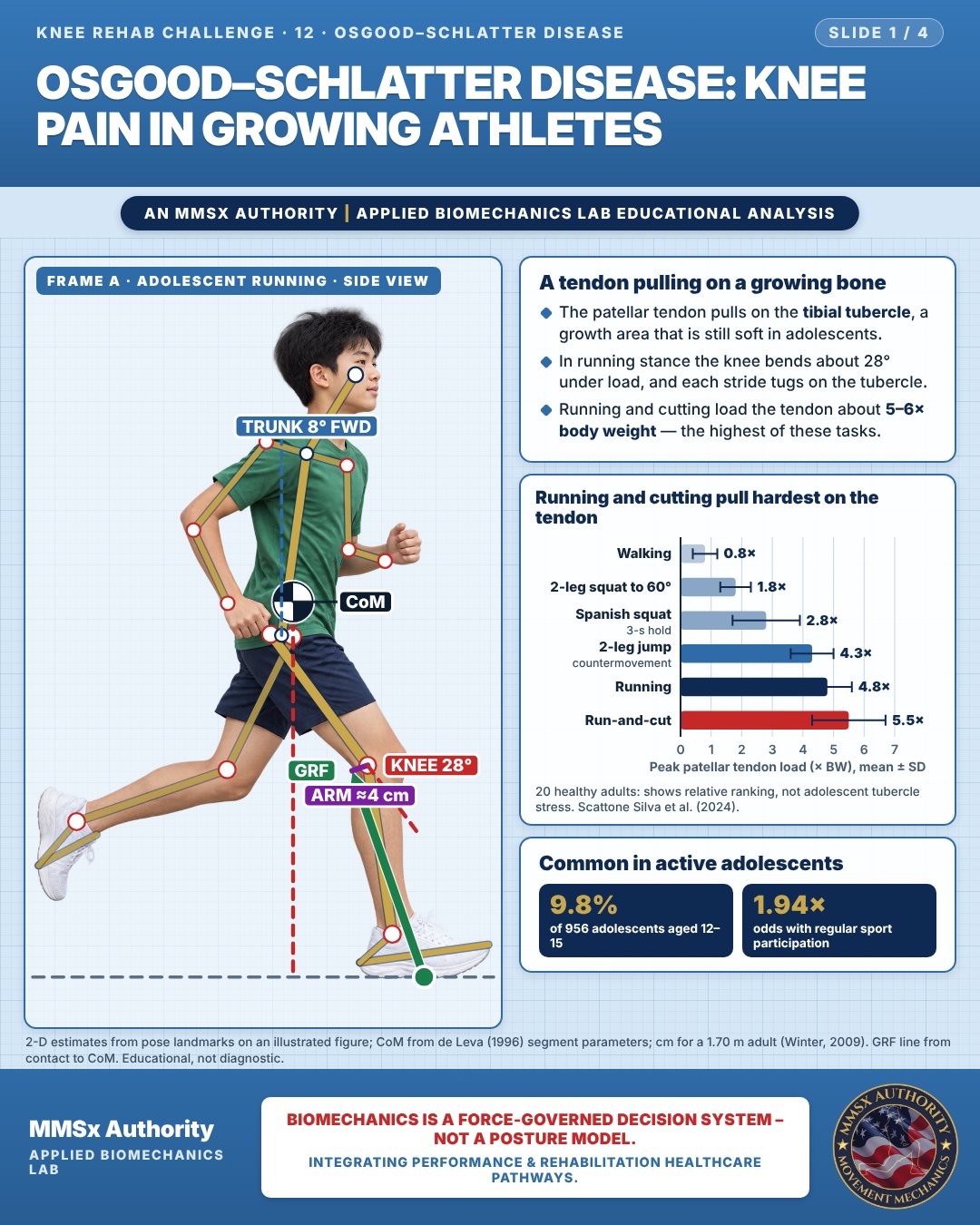
A tendon pulling on a growing bone
The patellar tendon pulls on the tibial tubercle, a growth area that is still soft in adolescents.
In running stance the knee bends about 28° under load, and each stride tugs on the tubercle.
Running and cutting load the tendon about 5–6× body weight — the highest of these tasks.
Running and cutting pull hardest on the tendon
Common in active adolescents
Movement B: Jump preparation (side view)
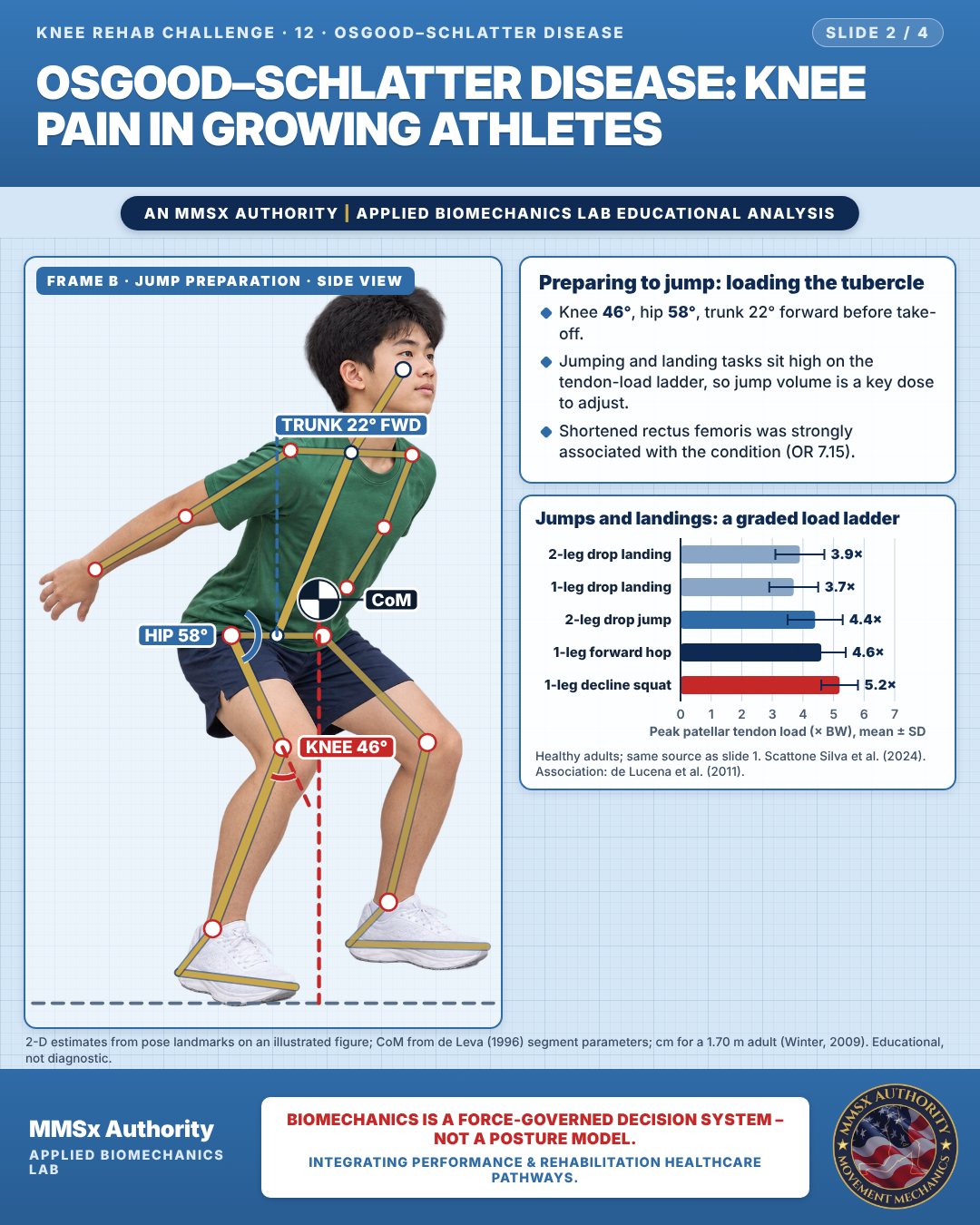
Preparing to jump: loading the tubercle
Knee 46°, hip 58°, trunk 22° forward before take-off.
Jumping and landing tasks sit high on the tendon-load ladder, so jump volume is a key dose to adjust.
Shortened rectus femoris was strongly associated with the condition (OR 7.15).
Jumps and landings: a graded load ladder
Movement C: Kneeling (side view)
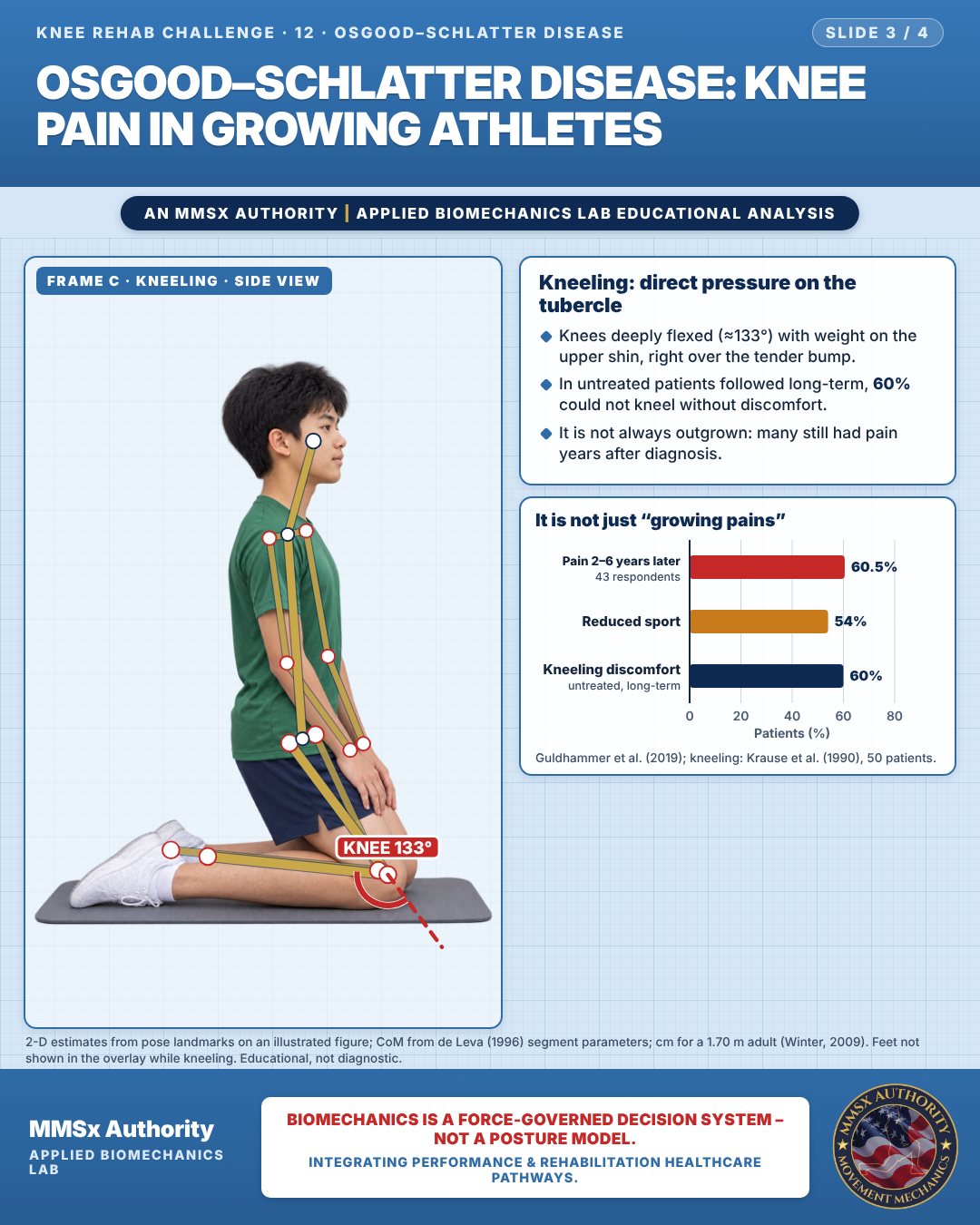
Kneeling: direct pressure on the tubercle
Knees deeply flexed (≈133°) with weight on the upper shin, right over the tender bump.
In untreated patients followed long-term, 60% could not kneel without discomfort.
It is not always outgrown: many still had pain years after diagnosis.
It is not just “growing pains”
Decision pathway
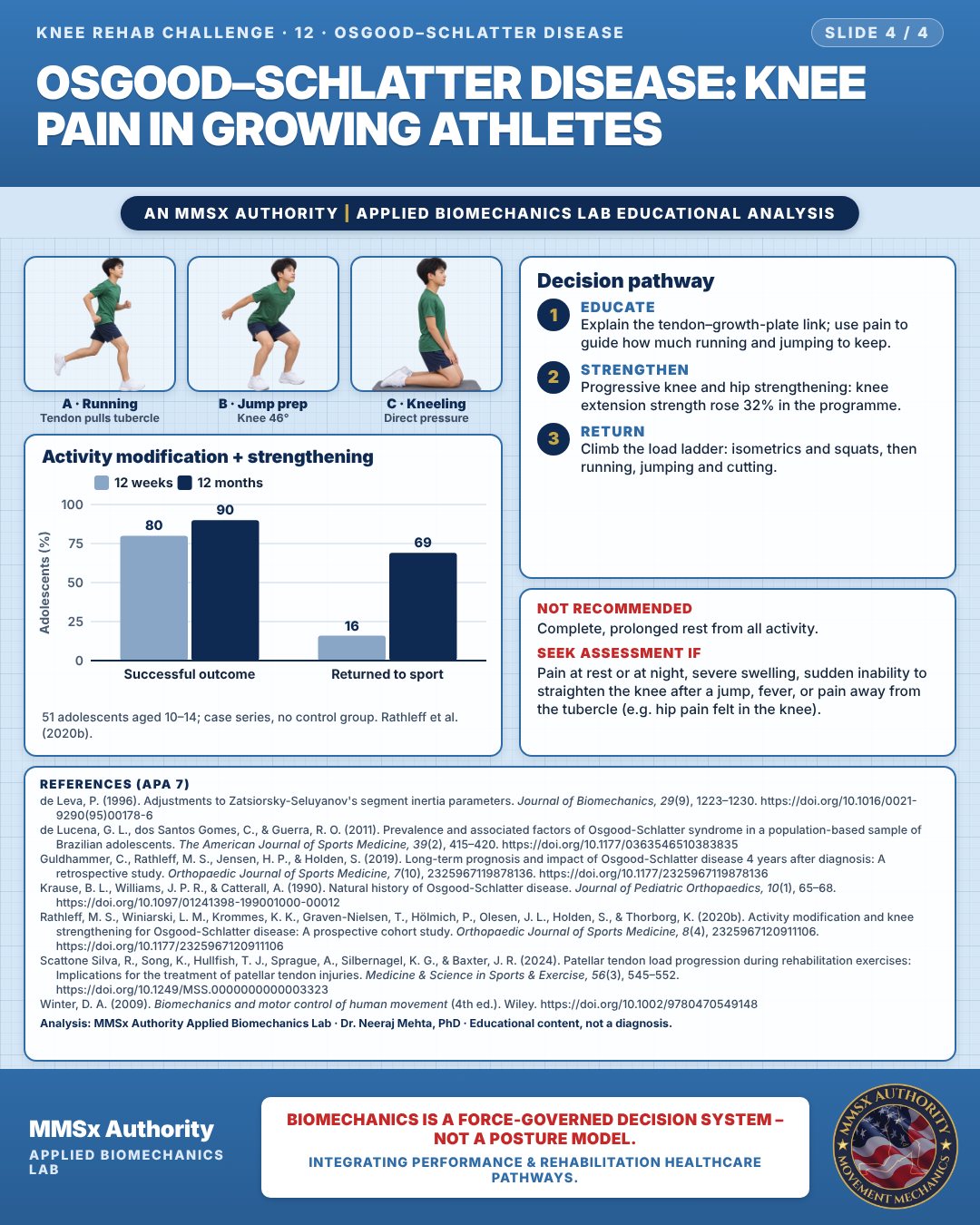
Activity modification + strengthening
Educate
Explain the tendon–growth-plate link; use pain to guide how much running and jumping to keep.
Strengthen
Progressive knee and hip strengthening: knee extension strength rose 32% in the programme.
Return
Climb the load ladder: isometrics and squats, then running, jumping and cutting.
What the evidence supports
- Recommended (best available evidence): education, pain-guided activity modification (temporarily reduce running/jumping volume), then progressive knee and hip strengthening and gradual return to sport (Rathleff et al., 2020b). Use the patellar-tendon load ladder (Scattone Silva et al., 2024) to progress from low-load (isometrics/Spanish squat, 2-leg partial squats) to running, jumping and cutting.
Myth and evidence
Myth“It's just growing pains — they'll grow out of it.”
Evidence60.5% still had OSD-related pain 2–6 years later (Guldhammer et al., 2019); 60% of untreated patients could not kneel comfortably at long-term follow-up (Krause et al., 1990).
Myth“Stop all sport until it goes away.”
EvidenceStructured activity modification plus strengthening produced 80% success at 12 weeks and 69% return to sport by 12 months (Rathleff et al., 2020b).
Cautions
Not recommended
Complete, prolonged rest from all activity.
Seek assessment if
Pain at rest or at night, severe swelling, sudden inability to straighten the knee after a jump, fever, or pain away from the tubercle (e.g. hip pain felt in the knee).
Methods note
2-D estimates from pose landmarks on an illustrated figure; CoM from de Leva (1996) segment parameters; cm for a 1.70 m adult (Winter, 2009). GRF line from contact to CoM. Feet not shown in the overlay while kneeling. These are educational estimates, not a diagnosis.
References
- de Leva, P. (1996). Adjustments to Zatsiorsky-Seluyanov's segment inertia parameters. Journal of Biomechanics, 29(9), 1223–1230. https://doi.org/10.1016/0021-9290(95)00178-6
- de Lucena, G. L., dos Santos Gomes, C., & Guerra, R. O. (2011). Prevalence and associated factors of Osgood-Schlatter syndrome in a population-based sample of Brazilian adolescents. The American Journal of Sports Medicine, 39(2), 415–420. https://doi.org/10.1177/0363546510383835
- Guldhammer, C., Rathleff, M. S., Jensen, H. P., & Holden, S. (2019). Long-term prognosis and impact of Osgood-Schlatter disease 4 years after diagnosis: A retrospective study. Orthopaedic Journal of Sports Medicine, 7(10), 2325967119878136. https://doi.org/10.1177/2325967119878136
- Krause, B. L., Williams, J. P. R., & Catterall, A. (1990). Natural history of Osgood-Schlatter disease. Journal of Pediatric Orthopaedics, 10(1), 65–68. https://doi.org/10.1097/01241398-199001000-00012
- Rathleff, M. S., Winiarski, L. M., Krommes, K. K., Graven-Nielsen, T., Hölmich, P., Olesen, J. L., Holden, S., & Thorborg, K. (2020b). Activity modification and knee strengthening for Osgood-Schlatter disease: A prospective cohort study. Orthopaedic Journal of Sports Medicine, 8(4), 2325967120911106. https://doi.org/10.1177/2325967120911106
- Scattone Silva, R., Song, K., Hullfish, T. J., Sprague, A., Silbernagel, K. G., & Baxter, J. R. (2024). Patellar tendon load progression during rehabilitation exercises: Implications for the treatment of patellar tendon injuries. Medicine & Science in Sports & Exercise, 56(3), 545–552. https://doi.org/10.1249/MSS.0000000000003323
- Winter, D. A. (2009). Biomechanics and motor control of human movement (4th ed.). Wiley. https://doi.org/10.1002/9780470549148
Cite this article
Mehta, N. (2026, October 23). Osgood–Schlatter disease: knee pain in growing athletes. MMSx Authority Applied Biomechanics Lab. https://mmsxauthority.org/edu/analysis/knee/12-osgood-schlatter-disease-knee-pain-in-growing-athletes/
Part of the collection
Mehta, N. (2026). Knee Rehabilitation: 50 Evidence-Based Biomechanics Analyses [Collection]. MMSx Authority Applied Biomechanics Lab. Zenodo. https://doi.org/10.5281/zenodo.23735752