Knee Rehab Challenge · 06
IT band syndrome: pain on the outside of the knee
Iliotibial band syndrome (ITBS) is an overuse condition producing sharp or burning pain over the lateral femoral epicondyle, typically provoked by…
Key points
- Modify load. Cut downhill running and the provoking volume for a while; cyclists check saddle height and cleat set-up.
- Strengthen. Progressive hip abductor strengthening, then return running on the flat before slopes.
- Escalate. Persistent cases: a corticosteroid injection may ease pain in the first 2 weeks; surgery only for refractory cases.
What it is
Iliotibial band syndrome (ITBS) is an overuse condition producing sharp or burning pain over the lateral femoral epicondyle, typically provoked by repetitive knee flexion–extension in running or cycling and classically linked to compression/friction of the distal iliotibial band region near 20–30° of knee flexion.
How we analysed the movement
Three movements relevant to this topic were analysed from illustrated reference figures. Joint centres were located with two-dimensional pose estimation; joint angles, the whole-body centre of mass and, where relevant, the ground-reaction-force line and its moment arm about the knee were then calculated from standard segment parameters. The figures are educational estimates that show how position changes mechanical demand; they are not measurements of a patient. Every research value quoted below comes from the published source cited beside it.
Movement A: Running stance (rear view)
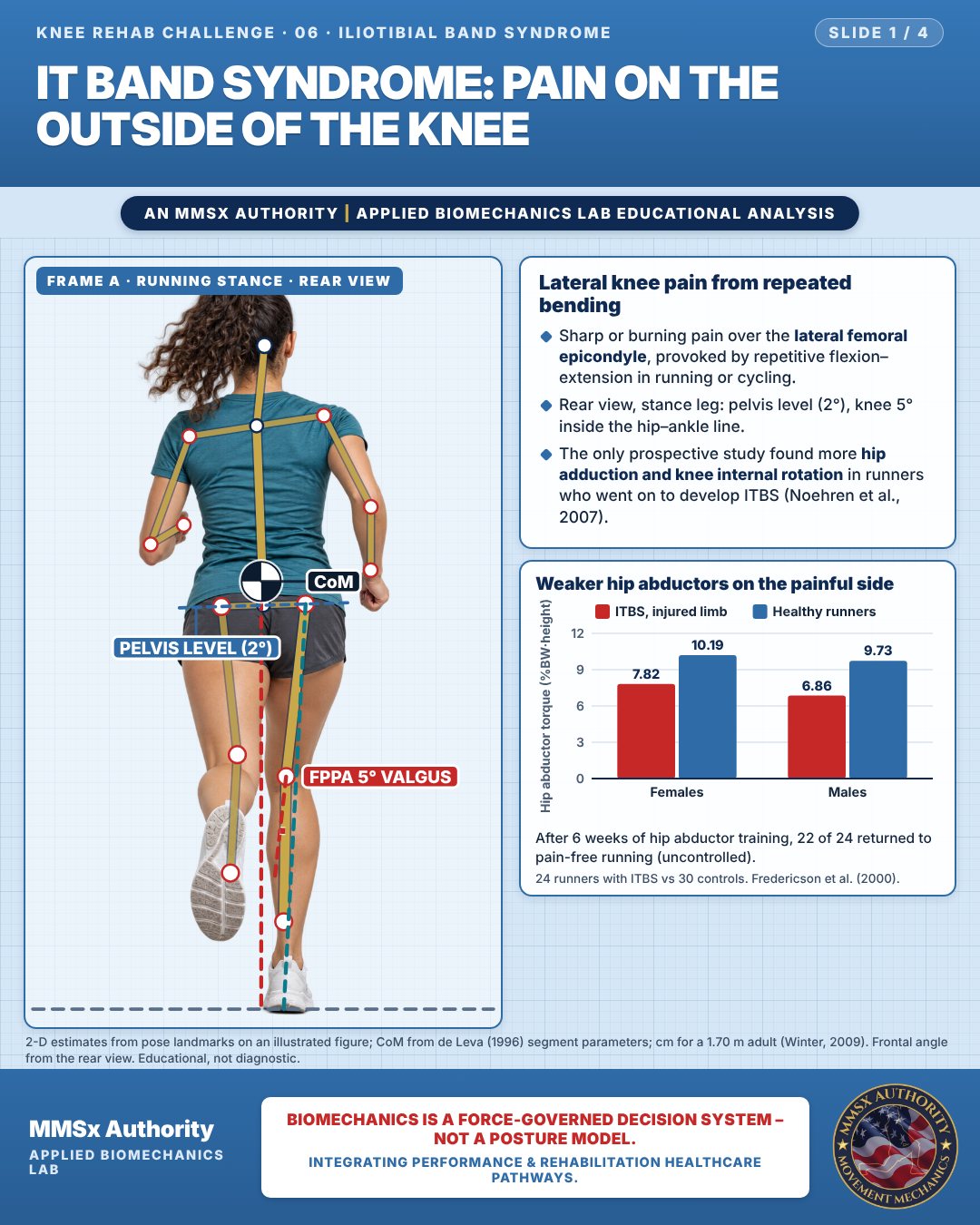
Lateral knee pain from repeated bending
Sharp or burning pain over the lateral femoral epicondyle, provoked by repetitive flexion–extension in running or cycling.
Rear view, stance leg: pelvis level (2°), knee 5° inside the hip–ankle line.
The only prospective study found more hip adduction and knee internal rotation in runners who went on to develop ITBS (Noehren et al., 2007).
Weaker hip abductors on the painful side
After 6 weeks of hip abductor training, 22 of 24 returned to pain-free running (uncontrolled).
Movement B: Downhill running (side view)
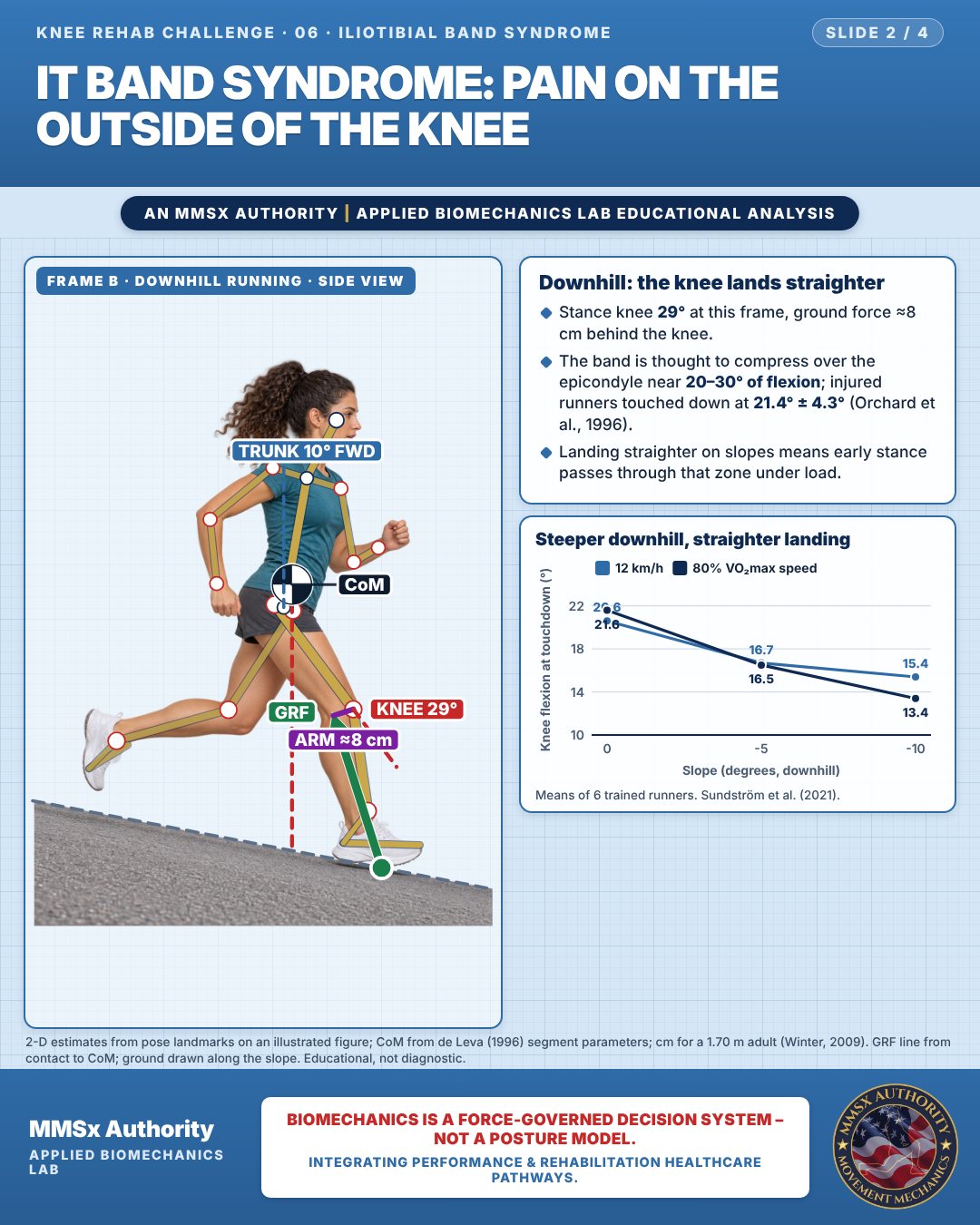
Downhill: the knee lands straighter
Stance knee 29° at this frame, ground force ≈8 cm behind the knee.
The band is thought to compress over the epicondyle near 20–30° of flexion; injured runners touched down at 21.4° ± 4.3° (Orchard et al., 1996).
Landing straighter on slopes means early stance passes through that zone under load.
Steeper downhill, straighter landing
Movement C: Stationary cycling (side view)
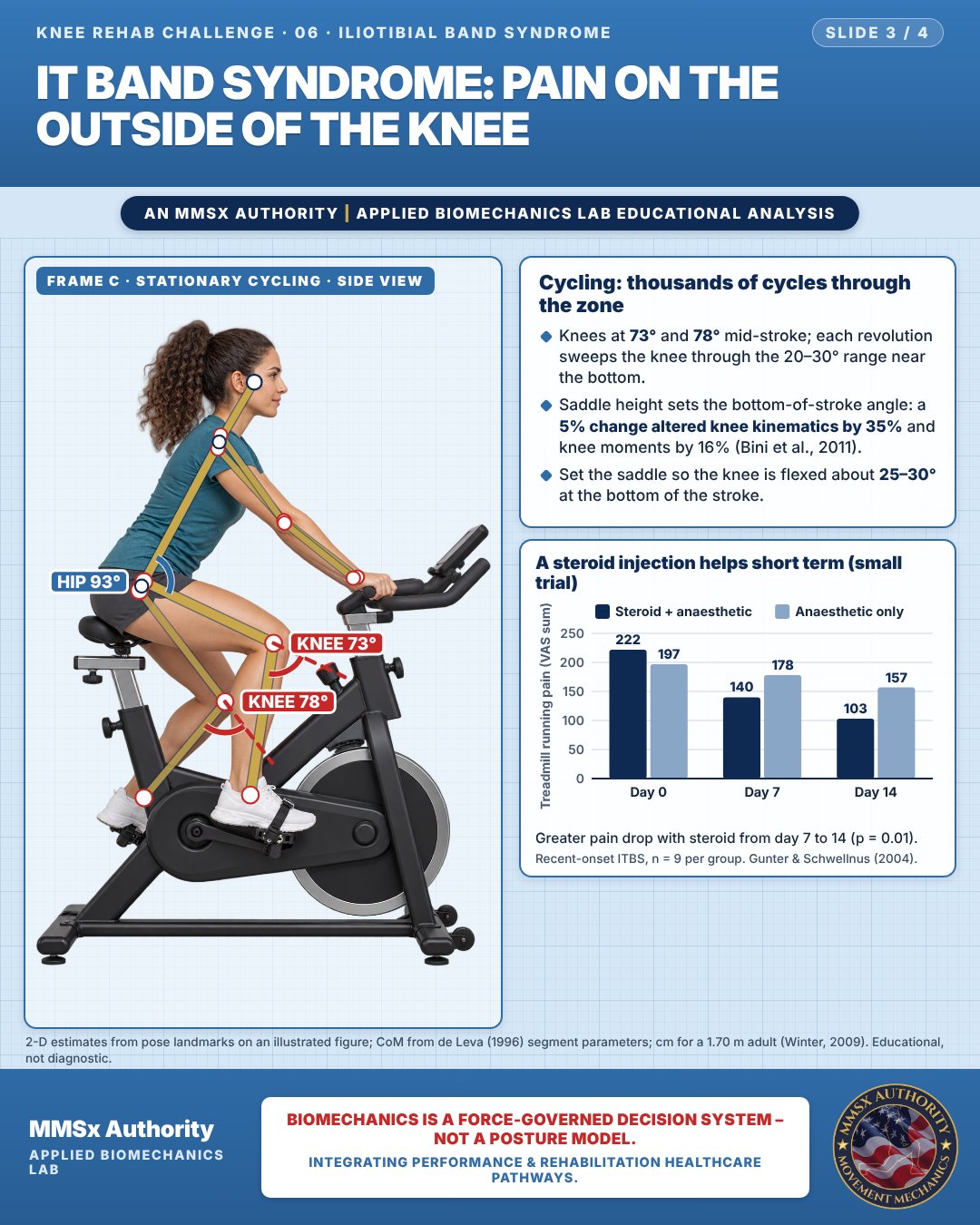
Cycling: thousands of cycles through the zone
Knees at 73° and 78° mid-stroke; each revolution sweeps the knee through the 20–30° range near the bottom.
Saddle height sets the bottom-of-stroke angle: a 5% change altered knee kinematics by 35% and knee moments by 16% (Bini et al., 2011).
Set the saddle so the knee is flexed about 25–30° at the bottom of the stroke.
A steroid injection helps short term (small trial)
Greater pain drop with steroid from day 7 to 14 (p = 0.01).
Decision pathway
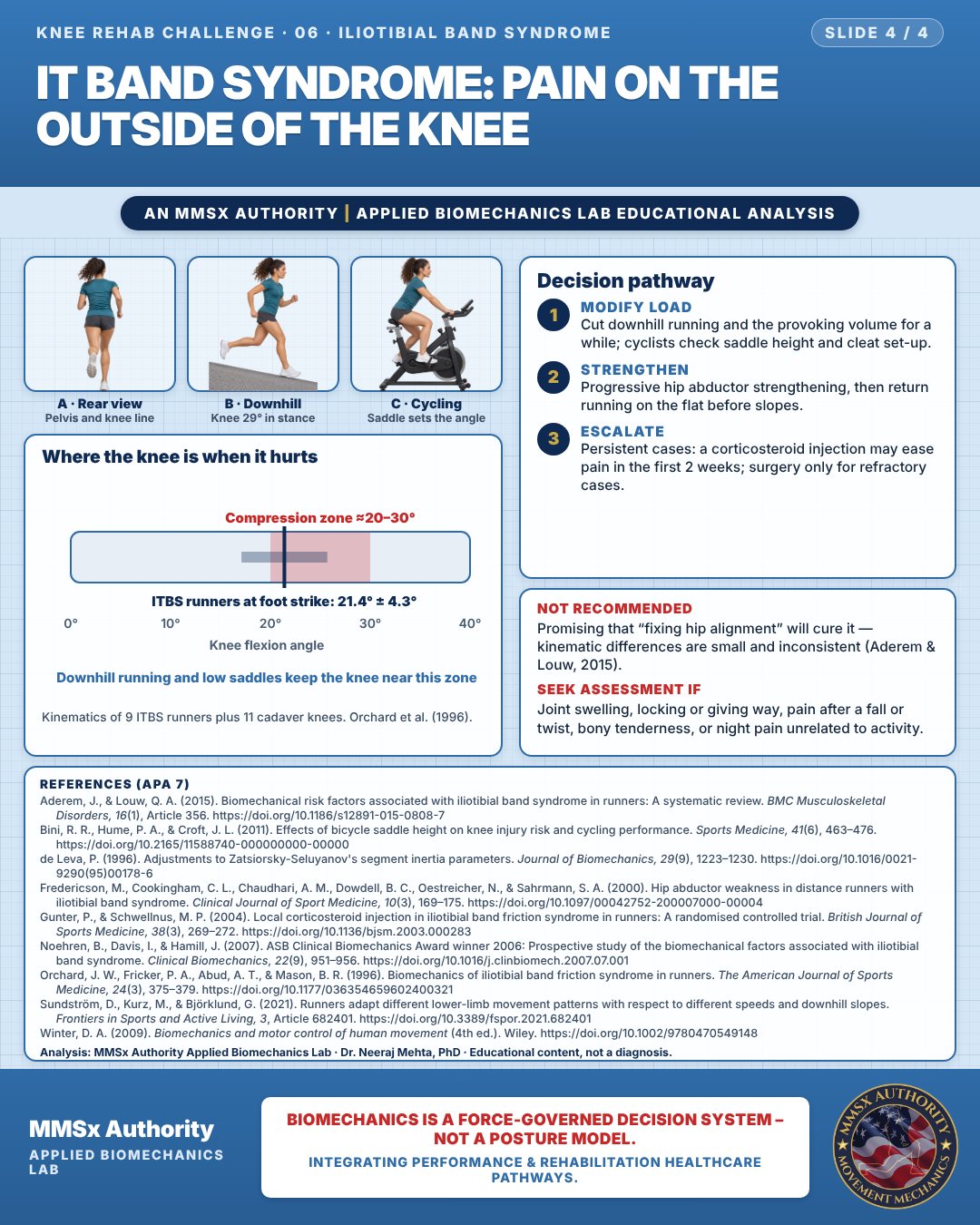
Where the knee is when it hurts
Modify load
Cut downhill running and the provoking volume for a while; cyclists check saddle height and cleat set-up.
Strengthen
Progressive hip abductor strengthening, then return running on the flat before slopes.
Escalate
Persistent cases: a corticosteroid injection may ease pain in the first 2 weeks; surgery only for refractory cases.
What the evidence supports
- Load modification: reduce downhill running and the provocative volume temporarily (mechanism: Orchard et al., 1996; Sundström et al., 2021).
- Hip abductor strengthening programme (Fredericson et al., 2000 — uncontrolled but encouraging).
- Cyclists: check saddle height (knee flexion 25–30° method; Bini et al., 2011) and cleat/set-up; Holmes et al. (1993) recommend bicycle adjustments and training changes as first-line non-operative care.
- Corticosteroid injection can reduce running pain in the first 2 weeks of recent-onset ITBS (Gunter & Schwellnus, 2004) — short-term option, small trial.
- Do not promise that changing hip adduction will fix ITBS — the kinematic evidence is limited (Aderem & Louw, 2015).
Myth and evidence
Myth“Bad hip alignment causes ITBS — fix the form and it's gone.”
Evidence— one prospective study (18 cases) supports association; pooled cross-sectional differences are small (≈2.5° knee internal rotation), near measurement error (Aderem & Louw, 2015).
Myth“Downhill is easier on the knee.”
Evidence— knee lands ~5–8° straighter on −5° to −10° slopes (Sundström et al., 2021), pushing early stance through the ITBS-provoking zone (Orchard et al., 1996).
Cautions
Not recommended
Promising that “fixing hip alignment” will cure it — kinematic differences are small and inconsistent (Aderem & Louw, 2015).
Seek assessment if
Joint swelling, locking or giving way, pain after a fall or twist, bony tenderness, or night pain unrelated to activity.
Methods note
2-D estimates from pose landmarks on an illustrated figure; CoM from de Leva (1996) segment parameters; cm for a 1.70 m adult (Winter, 2009). Frontal angle from the rear view. GRF line from contact to CoM; ground drawn along the slope. These are educational estimates, not a diagnosis.
References
- Aderem, J., & Louw, Q. A. (2015). Biomechanical risk factors associated with iliotibial band syndrome in runners: A systematic review. BMC Musculoskeletal Disorders, 16(1), Article 356. https://doi.org/10.1186/s12891-015-0808-7
- Bini, R. R., Hume, P. A., & Croft, J. L. (2011). Effects of bicycle saddle height on knee injury risk and cycling performance. Sports Medicine, 41(6), 463–476. https://doi.org/10.2165/11588740-000000000-00000
- de Leva, P. (1996). Adjustments to Zatsiorsky-Seluyanov's segment inertia parameters. Journal of Biomechanics, 29(9), 1223–1230. https://doi.org/10.1016/0021-9290(95)00178-6
- Fredericson, M., Cookingham, C. L., Chaudhari, A. M., Dowdell, B. C., Oestreicher, N., & Sahrmann, S. A. (2000). Hip abductor weakness in distance runners with iliotibial band syndrome. Clinical Journal of Sport Medicine, 10(3), 169–175. https://doi.org/10.1097/00042752-200007000-00004
- Gunter, P., & Schwellnus, M. P. (2004). Local corticosteroid injection in iliotibial band friction syndrome in runners: A randomised controlled trial. British Journal of Sports Medicine, 38(3), 269–272. https://doi.org/10.1136/bjsm.2003.000283
- Noehren, B., Davis, I., & Hamill, J. (2007). ASB Clinical Biomechanics Award winner 2006: Prospective study of the biomechanical factors associated with iliotibial band syndrome. Clinical Biomechanics, 22(9), 951–956. https://doi.org/10.1016/j.clinbiomech.2007.07.001
- Orchard, J. W., Fricker, P. A., Abud, A. T., & Mason, B. R. (1996). Biomechanics of iliotibial band friction syndrome in runners. The American Journal of Sports Medicine, 24(3), 375–379. https://doi.org/10.1177/036354659602400321
- Sundström, D., Kurz, M., & Björklund, G. (2021). Runners adapt different lower-limb movement patterns with respect to different speeds and downhill slopes. Frontiers in Sports and Active Living, 3, Article 682401. https://doi.org/10.3389/fspor.2021.682401
- Winter, D. A. (2009). Biomechanics and motor control of human movement (4th ed.). Wiley. https://doi.org/10.1002/9780470549148
Cite this article
Mehta, N. (2026, October 23). IT band syndrome: pain on the outside of the knee. MMSx Authority Applied Biomechanics Lab. https://mmsxauthority.org/edu/analysis/knee/06-it-band-syndrome-pain-on-the-outside-of-the-knee/
Part of the collection
Mehta, N. (2026). Knee Rehabilitation: 50 Evidence-Based Biomechanics Analyses [Collection]. MMSx Authority Applied Biomechanics Lab. Zenodo. https://doi.org/10.5281/zenodo.23735752