Knee Rehab Challenge · 05
Jumper's knee: pain just below the kneecap
Jumper's knee (patellar tendinopathy) is load-related pain localised to the patellar tendon, usually at its attachment to the lower pole of the…
Key points
- Settle. Keep training, lower the dose: drop the highest-index tasks; use isometric holds for short-term pain relief.
- Load. Progress isometric → heavy slow strength → energy storage (jumps, landings) → sport, using the loading-index ladder.
- Return. Re-introduce jumping volume gradually and track pain the next morning. Rest alone rarely resolves it.
What it is
Jumper's knee (patellar tendinopathy) is load-related pain localised to the patellar tendon, usually at its attachment to the lower pole of the kneecap, provoked by energy-storage activities such as jumping, landing and change of direction, and typically worse with increasing load.
How we analysed the movement
Three movements relevant to this topic were analysed from illustrated reference figures. Joint centres were located with two-dimensional pose estimation; joint angles, the whole-body centre of mass and, where relevant, the ground-reaction-force line and its moment arm about the knee were then calculated from standard segment parameters. The figures are educational estimates that show how position changes mechanical demand; they are not measurements of a patient. Every research value quoted below comes from the published source cited beside it.
Movement A: Jump take-off (side view)
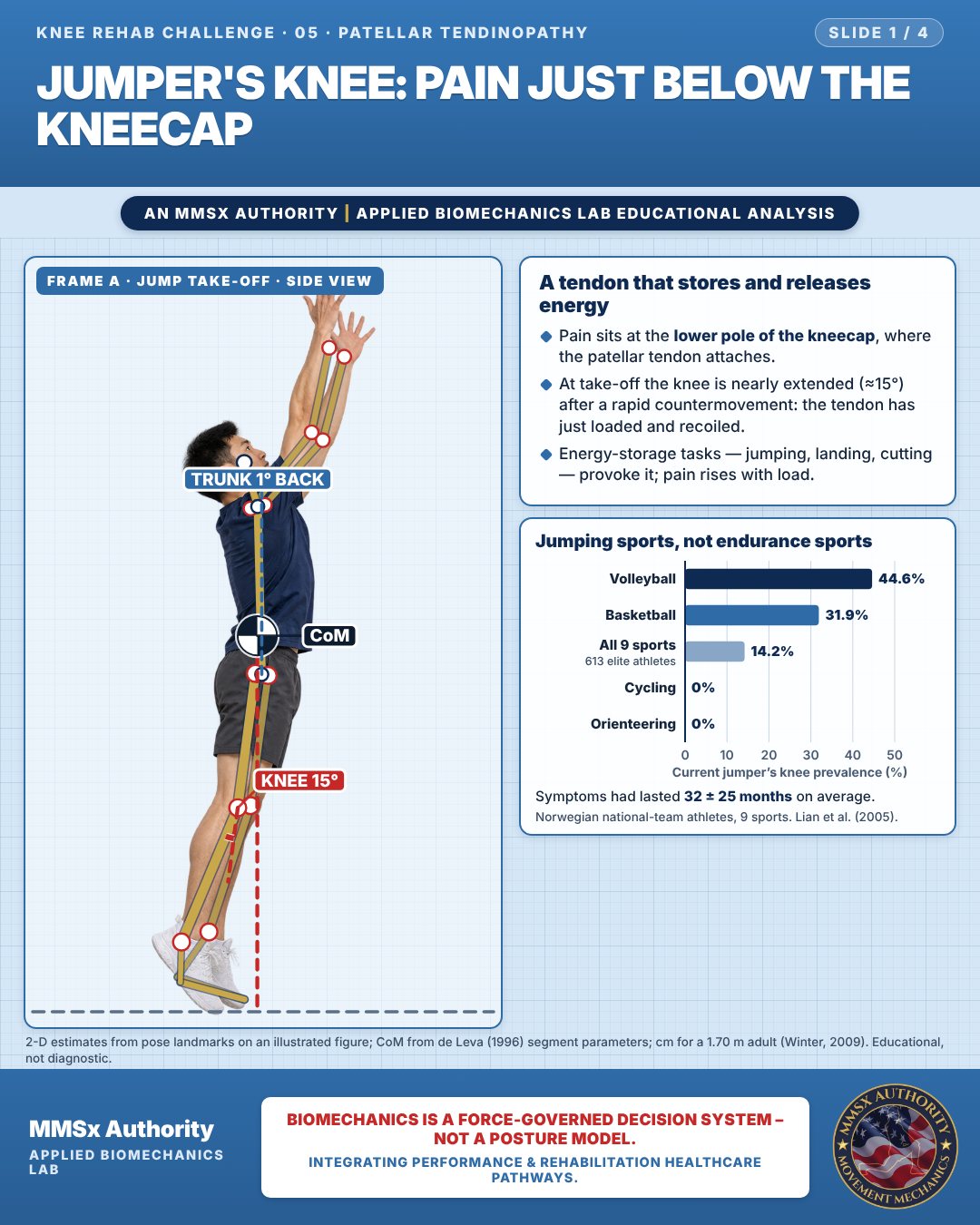
A tendon that stores and releases energy
Pain sits at the lower pole of the kneecap, where the patellar tendon attaches.
At take-off the knee is nearly extended (≈15°) after a rapid countermovement: the tendon has just loaded and recoiled.
Energy-storage tasks — jumping, landing, cutting — provoke it; pain rises with load.
Jumping sports, not endurance sports
Symptoms had lasted 32 ± 25 months on average.
Movement B: Two-foot landing (front view)
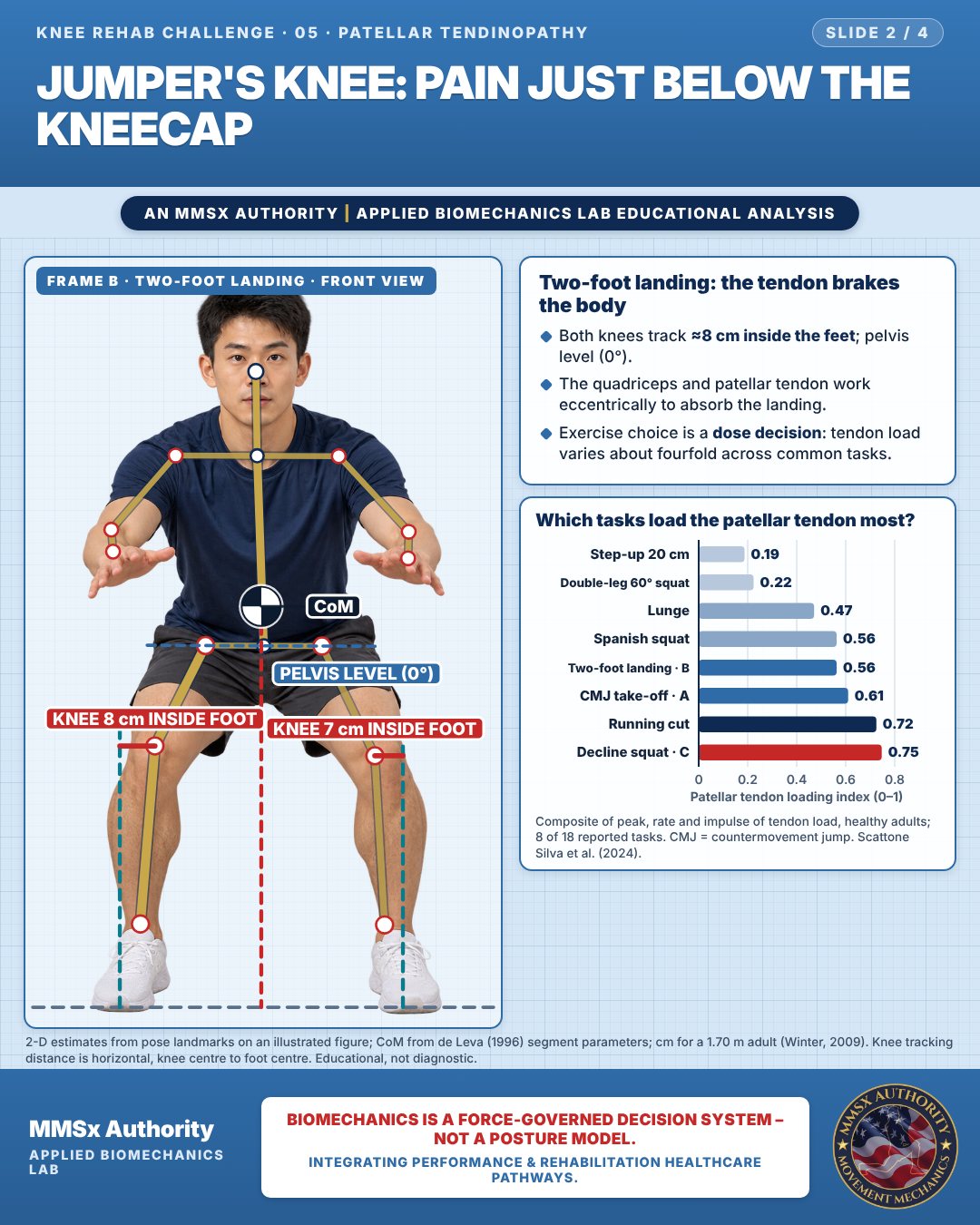
Two-foot landing: the tendon brakes the body
Both knees track ≈8 cm inside the feet; pelvis level (0°).
The quadriceps and patellar tendon work eccentrically to absorb the landing.
Exercise choice is a dose decision: tendon load varies about fourfold across common tasks.
Which tasks load the patellar tendon most?
Movement C: Decline squat (side view)
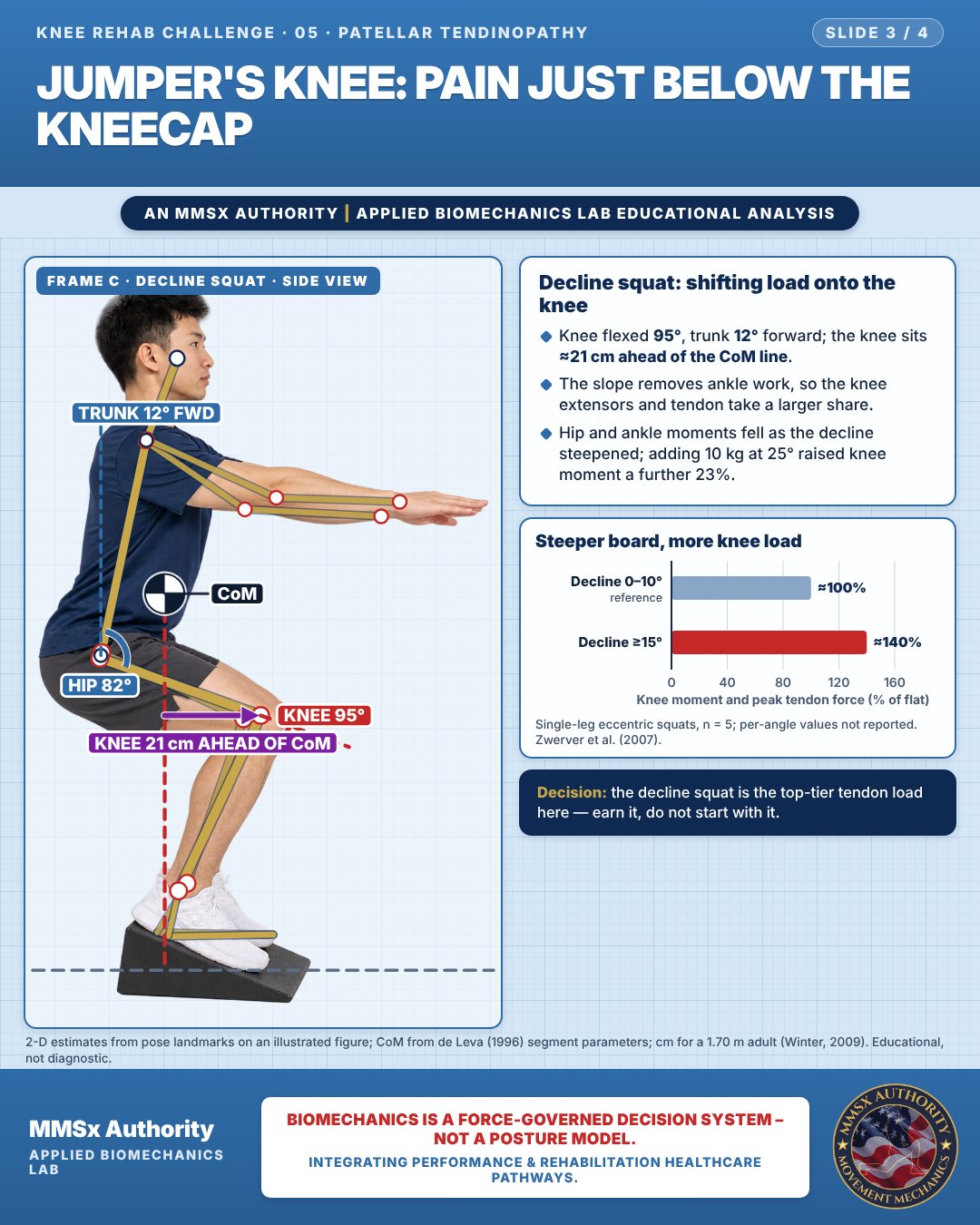
Decline squat: shifting load onto the knee
Knee flexed 95°, trunk 12° forward; the knee sits ≈21 cm ahead of the CoM line.
The slope removes ankle work, so the knee extensors and tendon take a larger share.
Hip and ankle moments fell as the decline steepened; adding 10 kg at 25° raised knee moment a further 23%.
Steeper board, more knee load
Decision pathway
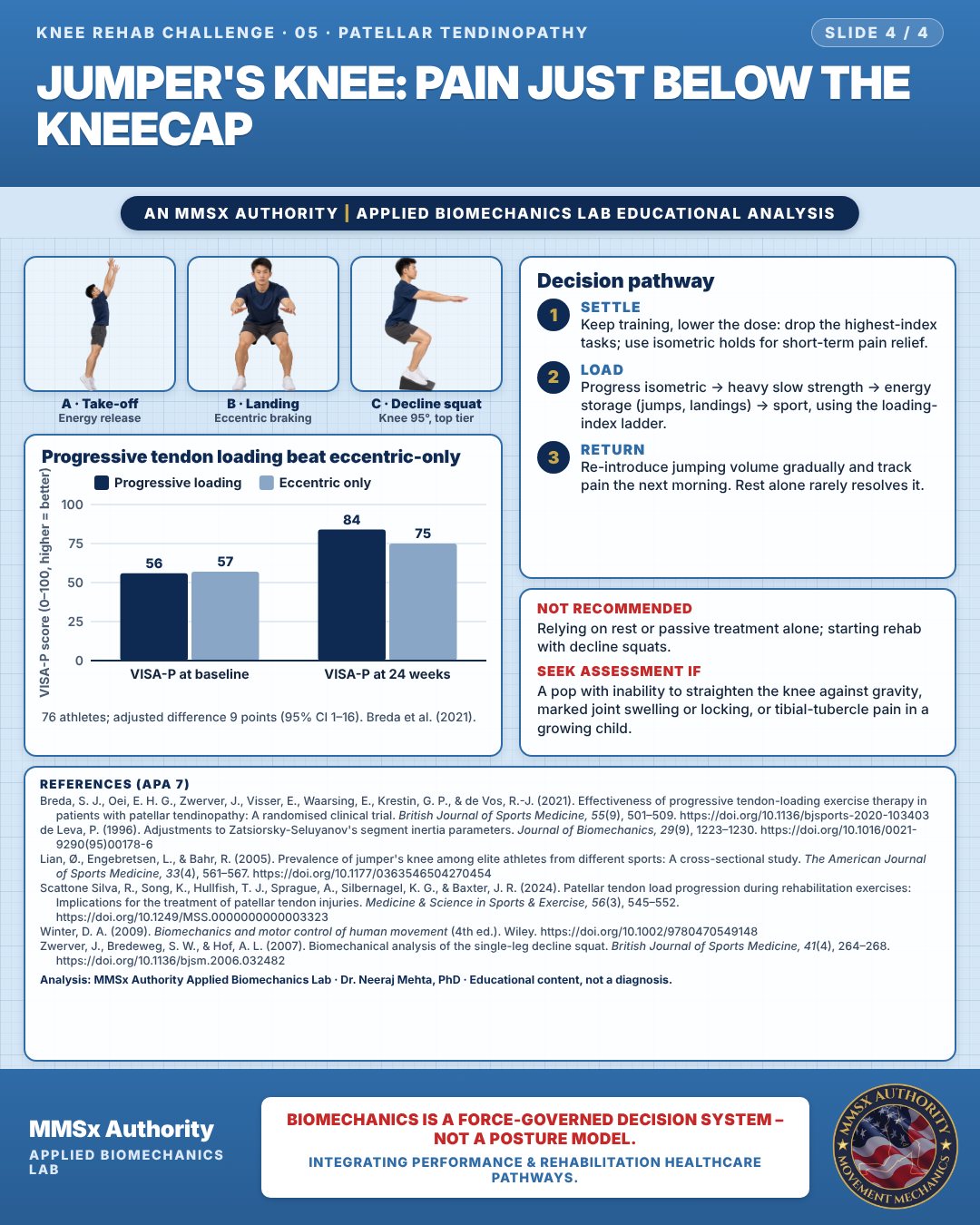
Progressive tendon loading beat eccentric-only
Settle
Keep training, lower the dose: drop the highest-index tasks; use isometric holds for short-term pain relief.
Load
Progress isometric → heavy slow strength → energy storage (jumps, landings) → sport, using the loading-index ladder.
Return
Re-introduce jumping volume gradually and track pain the next morning. Rest alone rarely resolves it.
What the evidence supports
- Recommend: progressive tendon-loading programme graded from low-load (isometric, tier 1 tasks) through heavy slow resistance to energy-storage tasks (jumps, landings, cuts) and return to sport (Breda et al., 2021; load ranking from Scattone Silva et al.).
- Eccentric-only decline-squat protocols were inferior to progressive loading at 24 weeks (Breda et al., 2021).
Myth and evidence
Myth“Rest until the pain goes away.”
Evidence— symptoms in elite athletes lasted 32 ± 25 months on average (Lian et al., 2005); structured progressive loading improved VISA-P by 28 points (Breda et al., 2021).
Myth“Only eccentric decline squats work.”
Evidence— progressive tendon-loading beat eccentric-only by 9 VISA-P points (Breda et al., 2021).
Cautions
Not recommended
Relying on rest or passive treatment alone; starting rehab with decline squats.
Seek assessment if
A pop with inability to straighten the knee against gravity, marked joint swelling or locking, or tibial-tubercle pain in a growing child.
Methods note
2-D estimates from pose landmarks on an illustrated figure; CoM from de Leva (1996) segment parameters; cm for a 1.70 m adult (Winter, 2009). Knee tracking distance is horizontal, knee centre to foot centre. These are educational estimates, not a diagnosis.
References
- Breda, S. J., Oei, E. H. G., Zwerver, J., Visser, E., Waarsing, E., Krestin, G. P., & de Vos, R.-J. (2021). Effectiveness of progressive tendon-loading exercise therapy in patients with patellar tendinopathy: A randomised clinical trial. British Journal of Sports Medicine, 55(9), 501–509. https://doi.org/10.1136/bjsports-2020-103403
- de Leva, P. (1996). Adjustments to Zatsiorsky-Seluyanov's segment inertia parameters. Journal of Biomechanics, 29(9), 1223–1230. https://doi.org/10.1016/0021-9290(95)00178-6
- Lian, Ø., Engebretsen, L., & Bahr, R. (2005). Prevalence of jumper's knee among elite athletes from different sports: A cross-sectional study. The American Journal of Sports Medicine, 33(4), 561–567. https://doi.org/10.1177/0363546504270454
- Scattone Silva, R., Song, K., Hullfish, T. J., Sprague, A., Silbernagel, K. G., & Baxter, J. R. (2024). Patellar tendon load progression during rehabilitation exercises: Implications for the treatment of patellar tendon injuries. Medicine & Science in Sports & Exercise, 56(3), 545–552. https://doi.org/10.1249/MSS.0000000000003323
- Winter, D. A. (2009). Biomechanics and motor control of human movement (4th ed.). Wiley. https://doi.org/10.1002/9780470549148
- Zwerver, J., Bredeweg, S. W., & Hof, A. L. (2007). Biomechanical analysis of the single-leg decline squat. British Journal of Sports Medicine, 41(4), 264–268. https://doi.org/10.1136/bjsm.2006.032482
Cite this article
Mehta, N. (2026, October 23). Jumper's knee: pain just below the kneecap. MMSx Authority Applied Biomechanics Lab. https://mmsxauthority.org/edu/analysis/knee/05-jumpers-knee-pain-just-below-the-kneecap/
Part of the collection
Mehta, N. (2026). Knee Rehabilitation: 50 Evidence-Based Biomechanics Analyses [Collection]. MMSx Authority Applied Biomechanics Lab. Zenodo. https://doi.org/10.5281/zenodo.23735752