Knee Rehab Challenge · 04
ACL injury: what happens during cutting and landing?
An anterior cruciate ligament (ACL) injury is a partial or complete tear of the ligament that resists anterior tibial translation and rotational laxity.
Key points
- Prevent. Neuromuscular warm-ups (landing, balance, strength, plyometrics) roughly halve ACL injuries: OR 0.50; in females non-contact OR 0.33 (Webster & Hewett, 2018).
- Train the task. Practise soft, flexed landings and controlled deceleration steps; build hip and quadriceps strength.
- Return by criteria. Clear return on hop symmetry, strength and psychological readiness, not time alone. Young athletes face a high second-injury risk.
What it is
An anterior cruciate ligament (ACL) injury is a partial or complete tear of the ligament that resists anterior tibial translation and rotational laxity; most sport injuries occur without direct contact to the knee, during landing, cutting or sudden deceleration.
How we analysed the movement
Three movements relevant to this topic were analysed from illustrated reference figures. Joint centres were located with two-dimensional pose estimation; joint angles, the whole-body centre of mass and, where relevant, the ground-reaction-force line and its moment arm about the knee were then calculated from standard segment parameters. The figures are educational estimates that show how position changes mechanical demand; they are not measurements of a patient. Every research value quoted below comes from the published source cited beside it.
Movement A: Change of direction, oblique
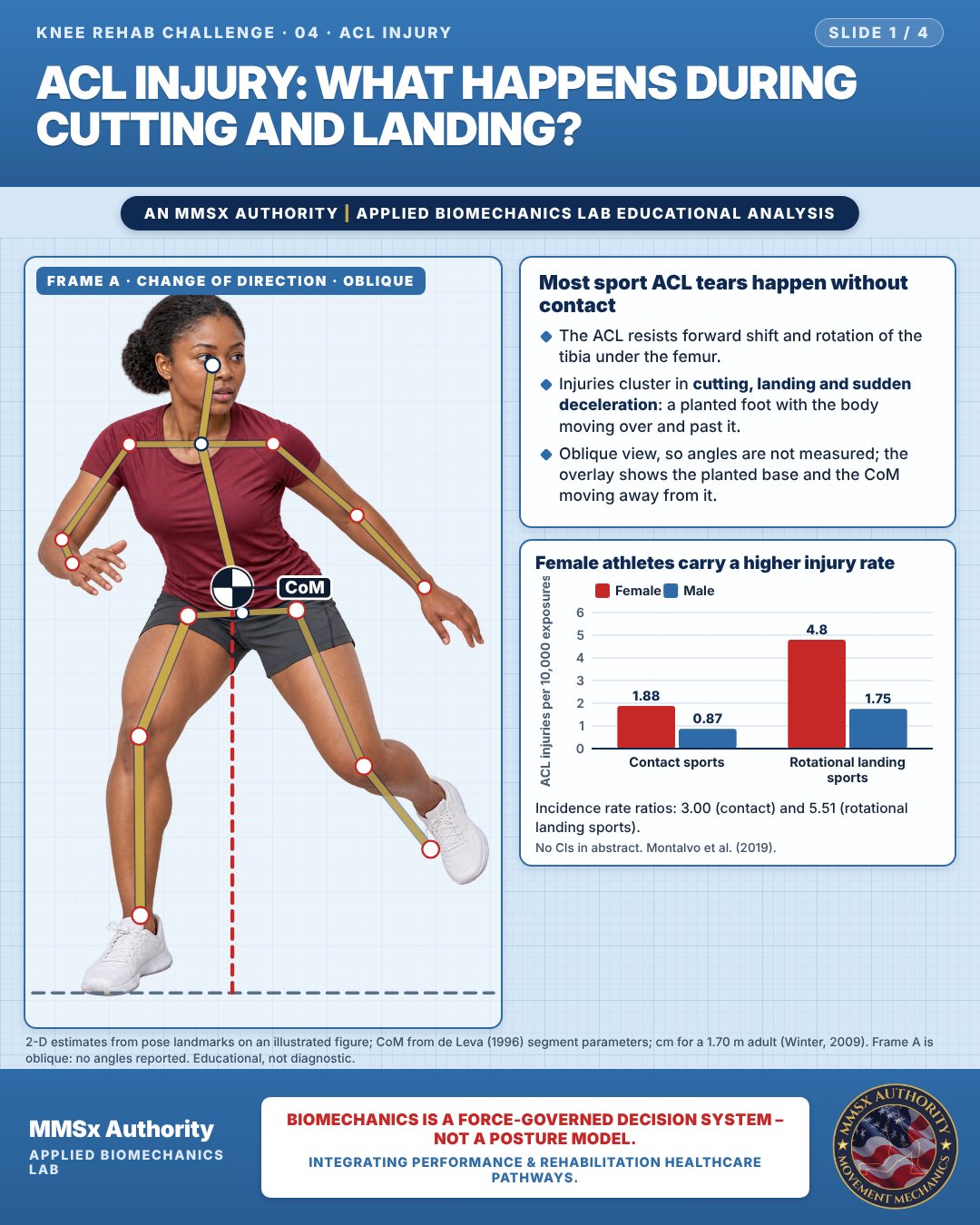
Most sport ACL tears happen without contact
The ACL resists forward shift and rotation of the tibia under the femur.
Injuries cluster in cutting, landing and sudden deceleration: a planted foot with the body moving over and past it.
Oblique view, so angles are not measured; the overlay shows the planted base and the CoM moving away from it.
Female athletes carry a higher injury rate
Incidence rate ratios: 3.00 (contact) and 5.51 (rotational landing sports).
Movement B: Deceleration step (side view)
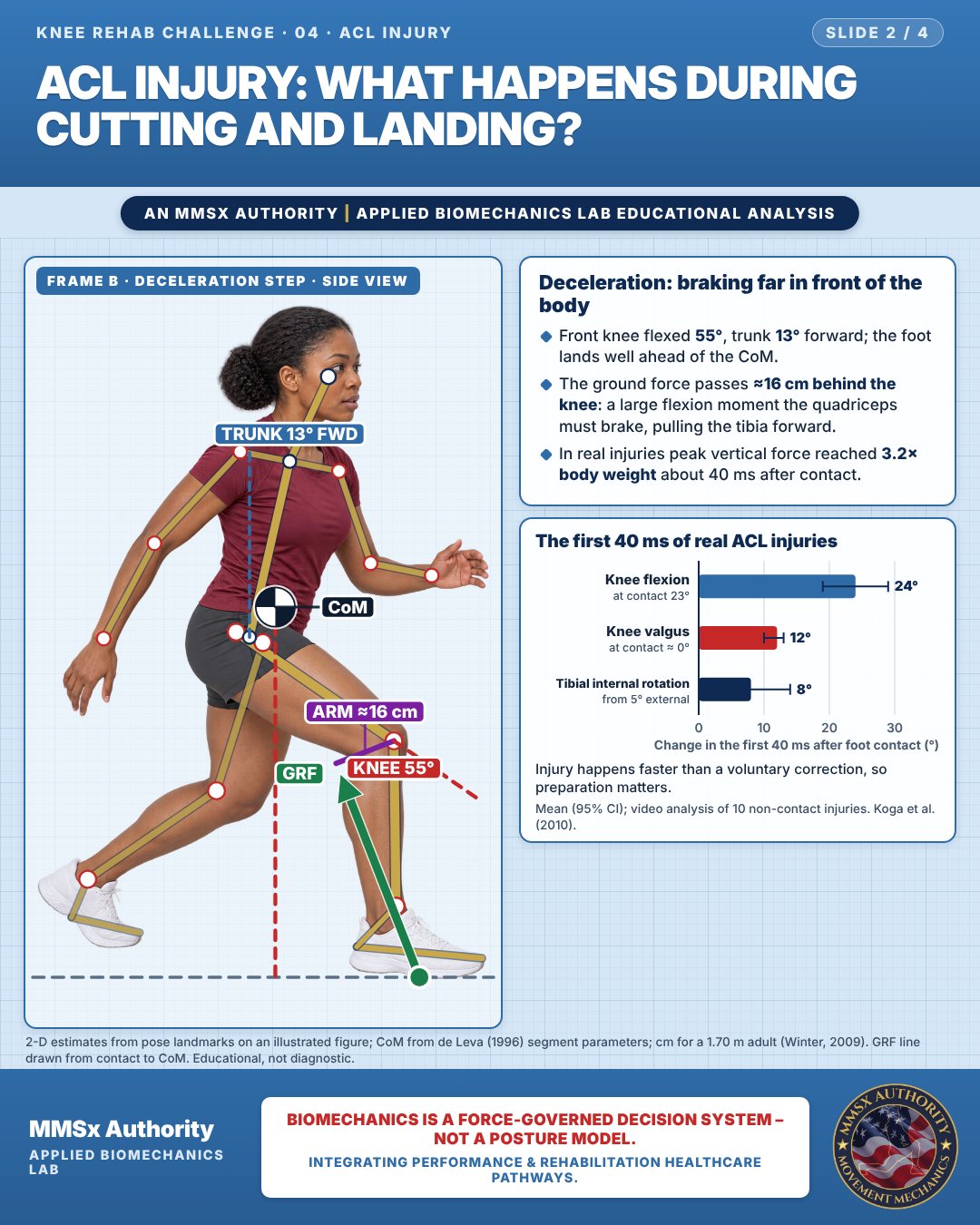
Deceleration: braking far in front of the body
Front knee flexed 55°, trunk 13° forward; the foot lands well ahead of the CoM.
The ground force passes ≈16 cm behind the knee: a large flexion moment the quadriceps must brake, pulling the tibia forward.
In real injuries peak vertical force reached 3.2× body weight about 40 ms after contact.
The first 40 ms of real ACL injuries
Injury happens faster than a voluntary correction, so preparation matters.
Movement C: Single-leg landing (side view)
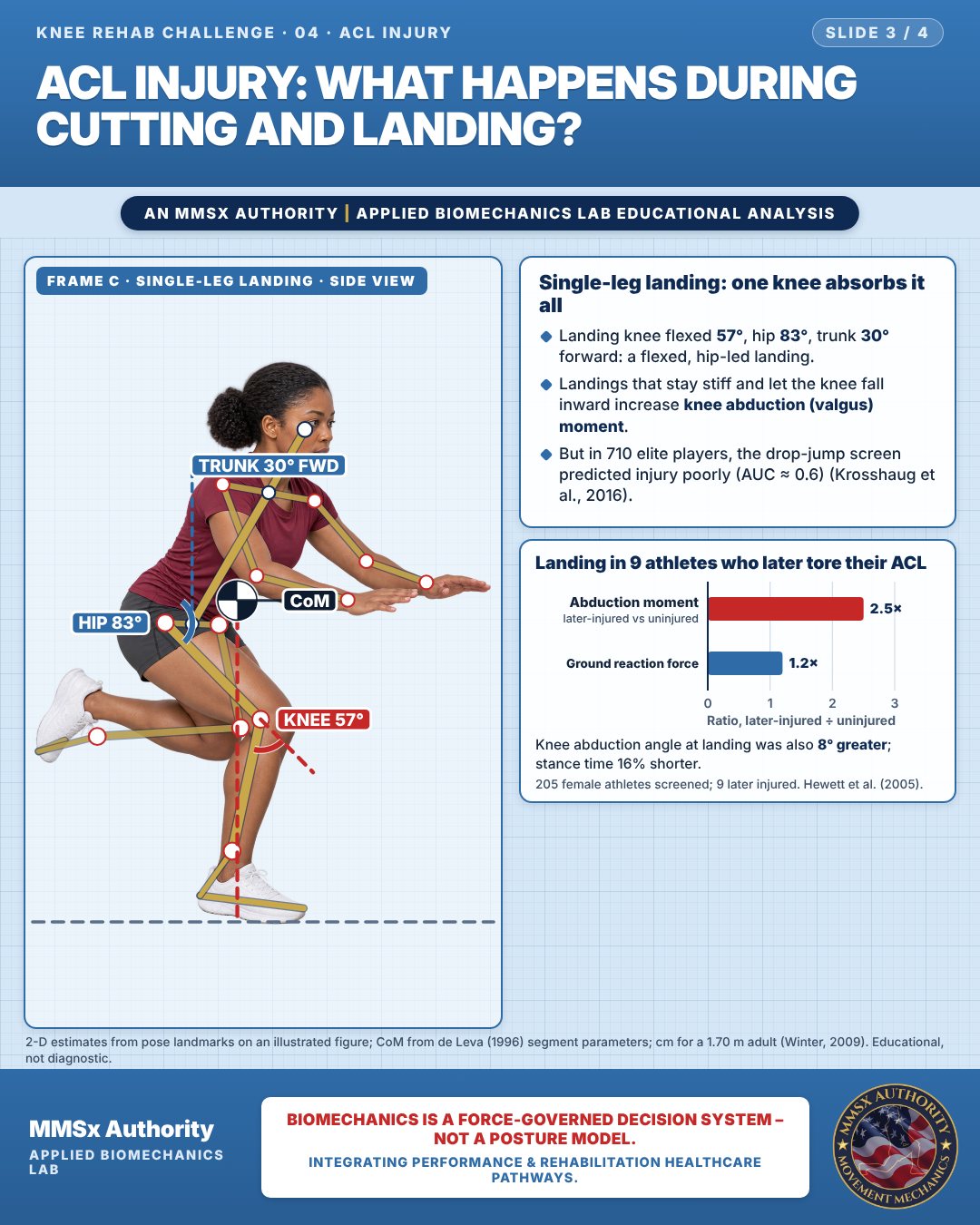
Single-leg landing: one knee absorbs it all
Landing knee flexed 57°, hip 83°, trunk 30° forward: a flexed, hip-led landing.
Landings that stay stiff and let the knee fall inward increase knee abduction (valgus) moment.
But in 710 elite players, the drop-jump screen predicted injury poorly (AUC ≈ 0.6) (Krosshaug et al., 2016).
Landing in 9 athletes who later tore their ACL
Knee abduction angle at landing was also 8° greater; stance time 16% shorter.
Decision pathway
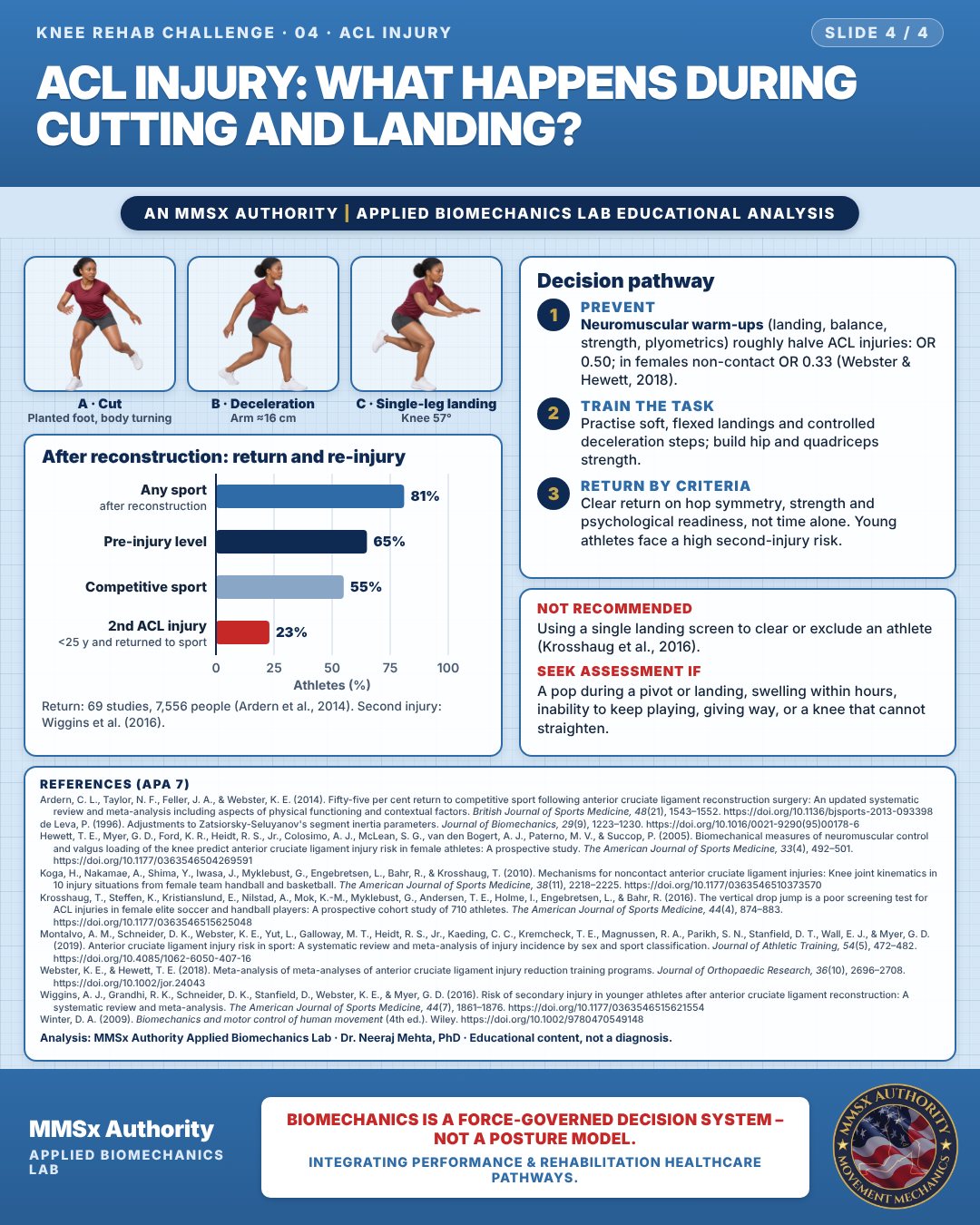
After reconstruction: return and re-injury
Prevent
Neuromuscular warm-ups (landing, balance, strength, plyometrics) roughly halve ACL injuries: OR 0.50; in females non-contact OR 0.33 (Webster & Hewett, 2018).
Train the task
Practise soft, flexed landings and controlled deceleration steps; build hip and quadriceps strength.
Return by criteria
Clear return on hop symmetry, strength and psychological readiness, not time alone. Young athletes face a high second-injury risk.
What the evidence supports
- Recommend: neuromuscular injury-prevention warm-ups (landing technique, balance, strength, plyometrics) for athletes in pivoting/landing sports — halves ACL injuries overall (Webster & Hewett, 2018).
- After injury/reconstruction: criteria-based (not time-only) return-to-sport decisions; restore hop symmetry and psychological readiness (factors in Ardern et al., 2014); recognise high second-injury risk in young athletes returning to pivoting sport (Wiggins et al., 2016).
- Do not rely on a single landing screening test to clear or exclude athletes (Krosshaug et al., 2016).
Myth and evidence
Myth“ACL injuries mostly come from being tackled.”
Evidence— the video series shows non-contact mechanisms: valgus +12° and internal rotation within 40 ms of foot contact (Koga et al., 2010).
Myth“A screening jump can tell who will tear their ACL.”
Evidence— AUC ≈0.6 in 710 athletes (Krosshaug et al., 2016).
Cautions
Not recommended
Using a single landing screen to clear or exclude an athlete (Krosshaug et al., 2016).
Seek assessment if
A pop during a pivot or landing, swelling within hours, inability to keep playing, giving way, or a knee that cannot straighten.
Methods note
2-D estimates from pose landmarks on an illustrated figure; CoM from de Leva (1996) segment parameters; cm for a 1.70 m adult (Winter, 2009). Frame A is oblique: no angles reported. GRF line drawn from contact to CoM. These are educational estimates, not a diagnosis.
References
- Ardern, C. L., Taylor, N. F., Feller, J. A., & Webster, K. E. (2014). Fifty-five per cent return to competitive sport following anterior cruciate ligament reconstruction surgery: An updated systematic review and meta-analysis including aspects of physical functioning and contextual factors. British Journal of Sports Medicine, 48(21), 1543–1552. https://doi.org/10.1136/bjsports-2013-093398
- de Leva, P. (1996). Adjustments to Zatsiorsky-Seluyanov's segment inertia parameters. Journal of Biomechanics, 29(9), 1223–1230. https://doi.org/10.1016/0021-9290(95)00178-6
- Hewett, T. E., Myer, G. D., Ford, K. R., Heidt, R. S., Jr., Colosimo, A. J., McLean, S. G., van den Bogert, A. J., Paterno, M. V., & Succop, P. (2005). Biomechanical measures of neuromuscular control and valgus loading of the knee predict anterior cruciate ligament injury risk in female athletes: A prospective study. The American Journal of Sports Medicine, 33(4), 492–501. https://doi.org/10.1177/0363546504269591
- Koga, H., Nakamae, A., Shima, Y., Iwasa, J., Myklebust, G., Engebretsen, L., Bahr, R., & Krosshaug, T. (2010). Mechanisms for noncontact anterior cruciate ligament injuries: Knee joint kinematics in 10 injury situations from female team handball and basketball. The American Journal of Sports Medicine, 38(11), 2218–2225. https://doi.org/10.1177/0363546510373570
- Krosshaug, T., Steffen, K., Kristianslund, E., Nilstad, A., Mok, K.-M., Myklebust, G., Andersen, T. E., Holme, I., Engebretsen, L., & Bahr, R. (2016). The vertical drop jump is a poor screening test for ACL injuries in female elite soccer and handball players: A prospective cohort study of 710 athletes. The American Journal of Sports Medicine, 44(4), 874–883. https://doi.org/10.1177/0363546515625048
- Montalvo, A. M., Schneider, D. K., Webster, K. E., Yut, L., Galloway, M. T., Heidt, R. S., Jr., Kaeding, C. C., Kremcheck, T. E., Magnussen, R. A., Parikh, S. N., Stanfield, D. T., Wall, E. J., & Myer, G. D. (2019). Anterior cruciate ligament injury risk in sport: A systematic review and meta-analysis of injury incidence by sex and sport classification. Journal of Athletic Training, 54(5), 472–482. https://doi.org/10.4085/1062-6050-407-16
- Webster, K. E., & Hewett, T. E. (2018). Meta-analysis of meta-analyses of anterior cruciate ligament injury reduction training programs. Journal of Orthopaedic Research, 36(10), 2696–2708. https://doi.org/10.1002/jor.24043
- Wiggins, A. J., Grandhi, R. K., Schneider, D. K., Stanfield, D., Webster, K. E., & Myer, G. D. (2016). Risk of secondary injury in younger athletes after anterior cruciate ligament reconstruction: A systematic review and meta-analysis. The American Journal of Sports Medicine, 44(7), 1861–1876. https://doi.org/10.1177/0363546515621554
- Winter, D. A. (2009). Biomechanics and motor control of human movement (4th ed.). Wiley. https://doi.org/10.1002/9780470549148
Cite this article
Mehta, N. (2026, October 23). ACL injury: what happens during cutting and landing? MMSx Authority Applied Biomechanics Lab. https://mmsxauthority.org/edu/analysis/knee/04-acl-injury-what-happens-during-cutting-and-landing/
Part of the collection
Mehta, N. (2026). Knee Rehabilitation: 50 Evidence-Based Biomechanics Analyses [Collection]. MMSx Authority Applied Biomechanics Lab. Zenodo. https://doi.org/10.5281/zenodo.23735752