Knee Rehab Challenge · 03
Meniscus injury: knee pain when twisting or turning
A meniscus injury is a tear of the medial or lateral fibrocartilage meniscus. Movement analysis, verified research data and a decision pathway from the MMSx A
Key points
- Triage. A knee that cannot fully straighten after a twist, or swells within hours, needs a prompt surgical opinion; repair is preferred over removal where possible.
- Exercise first. Degenerative tear: 12 weeks of supervised exercise matched partial meniscectomy at 2 years and built more thigh strength (Kise et al., 2016).
- Rebuild. Progress squat depth, load and pivoting gradually; turn the body before the knee when getting out of a car.
What it is
A meniscus injury is a tear of the medial or lateral fibrocartilage meniscus; in younger, active people it is usually traumatic (twisting on a flexed, loaded knee), whereas in middle-aged and older people degenerative tears are common, often incidental, and frequently part of early osteoarthritis.
How we analysed the movement
Three movements relevant to this topic were analysed from illustrated reference figures. Joint centres were located with two-dimensional pose estimation; joint angles, the whole-body centre of mass and, where relevant, the ground-reaction-force line and its moment arm about the knee were then calculated from standard segment parameters. The figures are educational estimates that show how position changes mechanical demand; they are not measurements of a patient. Every research value quoted below comes from the published source cited beside it.
Movement A: Planted-foot turn, oblique
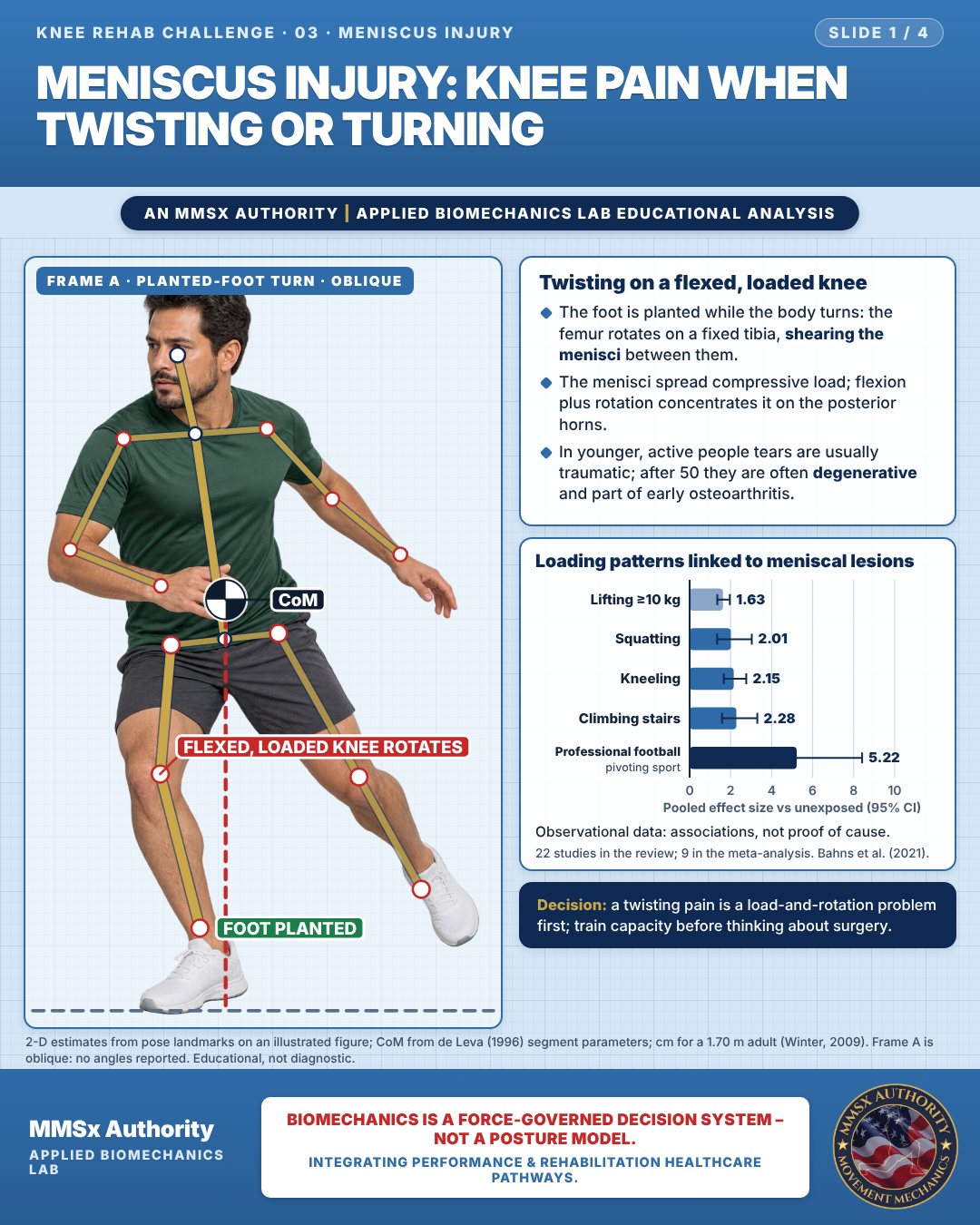
Twisting on a flexed, loaded knee
The foot is planted while the body turns: the femur rotates on a fixed tibia, shearing the menisci between them.
The menisci spread compressive load; flexion plus rotation concentrates it on the posterior horns.
In younger, active people tears are usually traumatic; after 50 they are often degenerative and part of early osteoarthritis.
Loading patterns linked to meniscal lesions
Observational data: associations, not proof of cause.
Movement B: Getting out of a car, oblique
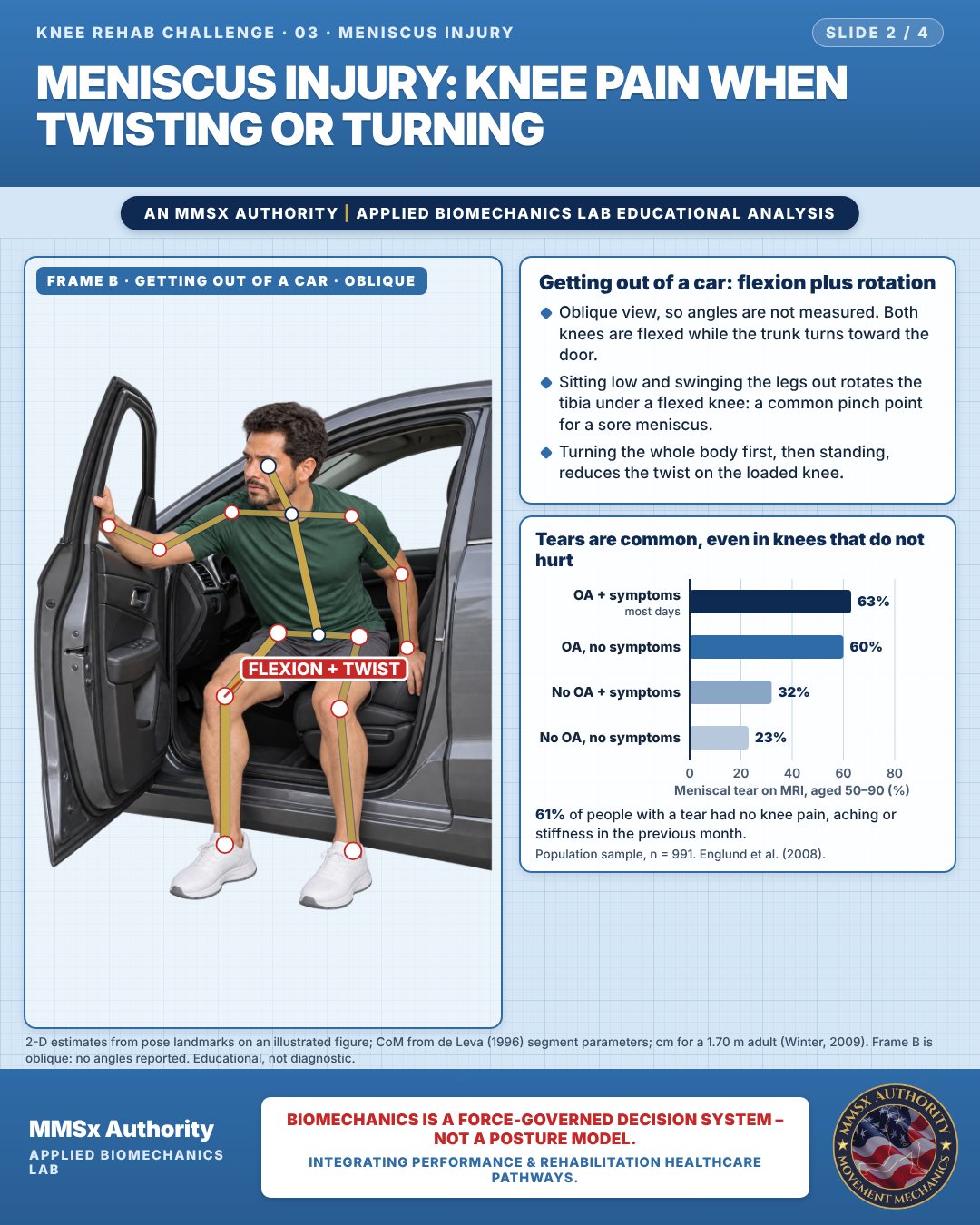
Getting out of a car: flexion plus rotation
Oblique view, so angles are not measured. Both knees are flexed while the trunk turns toward the door.
Sitting low and swinging the legs out rotates the tibia under a flexed knee: a common pinch point for a sore meniscus.
Turning the whole body first, then standing, reduces the twist on the loaded knee.
Tears are common, even in knees that do not hurt
61% of people with a tear had no knee pain, aching or stiffness in the previous month.
Movement C: Deep squat to a low shelf (side view)
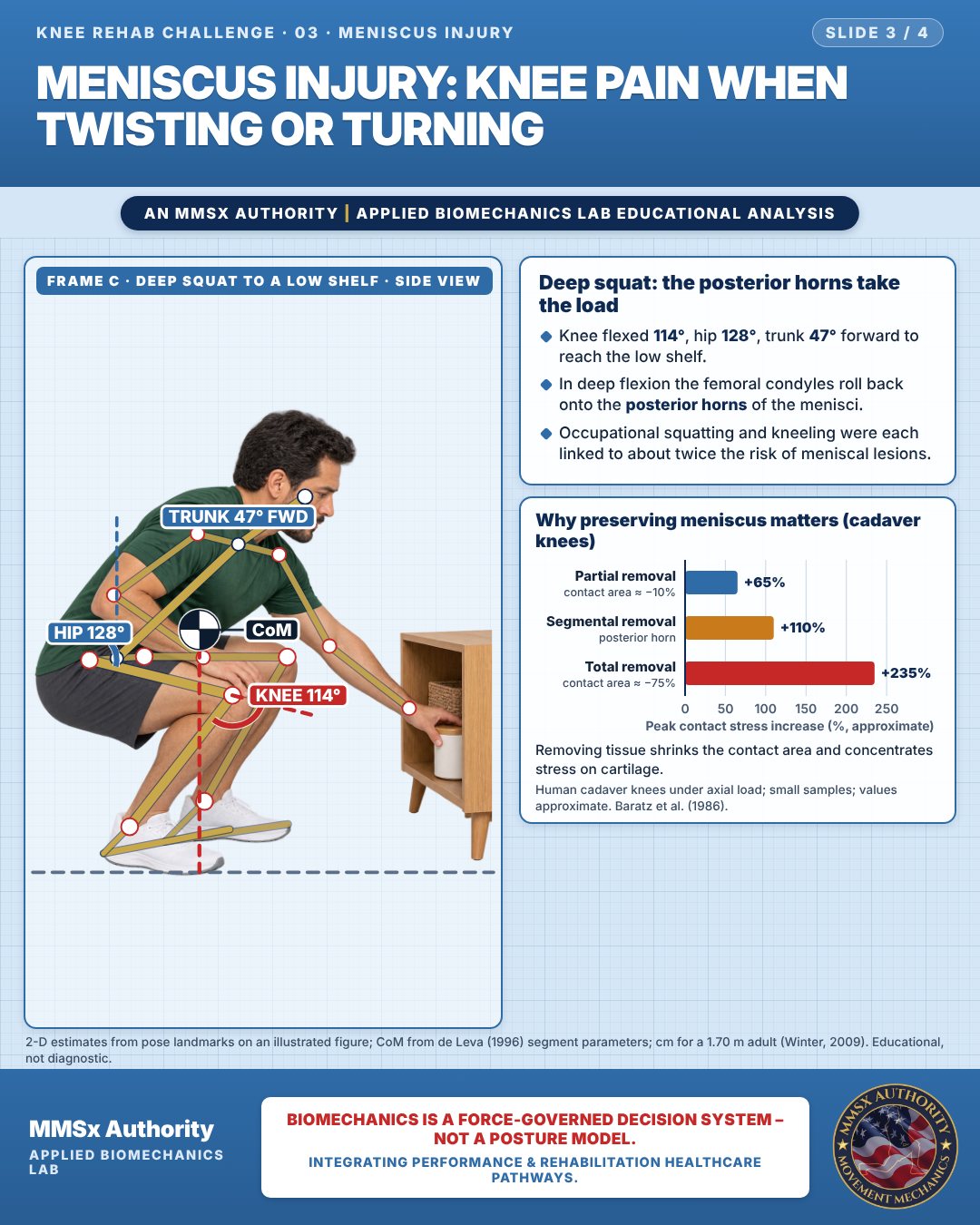
Deep squat: the posterior horns take the load
Knee flexed 114°, hip 128°, trunk 47° forward to reach the low shelf.
In deep flexion the femoral condyles roll back onto the posterior horns of the menisci.
Occupational squatting and kneeling were each linked to about twice the risk of meniscal lesions.
Why preserving meniscus matters (cadaver knees)
Removing tissue shrinks the contact area and concentrates stress on cartilage.
Decision pathway
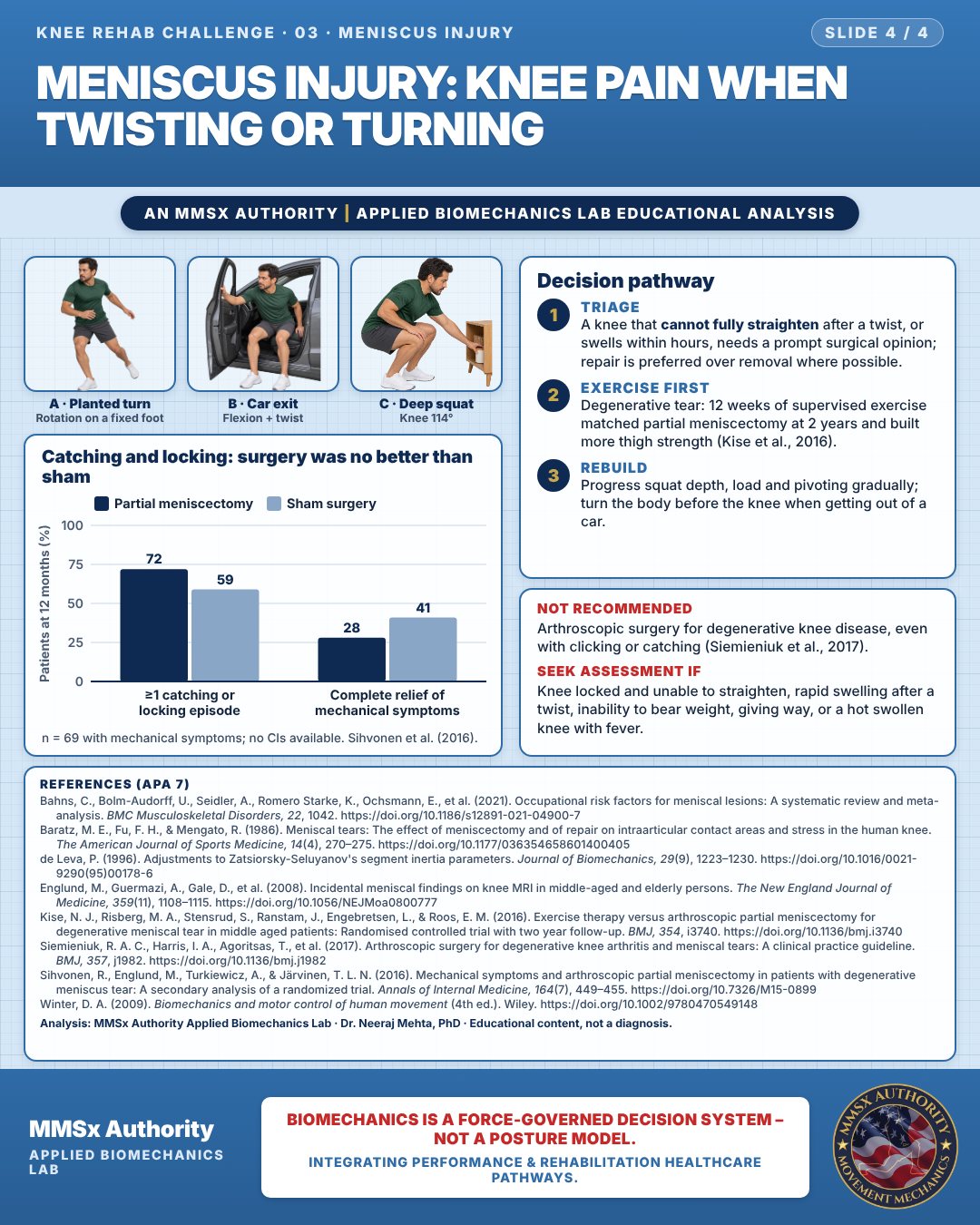
Catching and locking: surgery was no better than sham
Triage
A knee that cannot fully straighten after a twist, or swells within hours, needs a prompt surgical opinion; repair is preferred over removal where possible.
Exercise first
Degenerative tear: 12 weeks of supervised exercise matched partial meniscectomy at 2 years and built more thigh strength (Kise et al., 2016).
Rebuild
Progress squat depth, load and pivoting gradually; turn the body before the knee when getting out of a car.
What the evidence supports
- BMJ Rapid Recommendation (Siemieniuk et al., 2017): strong recommendation AGAINST arthroscopic knee surgery in degenerative knee disease, applying to patients with or without imaging evidence of OA, mechanical symptoms (locking, clicking, catching), acute onset, or meniscal tears. Panel: small short-term improvement in function possible, no important difference in pain or function at 1–2 years.com page.
- First line for degenerative tears: supervised exercise therapy (Kise et al., 2016 — non-inferior to APM at 2 years).
Myth and evidence
Myth“A tear on the MRI explains my pain.”
Evidence— 61% of people aged 50–90 with MRI tears had no recent symptoms; tear prevalence is 23% even in people with no OA and no symptoms (Englund et al., 2008).
Myth“Catching or locking means I need keyhole surgery.”
Evidence— after APM, 72% still had catching/locking episodes vs 59% after sham surgery (Sihvonen et al., 2016, via AFP summary); BMJ guideline recommends against arthroscopy even with mechanical symptoms (Siemieniuk et al., 2017).
Cautions
Not recommended
Arthroscopic surgery for degenerative knee disease, even with clicking or catching (Siemieniuk et al., 2017).
Seek assessment if
Knee locked and unable to straighten, rapid swelling after a twist, inability to bear weight, giving way, or a hot swollen knee with fever.
Methods note
2-D estimates from pose landmarks on an illustrated figure; CoM from de Leva (1996) segment parameters; cm for a 1.70 m adult (Winter, 2009). Frame A is oblique: no angles reported. Frame B is oblique: no angles reported. These are educational estimates, not a diagnosis.
References
- Bahns, C., Bolm-Audorff, U., Seidler, A., Romero Starke, K., Ochsmann, E., et al. (2021). Occupational risk factors for meniscal lesions: A systematic review and meta-analysis. BMC Musculoskeletal Disorders, 22, 1042. https://doi.org/10.1186/s12891-021-04900-7
- Baratz, M. E., Fu, F. H., & Mengato, R. (1986). Meniscal tears: The effect of meniscectomy and of repair on intraarticular contact areas and stress in the human knee. The American Journal of Sports Medicine, 14(4), 270–275. https://doi.org/10.1177/036354658601400405
- de Leva, P. (1996). Adjustments to Zatsiorsky-Seluyanov's segment inertia parameters. Journal of Biomechanics, 29(9), 1223–1230. https://doi.org/10.1016/0021-9290(95)00178-6
- Englund, M., Guermazi, A., Gale, D., et al. (2008). Incidental meniscal findings on knee MRI in middle-aged and elderly persons. The New England Journal of Medicine, 359(11), 1108–1115. https://doi.org/10.1056/NEJMoa0800777
- Kise, N. J., Risberg, M. A., Stensrud, S., Ranstam, J., Engebretsen, L., & Roos, E. M. (2016). Exercise therapy versus arthroscopic partial meniscectomy for degenerative meniscal tear in middle aged patients: Randomised controlled trial with two year follow-up. BMJ, 354, i3740. https://doi.org/10.1136/bmj.i3740
- Siemieniuk, R. A. C., Harris, I. A., Agoritsas, T., et al. (2017). Arthroscopic surgery for degenerative knee arthritis and meniscal tears: A clinical practice guideline. BMJ, 357, j1982. https://doi.org/10.1136/bmj.j1982
- Sihvonen, R., Englund, M., Turkiewicz, A., & Järvinen, T. L. N. (2016). Mechanical symptoms and arthroscopic partial meniscectomy in patients with degenerative meniscus tear: A secondary analysis of a randomized trial. Annals of Internal Medicine, 164(7), 449–455. https://doi.org/10.7326/M15-0899
- Winter, D. A. (2009). Biomechanics and motor control of human movement (4th ed.). Wiley. https://doi.org/10.1002/9780470549148
Cite this article
Mehta, N. (2026, October 23). Meniscus injury: knee pain when twisting or turning. MMSx Authority Applied Biomechanics Lab. https://mmsxauthority.org/edu/analysis/knee/03-meniscus-injury-knee-pain-when-twisting-or-turning/
Part of the collection
Mehta, N. (2026). Knee Rehabilitation: 50 Evidence-Based Biomechanics Analyses [Collection]. MMSx Authority Applied Biomechanics Lab. Zenodo. https://doi.org/10.5281/zenodo.23735752