Hamstring & Thigh Rehab Challenge · 49
Thigh red flags: when thigh pain needs urgent medical care
Red flags are features of thigh pain that suggest a serious, time-sensitive cause rather than a muscle problem.
Key points
- Stop. Do not stretch, massage or train through thigh pain that shows any red flag.
- Get checked. Seek prompt medical assessment; imaging or blood tests decide the cause, not exercise.
- Then rehab. Once serious causes are excluded, rehabilitation follows the specific diagnosis.
What it is
Red flags are features of thigh pain that suggest a serious, time-sensitive cause rather than a muscle problem. They include fracture, including stress fracture, after a fall or repeated loading; infection of the hip or bone; bone tumour; compartment syndrome; deep vein thrombosis; tendon avulsion; and exertional rhabdomyolysis. They call for prompt medical assessment, not exercise management.
How we analysed the movement
Three movements relevant to this topic were analysed from illustrated reference figures. Joint centres were located with two-dimensional pose estimation; hip and knee angles, pelvis level, the whole-body centre of mass and, where relevant, the hip lever (the horizontal distance from the hip joint to the upper-body centre of mass) and the resulting static hip moment were then calculated from standard segment parameters. The figures are educational estimates that show how position changes mechanical demand; they are not measurements of a patient. Every research value quoted below comes from the published source cited beside it.
Movement A: Cannot bear weight (front view)
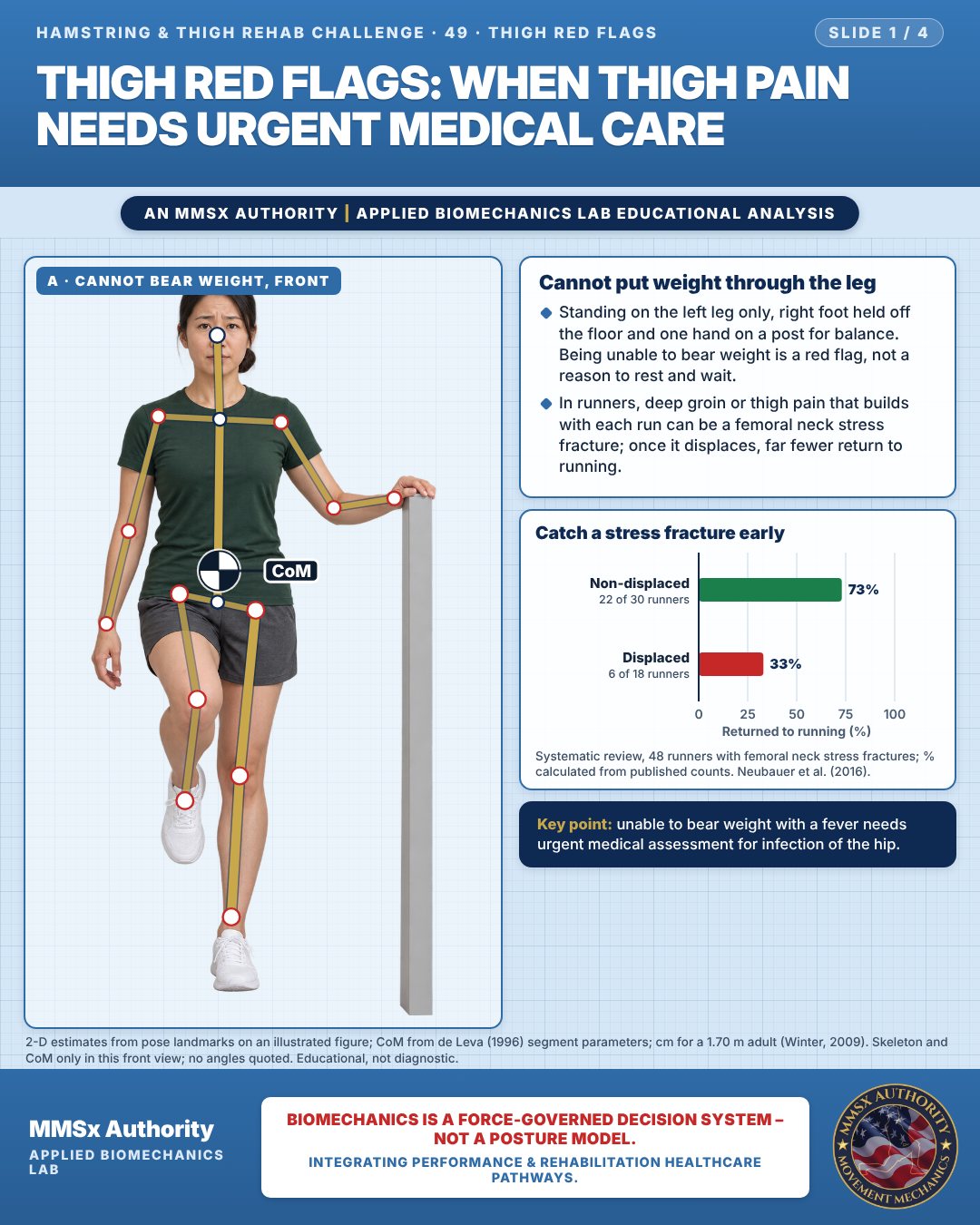
Cannot put weight through the leg
Standing on the left leg only, right foot held off the floor and one hand on a post for balance. Being unable to bear weight is a red flag, not a reason to rest and wait.
In runners, deep groin or thigh pain that builds with each run can be a femoral neck stress fracture; once it displaces, far fewer return to running.
Catch a stress fracture early
Movement B: Sitting on bed (side view)
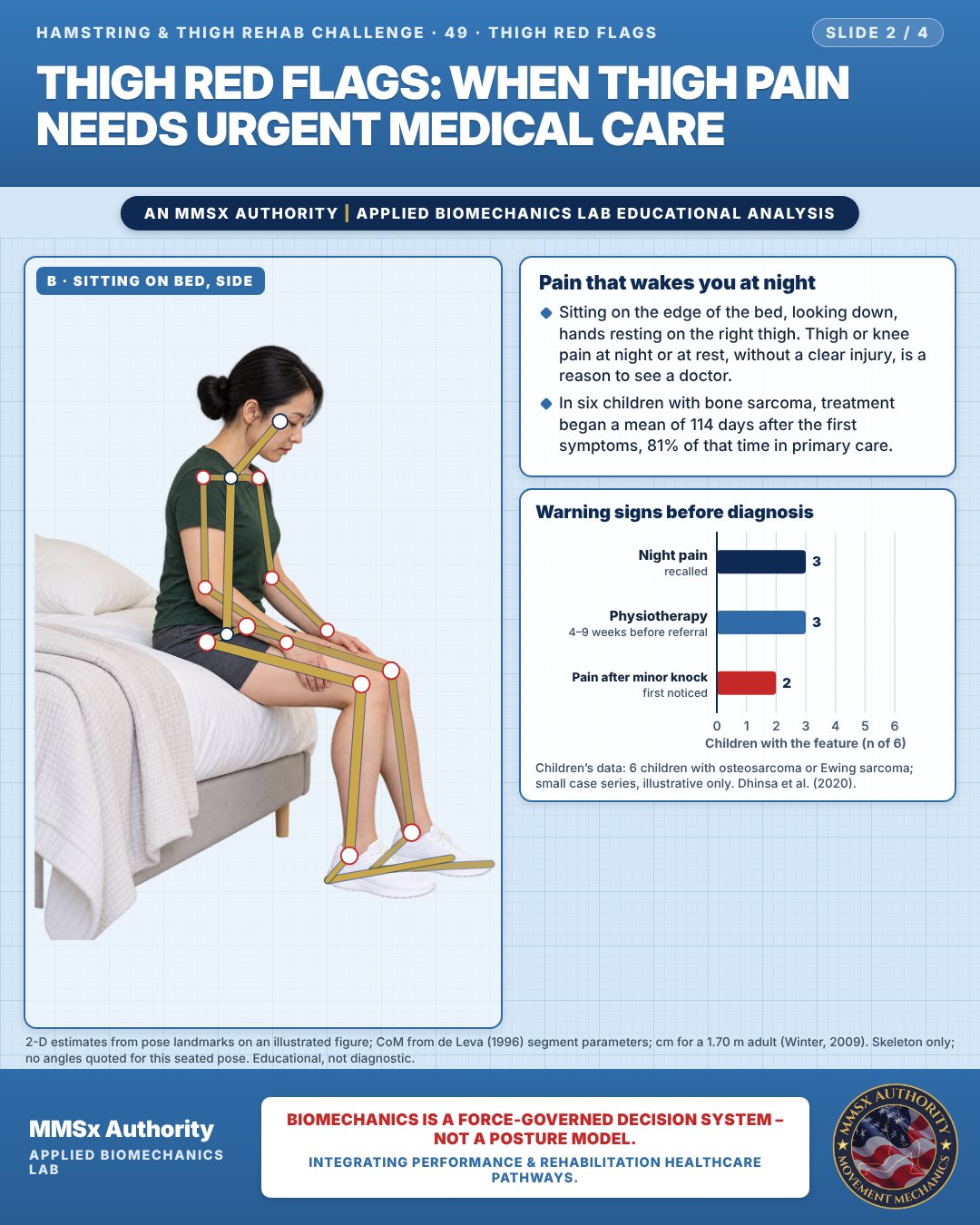
Pain that wakes you at night
Sitting on the edge of the bed, looking down, hands resting on the right thigh. Thigh or knee pain at night or at rest, without a clear injury, is a reason to see a doctor.
In six children with bone sarcoma, treatment began a mean of 114 days after the first symptoms, 81% of that time in primary care.
Warning signs before diagnosis
Movement C: After a fall (front view)
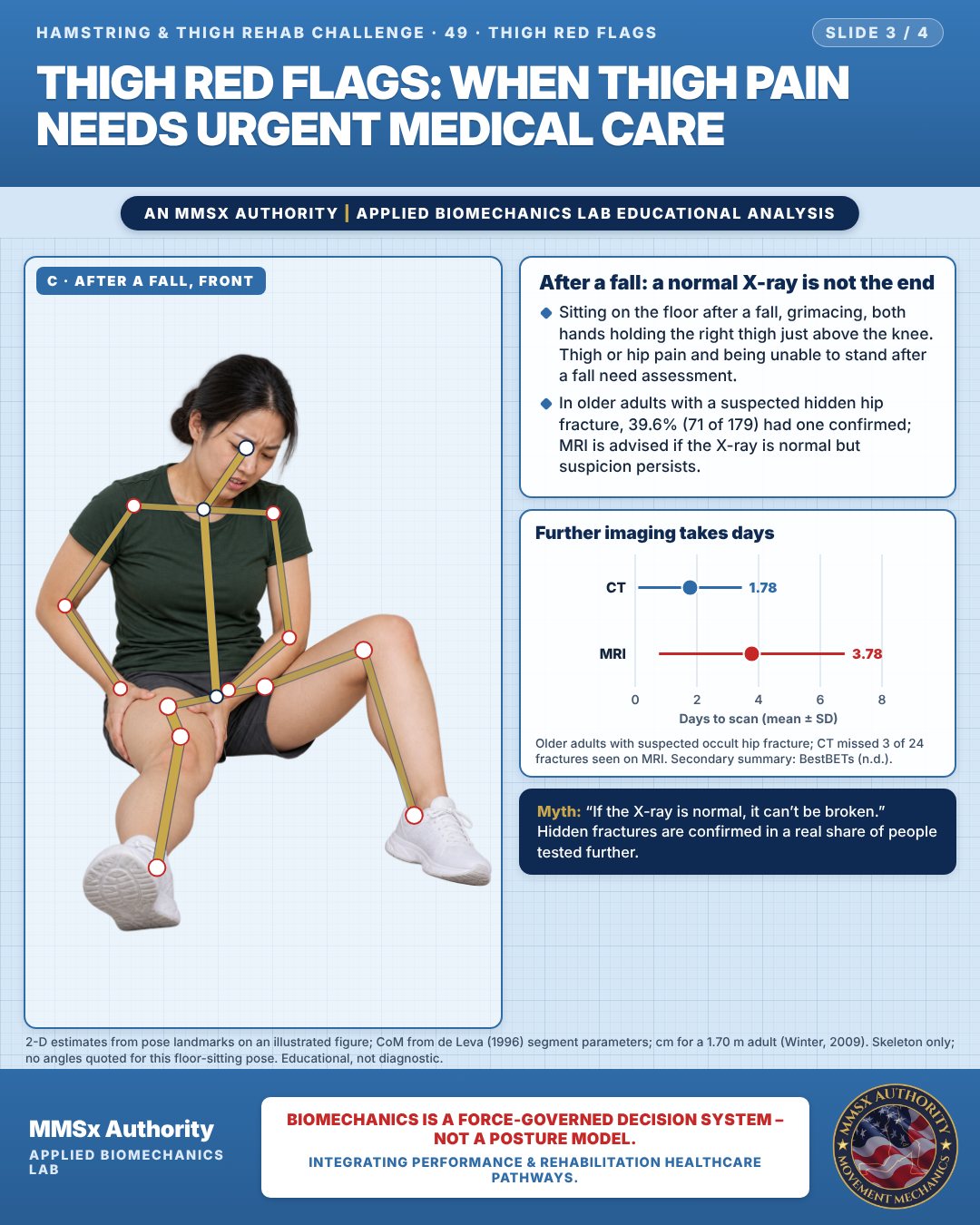
After a fall: a normal X-ray is not the end
Sitting on the floor after a fall, grimacing, both hands holding the right thigh just above the knee. Thigh or hip pain and being unable to stand after a fall need assessment.
In older adults with a suspected hidden hip fracture, 39.6% (71 of 179) had one confirmed; MRI is advised if the X-ray is normal but suspicion persists.
Further imaging takes days
Decision pathway
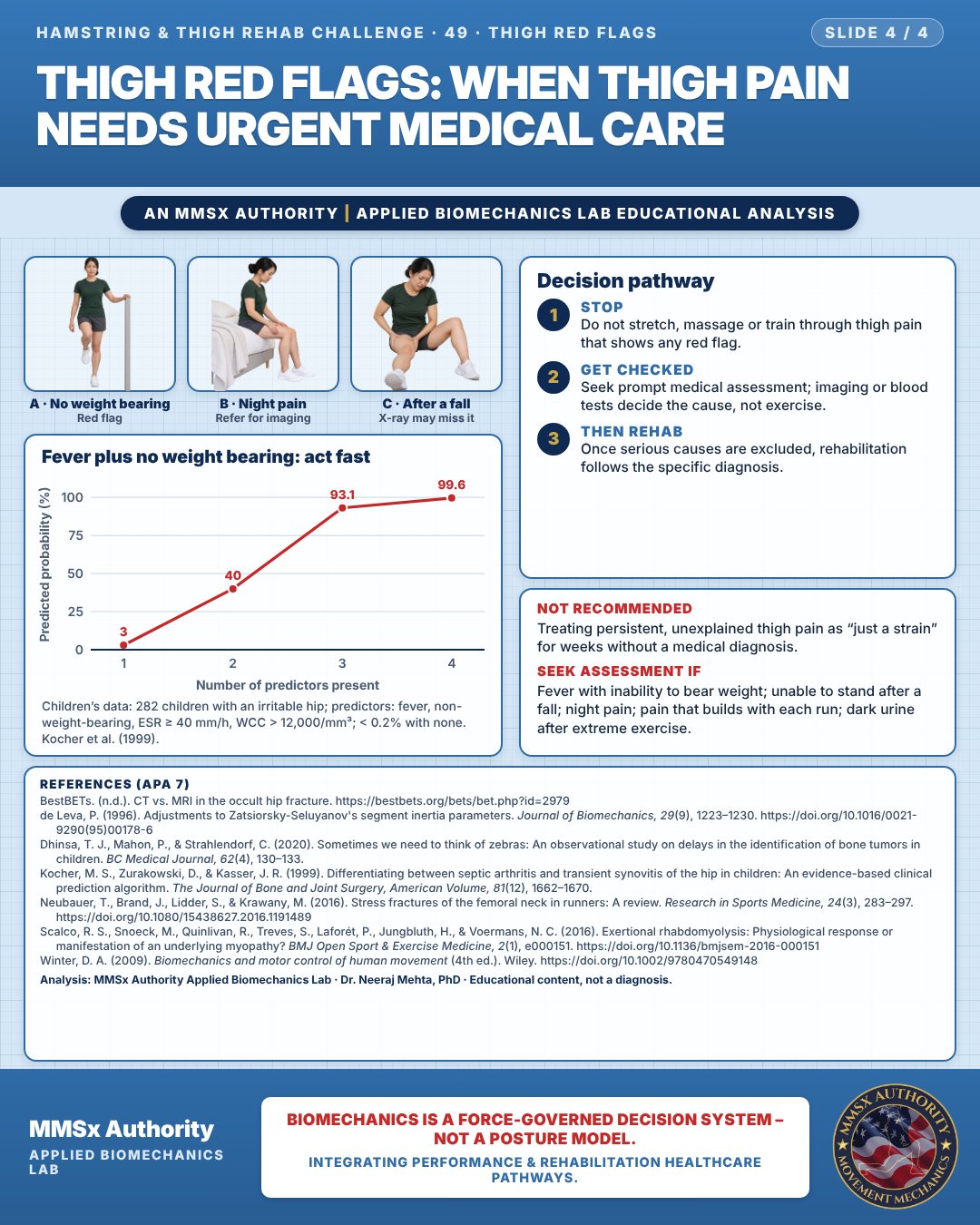
Fever plus no weight bearing: act fast
Stop
Do not stretch, massage or train through thigh pain that shows any red flag.
Get checked
Seek prompt medical assessment; imaging or blood tests decide the cause, not exercise.
Then rehab
Once serious causes are excluded, rehabilitation follows the specific diagnosis.
What the evidence supports
- Suspected septic hip: urgent assessment (Kocher et al., 1999);
Cautions
Not recommended
Treating persistent, unexplained thigh pain as “just a strain” for weeks without a medical diagnosis.
Seek assessment if
Fever with inability to bear weight; unable to stand after a fall; night pain; pain that builds with each run; dark urine after extreme exercise.
Methods note
2-D estimates from pose landmarks on an illustrated figure; CoM from de Leva (1996) segment parameters; cm for a 1.70 m adult (Winter, 2009). Skeleton and CoM only in this front view; no angles quoted. Skeleton only; no angles quoted for this seated pose. Skeleton only; no angles quoted for this floor-sitting pose. These are educational estimates, not a diagnosis.
References
- BestBETs. (n.d.). CT vs. MRI in the occult hip fracture. https://bestbets.org/bets/bet.php?id=2979
- de Leva, P. (1996). Adjustments to Zatsiorsky-Seluyanov's segment inertia parameters. Journal of Biomechanics, 29(9), 1223–1230. https://doi.org/10.1016/0021-9290(95)00178-6
- Dhinsa, T. J., Mahon, P., & Strahlendorf, C. (2020). Sometimes we need to think of zebras: An observational study on delays in the identification of bone tumors in children. BC Medical Journal, 62(4), 130–133.
- Kocher, M. S., Zurakowski, D., & Kasser, J. R. (1999). Differentiating between septic arthritis and transient synovitis of the hip in children: An evidence-based clinical prediction algorithm. The Journal of Bone and Joint Surgery, American Volume, 81(12), 1662–1670.
- Neubauer, T., Brand, J., Lidder, S., & Krawany, M. (2016). Stress fractures of the femoral neck in runners: A review. Research in Sports Medicine, 24(3), 283–297. https://doi.org/10.1080/15438627.2016.1191489
- Scalco, R. S., Snoeck, M., Quinlivan, R., Treves, S., Laforét, P., Jungbluth, H., & Voermans, N. C. (2016). Exertional rhabdomyolysis: Physiological response or manifestation of an underlying myopathy? BMJ Open Sport & Exercise Medicine, 2(1), e000151. https://doi.org/10.1136/bmjsem-2016-000151
- Winter, D. A. (2009). Biomechanics and motor control of human movement (4th ed.). Wiley. https://doi.org/10.1002/9780470549148
Cite this article
Mehta, N. (2026, October 26). Thigh red flags: when thigh pain needs urgent medical care. MMSx Authority Applied Biomechanics Lab. https://mmsxauthority.org/edu/analysis/hamstring-thigh/49-thigh-red-flags-when-thigh-pain-needs-urgent-medical-care/
Part of the collection
Mehta, N. (2026). Hamstring and Thigh Rehabilitation: 50 Evidence-Based Biomechanics Analyses [Collection]. MMSx Authority Applied Biomechanics Lab. Zenodo. https://doi.org/10.5281/zenodo.23735792
All Hamstring & Thigh Rehab Challenge articles · Rehabilitation Library