Hamstring & Thigh Rehab Challenge · 50
Returning to sport after a thigh injury: strength, speed and confidence tests
Return to sport after a thigh muscle injury is a staged decision that combines time-based healing, symptom response and performance on tests of…
Key points
- Strength. Measure knee-flexor strength with a dynamometer; low eccentric force carried 2.7–4.3× risk.
- Speed. Test repeated sprints and confirm near-maximal speed in training before match return.
- Progress. Use injury history in the plan and keep the Nordic exercise going after return.
What it is
Return to sport after a thigh muscle injury is a staged decision that combines time-based healing, symptom response and performance on tests of strength, running and sprinting, and readiness. For hamstring strain injury, no single set of return-to-play criteria has been validated, so decisions rest on several measures together (Martin et al., 2022).
How we analysed the movement
Three movements relevant to this topic were analysed from illustrated reference figures. Joint centres were located with two-dimensional pose estimation; hip and knee angles, pelvis level, the whole-body centre of mass and, where relevant, the hip lever (the horizontal distance from the hip joint to the upper-body centre of mass) and the resulting static hip moment were then calculated from standard segment parameters. The figures are educational estimates that show how position changes mechanical demand; they are not measurements of a patient. Every research value quoted below comes from the published source cited beside it.
Movement A: Single-leg hop (side view)
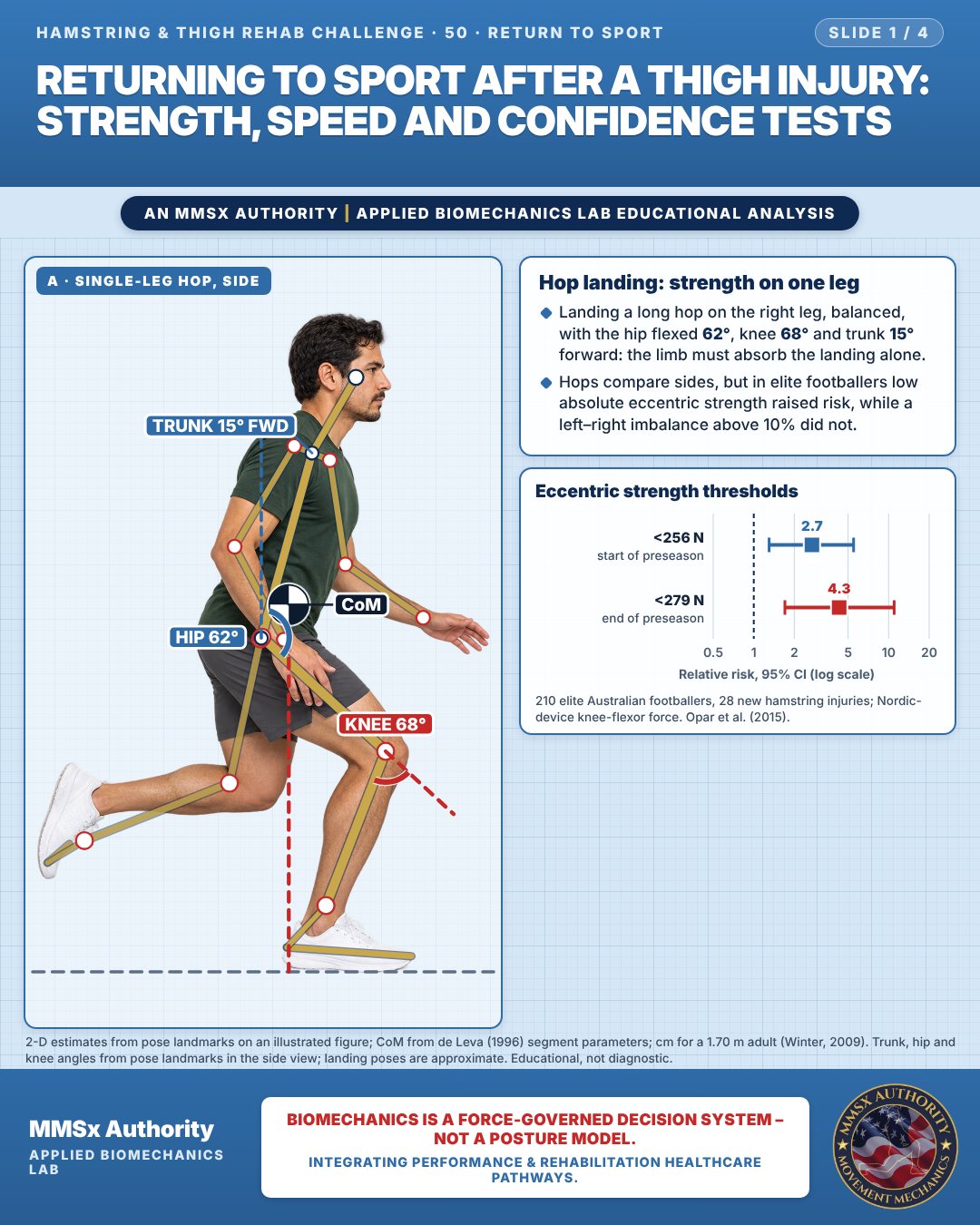
Hop landing: strength on one leg
Landing a long hop on the right leg, balanced, with the hip flexed 62°, knee 68° and trunk 15° forward: the limb must absorb the landing alone.
Hops compare sides, but in elite footballers low absolute eccentric strength raised risk, while a left–right imbalance above 10% did not.
Eccentric strength thresholds
Movement B: Full-speed sprint (side view)
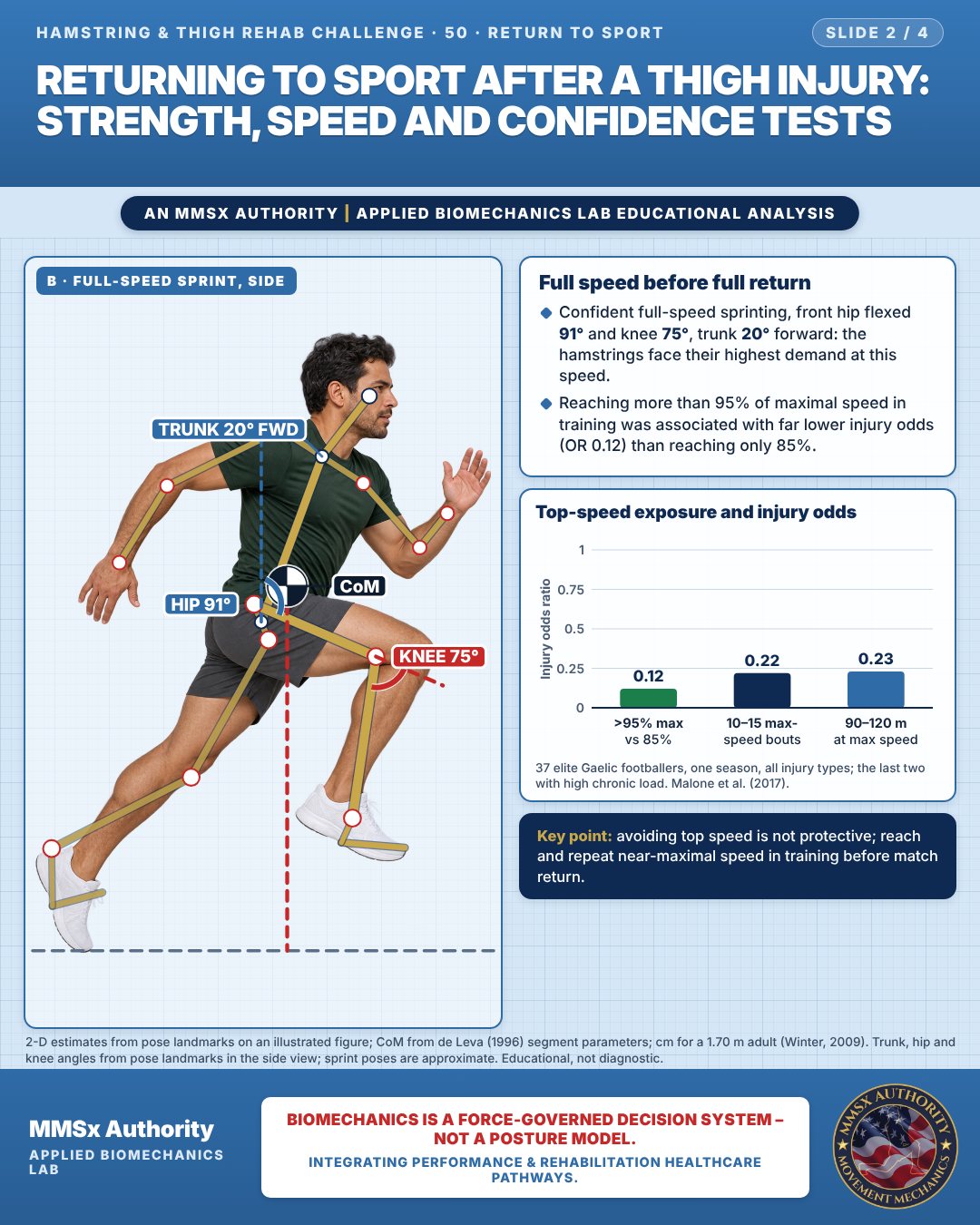
Full speed before full return
Confident full-speed sprinting, front hip flexed 91° and knee 75°, trunk 20° forward: the hamstrings face their highest demand at this speed.
Reaching more than 95% of maximal speed in training was associated with far lower injury odds (OR 0.12) than reaching only 85%.
Top-speed exposure and injury odds
Movement C: Agility cut (front view)
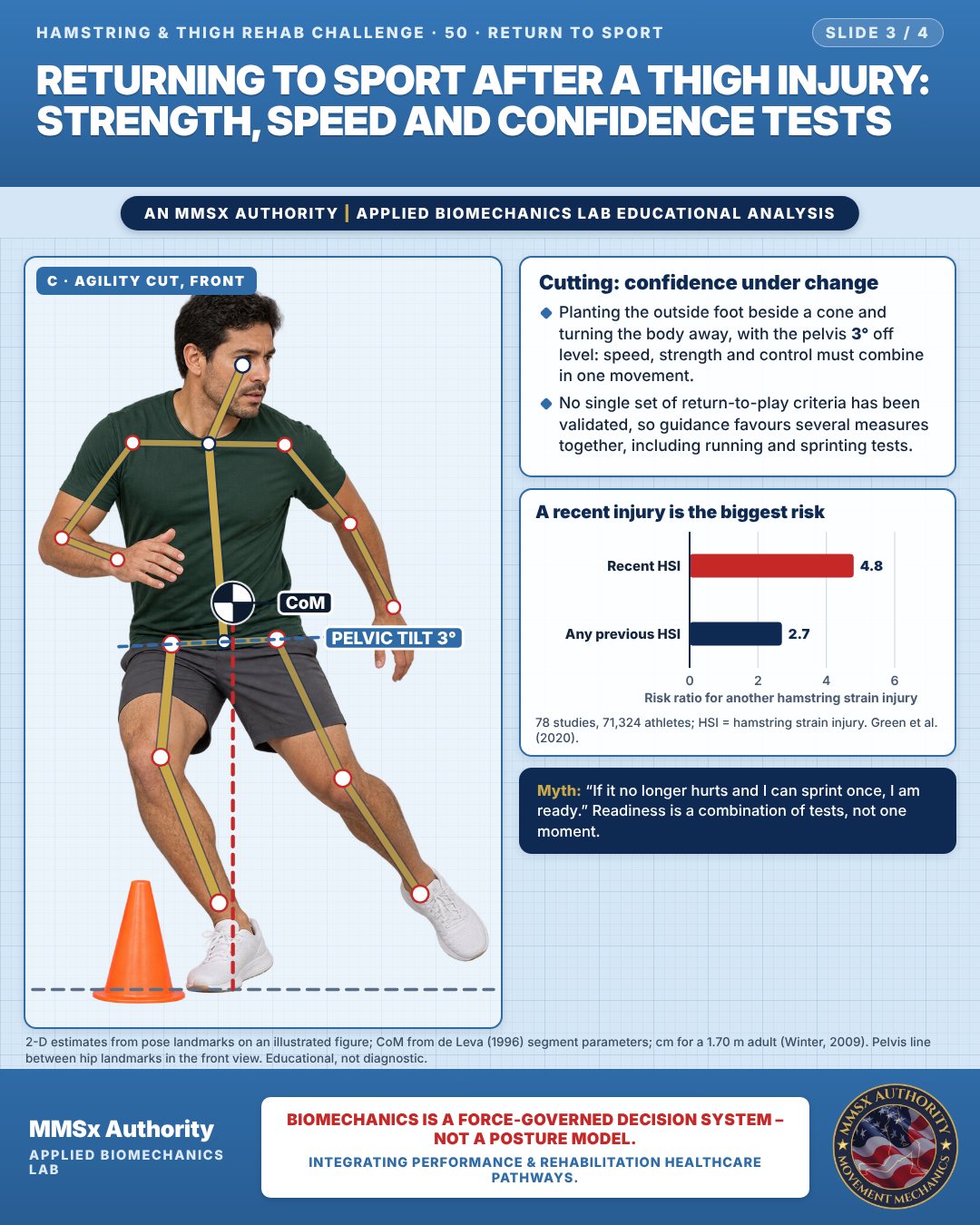
Cutting: confidence under change
Planting the outside foot beside a cone and turning the body away, with the pelvis 3° off level: speed, strength and control must combine in one movement.
No single set of return-to-play criteria has been validated, so guidance favours several measures together, including running and sprinting tests.
A recent injury is the biggest risk
Decision pathway
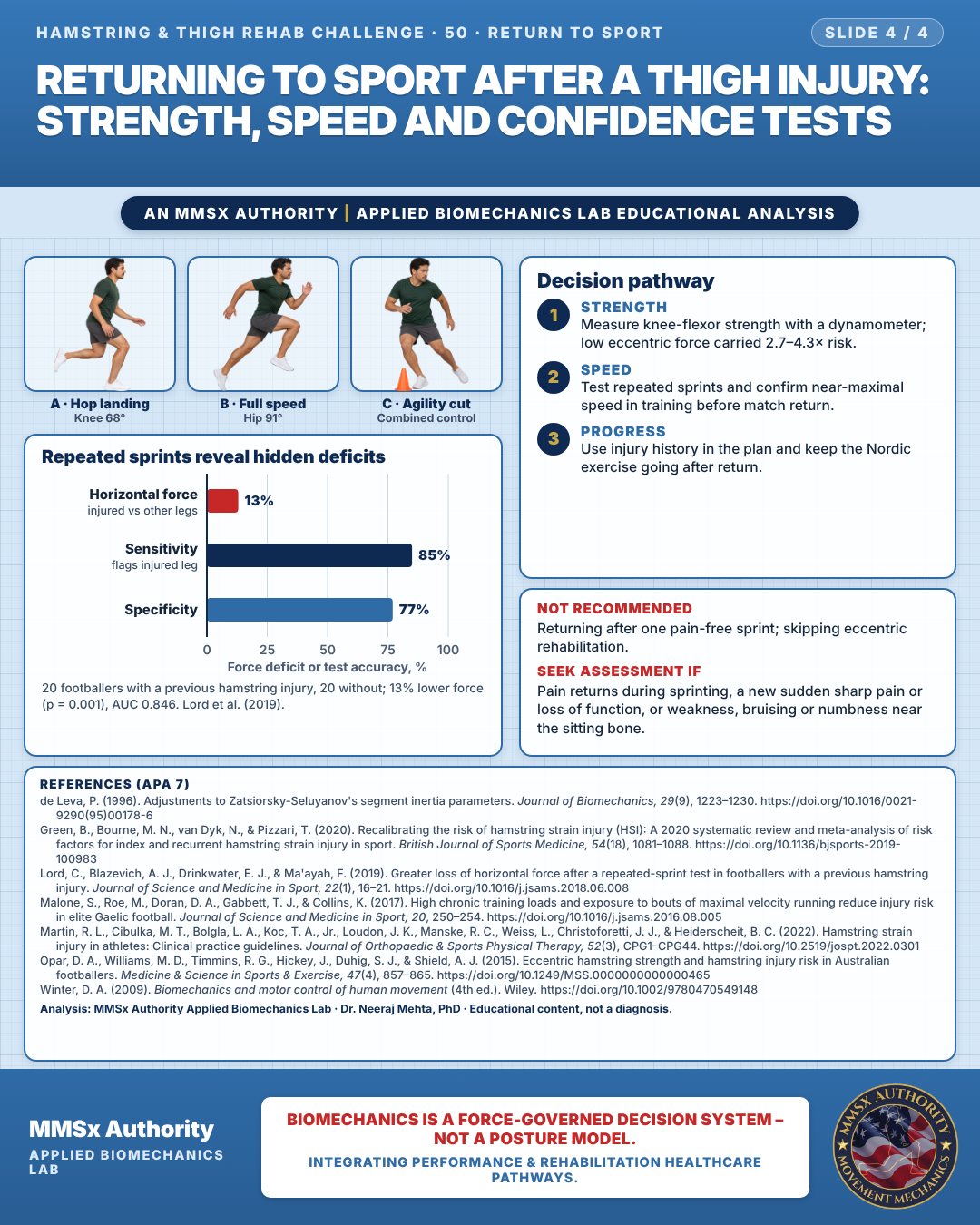
Repeated sprints reveal hidden deficits
Strength
Measure knee-flexor strength with a dynamometer; low eccentric force carried 2.7–4.3× risk.
Speed
Test repeated sprints and confirm near-maximal speed in training before match return.
Progress
Use injury history in the plan and keep the Nordic exercise going after return.
What the evidence supports
- JOSPT clinical practice guideline (Martin et al., 2022): use hamstring strain history in return-to-play progression (Grade B); be cautious about return in athletes who did not complete an appropriately progressed rehabilitation programme including eccentric training (Grade B); use hamstring strength, pain level at the time of injury and days to pain-free walking to estimate time to return (Grade B); include objective measures of walking, running and sprinting (Grade B); quantify knee flexor strength with a dynamometer (Grade A). The guideline states that return-to-play criteria are inconsistent and none has been validated.
- Continue the Nordic hamstring exercise after return as part of prevention (Grade A) (Martin et al., 2022).
Myth and evidence
Myth“If it no longer hurts and I can sprint once, I am ready.”
EvidencePain-free single efforts can hide deficits that appear with repeated sprints (13% lower horizontal force; Lord et al., 2019), low eccentric strength carried 2.7–4.3 times the risk (Opar et al., 2015), and a recent injury is the strongest risk factor for another (Green et al., 2020). Readiness is a combination of tests, not one moment (Martin et al., 2022).
Cautions
Not recommended
Returning after one pain-free sprint; skipping eccentric rehabilitation.
Seek assessment if
Pain returns during sprinting, a new sudden sharp pain or loss of function, or weakness, bruising or numbness near the sitting bone.
Methods note
2-D estimates from pose landmarks on an illustrated figure; CoM from de Leva (1996) segment parameters; cm for a 1.70 m adult (Winter, 2009). Trunk, hip and knee angles from pose landmarks in the side view; landing poses are approximate. Trunk, hip and knee angles from pose landmarks in the side view; sprint poses are approximate. Pelvis line between hip landmarks in the front view. These are educational estimates, not a diagnosis.
References
- de Leva, P. (1996). Adjustments to Zatsiorsky-Seluyanov's segment inertia parameters. Journal of Biomechanics, 29(9), 1223–1230. https://doi.org/10.1016/0021-9290(95)00178-6
- Green, B., Bourne, M. N., van Dyk, N., & Pizzari, T. (2020). Recalibrating the risk of hamstring strain injury (HSI): A 2020 systematic review and meta-analysis of risk factors for index and recurrent hamstring strain injury in sport. British Journal of Sports Medicine, 54(18), 1081–1088. https://doi.org/10.1136/bjsports-2019-100983
- Lord, C., Blazevich, A. J., Drinkwater, E. J., & Ma'ayah, F. (2019). Greater loss of horizontal force after a repeated-sprint test in footballers with a previous hamstring injury. Journal of Science and Medicine in Sport, 22(1), 16–21. https://doi.org/10.1016/j.jsams.2018.06.008
- Malone, S., Roe, M., Doran, D. A., Gabbett, T. J., & Collins, K. (2017). High chronic training loads and exposure to bouts of maximal velocity running reduce injury risk in elite Gaelic football. Journal of Science and Medicine in Sport, 20, 250–254. https://doi.org/10.1016/j.jsams.2016.08.005
- Martin, R. L., Cibulka, M. T., Bolgla, L. A., Koc, T. A., Jr., Loudon, J. K., Manske, R. C., Weiss, L., Christoforetti, J. J., & Heiderscheit, B. C. (2022). Hamstring strain injury in athletes: Clinical practice guidelines. Journal of Orthopaedic & Sports Physical Therapy, 52(3), CPG1–CPG44. https://doi.org/10.2519/jospt.2022.0301
- Opar, D. A., Williams, M. D., Timmins, R. G., Hickey, J., Duhig, S. J., & Shield, A. J. (2015). Eccentric hamstring strength and hamstring injury risk in Australian footballers. Medicine & Science in Sports & Exercise, 47(4), 857–865. https://doi.org/10.1249/MSS.0000000000000465
- Winter, D. A. (2009). Biomechanics and motor control of human movement (4th ed.). Wiley. https://doi.org/10.1002/9780470549148
Cite this article
Mehta, N. (2026, October 26). Returning to sport after a thigh injury: strength, speed and confidence tests. MMSx Authority Applied Biomechanics Lab. https://mmsxauthority.org/edu/analysis/hamstring-thigh/50-returning-to-sport-after-a-thigh-injury-strength-speed-and-confidence/
Part of the collection
Mehta, N. (2026). Hamstring and Thigh Rehabilitation: 50 Evidence-Based Biomechanics Analyses [Collection]. MMSx Authority Applied Biomechanics Lab. Zenodo. https://doi.org/10.5281/zenodo.23735792
All Hamstring & Thigh Rehab Challenge articles · Rehabilitation Library