Hamstring & Thigh Rehab Challenge · 48
Deep vein thrombosis: calf or thigh pain that is not a muscle injury
Deep vein thrombosis (DVT) is a blood clot in a deep vein, usually of the leg (calf, popliteal or femoral veins).
Key points
- Move. On long journeys, break up sitting and use forceful ankle and toe pumps to drive venous return.
- Protect. On flights over 5 hours, compression stockings reduced symptomless DVT in randomised trials.
- Get tested. Suspected DVT is assessed with a probability score, then a D-dimer test and/or ultrasound.
What it is
Deep vein thrombosis (DVT) is a blood clot in a deep vein, usually of the leg (calf, popliteal or femoral veins). It can cause calf or thigh pain, swelling and warmth that can be mistaken for a muscle strain, and a clot can travel to the lungs (pulmonary embolism). Suspected DVT is assessed with a clinical probability score and then D-dimer testing and/or ultrasound.
How we analysed the movement
Three movements relevant to this topic were analysed from illustrated reference figures. Joint centres were located with two-dimensional pose estimation; hip and knee angles, pelvis level, the whole-body centre of mass and, where relevant, the hip lever (the horizontal distance from the hip joint to the upper-body centre of mass) and the resulting static hip moment were then calculated from standard segment parameters. The figures are educational estimates that show how position changes mechanical demand; they are not measurements of a patient. Every research value quoted below comes from the published source cited beside it.
Movement A: Long-haul sitting (side view)
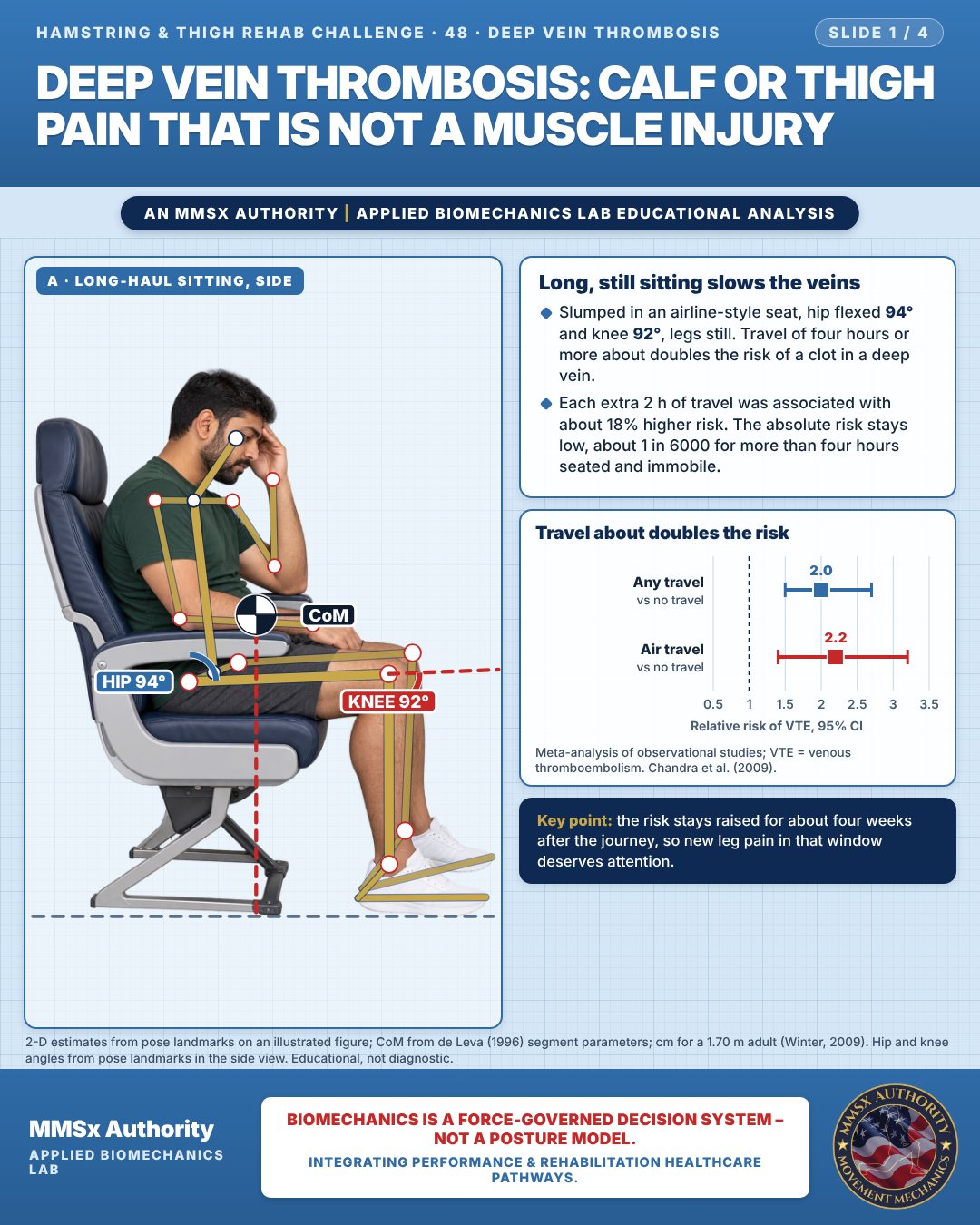
Long, still sitting slows the veins
Slumped in an airline-style seat, hip flexed 94° and knee 92°, legs still. Travel of four hours or more about doubles the risk of a clot in a deep vein.
Each extra 2 h of travel was associated with about 18% higher risk. The absolute risk stays low, about 1 in 6000 for more than four hours seated and immobile.
Travel about doubles the risk
Movement B: Seated ankle pump (side view)
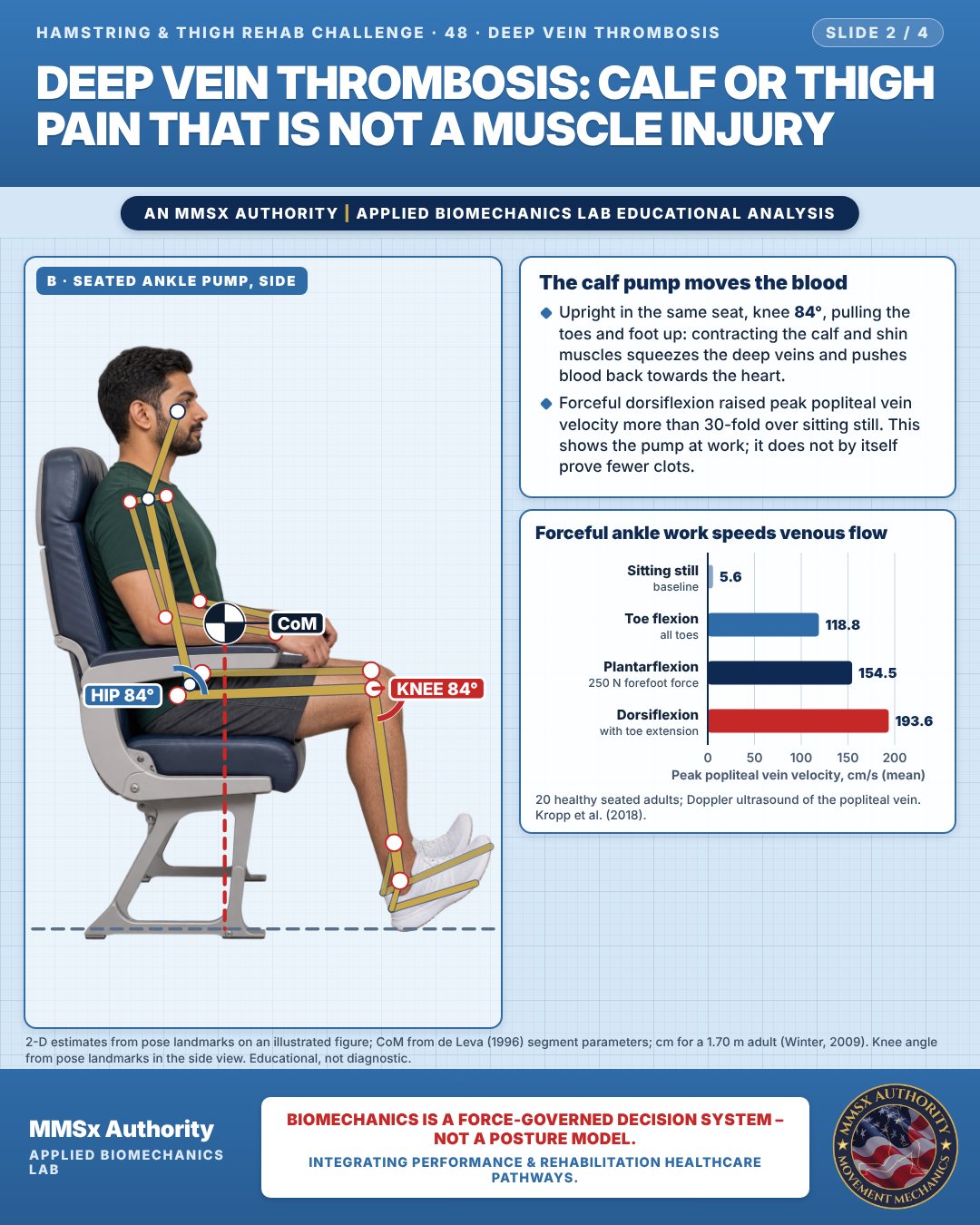
The calf pump moves the blood
Upright in the same seat, knee 84°, pulling the toes and foot up: contracting the calf and shin muscles squeezes the deep veins and pushes blood back towards the heart.
Forceful dorsiflexion raised peak popliteal vein velocity more than 30-fold over sitting still. This shows the pump at work; it does not by itself prove fewer clots.
Forceful ankle work speeds venous flow
Movement C: Holding lower leg (front view)
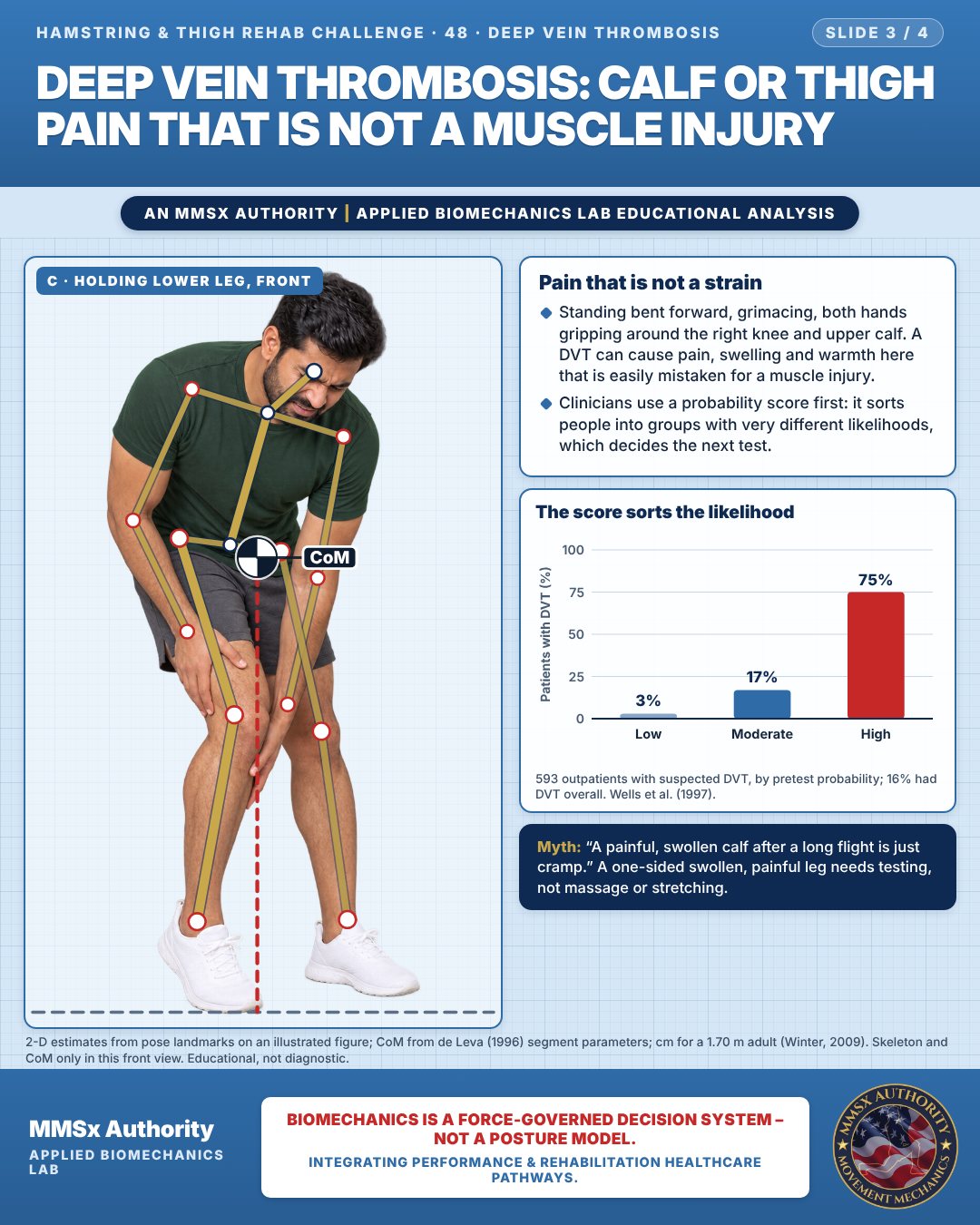
Pain that is not a strain
Standing bent forward, grimacing, both hands gripping around the right knee and upper calf. A DVT can cause pain, swelling and warmth here that is easily mistaken for a muscle injury.
Clinicians use a probability score first: it sorts people into groups with very different likelihoods, which decides the next test.
The score sorts the likelihood
Decision pathway
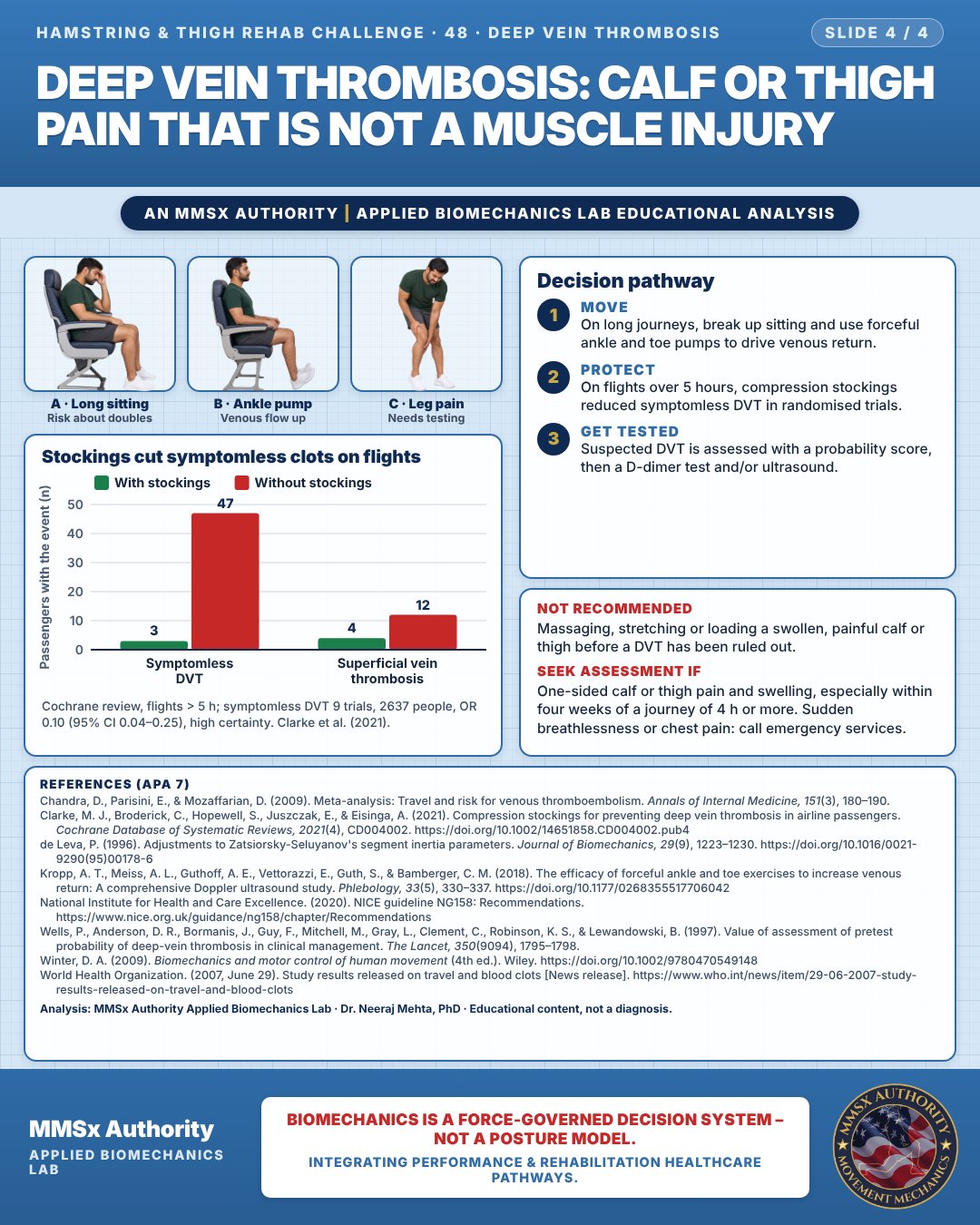
Stockings cut symptomless clots on flights
Move
On long journeys, break up sitting and use forceful ankle and toe pumps to drive venous return.
Protect
On flights over 5 hours, compression stockings reduced symptomless DVT in randomised trials.
Get tested
Suspected DVT is assessed with a probability score, then a D-dimer test and/or ultrasound.
What the evidence supports
- On long flights: compression stockings reduced symptomless DVT (high-certainty evidence) (Clarke et al., 2021). Forceful seated ankle and toe exercises increase venous return (Kropp et al., 2018).
Cautions
Not recommended
Massaging, stretching or loading a swollen, painful calf or thigh before a DVT has been ruled out.
Seek assessment if
One-sided calf or thigh pain and swelling, especially within four weeks of a journey of 4 h or more. Sudden breathlessness or chest pain: call emergency services.
Methods note
2-D estimates from pose landmarks on an illustrated figure; CoM from de Leva (1996) segment parameters; cm for a 1.70 m adult (Winter, 2009). Hip and knee angles from pose landmarks in the side view. Knee angle from pose landmarks in the side view. Skeleton and CoM only in this front view. These are educational estimates, not a diagnosis.
References
- Chandra, D., Parisini, E., & Mozaffarian, D. (2009). Meta-analysis: Travel and risk for venous thromboembolism. Annals of Internal Medicine, 151(3), 180–190.
- Clarke, M. J., Broderick, C., Hopewell, S., Juszczak, E., & Eisinga, A. (2021). Compression stockings for preventing deep vein thrombosis in airline passengers. Cochrane Database of Systematic Reviews, 2021(4), CD004002. https://doi.org/10.1002/14651858.CD004002.pub4
- de Leva, P. (1996). Adjustments to Zatsiorsky-Seluyanov's segment inertia parameters. Journal of Biomechanics, 29(9), 1223–1230. https://doi.org/10.1016/0021-9290(95)00178-6
- Kropp, A. T., Meiss, A. L., Guthoff, A. E., Vettorazzi, E., Guth, S., & Bamberger, C. M. (2018). The efficacy of forceful ankle and toe exercises to increase venous return: A comprehensive Doppler ultrasound study. Phlebology, 33(5), 330–337. https://doi.org/10.1177/0268355517706042
- National Institute for Health and Care Excellence. (2020). NICE guideline NG158: Recommendations. https://www.nice.org.uk/guidance/ng158/chapter/Recommendations
- Wells, P., Anderson, D. R., Bormanis, J., Guy, F., Mitchell, M., Gray, L., Clement, C., Robinson, K. S., & Lewandowski, B. (1997). Value of assessment of pretest probability of deep-vein thrombosis in clinical management. The Lancet, 350(9094), 1795–1798.
- Winter, D. A. (2009). Biomechanics and motor control of human movement (4th ed.). Wiley. https://doi.org/10.1002/9780470549148
- World Health Organization. (2007, June 29). Study results released on travel and blood clots [News release]. https://www.who.int/news/item/29-06-2007-study-results-released-on-travel-and-blood-clots
Cite this article
Mehta, N. (2026, October 26). Deep vein thrombosis: calf or thigh pain that is not a muscle injury. MMSx Authority Applied Biomechanics Lab. https://mmsxauthority.org/edu/analysis/hamstring-thigh/48-deep-vein-thrombosis-calf-or-thigh-pain-that-is-not-a-muscle-injury/
Part of the collection
Mehta, N. (2026). Hamstring and Thigh Rehabilitation: 50 Evidence-Based Biomechanics Analyses [Collection]. MMSx Authority Applied Biomechanics Lab. Zenodo. https://doi.org/10.5281/zenodo.23735792
All Hamstring & Thigh Rehab Challenge articles · Rehabilitation Library