Hamstring & Thigh Rehab Challenge · 47
Thigh compartment syndrome: severe swelling after impact or exertion
Acute compartment syndrome of the thigh is a rise in pressure within a closed fascial compartment of the thigh that compromises blood flow and can…
Key points
- Act fast. Escalating pain and a tense thigh after a blow, crush or fracture need emergency care now.
- Don’t wait. Numbness and weakness are late and unreliable signs; do not wait for them to appear.
- Rehab later. Treatment is surgical decompression; exercise-based rehabilitation starts only after surgery.
What it is
Acute compartment syndrome of the thigh is a rise in pressure within a closed fascial compartment of the thigh that compromises blood flow and can lead to muscle death (necrosis). It is a surgical emergency, usually treated by fasciotomy. It is rare: fewer than 0.3% of trauma patients are affected (Kanlic et al., 2010). Most cases follow high-energy blunt trauma, but cases after exertion such as squats, running and cycling have also been reported (Khan et al., 2011; Ojike et al., 2010).
How we analysed the movement
Three movements relevant to this topic were analysed from illustrated reference figures. Joint centres were located with two-dimensional pose estimation; hip and knee angles, pelvis level, the whole-body centre of mass and, where relevant, the hip lever (the horizontal distance from the hip joint to the upper-body centre of mass) and the resulting static hip moment were then calculated from standard segment parameters. The figures are educational estimates that show how position changes mechanical demand; they are not measurements of a patient. Every research value quoted below comes from the published source cited beside it.
Movement A: Resting supine (side view)
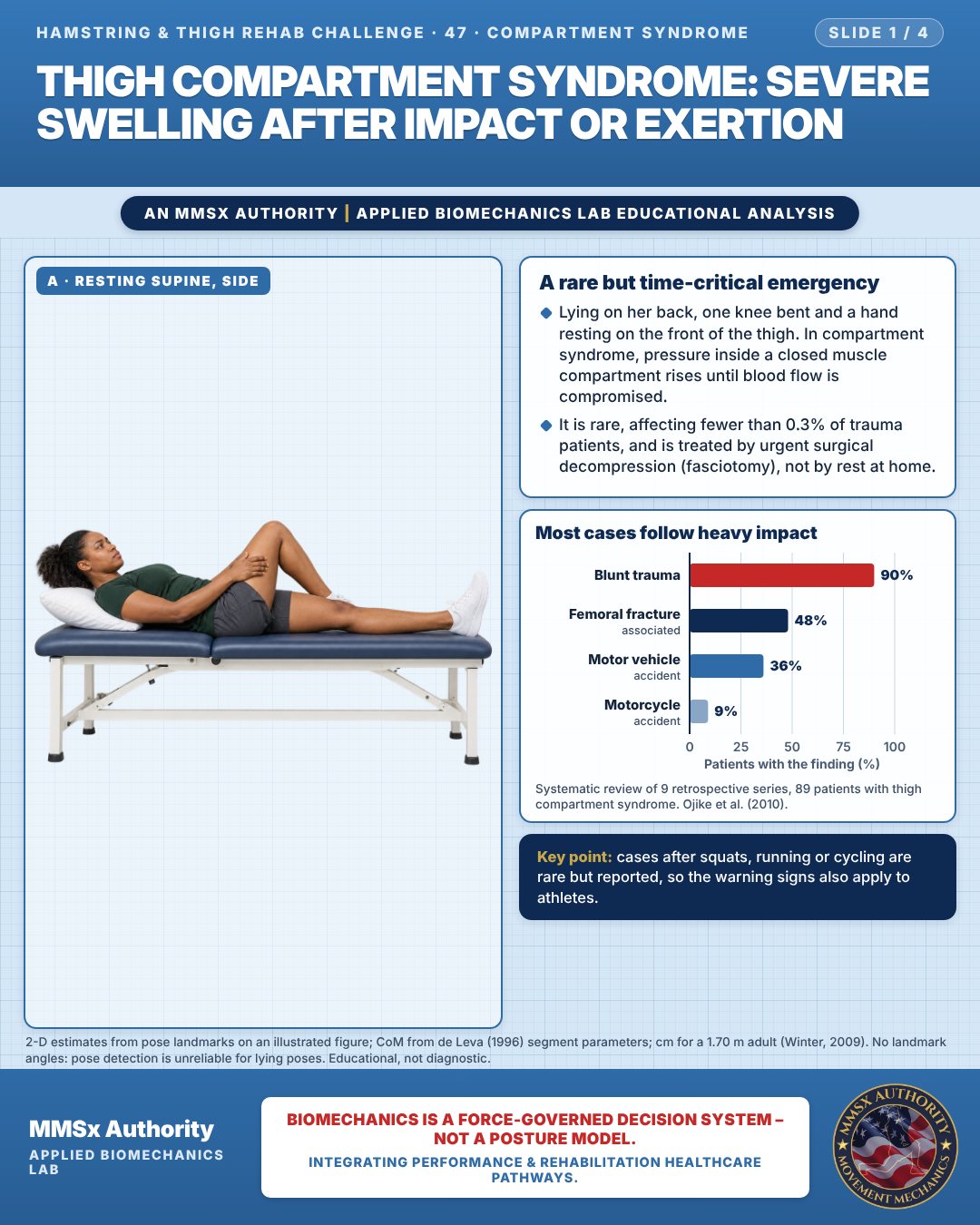
A rare but time-critical emergency
Lying on her back, one knee bent and a hand resting on the front of the thigh. In compartment syndrome, pressure inside a closed muscle compartment rises until blood flow is compromised.
It is rare, affecting fewer than 0.3% of trauma patients, and is treated by urgent surgical decompression (fasciotomy), not by rest at home.
Most cases follow heavy impact
Movement B: Holding thigh (front view)
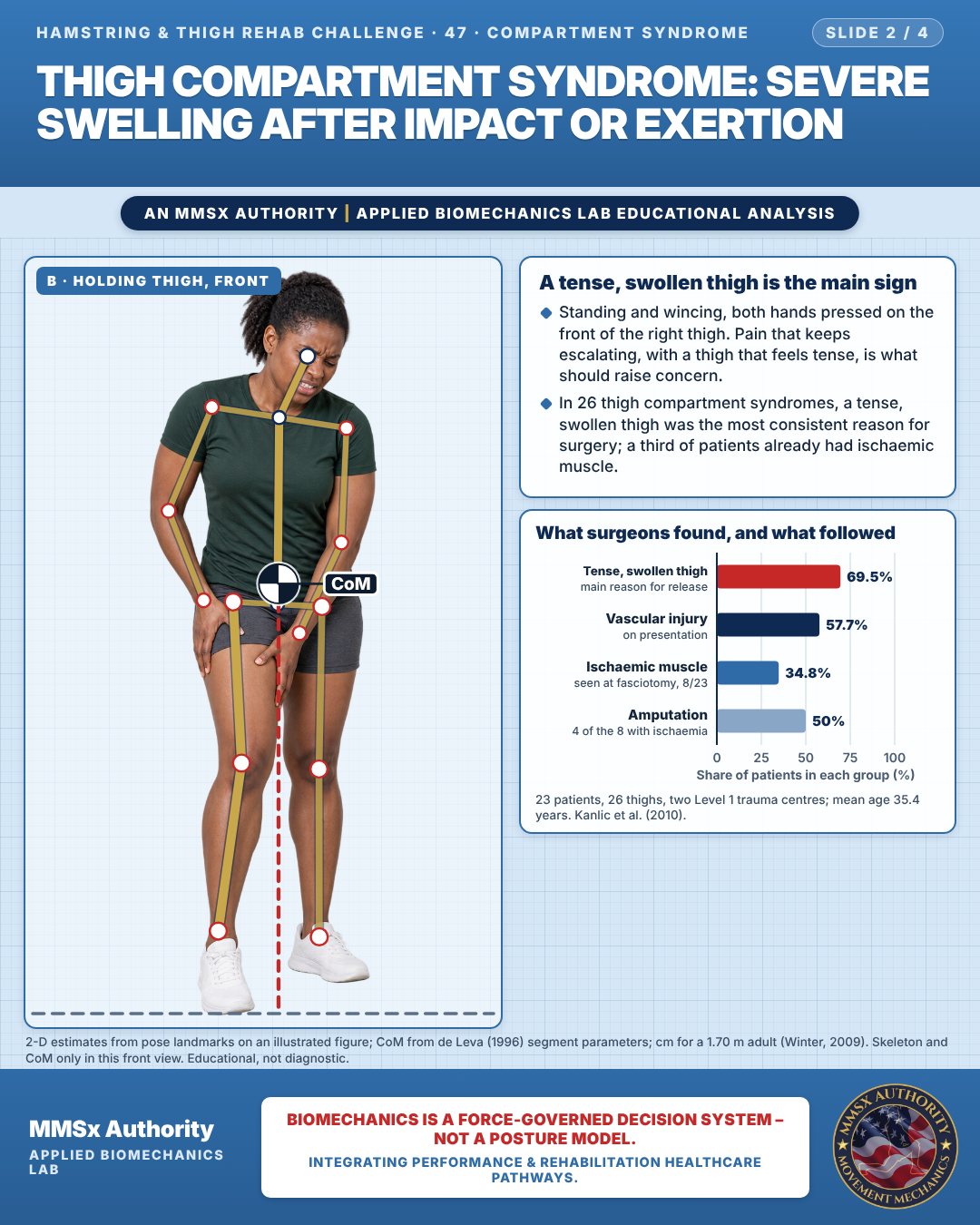
A tense, swollen thigh is the main sign
Standing and wincing, both hands pressed on the front of the right thigh. Pain that keeps escalating, with a thigh that feels tense, is what should raise concern.
In 26 thigh compartment syndromes, a tense, swollen thigh was the most consistent reason for surgery; a third of patients already had ischaemic muscle.
What surgeons found, and what followed
Movement C: Knee held straight (side view)
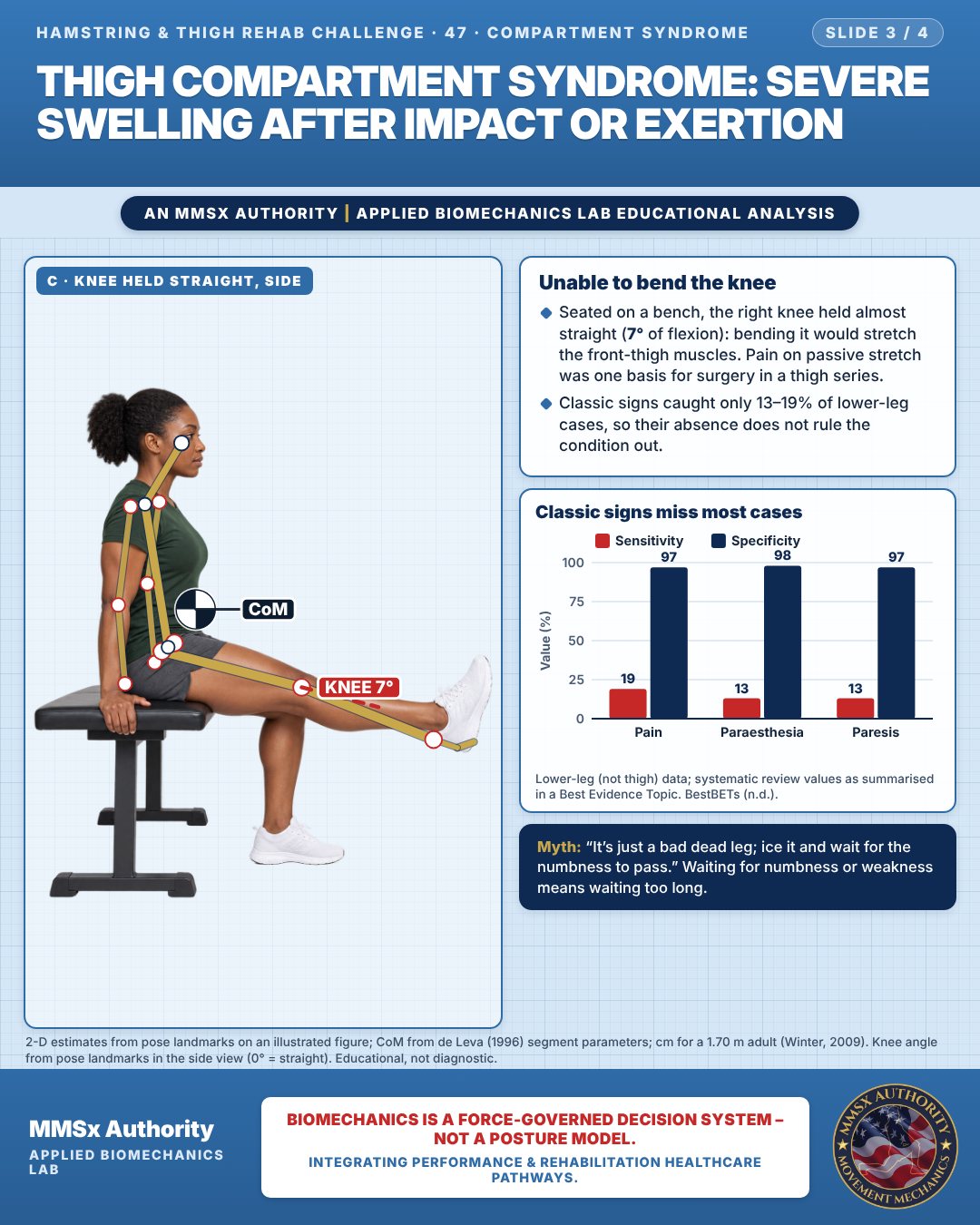
Unable to bend the knee
Seated on a bench, the right knee held almost straight (7° of flexion): bending it would stretch the front-thigh muscles. Pain on passive stretch was one basis for surgery in a thigh series.
Classic signs caught only 13–19% of lower-leg cases, so their absence does not rule the condition out.
Classic signs miss most cases
Decision pathway
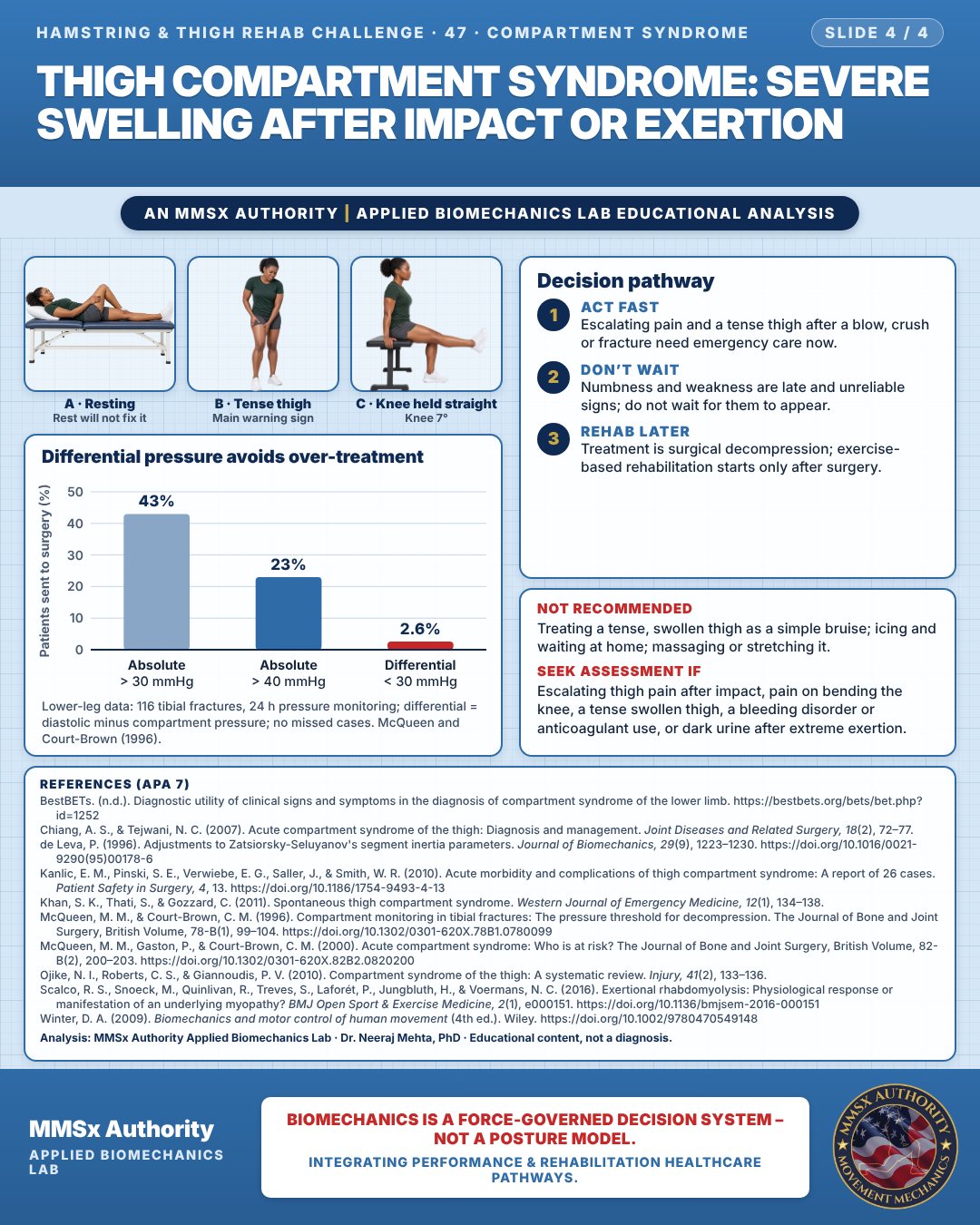
Differential pressure avoids over-treatment
Act fast
Escalating pain and a tense thigh after a blow, crush or fracture need emergency care now.
Don’t wait
Numbness and weakness are late and unreliable signs; do not wait for them to appear.
Rehab later
Treatment is surgical decompression; exercise-based rehabilitation starts only after surgery.
What the evidence supports
- Acute compartment syndrome is treated by urgent surgical decompression (fasciotomy). Decompression is recommended when the differential pressure falls below 30 mmHg (McQueen & Court-Brown, 1996). In the thigh review, 86% of fasciotomies used a single incision (Ojike et al., 2010).
- Fasciotomy for thigh compartment syndrome was most often prompted by a tense, swollen thigh (69.5%) (Kanlic et al., 2010). In the thigh review, 52% of cases were diagnosed using both clinical signs and pressure measurement, 26% on clinical signs alone and 22% on pressure measurement alone (Ojike et al., 2010, as summarised by Khan et al., 2011).
Cautions
Not recommended
Treating a tense, swollen thigh as a simple bruise; icing and waiting at home; massaging or stretching it.
Seek assessment if
Escalating thigh pain after impact, pain on bending the knee, a tense swollen thigh, a bleeding disorder or anticoagulant use, or dark urine after extreme exertion.
Methods note
2-D estimates from pose landmarks on an illustrated figure; CoM from de Leva (1996) segment parameters; cm for a 1.70 m adult (Winter, 2009). No landmark angles: pose detection is unreliable for lying poses. Skeleton and CoM only in this front view. Knee angle from pose landmarks in the side view (0° = straight). These are educational estimates, not a diagnosis.
References
- BestBETs. (n.d.). Diagnostic utility of clinical signs and symptoms in the diagnosis of compartment syndrome of the lower limb. https://bestbets.org/bets/bet.php?id=1252
- Chiang, A. S., & Tejwani, N. C. (2007). Acute compartment syndrome of the thigh: Diagnosis and management. Joint Diseases and Related Surgery, 18(2), 72–77.
- de Leva, P. (1996). Adjustments to Zatsiorsky-Seluyanov's segment inertia parameters. Journal of Biomechanics, 29(9), 1223–1230. https://doi.org/10.1016/0021-9290(95)00178-6
- Kanlic, E. M., Pinski, S. E., Verwiebe, E. G., Saller, J., & Smith, W. R. (2010). Acute morbidity and complications of thigh compartment syndrome: A report of 26 cases. Patient Safety in Surgery, 4, 13. https://doi.org/10.1186/1754-9493-4-13
- Khan, S. K., Thati, S., & Gozzard, C. (2011). Spontaneous thigh compartment syndrome. Western Journal of Emergency Medicine, 12(1), 134–138.
- McQueen, M. M., & Court-Brown, C. M. (1996). Compartment monitoring in tibial fractures: The pressure threshold for decompression. The Journal of Bone and Joint Surgery, British Volume, 78-B(1), 99–104. https://doi.org/10.1302/0301-620X.78B1.0780099
- McQueen, M. M., Gaston, P., & Court-Brown, C. M. (2000). Acute compartment syndrome: Who is at risk? The Journal of Bone and Joint Surgery, British Volume, 82-B(2), 200–203. https://doi.org/10.1302/0301-620X.82B2.0820200
- Ojike, N. I., Roberts, C. S., & Giannoudis, P. V. (2010). Compartment syndrome of the thigh: A systematic review. Injury, 41(2), 133–136.
- Scalco, R. S., Snoeck, M., Quinlivan, R., Treves, S., Laforét, P., Jungbluth, H., & Voermans, N. C. (2016). Exertional rhabdomyolysis: Physiological response or manifestation of an underlying myopathy? BMJ Open Sport & Exercise Medicine, 2(1), e000151. https://doi.org/10.1136/bmjsem-2016-000151
- Winter, D. A. (2009). Biomechanics and motor control of human movement (4th ed.). Wiley. https://doi.org/10.1002/9780470549148
Cite this article
Mehta, N. (2026, October 26). Thigh compartment syndrome: severe swelling after impact or exertion. MMSx Authority Applied Biomechanics Lab. https://mmsxauthority.org/edu/analysis/hamstring-thigh/47-thigh-compartment-syndrome-severe-swelling-after-impact-or-exertion/
Part of the collection
Mehta, N. (2026). Hamstring and Thigh Rehabilitation: 50 Evidence-Based Biomechanics Analyses [Collection]. MMSx Authority Applied Biomechanics Lab. Zenodo. https://doi.org/10.5281/zenodo.23735792
All Hamstring & Thigh Rehab Challenge articles · Rehabilitation Library